
What does the oneness of humanity mean?
The oneness of humanity means that every human being belongs to one interdependent human family and has equal dignity, whatever their ancestry, nationality, religion, language or way of life. It asks us to recognise in another person the same depth of experience we know from within: someone who can suffer, hope, love and begin again. Human oneness can name a biological fact of shared ancestry, an ethical commitment to everyone’s worth, or a spiritual understanding of a deeper unity. These meanings meet, but they are not interchangeable. Shared humanity does not require a shared religion, identical lives or a single world state. Its most demanding promise is that difference need never cancel belonging. [1] [2] [3]
A face remains a face, with its own history. The circle grows large enough to hold it.
What does oneness mean?
Oneness means belonging to, or participating in, a whole; in discussions of humanity, the word can describe our common life without claiming that every person is the same. The first task is to ask what kind of whole a speaker means. A common origin, a moral community and a single underlying reality are different propositions. One can accept any of them without automatically accepting the others. [4]
- Biological unity: living humans belong to the same species, Homo sapiens, with shared evolutionary ancestry. This is a scientific claim. [3]
- Ethical unity: every person deserves consideration and protection, including strangers. This is a judgement about how we ought to live. [1]
- Social and ecological interdependence: lives are connected through care, work, environments and institutions. A connection can help people or transmit harm. [8]
- Spiritual or metaphysical unity: apparent separateness may rest within a deeper reality. Traditions disagree about whether that reality is God, being, a divine spirit, or something that should not be described as a permanent self. [5] [6] [40]
- Political unity: people can build common rules and institutions. Moral concern for everyone does not settle whether those institutions should form a federation, a treaty system or a world state. [4]
Our reading: the most useful everyday sense of human oneness begins with recognition. The other person is a centre of life, rather than scenery around one’s own. Cooperation can then give that recognition a durable form. Unity is both something encountered and something practised.
Where does the idea of one human family come from in different cultures and religions?
The idea of one human family has several histories, in South Asian teachings, Chinese thought, African relational ethics, the Abrahamic religions and philosophical cosmopolitanism. Similar language can carry different accounts of the self, society and the sacred.
What do the Upanishads mean by recognising oneself in another?
The Chāndogya Upanishad connects the self with the subtle reality underlying existence. In its sixth book, Uddalaka Aruni teaches Shvetaketu through clay, honey, rivers, a seed and salt dissolved in water. The repeated tat tvam asi, commonly rendered as you are that, addresses the student himself: the ground being discussed is not merely elsewhere. Later Vedanta schools interpret the relationship differently. The passage is a teaching about being and self-knowledge, not a modern charter of equal civil rights. [5]
Our reading: the salt-water image makes oneness unusually concrete. Salt cannot be recovered by looking for a separate lump, yet its presence can be tasted throughout the bowl. The analogy invites a changed way of noticing.
Does Buddhism teach that everyone is one self?
Buddhist compassion does not require the claim that everyone shares one permanent self. In the Anatta-lakkhana Sutta (SN 22.59), bodily form, feeling, perception, mental formations and consciousness are examined as impermanent and not to be identified as self. The Karaṇīya Mettā Sutta extends goodwill to living beings near and far, seen and unseen, without making kinship a condition of care. The teachings of Gautama Buddha connect this examination of experience with concern for suffering. [40] [7]
The Vietnamese teacher Thích Nhất Hạnh’s term interbeing describes existence through dependence on other things. In his paper-and-cloud teaching, reproduced by Plum Village, a sheet of paper depends on trees, the trees on rain, and rain on clouds. The cloud belongs to the paper’s conditions of existence, without becoming a second object printed on the page. Human life can be examined with the same attention to what sustains it. [9]
How does Chinese thought imagine a wider human family?
Chinese thought includes an expansive language of kinship in Zhang Zai’s Western Inscription. Zhang Zai, who lived from 1020 to 1077, places human beings within the generative life of heaven and earth, extending family concern beyond blood relations. The Chinese educational project Key Concepts in Chinese Thought and Culture explains how the language can widen from compatriots to humanity as a whole. This is a specific Confucian cosmology and ethic, rather than a claim that China has held one unchanging view. [10]
For a contrasting Chinese point of entry, Laozi asks how human life can accord with the Dao. A shared interest in a larger whole does not make Daoist and Confucian answers identical.
What does Ubuntu add to human oneness?
Ubuntu adds the insight that humanity is expressed through relationships and care. The Dictionary of South African English traces the word to isiXhosa and isiZulu and defines it through human-heartedness and compassion. Its entry preserves Desmond Tutu’s 1991 explanation through caring, hospitality and the connection of one person’s humanity with another’s. Ubuntu gives belonging the texture of conduct: how someone receives a guest, shares resources or responds to need. [11]
The Ghanaian philosopher Kwame Gyekye’s African Ethics, published in 2010, approaches related questions through Akan and other moral vocabularies. Good character becomes visible in conduct towards people; humanity and the common good carry practical duties. His account also distinguishes being biologically human from being praised as a morally exemplary person. Failing the latter standard does not remove someone’s human rights. Relations ask something of us, while dignity remains. [12]
How do Judaism, Christianity and Islam connect dignity with difference?
Judaism and Christianity share the Genesis account of humanity created in the image of God, a major scriptural resource for thinking about human worth. Genesis 1:27 includes male and female in that account. The claim is theological; it does not depend on a person’s nationality, usefulness or achievement. [13]
In the Christian Gospel of Luke, Jesus of Nazareth answers a question about the neighbour through the Good Samaritan. A traveller’s wounds call forth help across an inherited social boundary. The story shifts attention from defining a safe circle of neighbours to becoming a neighbour through mercy. [14]
Islam’s Qur’an 49:13 addresses humanity’s common origin and the existence of peoples and tribes as an occasion for mutual recognition. The verse does not demand the disappearance of these peoples. Its measure of honour before God is righteousness, rather than lineage. Jalal al-Din Rumi offers a different, poetic approach to love and the loosening of self-centred separation within an Islamic setting. [15]
Why is the oneness of humanity central to the Bahá’í Faith?
The oneness of humanity is central to the Bahá’í Faith because its teachings make the human family the scale of religious and social responsibility. Bahá’u’lláh’s writings connect love of the whole world with humanity’s common citizenship. The official Bahá’í account explicitly defends unity in diversity and compares the human race with a living body whose different parts cooperate. [2] [16]
The body is a suggestive image: a hand contributes by being a hand. The Bahá’í position deserves a full place in any account of this subject, alongside other traditions and secular philosophies. The principle’s prominence in this religion does not give the phrase a single religious owner.
Can one human family be a secular idea?
One human family can be a secular idea when belonging rests on common humanity rather than shared worship. Cosmopolitanism, from the Greek language of world citizenship, includes moral, political and economic versions. The Cynic and Stoic histories matter here, although ancient universal language should not be confused with the actual achievement of modern equality. [4]
Modern cosmopolitanism makes the institutions of belonging a central problem. In Toward Perpetual Peace (1795), Immanuel Kant connects peace with republican government, a voluntary league of states and rights extending to foreigners. Marx and Engels locate international solidarity in workers’ common interests while criticising the exploitation carried by global capitalism. The development of international law gives individuals rights, and responsibility for crimes, that can reach beyond the shield of state sovereignty. [4]
Contemporary debates over global justice ask whether states should represent peoples or whether principles of justice should begin directly with every individual. John Rawls and his cosmopolitan critics disagree over this choice: a state can enable democratic self-determination, yet also shelter national advantage from the claims of people outside it. [4]
Which rights give human oneness a concrete form?
The Universal Declaration of Human Rights gives human oneness a concrete form through equal dignity and protections that apply across differences of origin and belief. The UN General Assembly proclaimed it in Paris on 10 December 1948 through resolution 217 A. Its thirty articles address civil, political, economic, social and cultural life; the UN’s account, consulted in 2026, records more than 500 translations. The declaration sets a common standard, rather than itself providing a world constitution or an enforcement system. [1]
- Conscience, Article 18: freedom of thought, conscience and religion, including changing religion or belief and expressing it alone or with others, publicly or privately. Belonging cannot depend on agreeing about the sacred.
- Education, Article 26: free elementary and fundamental education, compulsory elementary schooling, generally available technical and professional education, and equal access to higher education on merit. Education should develop the person and respect for human rights; parents have a prior right to choose its kind.
- Culture and science, Article 27: participation in community cultural life, enjoyment of the arts and a share in scientific advances and their benefits. Authors also have rights to protection of the moral and material interests arising from their work. A shared culture includes both access and the people who create it.
Articles 18, 26 and 27 make unity in diversity practical: people need freedom to believe differently, opportunities to learn, and a place in cultural life. [1]
Metaphysical questions can be pursued separately through Plotinus and the One, or Baruch Spinoza and the unity of substance. Neither route is a prerequisite for respecting another human being.
What does science say about human unity?
Science supports human unity in the sense that living humans form one species with common evolutionary ancestry and extensive genetic similarity. The Smithsonian’s Human Origins Program traces modern humans to African origins around 300,000 years ago in its account updated in 2024. Our family history is deep, branching and entangled. Present national borders do not divide that ancestry into separate origins of humanity. [3]
Do all humans share 99.9 percent of their DNA?
The familiar statement that humans share 99.9 percent of their DNA is an oversimplification of what is being compared. The US National Human Genome Research Institute explains that the figure mainly counts single-nucleotide differences; including differences involving multiple nucleotides gives an average similarity of approximately 99.6 percent. These figures are from its Human Genomic Variation fact sheet, consulted in 2026. The change in percentage reflects a change in accounting, not the discovery of a different species. [17]
Genetic variants help explain some differences in appearance, health and responses to medicines. Environment and social circumstances also shape lives. A percentage is therefore useful for correcting a fantasy of separate biological humanities, but poor at describing a person. It cannot tell us someone’s language, memories, loyalties or moral worth. [17]
Does shared ancestry prove a spiritual or ethical oneness?
Shared ancestry does not prove a single consciousness, a universal soul or a moral obligation. Those conclusions need philosophical, religious or ethical arguments of their own. Biology describes relationships; the judgement that people deserve equal concern adds a norm to the description. Our reading is that this distinction strengthens human unity: dignity should remain secure without making it depend on a genetic similarity score.
Research practice must also take diversity seriously. NHGRI describes the underrepresentation of many populations in genomic studies and the consequences for who benefits from their findings. Shared humanity makes the missing participant more important, rather than making population differences irrelevant. [18]
What did Sri Aurobindo mean by human unity?
Sri Aurobindo understood human unity as a problem of consciousness and collective life: political arrangements need an inward sense of human kinship if unity is to become more than an administrative structure. The Ideal of Human Unity first appeared in thirty-five chapters in Arya from September 1915 to July 1918. The publisher’s textual history records a book edition in 1919 and later revisions culminating in the 1950 edition. These dates matter because the argument developed through the experience of world wars and changing international institutions. [19]
Aurobindo’s own explanation of the project warns against confusing unity with uniformity or mechanical association. The distinction is between making people function together and enabling them to experience a common life. A central authority might coordinate action while leaving fear, rivalry and domination intact. Conversely, a sentiment of brotherhood needs forms through which people can actually live and work together. [19]
In the book’s concluding argument, Aurobindo’s spiritual religion of humanity means the growing recognition of a divine reality in which people are one. He expressly distinguishes this from imposing one creed, dogma or outward ritual. That is a spiritual proposal, with a stronger metaphysical claim than a secular human-rights agreement. [6]
Our reading: Aurobindo’s lasting question is whether our sense of belonging can become as wide as our practical interdependence. The external network already connects people who do not feel connected. The unfinished work lies in how they inhabit it. His optimism concerns a capacity for development, not a claim that history has already solved domination or conflict.
How does Auroville put human unity into practice?
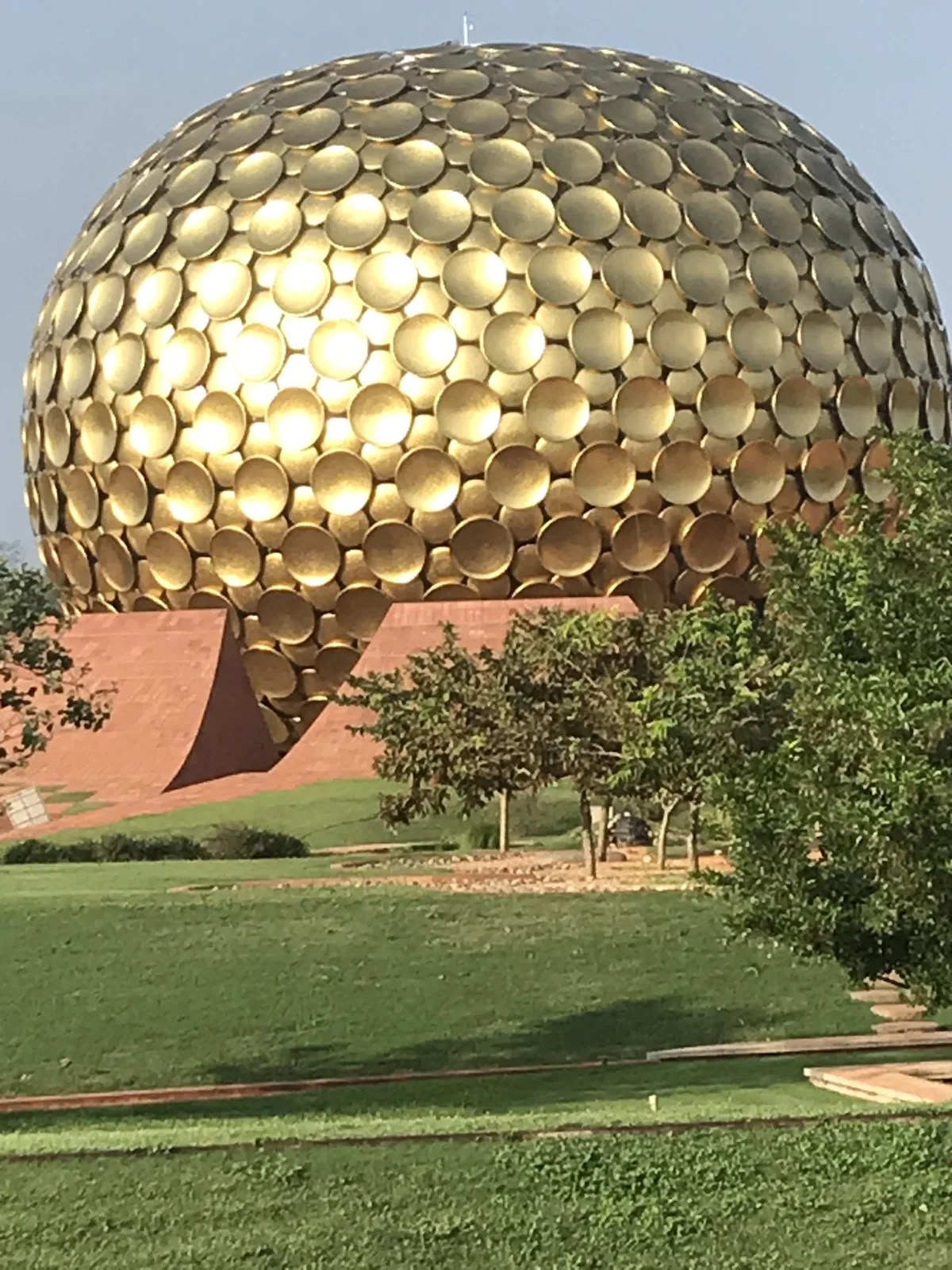
Auroville puts human unity into practice as an ongoing international township experiment in Tamil Nadu, India, founded in 1968 by Mirra Alfassa, known as the Mother. At its inauguration on 28 February 1968, young representatives brought soil from 124 nations to a common urn, according to Auroville’s account. The gesture joined distinct places without pretending that their histories were identical. [20]
The Auroville Charter sets out an ambition of education, material and spiritual research, and an embodied human unity. The golden Matrimandir gives the settlement a place of concentration. A town, however, is made of decisions about land, work, resources and relationships as well as buildings. Auroville is best approached as a demanding experiment with an explicit ideal, not as proof that human unity has been accomplished. [21]
Is oneness the same as uniformity?
Oneness is not the same as uniformity: human unity concerns belonging and equal consideration, while uniformity concerns sameness of form, belief or behaviour. The Bahá’í account explicitly separates the two; Aurobindo’s account likewise warns against mistaking mechanical association for unity. A common life can contain distinct languages, convictions and ways of making meaning. [2] [19]
The distinction has practical consequences. A multilingual gathering can translate rather than require everyone to abandon a language. A shared institution can protect the person who disagrees with the majority. A work of art can bring many forms into relation while keeping the small irregularities by which each form becomes recognisable.
Our reading: a useful test of any proposal made in the name of unity is what happens to the dissenter, the minority and the person who cannot participate on the majority’s terms. If belonging requires silence about an injury, unity has become a demand placed on the injured person. Shared dignity needs room for truthful disagreement, redress and refusal.
This also clarifies a common misunderstanding about peace. Recognising another person’s humanity does not require approving their actions, surrendering boundaries or treating every belief as equally sound. Care and accountability can belong to the same relationship.
Does human unity require a world government?
Human unity leaves the form of government open: equal concern establishes who counts, while institutional arguments must explain how power should be organised and restrained. Political cosmopolitans defend several arrangements, with different answers to war, justice and self-government. [4]
- A voluntary league or limited international institutions preserve states’ autonomy and allow cooperation on particular problems. The difficulty is securing compliance when members refuse a common decision.
- A federation gives a common authority enforceable powers while reserving others to its members. Its argument is that peace needs law above states; its challenge is deciding which powers can be transferred without sacrificing democratic self-determination.
- A central world state seeks to end the condition in which states face one another without a superior authority, and to make global justice enforceable. Critics warn of worldwide despotism with no rival power able to resist it.
- Dispersed sovereignty, associated with Thomas Pogge, distributes authority among political units of different sizes without one dominating the rest. It seeks common protection while keeping power open to checks at several levels.
The disagreement concerns more than administrative efficiency. Defenders of stronger global authority ask how rights can survive unenforced promises; defenders of decentralisation ask how rights can survive an authority nobody can escape or control. Shared humanity gives both questions their urgency. [4]
How did a photograph change the idea of human unity?
Earthrise changed the public imagery of human unity by allowing people to see their inhabited world from the vicinity of another world. On 24 December 1968, William Anders photographed Earth above the Moon’s horizon during Apollo 8. The image below is his black-and-white frame AS08-13-2329, made before the more widely reproduced colour sequence. The difference matters: the familiar title belongs to a photographic event, not just one interchangeable picture. [22]

Our reading: Earthrise makes a reversal of attention. The expedition goes outward, but the photograph’s subject is home. The Moon’s uninhabitable foreground lends the small, illuminated Earth a new intimacy. Nothing in the frame labels a people as foreign. That absence is a perspective on borders, rather than evidence that borders or unequal lives have ceased to matter.
The Blue Marble, photographed by the Apollo 17 crew on 7 December 1972, offers another composition: Earth fills the image, its cloud systems and continents forming one visible sphere. The archive credits this frame to Harrison Schmitt / Apollo 17. Where Earthrise depends on the relationship between two worlds, the Blue Marble presents the inhabited world as an encompassing whole. [23]

Earthrise was not the first photograph of Earth from space. Its particular importance lies in the human journey, the lunar setting and the image’s cultural life. NASA describes its association with growing environmental awareness. [24] Our reading is that communication networks and AI translation offer a related possibility today: they can help people encounter one another across distance and language, provided those encounters preserve the people and meanings being translated.
What is the overview effect?
The overview effect is a reported shift in perspective when seeing Earth from space, often involving a stronger sense of planetary unity, ecological vulnerability and human connection. Frank White named it in his 1987 book The Overview Effect: Space Exploration and Human Evolution. In his account of the project, published in 2009, White describes interviewing astronauts and finding a recurring awareness of a planet without visible national boundaries. [25]
The overview effect is a description of experience, rather than a guarantee that every traveller has the same revelation or returns with the same politics. A photograph may suggest something of the perspective while leaving out the bodily experience of flight, scale and distance. Neither a space journey nor an intense feeling of unity automatically supplies a programme for living together.
Our reading: the value of the overview effect lies in bringing an encompassing scale into ordinary judgement. A person does not have to leave Earth to ask which consequences cross a border, who has been left outside a decision, or what makes a shared habitat possible.
The noosphere of Pierre Teilhard de Chardin provides another language for a planet increasingly connected through human thought. It belongs to an evolutionary and spiritual philosophy, rather than serving as scientific proof of a single planetary mind.
Which works of art express the unity of humanity?
Works of art express the unity of humanity through distinct acts of attention: a chorus joining voices, photographs putting lives beside lives, a room shared in silence, fragments made into a surface, or light offered across darkness. Some works state a universal ambition. Others make a shared experience possible without naming it. The distinction between an artist’s stated purpose and our reading matters throughout.
How does Beethoven’s Ninth Symphony turn fellowship into sound?
Beethoven’s Symphony No. 9 in D minor, Op. 125 turns fellowship into sound by bringing human voices into its final movement and setting words from Friedrich Schiller’s An die Freude. Beethoven completed the symphony in February 1824; it was first performed in Vienna on 7 May that year. The poem’s famous promise of human brotherhood belongs to Schiller, while its musical transformation belongs to Beethoven. [26]
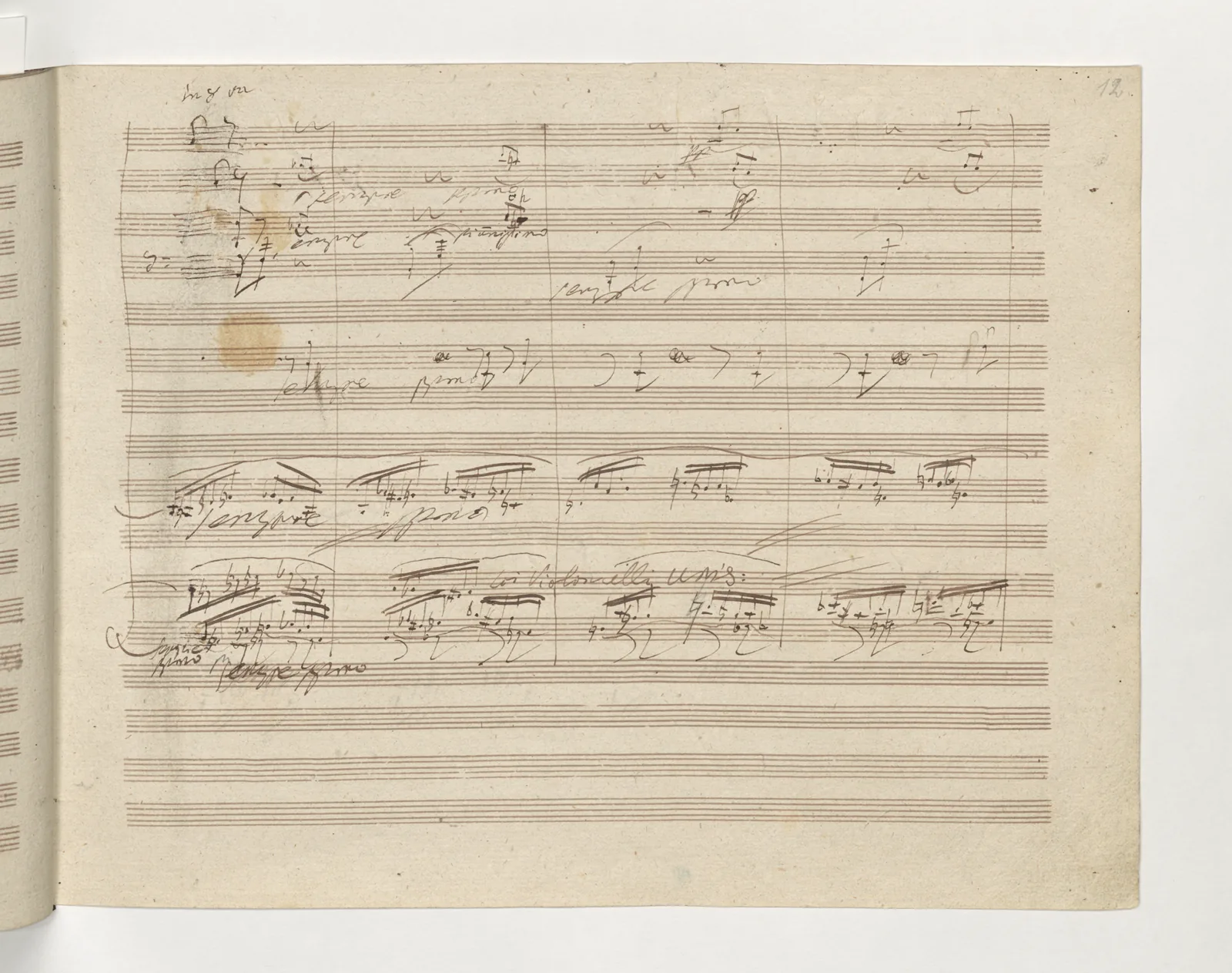
Our listening suggestion: attend to the movement’s changes of scale. An individual voice opens a space that other voices enter; the same theme can be carried by a singer, an orchestra and a chorus. The music does not give everyone the same part. Its fellowship becomes audible through the relationship between parts. The manuscript shown here belongs to the symphony as a whole; it is not presented as a page containing Schiller’s words.
What did The Family of Man show, and what did it leave out?
The Family of Man showed human lives across the world as a shared field of birth, work, love, pain and death. Edward Steichen organised the exhibition at the Museum of Modern Art in New York in 1955. The collection brought together 503 photographs by 273 photographers from 68 countries, according to the collection’s custodian, Luxembourg’s Centre national de l’audiovisuel. In MoMA’s 1955 press release, Steichen describes photography as revealing human kinship across languages and ways of life. [27] [28]

Our looking suggestion: move between the individual picture and the arrangement. A photograph can show a person whose life differs sharply from one’s own, then an adjacent image can disclose an unexpected resemblance. Much of the exhibition’s power comes from this movement between specificity and recognition.
The French critic Roland Barthes challenged this universalism in Mythologies in 1957. The problem was the risk of making social history look like timeless human nature: everyone is born and dies, but not under the same conditions. Choi Bong-lim’s 2008 Korean study makes a related criticism of the display’s removed dates and titles and its Western frame of representation. An image of common humanity can still be arranged from a particular position of power. [29] [30]
Our reading: this criticism does not empty the photographs of tenderness. It asks for a more exact tenderness, one willing to learn whose life is pictured, what happened there, and who selected the frame. The most generous universal image can survive the return of names and dates.
How does the Rothko Chapel make a place for people with different beliefs?
The Rothko Chapel makes a place for people with different beliefs through a shared encounter with painting and quiet. Opened in Houston in 1971, the chapel houses fourteen paintings by Mark Rothko and serves a deliberately interfaith mission. Its institutional history joins contemplation with human rights. The room offers a common setting without requiring visitors to supply a common explanation of what they feel. [31]
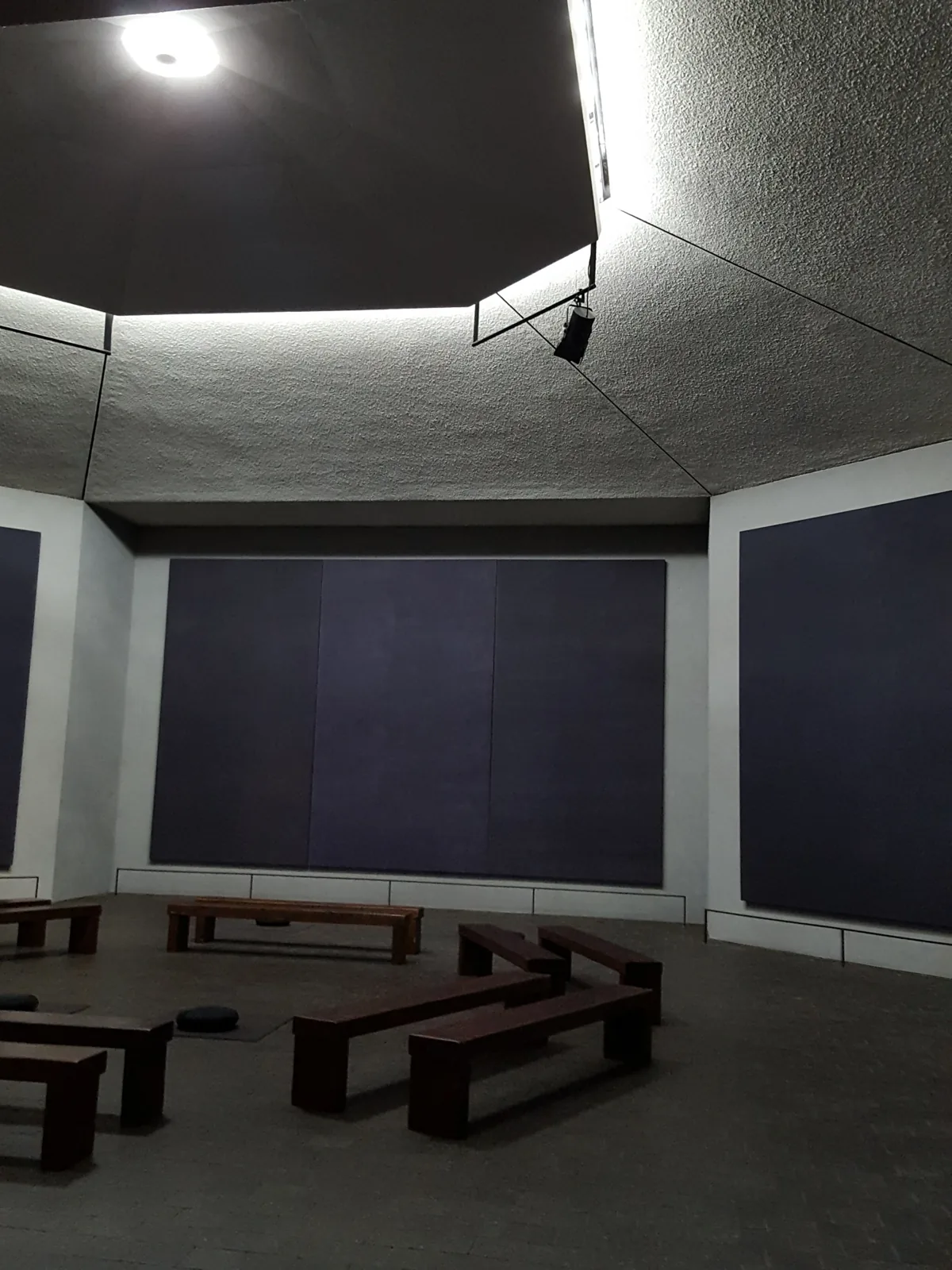
Our looking suggestion: let the dark surfaces remain different. Watch how daylight changes the maroon and purple tones, the edges of the forms, and the apparent depth of a canvas. Another visitor may be praying, another grieving, another attending only to colour. Sharing the room need not settle the meaning of the encounter.
Outside, Barnett Newman’s Broken Obelisk stands in a reflecting pool. In 1969, the de Menils offered to match a grant to help Houston buy the sculpture, with a site near City Hall and a dedication to Martin Luther King Jr. The city accepted the purchase offer but rejected the dedication. The de Menils withdrew their offer, bought the work themselves and dedicated it to King at the chapel’s opening in 1971. A shared space carries this particular refusal to separate art from civic conscience. [31]
What can El Anatsui’s joined fragments tell us about unity?
El Anatsui’s metal hangings give unity a material vocabulary of many distinct fragments joined without losing their histories. The Ghanaian artist, long based in Nigeria, uses discarded liquor-bottle closures and copper wire to make surfaces that behave differently from a rigid panel. The artist’s record documents Man’s Cloth as an early bottle-cap work, dated 1999 to 2002 in its title. [32] [33]
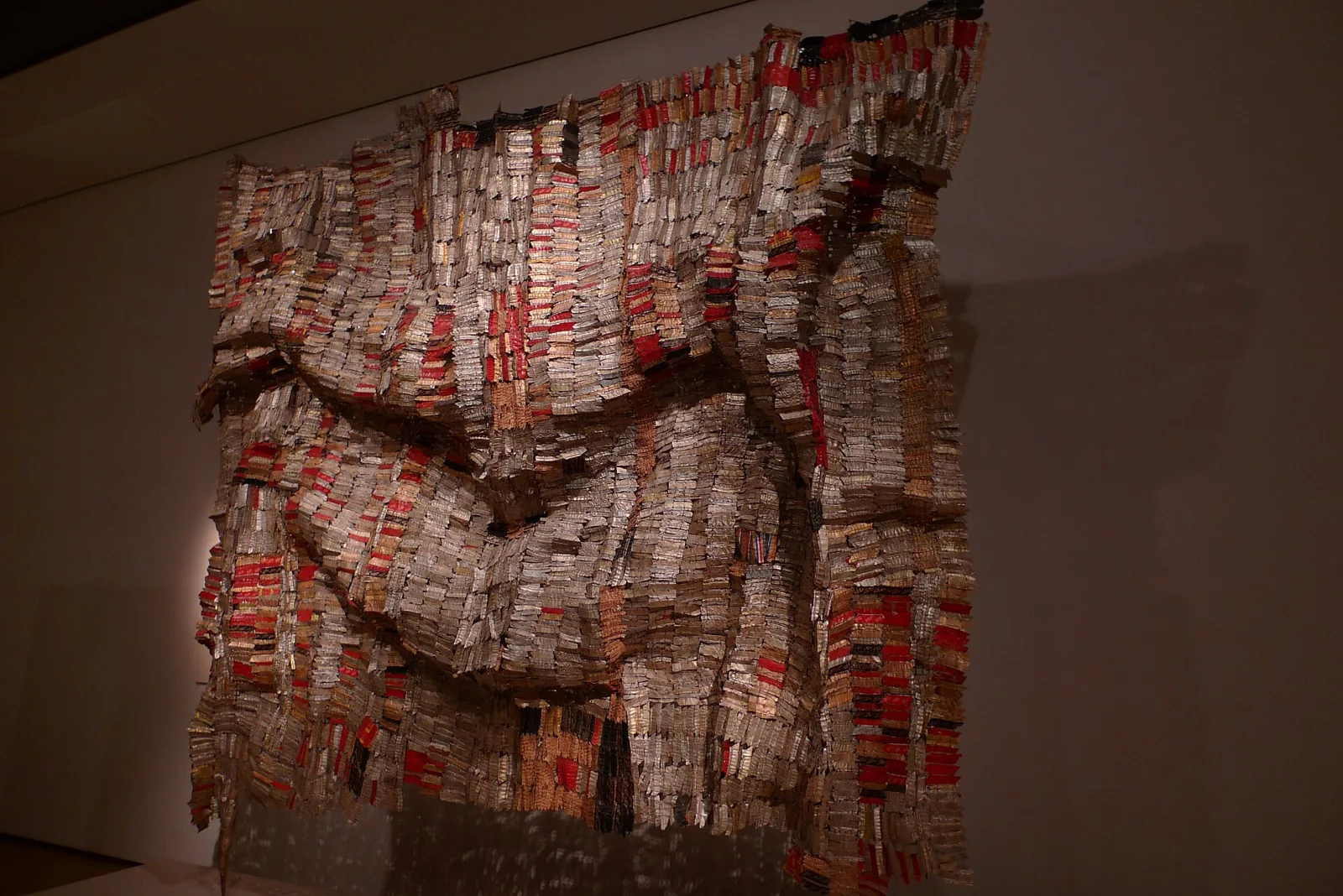
The materials carry connections with consumption, exchange and colonial histories. They should not be reduced to a cheerful recycling symbol. The Guggenheim Bilbao’s account places Anatsui’s practice within his engagement with materials, Ghanaian traditions and changes in sculptural form. [33]
Our reading: from a distance, the hanging appears almost continuous. Nearer, continuity resolves into separate pieces, bends and joins. A whole has been made through repeated acts of connection. Nothing requires its smallest element to disappear. That is a particularly persuasive visual companion to unity in diversity, although it is our interpretation of the work rather than a slogan attributed to Anatsui.
How does Yoko Ono’s Imagine Peace Tower invite a common future?
Yoko Ono’s Imagine Peace Tower invites a common future through a column of light dedicated to John Lennon and to their shared campaign for peace. The installation on Viðey, near Reykjavík, was unveiled on 9 October 2007. Its official account links the work to people’s wishes for peace, so its universal aspiration is stated rather than inferred. [34]

Our reading: light offers a monument with a different relation to possession. It can be seen from more than one place and asks for no single viewing position. The work makes an invitation visible. Whether people answer it remains a human task outside the beam.
Does the Statue of Unity stand for all humanity?
The Statue of Unity primarily commemorates India’s political unification, rather than the oneness of all humanity. Ram V. Sutar’s monument depicts Sardar Vallabhbhai Patel in Gujarat and was dedicated on 31 October 2018. India’s Press Information Bureau gives its height as 182 metres and relates its symbolism to Patel’s role in national integration. A title containing unity still needs its historical object named. [35]
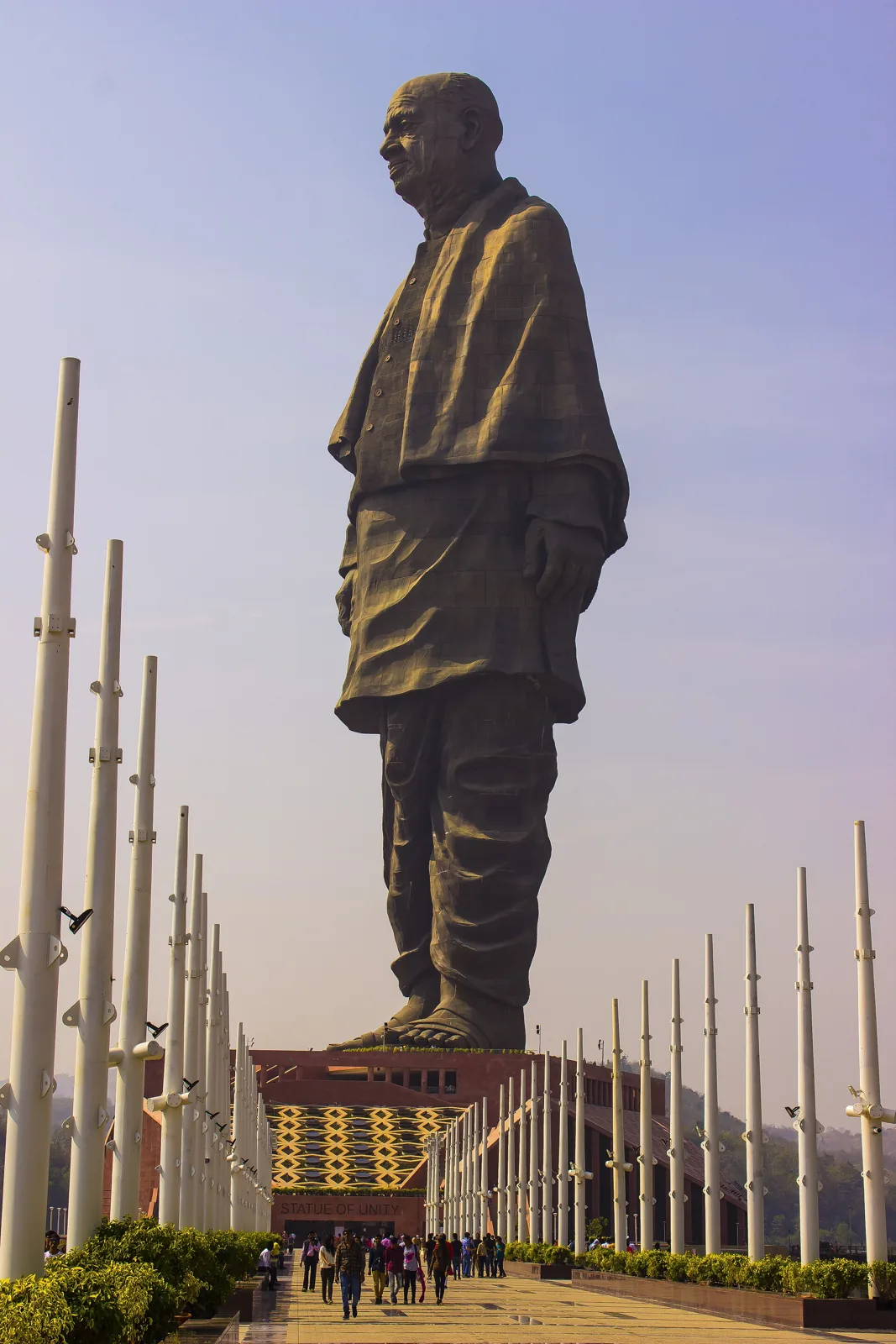
Our reading: the monument offers a useful comparison with the other works here. The statue gives an idea the scale of a colossal body; the chapel gives people a room; Anatsui gives fragments a join; Earthrise changes the distance from which we look. Art can enlarge the felt size of belonging through very different means. National unity and human unity can meet, but neither term should silently replace the other.
An exercise for any artwork: look first for what is actually joined. Are these bodies, voices, materials, memories or viewers? Then ask what remains distinct. The answer is usually more revealing than deciding whether the work has a universal message.
How does the world see the oneness of humanity?
The oneness of humanity is seen around the world as a promise, a practice and a question about who gets to define the whole. The following named voices offer a cross-section, with dates and sources. They do not represent entire countries, religions or continents, and their disagreements are part of the subject.
What does the Dalai Lama emphasise in human oneness?
The Dalai Lama emphasises a shared human condition before differences of faith and nationality. In a conversation on 12 April 2021, the Tibetan Buddhist teacher described meeting people from many backgrounds after exile in India as widening his sense of belonging. His account joins compassion, religious coexistence and practical interdependence. Human oneness, on this reading, can be cultivated without asking everyone to become Buddhist. [8]
What does Kwame Gyekye’s African ethics contribute?
Kwame Gyekye’s 2010 account contributes an African philosophical vocabulary of humanity, character and obligations to others. Writing from Ghanaian Akan thought while comparing other traditions, Gyekye grounds the reach of moral concern in common human needs and interests. This is a substantial philosophical contribution, rather than a decorative proverb attached to a supposedly complete Western account. [12]
How did Hansa Mehta make universal dignity more exact?
Hansa Mehta made universal dignity more exact in the drafting of the 1948 human-rights declaration. The United Nations credits the Indian delegate with helping change Article 1’s wording from a formulation about men to one explicitly about human beings. The contribution shows how universality can improve through someone noticing whom a supposedly inclusive sentence might leave uncertain. [36]
Why did Martin Luther King Jr. connect distant injustices?
Martin Luther King Jr. connected distant injustices because the moral and practical lives of communities were intertwined. His Letter from Birmingham Jail of 16 April 1963 responds to criticism of his presence in Birmingham by refusing the idea that another community’s injustice is simply someone else’s concern. The National Civil Rights Museum preserves the passage. His unity demands action against segregation, rather than a polite feeling that everyone gets along. [37]
What does Enrique Dussel ask of a universal humanity?
Enrique Dussel asks a universal humanity to allow cultures to speak from their own histories. In Agenda for a South-South Philosophical Dialogue, published in 2013, the Argentine-born, Mexico-based philosopher challenges the historical presentation of a European subject as the universal standard. He proposes dialogue among postcolonial philosophical communities and a pluriverse of mutually creative relations. The warning is precise: a common world should not make one inherited standpoint invisible by calling it everyone’s. [38]
Why does Choi Bong-lim question a universal family album?
Choi Bong-lim questions the frame of the universal family album in a 2008 study published by the Korean Society of Photography. His analysis of The Family of Man argues that the exhibition’s thematic captions and removed historical details can make a Western selection appear naturally universal. The useful question for any viewer is who can appear as a speaking subject and who is merely shown. [30]
What does Jane Lydon’s Australian research reveal?
Jane Lydon’s Australian research reveals how a universal image can leave people out. In her 2020 study of UNESCO’s 1951 human-rights exhibition in Australia, the historian identifies the absence of Indigenous people and connects the display’s universal narrative with contemporary assimilation policies. The case adds a concrete test to human oneness: whose particular culture would someone have to surrender to enter the picture? [29]
Our reading: these voices can sharpen one another. Compassion widens concern; rights make protection explicit; relational ethics asks for conduct; criticism brings hidden power back into view. Belonging becomes credible when it changes whom we hear and whose rights we protect.
How can you live oneness in daily life?
Living the oneness of humanity means giving shared dignity a practical form in attention, decisions and relationships. These suggested exercises let a large idea alter a small, repeatable action.
- Let a person become specific. Learn a name, pronounce it carefully, and ask something that cannot be answered by the category you first placed them in. Familiarity with a label is not knowledge of a life.
- Listen for a need before defending a position. In a disagreement, try to state the other person’s concern in words they recognise. Understanding gives disagreement a better foundation; it does not require assent.
- Make one shared activity easier to enter. Translate an invitation, explain an unfamiliar custom, offer an accessible format, or change a meeting so that the same person is not always excluded. Belonging often lives in arrangements.
- Follow an ordinary object outward. Consider the people whose labour made a meal, garment or device possible. Use that attention in a concrete purchasing, repair or workplace decision when you have a real choice.
- Offer useful care beyond your familiar circle. Join a local project or help someone with a task they actually identify. Reciprocity begins by asking what is needed, rather than deciding what another person ought to need.
- Let art interrupt an assumption. Spend unhurried time with a photograph, song or work from an unfamiliar setting. Learn its maker and circumstances. Notice resemblance without losing the particulars that made the work possible.
- Keep dignity present when setting a boundary. Refuse harm clearly. Describe an action accurately without reducing a whole person or people to that action. Protection and humanity belong together.
Can family come before strangers?
Family can come before strangers in a defensible account of human oneness, because equal worth need not mean identical responsibilities. The philosophical dispute is whether particular relationships create additional duties or whether priority must always be justified by reasons applying equally to anyone. Moderate cosmopolitans accept special duties alongside universal ones; critics of strict impartiality argue that friendship and kinship themselves involve responsibilities. The difficult question is how far those responsibilities reach when someone outside the circle urgently needs help. [4]
Our proposed way to weigh a conflict is to ask about urgency, dependence and who else can help. Collecting a young child you have promised to care for can outweigh a routine request from a stranger. An unfamiliar person’s immediate danger can outweigh a relative’s minor convenience. If needs are comparable and someone depends specifically on you, that relationship supplies a reason for priority. If a small sacrifice could avert severe harm elsewhere, familiarity alone is a weak reason to refuse. Family care gives love an address; it need not give concern a border.
Our proposed evening question is simple: where did another person become more real to me today? The answer may be a changed decision, a repaired misunderstanding, or a face that is no longer anonymous. That gives human oneness something observable to grow through.
What are famous quotes about the oneness of humanity?
Famous quotations about human oneness speak of kinship, citizenship, justice and a shared home. These short passages are reproduced from the linked editions or institutional sources, rather than from unsourced quotation collections.
- “All people are my brothers and sisters, and all living things are my companions.” Zhang Zai, The Western Inscription, eleventh century; translation in Key Concepts in Chinese Thought and Culture. [10]
- “The earth is but one country, and mankind its citizens.” Bahá’u’lláh, Gleanings from the Writings of Bahá’u’lláh, CXVII, translated by Shoghi Effendi. [16]
- “All human beings are born free and equal in dignity and rights.” Universal Declaration of Human Rights, Article 1, 1948. [1]
- “Injustice anywhere is a threat to justice everywhere.” Martin Luther King Jr., Letter from Birmingham Jail, 16 April 1963, reproduced by the National Civil Rights Museum. [37]
- “A spiritual religion of humanity is the hope of the future.” Sri Aurobindo, The Ideal of Human Unity, CWSA 25, p. 577, excerpt reproduced by Auroville. [6]
- “Look again at that dot. That's here. That's home. That's us.” Carl Sagan, Pale Blue Dot, 1994, quoted by NASA alongside Voyager 1’s image of Earth. [39]
The contexts matter. Zhang Zai speaks within a cosmology; Bahá’u’lláh within religious teaching; the declaration within a statement of rights; King within a struggle against segregation; Aurobindo within a philosophical inquiry; Sagan before an astronomical image. Their words can illuminate one another without becoming evidence that they meant exactly the same thing.
What else do readers ask about human oneness?
What does basic humanity mean?
Basic humanity usually means the shared needs, vulnerability and dignity that make every person worthy of humane treatment. Article 1 of the 1948 human-rights declaration supplies a clear public formulation of equal dignity and rights. The phrase does not imply that people have identical abilities, experiences or circumstances. [1]
Do you have to be religious to believe in the oneness of humanity?
Belief in human oneness need not be religious. Secular cosmopolitanism and human rights can defend equal concern on philosophical and ethical grounds. A person may share that commitment while disagreeing with any claim about a universal soul or divine origin. [4] [1]
What is the Bahá’í religion?
The Bahá’í Faith is a religion founded by Bahá’u’lláh that places the oneness of humanity at the centre of its teachings. Its account of human unity includes cooperation and diversity. The wider subject also belongs to other religions and secular thought. [2]
Does one human family mean one world government?
One human family does not by itself entail one world government. A league preserves autonomy but faces problems of enforcement; a federation or world state can strengthen common law but risks concentrating power; dispersed sovereignty spreads authority across several levels. The choice turns on protecting rights while keeping rulers accountable. Compare the institutional arguments above. [4]
Can I put my family first and still value all humanity?
Valuing all humanity can include special responsibilities to family. Equal dignity does not require identical claims on your time: dependence, promises and the urgency of need matter. A relative’s minor preference should not automatically outweigh a stranger’s grave danger. The family-and-strangers discussion gives concrete examples. [4]
Which human rights protect unity in diversity?
The 1948 declaration protects unity in diversity through freedom of thought, conscience and religion, including changing belief (Article 18); education, with free and compulsory elementary schooling (Article 26); and participation in culture, the arts and scientific benefits, alongside protection of creators’ interests (Article 27). These protections give belonging practical content. [1]
Can oneness include conflict, anger and accountability?
Human oneness can include conflict and accountability because common dignity does not make harmful actions acceptable. King’s Birmingham argument ties interdependence to confronting injustice. Our practical reading is to protect people, name harm and seek repair while keeping the human status of everyone involved intact. [37]
Is a feeling of oneness enough?
A feeling of oneness can change attention, but it does not by itself establish fair conduct or institutions. The overview effect describes a perspective; human rights describe standards of treatment. The connection between them has to be made through choices that can be questioned and improved. [25] [1]
Which sources and image credits support this page?
The sources below were opened for this page or its research on 2 November 2026. Quotations were checked against the cited text. Scripture references identify particular passages; translations and interpretations can differ. Institutional accounts establish how organisations describe their own ideals, rather than proving those ideals have been achieved. Passages marked Our reading and the suggested exercises are interpretations.
This site has no affiliation with any religious tradition, church or organisation.
- United Nations, Universal Declaration of Human Rights, Paris, 10 December 1948, General Assembly resolution 217 A, especially Articles 1, 2, 18, 26, 27 and 29. Primary text and UN historical introduction; translation count consulted in 2026.
- Bahá’í International Community, Uniting Humanity. Official account of the Bahá’í teaching and unity in diversity.
- Smithsonian Human Origins Program, One Species, Living Worldwide, updated 9 July 2024. Common ancestry and African origins; the page corrects the older dating retained in its video.
- Pauline Kleingeld and Eric Brown, Cosmopolitanism, Stanford Encyclopedia of Philosophy. History, varieties and objections.
- Chāndogya Upanishad 6, translated by F. Max Müller, Sacred Books of the East 1, 1879. Primary text; especially 6.8 to 6.13. This is one historical translation, not a consensus interpretation.
- Auroville, The Advent of a New World, section Towards Human Unity: excerpt from Sri Aurobindo, The Ideal of Human Unity, CWSA 25, p. 577.
- Karaṇīya Mettā Sutta, Sutta Nipāta 1.8, translated by the Amaravati Sangha, 1994, Access to Insight. Primary text, paraphrased here.
- Office of the Dalai Lama, Be the Love for One Better World, 12 April 2021. First-party report of a conversation on human oneness.
- Plum Village App, The Plum Village Tradition, Ethics and Interbeing. First-party explanation with Thích Nhất Hạnh’s paper-and-cloud teaching, reproduced as a primary excerpt.
- Key Concepts in Chinese Thought and Culture, Brothers and Sisters of the Same Parents; Compatriots. Translation of Zhang Zai’s Western Inscription and explanation of its widening kinship.
- Dictionary of South African English, ubuntu. IsiXhosa and isiZulu origins, definitions and historical examples, including Desmond Tutu in the Sunday Times, 26 May 1991, p. 2.
- Kwame Gyekye, African Ethics, Stanford Encyclopedia of Philosophy, 9 September 2010, especially Humanity and Brotherhood and the discussion of moral personhood.
- Genesis 1:27, New Revised Standard Version Updated Edition, Bible Gateway. Primary text, paraphrased here.
- Luke 10:25 to 37, New Revised Standard Version Updated Edition, Bible Gateway. Primary text: the Good Samaritan.
- Qur’an 49:13, Towards Understanding the Qur’an, translation and commentary by Abul A‘la Maududi, Islamic Foundation / Islamicstudies.info. Translation and commentary distinguished.
- Bahá’u’lláh, Gleanings from the Writings of Bahá’u’lláh, CXVII, translated by Shoghi Effendi, Bahá’í Reference Library. Primary text; verified against the complete HTML edition.
- National Human Genome Research Institute, Human Genomic Variation. Explanation of the 99.9 and 99.6 percent comparisons, consulted 2 November 2026.
- National Human Genome Research Institute, Participation in Genomic Research. Representation and the benefits of inclusive studies.
- Sri Aurobindo Ashram, CWSA 25, Note on the Texts, pp. 687 to 689, mirrored by Mother and Sri Aurobindo. Serialisation, editions, revisions and the author’s letter on uniformity.
- Auroville, The Inauguration of Auroville. First-party record of the ceremony on 28 February 1968 and participation of 124 nations.
- The Auroville Charter, 28 February 1968. Primary statement of the township’s aspirations.
- NASA Earth Observatory, Earthrise Revisited, 24 December 2013. Apollo 8’s photographs of 24 December 1968, including Anders’ first black-and-white exposure.
- NASA / Apollo 17 archive, The Blue Marble, AS17-148-22727, 7 December 1972, via Wikimedia Commons. File metadata and public-domain status.
- NASA Earth Observatory, Earthrise Reimagined, 25 December 2015. The image’s cultural association with environmental awareness.
- Frank White, The Overview Effect, March 2009. First-person account of his book of 1987 and astronaut interviews.
- Beethoven-Haus Bonn, Symphony no. 9 (D minor) op. 125. Work record, Schiller’s text, composition and premiere.
- Museum of Modern Art, The Family of Man, press release of 26 January 1955, pp. 1 to 3. Primary statement by Edward Steichen and description of the exhibition. Collection totals here follow the custodian in source 28.
- Steichen Collections, Centre national de l’audiovisuel, Luxembourg, The Family of Man. Collection numbers, Clervaux installation and historical reception.
- Jane Lydon, The Universal Language of Photography? UNESCO’s Human Rights Exhibition in Australia, 1951, 2020. Research abstract discussing Barthes and the risks of universal imagery; Mythologies (1957) also appears in Choi’s bibliography.
- Choi Bong-lim (최봉림), Some Problems of The Family of Man (1955): From Human Universalism to Western Ethnocentrism, AURA 19, 2008, pp. 90 to 98. Korean Citation Index record and English abstract.
- Rothko Chapel, About: paintings, interfaith purpose, human rights and the history of Broken Obelisk. First-party institutional account.
- El Anatsui, Man’s Cloth, 1999 to 2002. Artist’s work record; the heading, date field and image caption give a range and individual years. The photographed British Museum work is catalogued as 2001 on its Commons file page.
- Guggenheim Museum Bilbao, El Anatsui. Biography, bottle-cap works, materials and colonial memory.
- Yoko Ono, Imagine Peace Tower, official project site. Viðey, Reykjavík; dedication on 9 October 2007 and the work’s peace aspiration.
- Government of India, Press Information Bureau, PM dedicates Statue of Unity to the Nation, 31 October 2018. Patel, national integration and the monument’s height.
- United Nations, Drafters of the Declaration. Account of Hansa Mehta’s contribution to the wording of Article 1.
- National Civil Rights Museum, Justice. Reproduces the passage from Martin Luther King Jr.’s Letter from Birmingham Jail, 16 April 1963.
- Enrique Dussel, Agenda for a South-South Philosophical Dialogue, Budhi 17:1, 2013, pp. 1 to 27. Primary article in the author’s archive; the abstract on p. 1 supports the discussion here.
- NASA Science, Voyager 1’s Pale Blue Dot. Sagan quotation and the image of 14 February 1990. The Planetary Society, A Pale Blue Dot: excerpt with attribution to the 1994 book and copyright notice.
- Anatta-lakkhana Sutta, SN 22.59, translated by N. K. G. Mendis, Buddhist Publication Society, 1979, reproduced by Access to Insight. Primary text on impermanence and the not-self characteristic, paraphrased here.

Images are from Wikimedia Commons, with individual file pages and licences linked in each caption. Photographs were resized and converted to WebP without cropping; share-alike photographs retain their licence. Dates in the captions distinguish the work from the photograph.
- 01.webp: Earthrise, black-and-white frame AS08-13-2329, Apollo 8, 24 December 1968. NASA Apollo Archive. Photograph William Anders. Public domain.
- 02.webp: The Blue Marble, AS17-148-22727, Apollo 17, 7 December 1972. NASA Apollo Archive; credited to Harrison Schmitt / Apollo 17. Public domain.
- 03.webp: Rothko Chapel, opened 1971, Houston, with paintings by Mark Rothko. Photograph Alan Islas, 24 July 2017. CC BY-SA 4.0.
- 04.webp: Matrimandir, Auroville, Tamil Nadu, India. Photograph Jugraj Singh Sehri, 1 January 2022. CC BY-SA 4.0.
- 05.webp: Statue of Unity, Ram V. Sutar, dedicated 2018, Gujarat, India. Photograph Snehrashmi, 1 December 2018. CC BY-SA 4.0.
- 06.webp: Ludwig van Beethoven, Ninth Symphony, completed 1824: manuscript page 12, right-hand page, Staatsbibliothek zu Berlin. Historical manuscript scan; photographer not identified. Public domain.
- 07.webp: Imagine Peace Tower, Yoko Ono, unveiled 2007, Viðey, Reykjavík. Photograph McKay Savage, 9 October 2011. CC BY 2.0.
- 08.webp: The Family of Man, conceived by Edward Steichen, 1955: the collection’s home at Clervaux Castle, Luxembourg, exterior view. Photograph RG72, 7 August 2015. CC BY-SA 4.0.
- 09.webp: El Anatsui, Man’s Cloth, 2001, British Museum, London: metal bottle closures joined with copper wire. Photograph hahnchen, 6 June 2009. CC BY-SA 3.0.


