Thinkers / No. 008
Baruch Spinoza
For the Dutch philosopher Baruch Spinoza, “God or Nature” means the single, infinite substance of which all things are modes, making freedom a matter of understanding necessity and acting through reason. Ethics, Parts I, IV and V
His unity is neither a cosmic personality nor an invitation to ignore differences. The Ethics describes bodies, minds, desires and institutions within one causal reality. This guide follows its implications for freedom and perception, then distinguishes Spinoza's sparse remarks about beauty from the much larger artistic reception of his thought. Stanford Encyclopedia of Philosophy; Cengiz on aesthetics
Begin with a relationship, not a symbol
Our exercise: choose a sculpture with two contrasting masses. Describe what each does to the appearance of the other. Move around it and note which relationships persist while the silhouette changes. Instead of deciding that one piece represents God and the other represents Nature, ask how their identities depend on an arrangement. This is a contemporary exercise, not a design programme stated by Spinoza.
The relevant distinction comes from the opening definitions of the Ethics. Substance is understood through itself; a mode is an affection of substance, understood through something else. Translating mode as merely a fragment can mislead: a finite thing does not break off from an infinite object. The issue is dependence, both in what exists and in what an adequate explanation requires. Ethics I, definitions 3 and 5
Amsterdam, independence and posthumous publication
- 1632: Born in Amsterdam on 24 November into the Portuguese-Jewish community. Baruch, Bento and Benedictus are forms of his name. Biography
- 1656: The community issues its ban, or herem, on 27 July. The precise charges are not documented sufficiently to identify every cause with certainty. Steven Nadler, life
- 1660s: Lives in Rijnsburg and then Voorburg, works on lenses and develops his philosophy. His exposition of Descartes appears in 1663. Internet Encyclopedia of Philosophy
- 1670: Publishes the Theological-Political Treatise anonymously, defending freedom of thought and interpreting scripture historically. SEP
- 1673: Declines a professorship at Heidelberg. Joseph Ratner, The Philosophy of Spinoza, introduction; Letters 47 and 48, February and March 1673
- 1677: Dies in The Hague on 21 February. Friends publish the Ethics in his posthumous works. Biography and publication
One reality, many ways of being
God or Nature is not a supernatural manager
Part I defines God as absolutely infinite substance with infinitely many attributes. Proposition 14 argues that no substance other than God can exist or be conceived. Proposition 15 follows that whatever exists is in God. The phrase Deus sive Natura, God or Nature, makes sense inside this argument. It does not identify God with a scenic landscape or with the total number of visible objects alone. Ethics I, definition 6 and propositions 14 and 15; IV, preface
Spinoza distinguishes natura naturans, nature considered as active cause, from natura naturata, what follows from that cause. Neither introduces a second reality outside the first. God is an immanent cause: things depend on the one substance rather than being manufactured outside it. This explains why the ordinary image of a ruler choosing between possible worlds does not fit his account. Ethics I, propositions 18 and 29, scholium
Mind and body: two attributes, one order
Thought and extension are the attributes through which human beings understand reality. The human mind is the idea of the human body. This does not make a body a machine driven by a separate ghost, nor reduce an idea to a little physical object. Spinoza argues that the order and connection of ideas matches that of things. Mind and body express one reality through different attributes. Ethics II, propositions 1, 2, 7 and 13
That account changes how perception should be read. An image tells us about the condition of the perceiver's body as well as the external thing encountered. Seeing the sun as nearby is not itself a moral failure; error concerns what we take the appearance to establish. An adequate explanation distinguishes the encounter from an account of its causes. In front of art, that distinction helps separate a real response from a universal claim about the object. Ethics II, propositions 16 and 35, scholia
Part II distinguishes three kinds of knowledge. The first gathers imagination, signs and experience that lacks an adequate understanding of causes. The second, reason, works through common notions and adequate ideas. The third, intuitive knowledge, proceeds from an adequate idea of an attribute of God towards understanding the essence of things. These are technical differences in how something is known, not a ranking of people by artistic sensitivity or a claim that vivid intuition is automatically true. Ethics II, proposition 40, second scholium
For an art reader, that distinction keeps imagination philosophically interesting without making every imaginative association an adequate explanation. An encounter may disclose a real change in one's body while a subsequent account mistakes its cause. A more adequate understanding concerns why the encounter occurs and how its parts are related. Spinoza's theory gives these questions different epistemic jobs, rather than asking the reader to suppress appearances by force. Ethics II, propositions 17, 35 and 40
Conatus: why a finite thing strives
Each thing strives to persevere in its being. Spinoza calls this striving its actual essence, and treats human desire as fundamental rather than an accidental defect added to a rational soul. Joy and sadness register transitions in our power of acting. Love and hatred add an idea of an external cause to those transitions. His emotional vocabulary aims to explain patterns of dependence, rather than to sort feelings into a simple approved and forbidden list. Ethics III, propositions 6 to 9 and definitions of the affects
Passivity occurs when we are only a partial cause of what happens in us; activity is associated with adequate causation through our own nature. A person can feel intensely and still misunderstand the causes of that feeling. Conversely, understanding an affect can change its organisation. Spinoza's ideal is not a person who never feels, but someone whose understanding increases the extent to which feeling and action follow from adequate ideas. Ethics III, definitions 1 to 3; V, proposition 3
Freedom without an uncaused will
In Part I's definition 7, a free thing acts from the necessity of its own nature; a constrained thing is determined by another. Everything finite belongs to a causal order. Human freedom therefore cannot mean stepping outside causality whenever one chooses. Spinoza's practical contrast concerns acting through understanding rather than being pulled from one encounter to another by forces one scarcely comprehends. Ethics I, definition 7; II, proposition 48; IV, proposition 67
Reason also has a social dimension. Part IV argues that human beings guided by reason agree in nature and can be mutually useful. Cooperation can enlarge capacities rather than merely restrain isolated individuals. This is why his ethics does not end with inward tranquillity: institutions, security and freedom of thought matter to what finite people can understand and do together. Ethics IV, propositions 35 to 37 and 73; Political thought
Beauty, the senses and artistic freedom
Spinoza never wrote a systematic philosophy of fine art. In the appendix to Part I, beauty and ugliness belong to the ways people judge things through their own dispositions and interests. A harmonious sound can please one listener and trouble another. This undermines the idea that the world was arranged to satisfy human taste; it does not establish that responses to art are unreal or unworthy of explanation. Ethics I, appendix
Part IV contains a more affirmative passage about enjoyment. In the scholium to proposition 45, Spinoza includes pleasant surroundings, plants, dress, music, bodily exercise and theatre among the resources of a wise life, provided their use does not become harmful excess. Maintaining a body capable of many activities supports a mind capable of understanding many things. Sensory cultivation therefore has an ethical place without becoming a universal scale of beauty. Ethics IV, proposition 45, scholium
Turkish philosopher Övünç Cengiz distinguishes rival reconstructions of Spinoza's aesthetics. His discussion considers J. C. Morrison's objection that his naturalism lacks resources for classical aesthetics and Warren Montag's proposal of a “counter-aesthetics.” Cengiz's own account grounds art in the expression of human power and freedom. These are later arguments built from Spinoza, not a manifesto he left about abstraction or sculptural materials. Cengiz, Spinoza and the Aesthetics of Freedom, pages 55 and 56
Our sculptural application is relational. Imagine a work in which repeated elements change appearance as you walk around them. Its unity need not erase the particular shape of each element; instead, each becomes legible through the arrangement. A maker could test whether removing one part changes the capacities of the whole. This is a proposed visual analogy for dependence and composition, not evidence that the Ethics explains how to make a sculpture.
What philosophers, writers and a scientist say
In Germany, the eighteenth-century dispute over Spinozism involved Friedrich Heinrich Jacobi, Moses Mendelssohn and the legacy of Lessing. Was Spinoza's system a rigorous route to understanding nature, or did its necessity collapse into atheism and fatalism? Its later attraction to Goethe, Schelling and Hegel developed against that contested background. Admiration for coherence and alarm at its implications were intertwined. Pantheism and the Spinoza controversy
In Britain, Marian Evans completed an English translation of the Ethics in 1856 before becoming known as George Eliot. It remained unpublished after a disagreement involving George Henry Lewes and the publisher. Moira Gatens distinguishes this completed translation from Evans's earlier, probably unfinished attempt at the Theological-Political Treatise. The connection is unusually concrete: a novelist's engagement involved sustained translation, not merely a similar mood or a borrowed slogan. Gatens, The Cambridge Spinoza Lexicon
In Argentina, Jorge Luis Borges wrote sonnets about Spinoza. In the poem “Spinoza,” translated by Richard Howard and César Rennert, the philosopher makes a “clear labyrinth.” Those are Borges's words in those translators' English, not Spinoza's description of his own system. The poem turns lens grinding into an image of intellectual construction and uses poetry to approach a philosopher suspicious of human projections onto nature. Borges, Selected Poems, page 213
Albert Einstein admired Spinoza and visited the house at Rijnsburg in 1920. Leiden physicist Carlo Beenakker reproduces evidence of that visit and discusses Einstein's poem. The statement that Spinoza was the philosopher Einstein admired most is attributed there to Max Jammer, whose book Beenakker quotes. It should not be silently presented as Beenakker's eyewitness knowledge or as a quotation from Einstein. Beenakker, Einstein's poem on Spinoza
French philosopher Gilles Deleuze called Spinoza “the prince of philosophers.” His reading emphasised immanence, expression and the practical powers of bodies. This modern reception is influential, but it is one route through the Ethics rather than an uncontested definition of its meaning. Hegelian, analytic and materialist interpreters have asked different questions of the same geometrical text. Modern philosophical reception
Key books and six objects of transmission
The Ethics has five parts: God; the nature and origin of the mind; the affects; human bondage; and the power of understanding or human freedom. Definitions, axioms, propositions, demonstrations and scholia structure the argument. The scholia are particularly helpful for a first reading because examples and polemical comments make the stakes visible. They supplement the demonstrations rather than replacing the need to follow them. Ethics, contents and text
The Theological-Political Treatise asks about scripture, authority and the freedom to philosophise. The unfinished Political Treatise approaches the organisation of political power. His correspondence supplies further arguments and clarifications. These genres should be kept distinct: a letter responding to a particular objection is a different kind of evidence from a formally demonstrated proposition. IEP, works and political philosophy
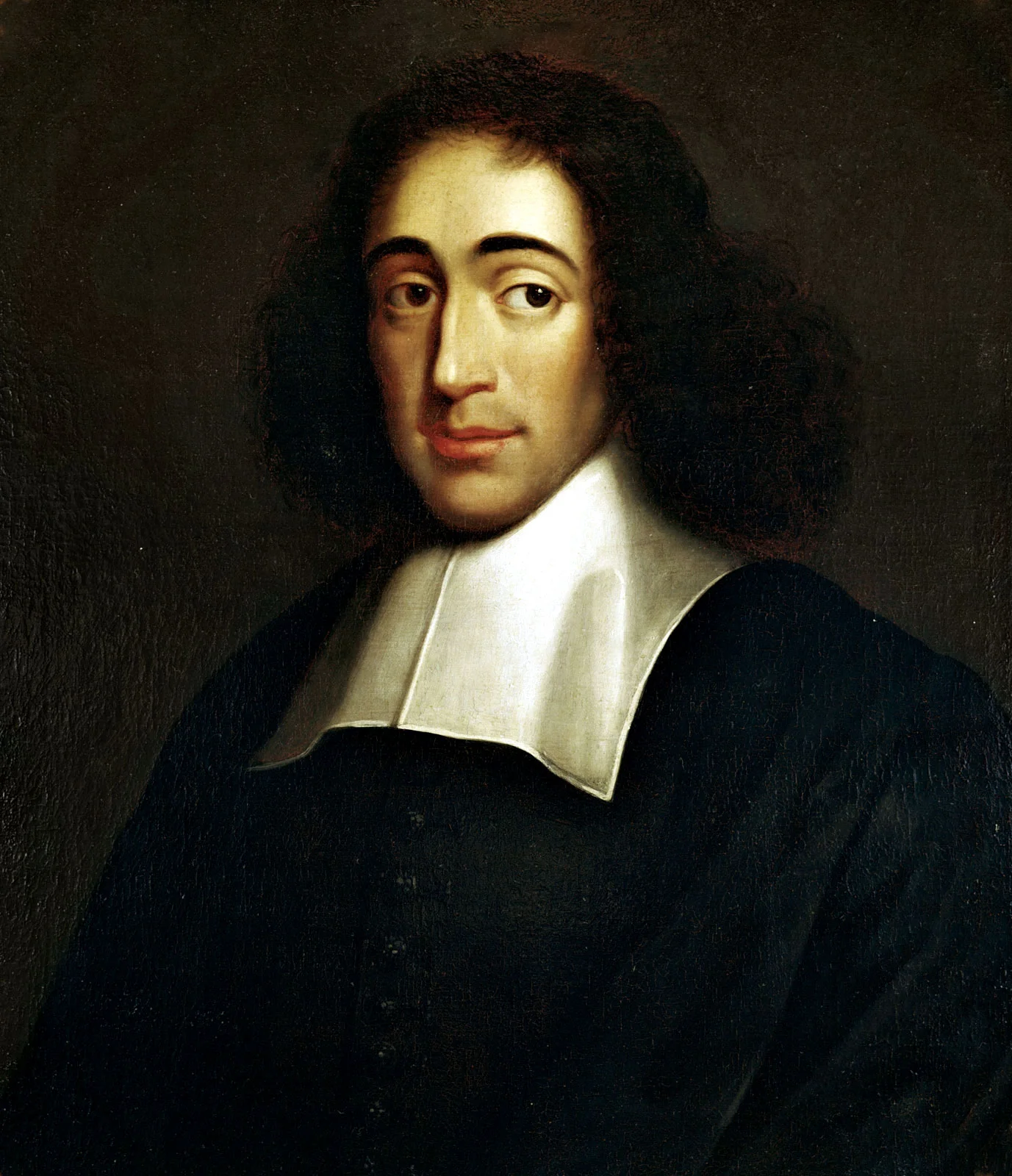
Anonymous portrait, about 1665
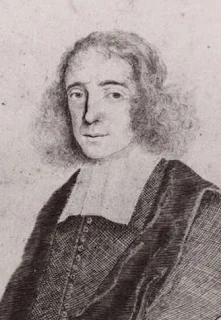
Johan Faber, about 1691
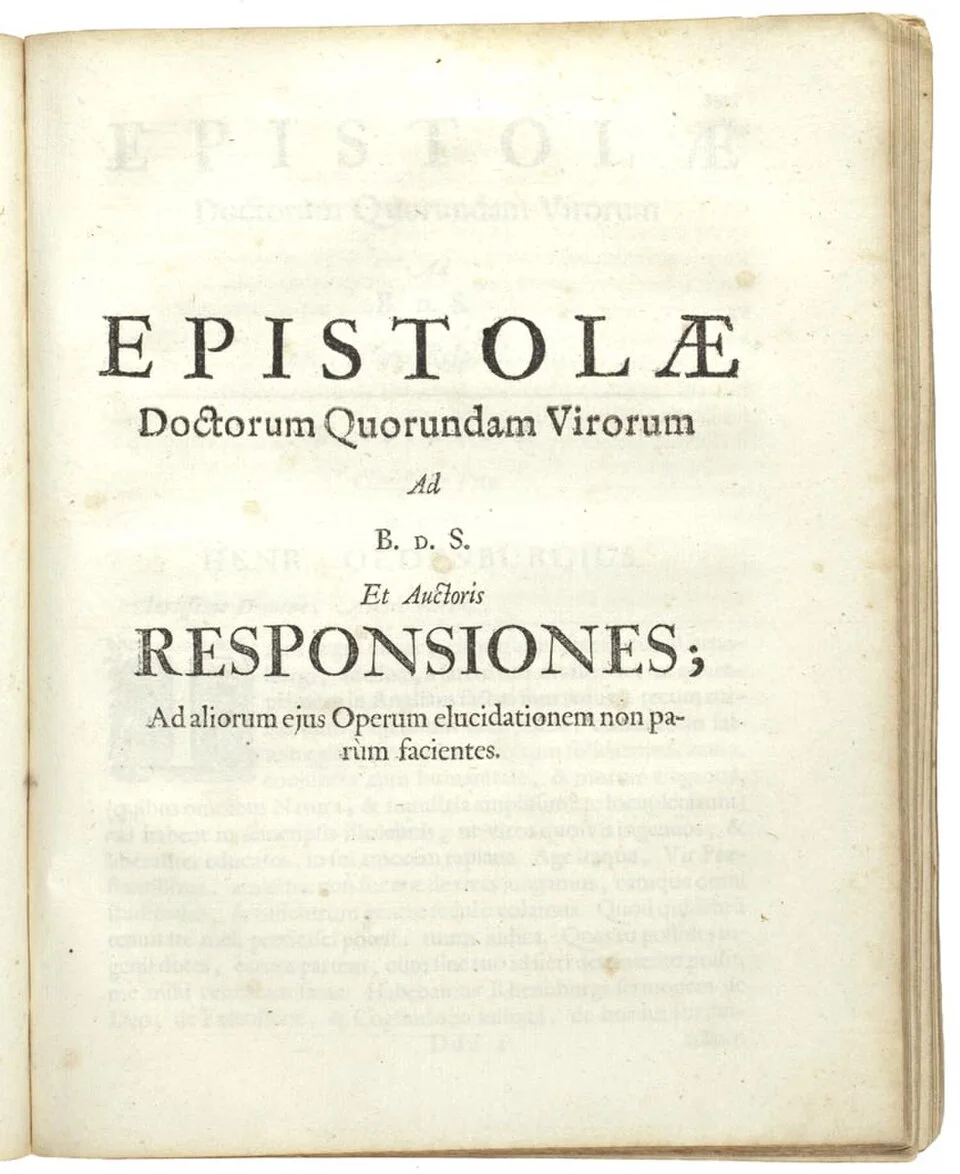
Epistolae, 1677
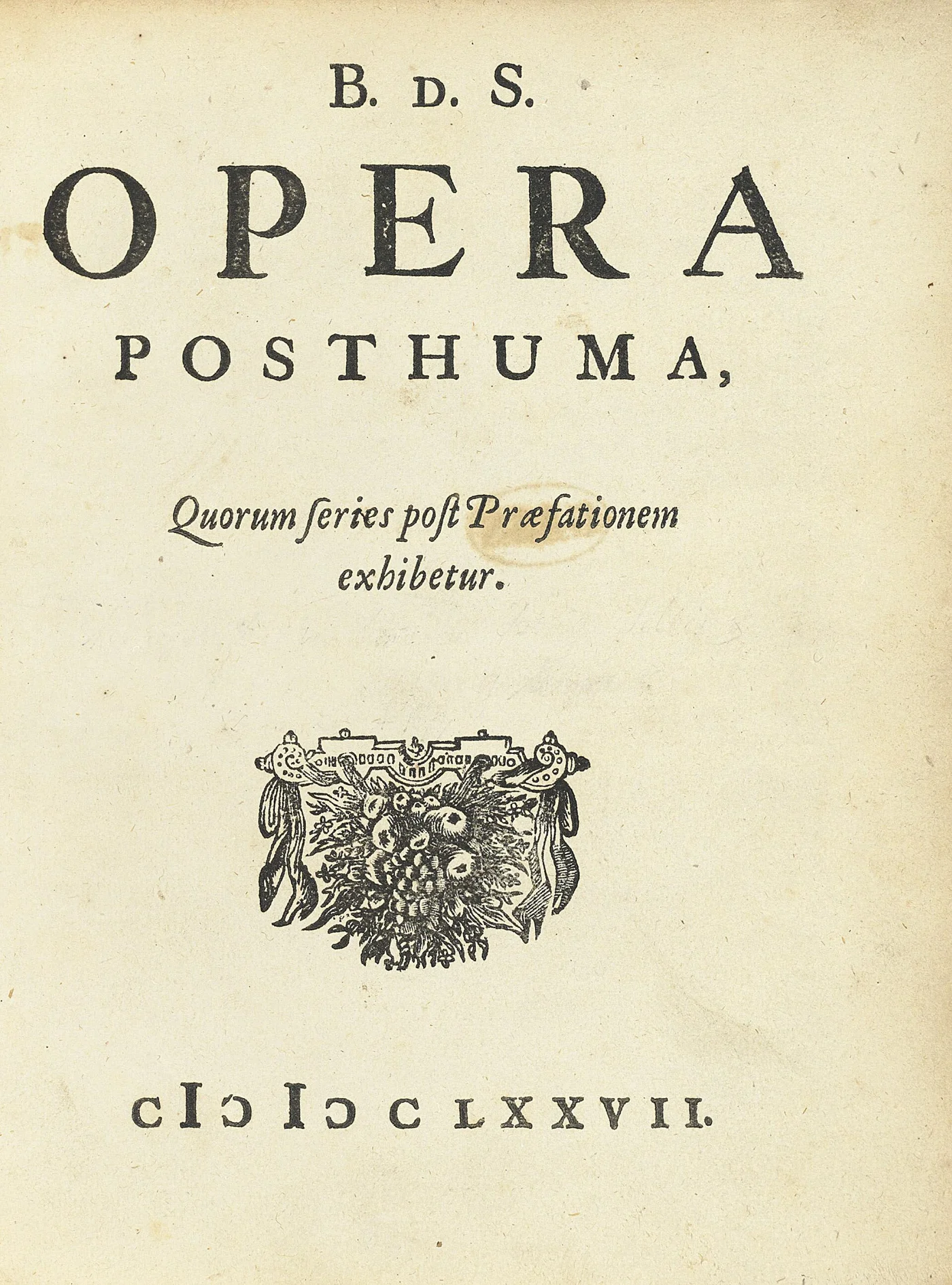
Opera posthuma, 1677
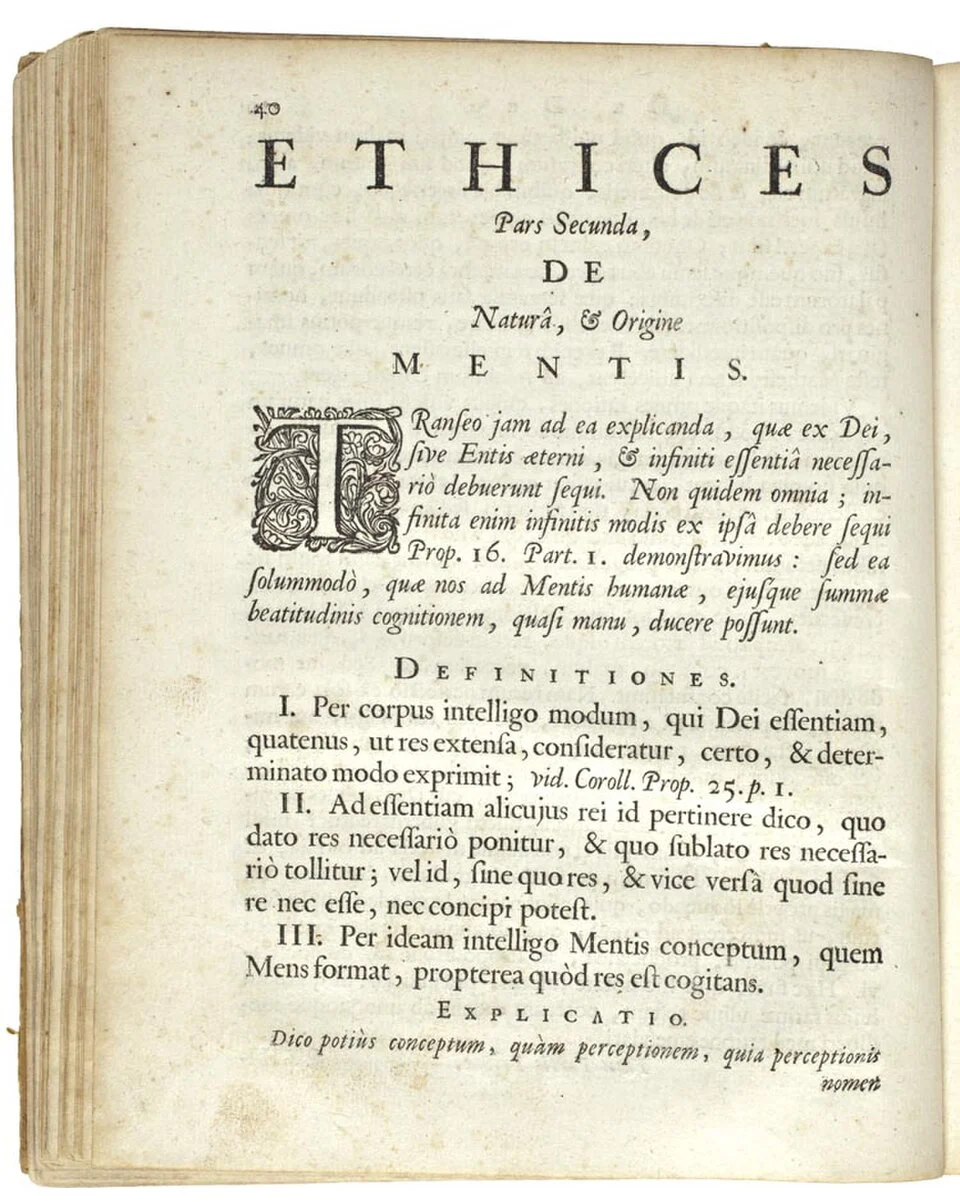
Ethics, Part II, 1677
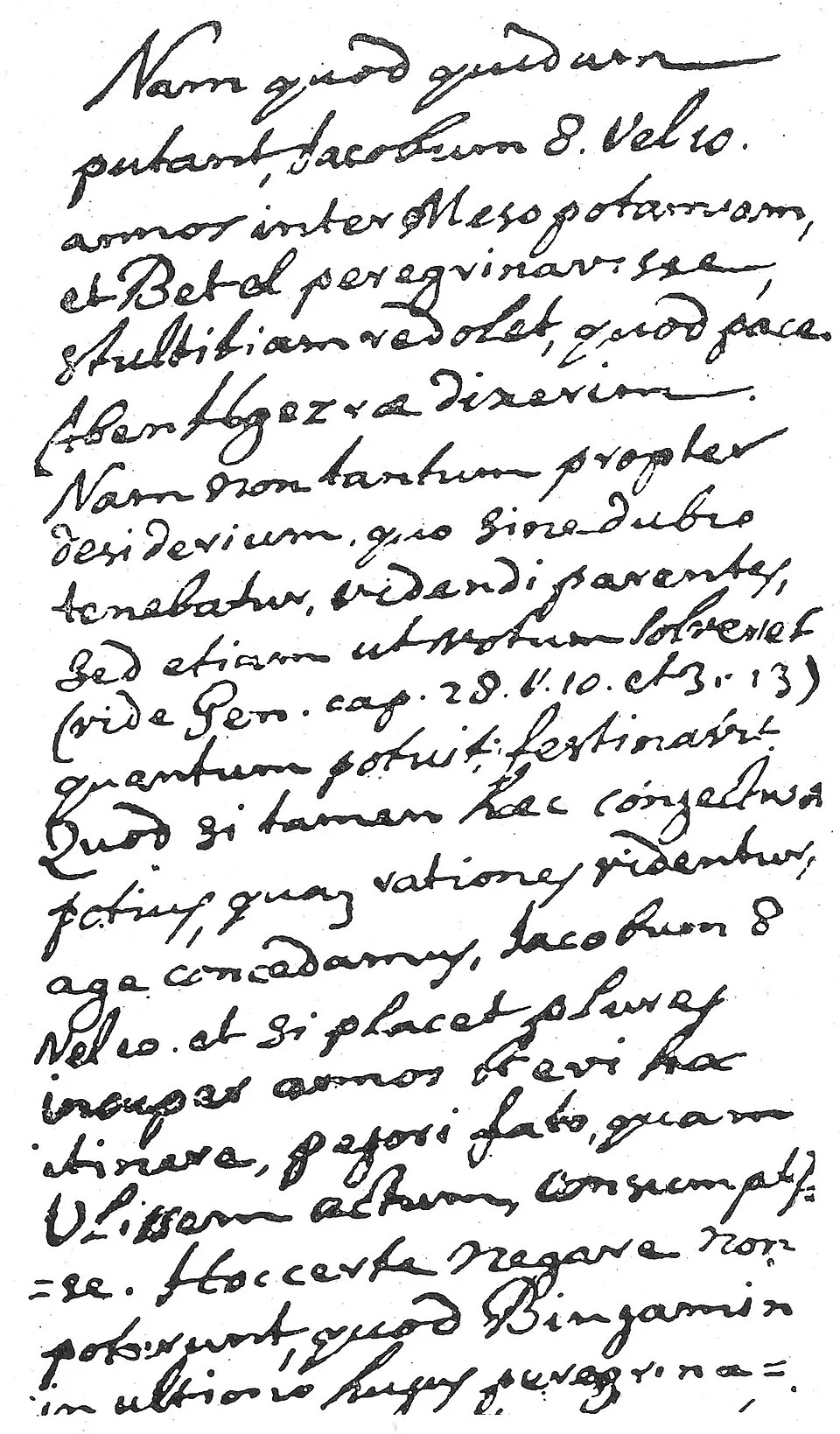
Notes for the Theological-Political Treatise, about 1670 to 1677
Where interpretation remains contested
“Pantheist,” “atheist” and “acosmist” have all been used to interpret his single substance. The disagreement concerns what the word God retains and what status finite things have. Spinoza explicitly denies a providential maker who rewards, punishes or acts for human purposes. Whether retaining the term God expresses a transformed theology or a radical naturalism is a further interpretive issue. Pantheism; Ethics I, appendix
Part V's account of the mind's eternity is another difficult case. It should not be reduced without argument to a personal afterlife, but neither does its language disappear simply because Spinoza rejects familiar providence. Proposition 23 distinguishes what is eternal from imagination and memory tied to bodily duration. Translators and commentators must explain how this fits the mind's status as the idea of a body. Ethics V, propositions 21 to 23; SEP, eternity and blessedness
Questions people ask about Spinoza
What does Spinoza mean by God or Nature?
He means the one infinite substance, understood through infinitely many attributes, of which particular things are modes. God is the immanent cause of what exists, rather than a person who makes decisions outside nature. The phrase does not mean only the visible countryside or a collection of separate objects. Ethics I, definitions 3 to 6 and propositions 14 to 18
How does Spinoza explain the unity of reality?
Everything belongs to a single substance and follows from its nature. Human minds and bodies express that reality through thought and extension, rather than belonging to two independent substances. Finite differences remain real within the account: unity does not make every body or idea interchangeable. The key relation is dependence, not physical fusion. Ethics I, proposition 15; II, propositions 7 and 13
What does freedom mean for Spinoza?
Freedom means acting from one's own nature through understanding, as far as a finite person can, rather than being governed predominantly by external causes and confused passions. It does not mean an uncaused will. Reason, adequate ideas and cooperative life can increase activity within the necessary order of nature. Ethics I, definition 7; IV, propositions 35 and 67; V, proposition 3
Where do Spinoza and Advaita overlap?
Both challenge the idea that the ordinary separate ego supplies an ultimate account of reality, and both connect understanding with liberation. Their systems differ in method and content. Spinoza's attributes, modes and causal necessity should not be substituted for Advaita's Brahman and account of ignorance. Similarity is a comparative question, not evidence that the systems are identical. Spinoza; Advaita Vedanta
How can Spinoza's idea of unity be expressed in art?
Our proposal is to make a work whose elements become intelligible through their relationships: repeated forms, changing viewpoints or a balance that depends on every part. This can provide an analogy for modes within one reality. It is a present-day artistic reading, not a style or iconography prescribed by Spinoza.
Who was Spinoza, and when did he live?
Baruch Spinoza was a Dutch philosopher born in Amsterdam on 24 November 1632 and deceased in The Hague on 21 February 1677. He worked on optical lenses and wrote philosophy in Latin. His Ethics appeared posthumously, while the anonymous Theological-Political Treatise had appeared in 1670. Life and works
Which Spinoza text and translation should I read first?
Our suggested starting text is the Ethics, reading the definitions alongside the scholia and keeping the part and proposition numbers. R. H. M. Elwes's translation is publicly available; Edwin Curley's and Samuel Shirley's translations offer modern alternatives. Eliot's 1856 translation has particular literary interest. Compare technical terms across editions rather than assuming different wording signals a different proposition. Elwes text; Translation bibliography; Eliot edition
Who was influenced by Spinoza?
His reception includes German thinkers and writers such as Goethe and Hegel, the British novelist and translator George Eliot, Argentina's Borges, France's Deleuze and the physicist Einstein. These connections range from translation and poetry to philosophical reconstruction and an admired conception of nature. None makes the recipient an automatic adherent of every proposition in the Ethics. Reception; Einstein connection
Sources and image credits
Sources consulted on 26 October 2026. Each factual passage links to its evidence; looking exercises are marked as our interpretations. The captions link to the Commons file records and identify creators and rights. Images are local WebP conversions. Image provenance rechecked on 27 October 2026.
- Ethics I, definition 7; IV, propositions 35 and 67; V, proposition 3
- Stanford Encyclopedia of Philosophy
- Cengiz, Spinoza and the Aesthetics of Freedom, pages 55 and 56
- Modern philosophical reception
- Internet Encyclopedia of Philosophy
- Pantheism and the Spinoza controversy
- Gatens, The Cambridge Spinoza Lexicon
- Borges, Selected Poems, page 213
- Beenakker, Einstein's poem on Spinoza
- Advaita Vedanta
- Eliot edition
- Joseph Ratner, The Philosophy of Spinoza, introduction
- Spinoza, Letters 47 and 48 (1673)