Teachers / No. 008
Sri Aurobindo
Sri Aurobindo (1872 to 1950) was an Indian nationalist, poet and philosopher whose Integral Yoga sought a transformation of human life through what he understood as an evolving divine consciousness. Routledge Encyclopedia of Philosophy
His project joins political history, a large philosophical system, practical correspondence and ambitious poetry. This guide separates its spiritual claims from established history, explains the vocabulary that makes the books difficult, and follows the people and artworks through which the ideas travelled. Life and writings
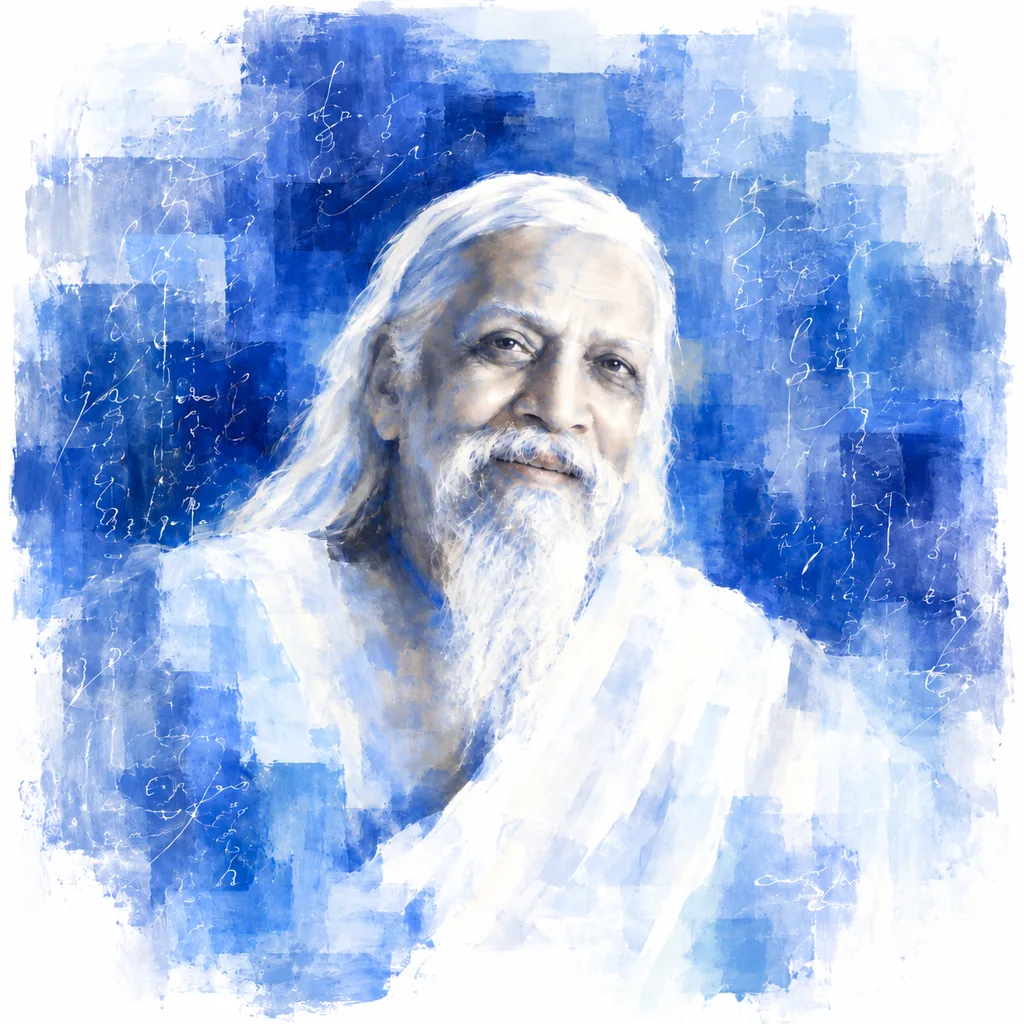
What makes his project distinctive?
Aurobindo’s central proposal is that spiritual discovery need not end in departure from the world. In his account, the material world contains possibilities that consciousness can progressively manifest; mind is an important stage, but not the final one. The aim is to transform thought, emotion, action and eventually embodied life. The official life sketch presents this as a movement towards spirit followed by a return that changes earthly existence. It describes a spiritual programme, not an accomplished biological transition demonstrated by science. Life sketch and account of the yoga
Stephen Phillips’s encyclopedia overview places that proposal inside a system joining epistemology, ontology, psychology and ethics. It also identifies evolutionary biology as important to Aurobindo’s thinking while distinguishing the metaphysical drive he places within matter. His phrase “evolutionary nisus” names a tendency towards higher emergence, not an extra mechanism accepted within contemporary evolutionary theory. The difference matters because a spiritual use of evolution can otherwise sound like a scientific prediction. Phillips’s article summary
The personal biography includes a marriage as well as political and spiritual commitments. He married Mrinalini Bose in 1901; she died during the influenza pandemic in December 1918. The early poems, college teaching, journalism and subsequent retreat were therefore parts of a life with relationships and historical disruptions, rather than successive masks of a figure outside ordinary history. His later philosophical system should not erase that human chronology. Marriage and early career
A life in politics, writing and retreat
- 1872 to 1893: born in Calcutta on 15 August 1872; educated in England from childhood, including St Paul’s School and King’s College, Cambridge; returned to India in 1893. Official life sketch
- 1893 to 1906: worked in Baroda, including teaching English and serving as a college vice-principal, while studying Indian languages and preparing political work. Baroda years
- 1906 to 1909: became a prominent nationalist journalist and organiser in Bengal. Arrested in the Alipore conspiracy case in 1908, he was acquitted in 1909 after a year in custody. Political activity and imprisonment
- 1910: moved to Pondicherry, then under French rule, and increasingly concentrated on spiritual practice and writing. Withdrawal to Pondicherry
- 1914 to 1921: the journal Arya serialised much of his major philosophical, cultural and social work. Mirra Alfassa first met him in 1914 and became his central collaborator. The Arya years; The Mother
- 1926: his further withdrawal from public contact and Alfassa’s organisation of the growing community mark the conventional beginning of the ashram. Ashram development
- 1950 and after: he died on 5 December 1950. Alfassa continued the work until 1973; the experimental township Auroville was founded during her lifetime in 1968. Final years; Auroville history
Integral Yoga in plain words
Spirit and matter belong to one account
The official explanation begins with a single being and consciousness understood as involved in matter. Life and mind emerge as stages of its development, and a greater consciousness is proposed as the next possibility. This differs from treating material existence as an unfortunate mistake that enlightenment simply cancels. Aurobindo’s system makes the transformation of nature part of the task, which is why his writings move between metaphysics and the stubborn details of daily conduct. Official explanation of the basic principle
What does Supermind mean?
Supermind is his name for a truth-consciousness beyond the divisions of ordinary mental knowledge. It is not an especially high intelligence score, a technological supercomputer or a poetic synonym for optimism. The life sketch contrasts a mind seeking truth from partial knowledge with a consciousness that knows through its own unity. Whether such a state exists as described is a spiritual and philosophical claim. Translating the term into a familiar technological future would silently change the subject. The account of Supermind
Why combine knowledge, devotion and work?
The yoga draws together discernment, love and surrender, and action freed from narrow self-interest. The ashram’s explanation says that the whole being must be trained to respond to a wider consciousness. An inward insight would therefore be incomplete if the patterns of desire and conduct remained untouched. This is the practical force of the word integral: integration concerns parts of a person’s life, rather than the indiscriminate collection of every spiritual technique. Relation to earlier systems of yoga
Inner growth is not a miraculous shortcut
The official account explicitly describes the discipline as long and difficult. It rejects the expectation that a rapid or miraculous event will convert every part of the being at once. This qualification is easily lost when the vocabulary of transformation is used for advertising. Progress in the teaching’s own terms would involve sustained changes across mental, emotional and physical habits; an intense experience alone would not settle the question. The primary claim is larger, and the standard correspondingly demanding. The difficulty of the discipline
The political life does not disappear
Before Pondicherry, Aurobindo argued for Indian self-rule and helped shape nationalist journalism and organisation. The official life sketch gives substantial space to boycott, national education and non-cooperation, alongside the context of revolutionary activity. Columbia’s description of Heehs’s biography stresses the need to keep scholar, revolutionary, poet and social thinker in the same frame. A portrait containing only a secluded sage would omit much of the historical person whose later work it seeks to explain. Nationalist programme; The biography’s scope
How can a beginner approach the practice?
Start by distinguishing an introduction to the teaching from entry into an institution. The official yoga summary gives a practical orientation: become aware of the inner being and its push towards truth, beauty and harmony, while working on the rest of one’s nature. It does not present a universally prescribed sequence of postures. Our recommendation is to read that short summary before attempting the much larger theoretical books, so their specialised vocabulary has a clear purpose. Main lines of practice
In ordinary activity, this means that motives matter as much as the outward task. Work can be examined for vanity, attachment or self-interest; devotion and discernment address other dimensions of the same problem. That is an explanation of the framework, not a promise that a reader can diagnose spiritual progress from a checklist. The official text also says that outward asceticism is not essential, while mastery of desire and attachment remains indispensable. Practice and self-discipline
For practical questions, begin with selected Letters on Yoga alongside an introductory account. The official Complete Works catalogue distinguishes this substantial correspondence from philosophical treatises, poetry and autobiographical material. Check each extract’s place in the collection, its addressee and the question it answers: a reply to one difficulty is not automatically a rule for every person. Complete Works catalogue
Ashram residence is a separate question from beginning to read. The community’s visitor information describes guest houses, passes, the samadhi and the Bureau Central information centre. It does not turn an ordinary visit into guaranteed personal instruction or permanent admission. People interested in a short visit, a study stay or a continuing commitment should check the relevant arrangements directly instead of treating all three as the same kind of retreat. Visitor guidance
Which books should you read first?
The Life Divine
This is the large philosophical work for readers interested in the relation between matter, consciousness, evolution and divine life. Much first appeared in Arya, later taking book form. It belongs after a basic introduction for most new readers: the argument’s terms develop through the text, and extracting an impressive passage can hide the problem it is trying to solve. The historical setting also shows that the project was formulated in conversation with modern intellectual questions. Major works and Arya; Philosophical scope
The Synthesis of Yoga and Essays on the Gita
The Synthesis of Yoga examines the paths of knowledge, devotion and works in relation to a larger spiritual aim. Essays on the Gita offers Aurobindo’s interpretation of that scripture, rather than a neutral substitute for every other translation or commentary. Choose according to the question you bring: an architecture of practice in the former, a sustained interpretive encounter with a particular text in the latter. Both belong to the major writings serialised in Arya. Publication history and descriptions
Savitri and The Future Poetry
Savitri, subtitled A Legend and a Symbol, is the central poetic work. The digital contents show its book-and-canto architecture; The Future Poetry gathers his literary criticism and reflections on poetic language. Our suggestion is to approach the poem as a poem before demanding that every line become a doctrinal statement. Rhythm, narrative and image carry work that a prose summary cannot preserve. The independent reader cited here identifies its source editions and does not claim to be an official publication. Savitri contents; The Future Poetry contents
What do people around the world say?
India: Rabindranath Tagore met Aurobindo in 1928 and wrote about the encounter in The Modern Review. His tribute repeats the salutation, “Aurobindo, accept the salutation from Rabindranath.” It is a poet’s expression of recognition, first shaped by the nationalist figure and later addressed to the spiritual writer. The source collection preserves the account and related material; its admiring interpretation should not be confused with detached confirmation of supernatural insight. Tagore’s account, reproduced
France and India: Mirra Alfassa, called the Mother by the community, became a collaborator in practice, education and the organisation of the ashram. Her subsequent work gives the reception a concrete institutional and international history. The official introduction presents her through the community’s spiritual understanding of her role. Historically, it is important to distinguish that understanding from the observable fact that she directed and developed the work after Aurobindo’s death. Official introduction to the Mother; Later international development
The United States: the biographical overview identifies Michael Murphy and Ken Wilber among figures influenced by Aurobindo. These connections helped bring his vocabulary into human-potential and integral-theory conversations. They do not make the later systems identical with Integral Yoga. The same overview records criticism of Wilber’s interpretation, illustrating that influence can generate disagreement about what was borrowed, simplified or changed. A name in an intellectual genealogy is a beginning for comparison, not its conclusion. Influence and later interpreters
American and British scholarship: Heehs’s biography attempts to join the political, literary and spiritual lives through archival sources. Columbia quotes the British historian Antony Copley calling it “A formidable piece of scholarship.” This praises the biography’s research, not every spiritual claim made by its subject. The publisher’s description and reviews give a route to scholarly reception; they should not be presented as if the entire book had been opened here. Publisher’s description and quoted reviews
Where do critics disagree?
There is a philosophical objection before any biographical controversy: a system may be internally ambitious without demonstrating the supramental future it proposes. Phillips’s summary explicitly locates the evolutionary tendency within metaphysics. Our assessment is that readers should distinguish a theory’s explanatory reach from evidence that its promised transformation has occurred. Admiration for the integration of ideas does not remove the need to ask what would count against the theory. Phillips’s philosophical summary
Heehs’s book also provoked opposition among some admirers. In a 2014 article on the publisher’s blog, he reported an injunction against the Indian edition and legal complaints relating to his biography. That is a dated first-person account of the dispute, not a claim about the present legal status of the book. The episode matters because a historical biography and a devotional portrait can be judged by different expectations, especially when ordinary human details are treated as threats to spiritual authority. Heehs’s account, 2014
How do poetry and painting connect to the teaching?
Aurobindo’s connection with art is direct: he wrote poetry, literary criticism and reflections on language. The contents of The Future Poetry include rhythm, style, poetic vision and the mantra, alongside historical discussions of English verse. His ambition therefore concerns the capacities of language as well as the delivery of religious ideas. Our reading is that a literary approach should ask what sound and image accomplish before converting the poems into a list of concepts. The Future Poetry, contents
A later visual translation is particularly well documented. The painter Huta, born Savita D. Hindocha, worked under the Mother’s guidance on Meditations on Savitri in the 1960s. Auroville’s account links the paintings to readings by the Mother and music by Sunil, and records the collection’s transfer to the care of Savitri Bhavan in 2001. This is a specific collaboration across poem, voice, painting and music, rather than a general assertion that all visionary art derives from Aurobindo. Shraddhavan’s account of Huta
The distinction between source and response is essential. Huta’s paintings interpret passages from the poem; they are not illustrations painted by Aurobindo or a definitive visual key to his entire system. The documented painting project
Ashram, samadhi and Auroville today
The Sri Aurobindo Ashram is in Puducherry, the city historically known as Pondicherry. Its main building contains the samadhi of Aurobindo and the Mother. Bureau Central provides introductory exhibits and practical information, and the visitor guide explains access, passes and guest houses. Opening information can change, so use the official page rather than treating a historical description as a reservation. The community is a living place of work and practice, not only a memorial. Official visitor questions; Community overview
Auroville is a distinct experimental township founded by the Mother in 1968, after Aurobindo’s death. Its history page dates the inauguration to 28 February and records participation from 124 nations. The connection is inspiration and subsequent development, not personal founding by Aurobindo. A visitor interested in poetry, painting or the human-unity experiment may find different questions there than at the ashram; consult each institution’s current information independently. Auroville history
Questions people ask about Sri Aurobindo
Who was Sri Aurobindo?
Sri Aurobindo was an Indian nationalist, poet and philosopher, born in 1872 and deceased in 1950. After political activity and imprisonment in Bengal, he settled in Pondicherry and developed a large body of writing on spiritual evolution and Integral Yoga. Official life sketch
What is Integral Yoga in plain words?
It is a spiritual discipline intended to transform the whole person and earthly life, rather than end only in inward liberation. It brings knowledge, devotion and action into a single project. Its divine and supramental explanation is a spiritual claim, not established evolutionary science. Official yoga explanation
How can I begin learning or practising?
Read the ashram’s short explanation of the yoga, then use a suitable introduction or selected letters to clarify the vocabulary. The practice concerns motives, desire, attention, work and devotion; it is not a universal sequence of postures. This is our suggested reading route, not personal spiritual instruction. Main lines of practice; Official writings catalogue
Which books should I read first?
For practical questions, begin with a carefully referenced selection from Letters on Yoga. Choose The Life Divine for philosophy, The Synthesis of Yoga for the relation between paths, and Savitri for poetry. These are editorial recommendations for different interests, rather than a compulsory order. Complete Works; Major works
What is the Supermind?
Aurobindo uses Supermind for a truth-consciousness beyond the divisions of ordinary mental knowing. It does not mean a high IQ or a computer. Its existence and transformative role belong to his philosophical and spiritual system. Account of Supermind; Routledge summary
Where can I visit his ashram and samadhi?
The Sri Aurobindo Ashram is in Puducherry, India, and its main building houses his samadhi together with the Mother’s. Bureau Central provides visitor guidance. Check the official information for access, guest-house arrangements and any passes required. Official visitor guide
Who were his collaborators and students?
The central collaborator was Mirra Alfassa, known as the Mother, who developed the ashram and continued the work after his death. Associates included Nolini Kanta Gupta, Nirodbaran and K. D. Sethna, known as Amal Kiran. Later influence should be distinguished from a claim to exclusive succession. The Mother; Associates and followers
Did Sri Aurobindo found Auroville?
No. The Mother founded Auroville in 1968, drawing on his vision of spiritual evolution and human unity. Aurobindo had died in 1950. Auroville and the ashram are connected historically but are distinct places and institutions. Auroville history; Life sketch
Sources and image credits
Sources opened and checked on 26 October 2026. The comparison uses Wikipedia, the official ashram, Phillips’s Routledge encyclopedia summary and Columbia’s description of Heehs’s biography. Publisher summaries are identified as summaries. Tagore’s account is read in reproduction; our interpretations are marked. This independent art site has no affiliation with this teacher, any lineage or any organisation mentioned here.
- Wikipedia, Sri Aurobindo
- Sri Aurobindo Ashram, introduction
- Sri Aurobindo, life sketch, official ashram edition
- Stephen H. Phillips, Aurobindo Ghose, Routledge Encyclopedia of Philosophy, 1998
- Peter Heehs, The Lives of Sri Aurobindo, Columbia University Press, 2008, description and reviews
- Peter Heehs, India’s Etiquette Police, Columbia University Press Blog, 2014
- Sri Aurobindo Ashram, Sri Aurobindo and His Yoga
- Sri Aurobindo Ashram, Complete Works catalogue
- Rabindranath Tagore, 1928 account and related documents, reproduced in a source collection
- Sri Aurobindo Ashram, The Mother
- Sri Aurobindo Ashram, visitor questions
- Sri Aurobindo Ashram, community overview
- Auroville, History
- Shraddhavan, Huta, Auroville, 2011
- The Future Poetry, contents of CWSA volume 26, independent digital reader
- Savitri, contents of CWSA volumes 33 and 34, independent digital reader