Thinkers / No. 007
Plotinus
Plotinus, the Greek-language philosopher who lived around 204 to 270 CE, explains beauty as intelligible form that unifies what we see, drawing the soul towards the One, his ultimate principle beyond being and thought. Enneads I.6; Stanford Encyclopedia of Philosophy
His writings turn a question about an attractive face or a carved stone into a question about how anything becomes a coherent whole. Read him through those examples first. His account can illuminate an encounter with art while leaving its metaphysical premises open to examination. Enneads V.8
Start with a stone, then ask what makes it a work
Our exercise: compare an unworked stone with a sculpture made from a similar material. List what the sculptor has changed: contour, balance, proportion, surface, relation to light. Then ask whether the result is simply a more complicated stone, or whether its parts now sustain a distinct whole. This is a contemporary way into Plotinus's own thought experiment, not a claim that he supplied criteria for modern sculpture.
In Enneads V.8.1 he compares two blocks, one untouched and the other shaped into a beautiful statue. Its beauty cannot belong to stone as such, because the unworked block would then be equally beautiful. He locates it in the form introduced by the artist. The argument concerns the source of beauty; it does not deny that a viewer meets that form through a physical material. On the Intellectual Beauty, section 1
From Egypt to Rome: a short timeline
- About 204 CE: Born in Egypt. The date is inferred from Porphyry's biographical account. SEP, life and works
- About 232: Begins studying with Ammonius Saccas in Alexandria and remains for eleven years. SEP
- 243 to 244: Joins Gordian III's expedition against Persia, hoping to encounter Persian and Indian wisdom. After the expedition fails, he eventually settles in Rome. This is evidence of interest, not evidence that he reached India. SEP
- 253 onward: Writes the treatises later arranged as the Enneads; Porphyry joins his circle in 263. Andre Nance, Porphyry: The Man and His Demons, page 46
- 270: Dies in Campania. Porphyry later edits fifty-four treatises into six groups of nine, giving the collection its name. IEP
- 1492: Ficino's Latin Plotinus appears in print, a major point in Renaissance transmission. Surviving edition

The One, Intellect and Soul in plain words
The One is not a very large object
The One is the ultimate source of unity. It cannot be one member of the collection it explains, nor a compound needing a further explanation of its own unity. Plotinus therefore places it beyond being and discursive thought. Calling it the Good identifies everything's dependence upon it and orientation towards it. The word “one” does not mean that all visible objects fuse into a single body. Enneads V.1 and V.2
Intellect, or Nous, is the level of intelligible reality: being and the forms are present in a unified act of thinking. It contains multiplicity, since thinking involves what thinks and what is thought, yet its objects are not externally scattered things. Soul relates intelligible order to the world of living and changing beings. These three principles are conventionally called hypostases. They are explanatory levels, not three persons occupying different regions of physical space. Enneads V.1, The Three Initial Hypostases
What does emanation mean?
Plotinus describes reality as proceeding from the One without diminishing it. An overflowing source or a light that illuminates without being depleted helps express the relation. Emanation is the familiar later label, but it can mislead if it suggests a fluid, a temporal explosion or a deliberate manufacturing decision. The dependent level turns towards its source and becomes determinate through that relation. Procession and return belong together. Enneads V.1 and V.2
The account also explains why contemplation matters. It is not merely what an observer does after an independently complete world has appeared. Turning towards the intelligible source belongs to what makes a level of reality what it is. For a reader, this connects metaphysics with a discipline of attention: understanding is not adding another object to a collection but grasping what gives the collection coherence. Enneads V.3, knowing and self-knowledge
Why beauty cannot be only symmetry
At the beginning of I.6, Plotinus tests the claim that beauty is symmetry or proportion. A beautiful colour, a flash of lightning and a single musical tone need not have separable parts whose ratios explain their appeal. The same face can seem beautiful at one moment and otherwise at another while keeping its proportions. Moral character and an intellectual argument introduce further cases that a geometrical account cannot easily cover. Enneads I.6.1
His alternative is form: something gathers multiplicity into an intelligible unity. A house, for instance, has more than an inventory of stones; its arrangement makes a whole apprehensible. The soul recognises a kinship between the form present in the object and its own intelligible character. This account explains his language of recognition and return. It remains a philosophical explanation of beauty, not a laboratory result about what every viewer must prefer. Enneads I.6.2 and 3
Inner vision requires transformation
Plotinus's inward turn is not a search for a private cinema behind the eyes. I.6 moves from bodily beauties to conduct, character and the soul's own condition. He compares self-formation with a sculptor removing what prevents a statue's beauty from emerging. The analogy links ethical work and perception: someone absorbed in disorder cannot simply acquire a better vantage point while remaining unchanged. Enneads I.6.5 to 9
Union with the One also differs from an ordinary subject inspecting an object. The ending of VI.9 describes a condition beyond that division. Translators use language such as vision, contact and presence because the text strains against the grammar of two separate things. Reading this as an exceptionally vivid visual image misses the very duality Plotinus is attempting to leave behind. Enneads VI.9, On the Good or the One
Virtue is not simply leaving the world
I.2 distinguishes the civic virtues that bring order to embodied life from purification and the higher activity to which it leads. Moderation and courage have an intelligible role before a reader reaches the discussion of union. Becoming like the divine cannot mean copying a human list of good habits into a higher realm without examining how those virtues work there. Plotinus asks whether a principle that has nothing to fear can possess courage in the same sense as a person confronting danger. Enneads I.2, On Virtue
This helps explain the ethical purpose of the sculptor analogy. Removing what obscures the soul is not the same as removing other people from one's concern. The text moves from the ordering of desires towards a different centre of activity, one less governed by the needs of the composite bodily individual. Whether that hierarchy gives embodied life sufficient value is a legitimate critical question. But its lower and higher virtues need to be distinguished before the philosophy can be described as recommending mere withdrawal. Enneads I.2
What did Plotinus think artists could do?
V.8 gives the artist a stronger position than a simple copying theory would allow. Natural objects already express intelligible principles. An artist may reach towards those principles instead of merely reproducing the surface of an existing object. Plotinus invokes Pheidias's Zeus: the sculptor did not need a visible god as a sitter, but could conceive the form appropriate to divine manifestation. This is Plotinus's example, not testimony from Pheidias about his own process. Enneads V.8.1
The same passage keeps a hierarchy. The artist's intelligible conception is more complete than its material realisation, which must contend with the limitations of stone. Plotinus can therefore defend the creative reach of art while judging its physical products as dependent images. That double position matters: it neither reduces artistic making to imitation nor gives material form the last word. Enneads V.8.1 and 2
Our application to abstraction: look for a unity that does not depend on identifying a depicted thing. A repeated interval, a relationship between masses or an entire surface held by one directional movement may organise a work. Describe the relationship precisely before calling it spiritual. This is an exercise in reading contemporary form through a Plotinian question, not evidence that Plotinus anticipated twentieth-century abstraction.
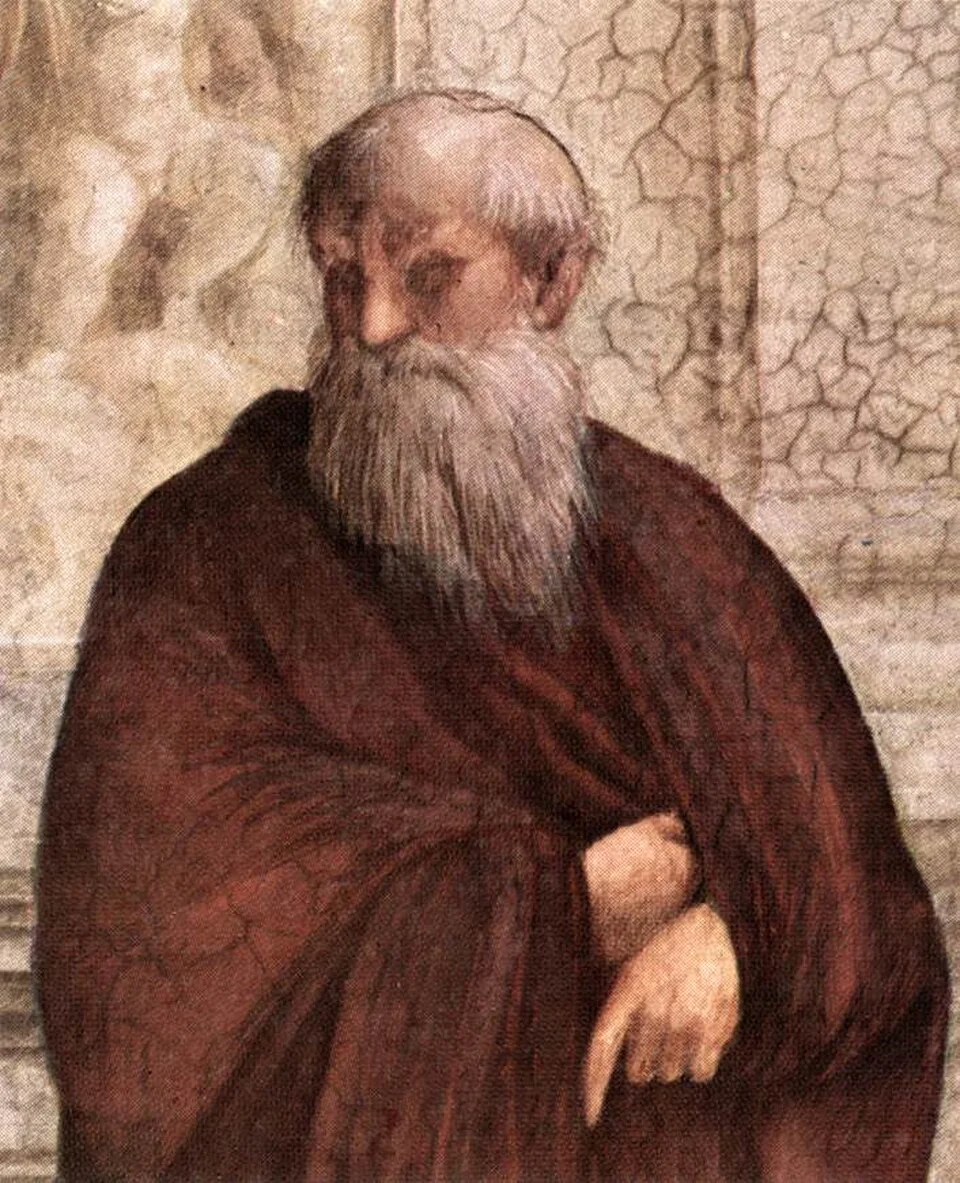
There is also tension between art theory and the philosopher's reported attitude to his own image. Porphyry recounts his reluctance to sit for a portrait and the painter Carterius's effort to observe him at lectures. The marble head often presented as Plotinus has an uncertain identification. The Raphael detail below documents a later visual interpretation rather than an authenticated likeness. Porphyry's biographical tradition; Ostia head, identification statement

What people say across languages and centuries
In North Africa and Italy, Augustine's engagement with Platonist books became a decisive episode in his intellectual development. James J. O'Donnell's commentary explains that the Confessions leaves those books unnamed, while another early work explicitly mentions Plotinus. How much belongs to Plotinus and how much to Porphyry remains a scholarly question. The secure connection is reception through texts, not identity between Plotinian and Christian doctrines. O'Donnell, commentary on Confessions VII
Arabic transmission brought another transformation. Material from the later Enneads circulated in a reworked text known as the Theology of Aristotle. Its title gave Plotinian arguments an Aristotelian identity and helped introduce them into later philosophical discussions. This is a case of adaptation and misattribution, rather than a straightforward translation carrying the author's name unchanged. Greek Sources in Arabic and Islamic Philosophy
Italian Renaissance philosopher Marsilio Ficino translated Plotinus into Latin. In Britain, Bertrand Russell later called Plotinus “historically important as an influence in moulding the Christianity of the Middle Ages and of theology.” Russell's judgement concerns a long reception history, not Plotinus's membership in Christianity. The two examples show why influence must specify an intermediary and a context. Reception and Russell quotation
Irish poet W. B. Yeats encountered the Enneads through Stephen MacKenna's translations. A study of Yeats's system documents the volumes in the poet's library and his reading as they appeared. John Dillon's account also traces how E. R. Dodds helped MacKenna's translation reach a wider public. This literary route gave Plotinus a new English voice, with all the choices a translator's philosophical vocabulary entails. Neil Mann, Plotinus and A Vision; Dillon on Dodds and MacKenna
In India, Ananda Coomaraswamy and Sarvepalli Radhakrishnan brought Plotinus into comparisons with the Upanishads and Advaita. The resemblance lies in questions about ultimate unity, inward knowledge and the limits of ordinary language. It is a comparative interpretation, not proof of a journey to India or a single historical source for both systems. Indian reception; Evidence for the Persian expedition
What to read, and a Renaissance image
The Enneads are organised thematically, not chronologically. A reference such as V.8.1 means fifth Ennead, eighth treatise, first section. For this page's concerns, read I.6, On Beauty, followed by V.8, On the Intellectual Beauty. V.1 introduces the three principles; VI.9 asks how the soul approaches the One. Reading the arguments in this sequence is our suggestion, rather than Porphyry's prescribed curriculum. IEP, organisation of the writings; I.6
The public-domain MacKenna and Page translation has a strong literary voice, including “Intellectual-Principle” for Nous. For study alongside the Greek, A. H. Armstrong's Loeb edition supplies a different apparatus; the modern English collection edited by Lloyd P. Gerson offers another route. Keep the Ennead and section numbers when comparing translations, since pagination and technical vocabulary differ. SEP bibliography
Raphael, The School of Athens, detail, 1509
Criticism: does unity explain too much?
A central difficulty is how a principle beyond thought can be argued for or described. Plotinus uses negation and reasoning to establish the need for a source, then denies that ordinary predication captures it. This creates a productive tension between argument and the union described in VI.9: the text offers reasons, yet says that the ultimate condition is not another discursive conclusion. Enneads VI.9
The status of matter creates another problem. Plotinus links evil with privation while also defending the ordered beauty of the cosmos against Gnostic rejection. Modern interpreters debate the origin of matter and how a world dependent on the Good admits deficiency. A description of him as simply hostile to the physical world misses both the cosmic order he defends and the difficulties his hierarchy generates. SEP, matter and evil; IEP, the Gnostic controversy
Questions people ask about Plotinus
What does Plotinus mean by the One?
The One is the ultimate source of unity and reality, beyond being and thought. It is not one physical object among others and does not deliberate like a human maker. Intellect and Soul depend upon it, while their multiplicity makes them less absolutely simple. Plotinus also calls it the Good. Enneads V.1 and V.2
How does Plotinus connect beauty with unity?
Beauty appears when form makes a multiplicity intelligibly one. Plotinus rejects symmetry as a sufficient explanation because simple colours and tones can be beautiful too. His theory directs attention from the inventory of an object's parts to the principle that holds them together. It also extends beauty to conduct, virtue and thought. Enneads I.6
What role does inner contemplation play for Plotinus?
Contemplation turns attention from scattered sensory concerns towards the soul's intelligible source. It involves ethical transformation as well as understanding: I.6 compares the work on oneself to shaping a statue. The final approach to the One is described as surpassing the ordinary separation between a spectator and an object seen. I.6.9; VI.9
What are the similarities between Plotinus and Advaita?
Both ask how an ultimate unity relates to experienced multiplicity and how inward knowledge can transform one's understanding of selfhood. Their concepts and explanatory structures differ: Plotinus distinguishes One, Intellect and Soul, while Advaita argues through Brahman, selfhood and ignorance. The comparison does not demonstrate direct historical dependence or erase differences between their accounts of reality. Plotinus; Advaita Vedanta
How can Plotinus's philosophy inspire abstract art?
Our suggestion is to make relationships, rather than a depicted object, carry a work's unity. Test whether rhythm, proportion or the relation of solid and empty space makes separate elements feel coherent. Plotinus's stone-and-statue example supplies the philosophical starting point. Applying it to modern abstraction remains a contemporary interpretation. Enneads V.8.1
Who was Plotinus, and when did he live?
Plotinus was a Greek-language philosopher born in Egypt around 204 CE who taught in Rome and died in 270. He studied with Ammonius Saccas in Alexandria. His pupil Porphyry edited his writings into the Enneads; later historians describe him as a central founder of Neoplatonism, although he understood himself as interpreting Plato. SEP, life and philosophical context
Which Plotinus text and translation should I read first?
Our starting choice for an art reader is Enneads I.6, On Beauty, followed by V.8, On the Intellectual Beauty. MacKenna and Page offer a public-domain English translation; Armstrong's Greek-English Loeb edition and Gerson's modern English collection provide alternatives for closer study. Compare numbered sections rather than page numbers across editions. On Beauty; Editions and translations
Who was influenced by Plotinus?
His reception includes Augustine, Arabic adaptations associated with the Theology of Aristotle, Ficino's Renaissance translation and Yeats's reading of MacKenna. Coomaraswamy and Radhakrishnan used him in Indian comparative philosophy. These are different kinds of influence: direct reading, adaptation, translation and comparison should be distinguished rather than gathered into a claim that every recipient taught the same system. Reception overview; Augustine commentary
Sources and image credits
Sources consulted on 26 October 2026. Each factual passage links to its evidence; looking exercises are marked as our interpretations. The captions link to the Commons file records and identify creators and rights. Images are local WebP conversions. Image provenance rechecked on 27 October 2026.
- Enneads I.6.2 and 3
- Stanford Encyclopedia of Philosophy
- On the Intellectual Beauty, section 1
- Internet Encyclopedia of Philosophy
- Enneads V.1, The Three Initial Hypostases
- Enneads VI.9, On the Good or the One
- Enneads I.2, On Virtue
- Porphyry's biographical tradition
- O'Donnell, commentary on Confessions VII
- Greek Sources in Arabic and Islamic Philosophy
- Neil Mann, Plotinus and A Vision
- Dillon on Dodds and MacKenna
- Advaita Vedanta
- Andre Nance, Porphyry: The Man and His Demons, page 46