Thinkers / No. 010
Laozi
Laozi, the traditional sage associated with the Daodejing, presents Dao as the inexhaustible way through which things arise and unfold, approached through simplicity, receptive emptiness and action that does not impose unnecessary force. Daodejing, chapters 1, 11, 25 and 37; Authorship and tradition
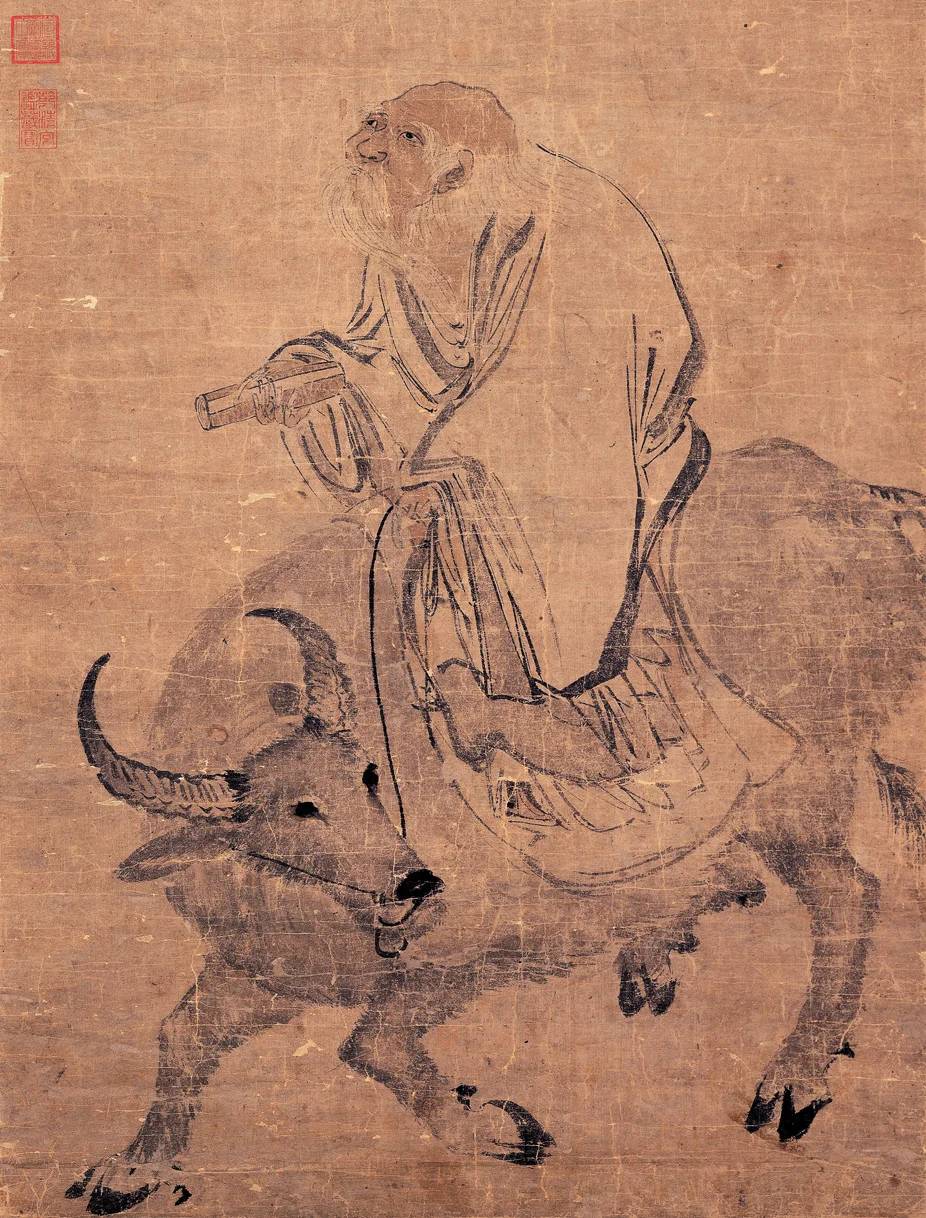
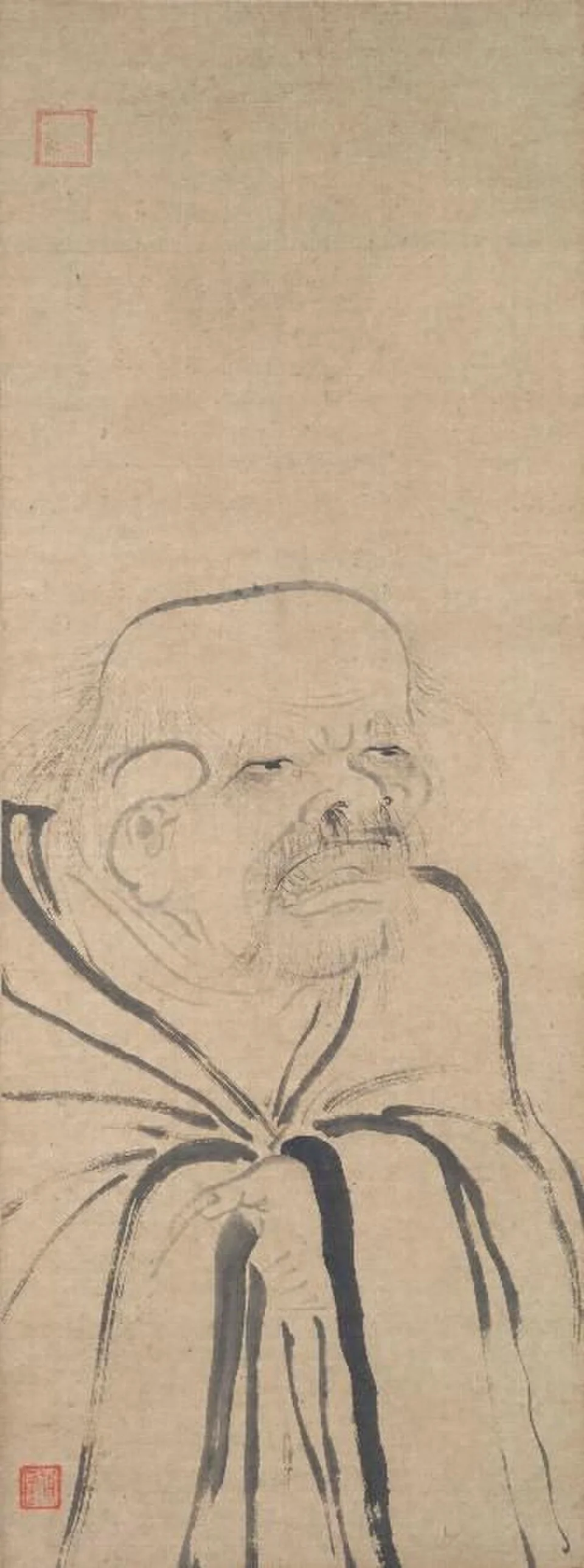
The name refers both to a traditionally remembered sage and to a text whose formation remains disputed. This guide follows the Daodejing's concrete images before comparing its claims with Brahman or applying them to sculpture. Later images of Laozi document reception, rather than providing a reliable likeness of an identifiable author. Stanford Encyclopedia of Philosophy
Begin with the space inside a vessel
Our exercise: look at a vessel and describe both the clay and the opening. Try to specify what the opening allows: holding, pouring, entry, light or a line of sight. Repeat with an open sculpture. This is a contemporary way of asking how solid material and absent material work together; it does not require accepting a metaphysical belief.
The historical starting point is unusually direct. Chapter 11 puts wheel, vessel and room side by side. Spokes and hub need an opening for the axle; a vessel's usefulness involves its hollow; doors and windows make a room usable. The examples do not argue that matter is worthless. They explain how what is present and what is absent contribute differently to the same capacity. Daodejing 11, James Legge translation
A timeline of the text rather than a fictional biography
- Traditional sixth century BCE: Laozi is remembered as an older contemporary of Confucius. Modern scholarship does not treat that dating as securely established. SEP, Laozi and the Daodejing
- Around 300 BCE: Bamboo manuscripts from the Guodian tomb contain material related to parts of the received text. The tomb was excavated in 1993. Internet Encyclopedia of Philosophy
- Before 168 BCE: The Mawangdui silk manuscripts were deposited in a tomb sealed by that date. Found in 1973, they place the De material before the Dao material. SEP, manuscript discoveries
- Around the first century BCE: Sima Qian's Shiji preserves a biography while also reporting competing identifications. IEP, the first biography
- Third century CE: Wang Bi's commentary becomes a central route for interpreting the text. SEP, commentarial traditions
- Nineteenth and twentieth centuries: Translations and reinterpretations bring the book to new readers, including Tolstoy and Ursula K. Le Guin. Jinyi Chu; Le Guin's introduction
Dao, de, wu wei and the uncarved block
Dao: a way beyond a fixed name
The opening chapter distinguishes the Dao that can be articulated from an enduring Dao. Names make distinctions available, but do not exhaust the process through which things arise. Chapter 25 describes something undifferentiated preceding heaven and earth and provisionally calls it Dao. The text therefore uses language while drawing attention to its limits. It does not simply replace every difficult question with the instruction to remain silent. Daodejing 1 and 25
Chapter 42 describes a progression from Dao through one, two and three to the myriad things, with yin and yang and their harmonising interaction. Its compressed wording has generated competing interpretations. Read alongside chapter 40's return and the relation between being and nonbeing, it supplies a cosmological vocabulary without giving the reader a mechanical creation story. The Daodejing's images invite interpretation, rather than a single diagram whose every label is self-evident. Daodejing 40 and 42; SEP, interpretive approaches
De is the way realised in a particular life
De is commonly translated as virtue, power or potency. It is not limited to a moral rule imposed from outside. In chapter 51, Dao generates and de nurtures, while things acquire their particular forms. The ideal of nurturing without possessing makes the relation practical: the sage supports processes without treating their results as private property. Translation choices matter because “virtue” can sound narrower in English than the text's range. Daodejing 51; SEP, Dao and de
Wu wei: acting without coercive interference
Wu wei is often rendered as nonaction. It does not require permanent physical inactivity. Chapter 37 connects it with the possibility that things transform of themselves; chapter 48 contrasts accumulating learning with reducing interference. The target is a kind of assertive, acquisitive doing that makes its own control the measure of success. Effective action need not always advertise the agent or multiply interventions. Daodejing 37 and 48
The political setting is essential. Chapters 17 and 57 imagine government whose success is not experienced as constant intrusion. Chapter 60 compares governing a large state with cooking a small fish, an image that makes excessive handling seem destructive. Reading wu wei only as a personal relaxation technique removes its argument about rule, incentives and the limits of imposed order. Daodejing 17, 57 and 60
Simplicity is a criticism of manufactured desire
The uncarved block, pu, evokes a condition before elaborate divisions and competitive display. Chapters 19 and 28 link simplicity with reduced desire and a return from fragmented roles. This does not mean that all learning, craft or distinction is mechanically prohibited. It gives the text a way to question what happens when rank, cleverness and possession become the organising ends of a life. Daodejing 19 and 28
Water supplies a complementary image. Chapter 8 praises its benefit to things and its willingness to occupy low places; chapter 78 contrasts softness with the power to overcome hardness. The point is neither sentimental gentleness nor a physics lesson. It is an argument against assuming that visible dominance, rigid resistance and elevated status always provide the strongest form of agency. Daodejing 8 and 78
Emptiness allows use and responsiveness
Emptiness has several functions across the text. Chapter 11 concerns useful openings; chapter 16 links stillness with observing return; chapter 4 imagines Dao as an inexhaustible vessel. These passages should not be collapsed into a single claim that nothing exists. They connect absence with capacity: a thing or a person may become less capable when every space is filled and every response predetermined. Daodejing 4, 11 and 16
Beauty and sculpture: more than a minimal appearance
Chapter 2 asks what happens when beauty is publicly recognised as beauty: its opposite becomes available too. This is a reflection on mutually dependent distinctions. It is not a straightforward instruction to stop making attractive things. Chapter 12 questions sensory excess through colours, sounds, flavours and the pursuit of rare goods. Read together, they unsettle the equation of visual stimulation with a well-ordered life. Daodejing 2 and 12
Chapter 41 places great form beyond ordinary shape and great sound beyond ordinary hearing, while chapter 45 describes great skill as apparently awkward. These paradoxes interrupt an easy equation between excellence and conspicuous finish. They do not specify an art movement, an architectural style or a ban on ornament. A later artist can develop their implications while remaining responsible for the new work's choices. Daodejing 41 and 45
There is a documented longer artistic history. Ieva Diemantaitė examines how ideas associated with Laozi and Zhuangzi were transformed in Chinese literati aesthetics, discussing writers including Zong Bing, Xie He, Su Shi and Shitao. Her emphasis on transformation is useful: landscape theory does not merely repeat the Daodejing. It develops a vocabulary of spontaneity, vitality, spirit, simplicity and emptiness for different artistic questions. Diemantaitė, Acta Orientalia Vilnensia
Our sculptural proposal starts with chapter 11. Make an opening whose shape changes as the viewer moves, so the surrounding room becomes part of the experience. Then remove one decorative addition and examine what capacity is gained or lost. This is a test of the relationship between material and space, not a rule that fewer elements always make a better work.
Our second proposal concerns wu wei. A sculptor might study the existing grain, balance or fracture of a material before deciding how much to alter it. Responsive making can require considerable skill and effort. Calling the process effortless would obscure that work; calling it receptive identifies the relation between intervention and what the material permits. This is our contemporary analogy, not a surviving craft instruction from Laozi.
What readers around the world say, and dispute
Chinese interpretation has never been a single voice. Wang Bi's commentary emphasises the relation of nonbeing, unity and the root; the Heshang Gong tradition gives a different weight to cultivation and government. Later religious communities also understood Laozi as a divine figure. These histories explain why the same short text can be approached as philosophy, political teaching, bodily cultivation or scripture without those approaches becoming interchangeable. SEP, major commentarial traditions
In Russia, Leo Tolstoy worked with English, French and German versions to render the Daodejing into Russian. Jinyi Chu argues that he constructed Laozi as an ally in debates about Christianity, modernisation and European civilisation. Tolstoy's response therefore belongs to a particular global translation network. It cannot stand in for the original author's intention, especially when that author remains historically uncertain. Chu, The Aphoristic Way
American writer Ursula K. Le Guin calls the book “funny, keen, kind, modest, indestructibly outrageous, and inexhaustibly refreshing.” Those words belong to Le Guin's introduction, not to Laozi. Her stated wish was to make a version accessible beyond the powerful male ruler foregrounded by many translations. The result is a literary interpretation informed by translation, not a claim that she could bypass Chinese philology. Le Guin, 1997 introduction and notes
The biography itself ends with an unusually open limit. In the account translated by the IEP, Sima Qian says, “No one knows where he ended his life.” The words belong to Sima Qian's biography, not to an anonymous modern sceptic. That admission sits beside the famous story of writing a book at the pass, reminding readers that the narrative already preserves uncertainty rather than offering an unbroken documentary life. IEP, Sima Qian's biography
The biographical dispute is equally consequential. Sima Qian reports Lao Dan, Lao Laizi and a grand historian Dan without resolving every identification. The buffalo ride and the writing of a book for the keeper of the western pass belong to a remembered narrative, not securely dated reportage. Modern scholars consequently debate whether the text grew through several contributors or reflects a more coherent authorship behind later compilation. IEP, biography and authorship
One short book, several textual histories
The received Daodejing has eighty-one chapters, conventionally divided into a Dao section, chapters 1 to 37, and a De section, chapters 38 to 81. The Mawangdui manuscripts reverse the order of those major divisions, while Guodian preserves only material corresponding to part of the received work. A translation can therefore differ because its base text differs, not only because its translator prefers different English words. IEP, textual versions
James Legge's public-domain translation offers a complete accessible starting text, but its nineteenth-century phrasing is interpretive. D. C. Lau, Philip J. Ivanhoe and Robert Henricks provide other scholarly entrances; Henricks's editions are particularly relevant to manuscript comparison. Le Guin's version has a different purpose and should be compared with a translation that explains its textual choices. This is our reading route, grounded in the available editions rather than a claim that one English voice finally settles the text. Legge; SEP bibliography
Zhang Lu, Laozi Riding an Ox, Ming dynasty
Mokkei or Muqi, thirteenth century
Dao and Brahman: a comparison with limits
Both Dao and Brahman can challenge the sufficiency of ordinary names and the isolation of familiar things. But the Daodejing does not teach the Upanishadic formula that the self is Brahman. Its characteristic vocabulary concerns the way, de, spontaneous unfolding, reversal and noncoercive action. Advaita develops a different argument about selfhood, knowledge and ignorance. A responsible comparison identifies those differences before asserting a shared ultimate doctrine. Laozi; Advaita Vedanta
The text also resists reduction to agreeable lifestyle advice. Chapter 80 imagines a small community with little travel and limited use of technologies; other chapters address warfare, rule and strategic weakness. Scholars disagree about how primitivist, political or mystical the whole should be read. Those difficult passages give the work historical and philosophical texture that disappears when every chapter becomes an instruction to relax. Daodejing 30, 31 and 80; SEP, modern approaches
Questions people ask about Laozi
What does Laozi mean by the Dao?
Dao names the way through which things arise and unfold, which no fixed description fully captures. The Daodejing uses images of source, mother, vessel and return to approach it. It is not presented as a personal creator issuing commands from outside the world, nor as a single visible object among the myriad things. Daodejing 1, 4, 25 and 40
What does wu wei mean in Laozi?
Wu wei is nonaction understood as acting without unnecessary coercion or self-assertive interference. It can involve responsive activity rather than literal immobility. Its political application questions government that continually imposes its own schemes, while its practical application asks whether doing less can let a process work better. Daodejing 17, 37, 48 and 57
Why are simplicity and emptiness important to Laozi?
Simplicity questions desires intensified by status, acquisition and elaborate distinctions. Emptiness can name a capacity: a vessel holds because it is hollow, and a room can be used because it has open space. These images connect restraint and receptivity without claiming that matter or skilled action has no value. Daodejing 11, 19 and 28
How does Laozi's Dao differ from Brahman?
The Dao belongs to an account of unfolding, de, reversal and noncoercive action; Brahman belongs to Upanishadic and Vedantic arguments about ultimate reality and selfhood. Both can be discussed through the limits of language, but the Daodejing does not teach the identity of Atman and Brahman. Similarity at that level does not establish equivalence between the traditions. Laozi; Advaita Vedanta
How can Laozi's simplicity be translated into sculpture?
Our proposal is to examine what each addition allows a work to do. An opening might make light and surrounding space active; a restrained intervention might disclose a material's structure. Test the relationships rather than assuming that a sparse appearance is automatically profound. These are contemporary artistic exercises inspired by the text, not historical prescriptions from Laozi.
Who was Laozi, and when did he live?
Laozi is the traditional sage associated with the Daodejing, often placed in the sixth century BCE. His historical identity and dates are uncertain. Manuscripts from Guodian and Mawangdui give firmer evidence for stages of textual transmission than the later biographical legends provide for one identifiable author's lifetime. SEP; IEP
Which Daodejing translation should I read first?
Our suggested route is one annotated scholarly translation, such as Lau or Ivanhoe, alongside the public-domain Legge text. Choose Henricks if you want to compare manuscript versions. Le Guin supplies a memorable literary response, but should not be treated as a substitute for information about Chinese terms and variant readings. Compare the same numbered chapter in more than one version. Translations bibliography; Legge
How has Laozi influenced writers and artists?
Chinese literati aesthetics transformed ideas associated with Laozi and Zhuangzi; Tolstoy translated and appropriated the Daodejing in Russia; Le Guin developed an English literary version in the United States. These are documented forms of reception with different historical aims. They do not prove that every later landscape, sparse sculpture or poem about silence derives directly from Laozi. Diemantaitė; Chu; Le Guin
Sources and image credits
Sources consulted on 26 October 2026. Each factual passage links to its evidence; looking exercises are marked as our interpretations. The captions link to the Commons file records and identify creators and rights. Images are local WebP conversions. Image provenance rechecked on 27 October 2026.