Thinkers / No. 012
Who was Pierre Teilhard de Chardin, and what is the Omega Point?
Pierre Teilhard de Chardin (1881 to 1955) was a French Jesuit priest, geologist and palaeontologist who worked on Peking Man in China and understood evolution as a movement from matter through life to reflective consciousness. His Omega Point is the ultimate convergence of consciousness and love in God: a union in which persons become more fully themselves instead of disappearing into a collective. Teilhard identified Omega with the cosmic Christ, a transcendent centre already active in creation. This is his Christian interpretation of evolution's meaning, not an established law of biology or a prediction of an AI singularity. American Teilhard Association, chronology; David Grumett, 2019
Teilhard's unusual instrument was the double attention of a fossil hunter and a priest. A tooth in a Chinese excavation belonged to the same world as a prayer. The earth was old, unfinished and capable of producing beings who could ask what the whole process meant. His most demanding question follows from that conjunction: can humanity grow closer together while each person becomes more fully a person?
Who was Teilhard de Chardin, and what happened in his life?
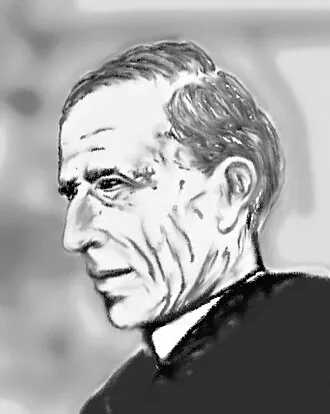
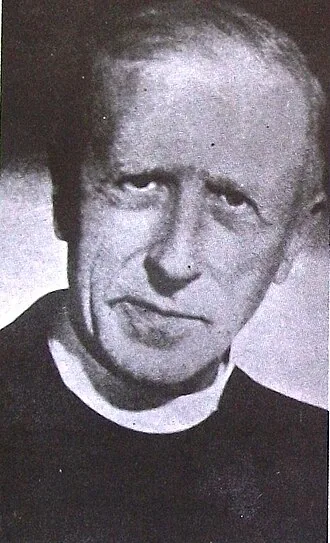
Teilhard de Chardin was a working scientist whose religious and philosophical manuscripts acquired their largest readership after his death. Born at Sarcenat, near Orcines in the French Auvergne, he entered the Jesuits, studied theology in England, trained with the palaeontologist Marcellin Boule in Paris and made China the centre of his scientific life. His professional subject was the history of the earth and its mammals; his larger subject was what it means to belong to an evolving world. Société géologique de France, biographical notice
- 1881: Born on 1 May at Sarcenat, in the commune of Orcines. ATA chronology
- 1899 to 1911: Enters the Jesuit novitiate in 1899, teaches physics and chemistry in Cairo from 1905 to 1908, and is ordained a priest at Hastings on 24 August 1911. ATA chronology; SGF
- 1912 to 1922: Studies under Boule, serves as a stretcher-bearer in the First World War, then completes a doctorate in natural sciences in Paris in 1922. SGF
- 1923 to 1924: Travels to China; explores the Ordos with Émile Licent in 1923 and undertakes a separate Gobi journey in 1924. Completes The Mass on the World during the first expedition. First China journey, with biographical references
- 1925 to 1926: Controversy over original sin costs him his teaching position in Paris; he returns to China. Biography, relations with Church authorities
- 1929: Becomes scientific adviser to the Geological Survey of China; works within the international research surrounding Zhoukoudian. ATA chronology, April 1929; Li-Chuan Tai, 2008
- 1931 to 1932: Participates in Citroën's Croisière Jaune, the Yellow Expedition across Asia. This is a later expedition, distinct from the Ordos journey. SGF
- 1938 to 1940: Writes the main text of Le Phénomène humain in Beijing; permission to publish remains withheld. Grumett, 2019
- 1950 to 1953: Elected to the French Académie des sciences in 1950; undertakes research visits to South Africa in 1951 and 1953 and spends his final years based in New York. SGF; Ursula King, 2018
- 1955 and 1959: Dies in New York on Easter Sunday, 10 April 1955. Le Phénomène humain appears in French later that year; Bernard Wall's English translation follows in 1959. ATA, death and burial; ATA bibliography
Teilhard stayed a Jesuit, accepted painful restrictions and continued scientific work while his religious manuscripts circulated privately. The posthumous publication depended on Jeanne Mortier, his literary executor, who could act without the obligations of religious obedience that bound him. The books arrived because someone survived to carry the papers into print. Grumett, publication history
Who helped Teilhard develop his ideas?
Teilhard developed his ideas through relationships and correspondence, including exchanges with his cousin Marguerite Teillard-Chambon, the American writer Ida Treat and the sculptor Lucile Swan. Marie Bayon de la Tour's 2016 account, published by the Teilhard Project in 2024, follows these women as intellectual and emotional presences in his life. Lucile Swan's attachment to Teilhard also made the demands of his celibate vocation painfully concrete. A thinker who wrote about love did not live outside the difficulty of loving particular people. Bayon de la Tour, Father Pierre Teilhard de Chardin and the Feminine
What did Teilhard mean by evolution and consciousness?
Teilhard understood evolution as the formation of increasingly organised wholes with increasingly developed inward lives. His law of complexity-consciousness associates richer organisation with richer consciousness. Complexity here means connected organisation, rather than a mere heap of parts. A living body matters because its parts participate in a coordinated whole. Teilhard extends that pattern from organisms towards persons and the relations among them. The Phenomenon of Man, Part I and Postscript
Teilhard's distinction between the outside and the inside of things carries the argument. The outside is what can be measured and described externally. The inside is the dimension of experience which, in human beings, is undeniable from within. Teilhard reasons backwards from human consciousness to an elementary interiority in the fabric of nature. That does not mean that a stone thinks like a person. It means that he refuses to make consciousness an inexplicable visitor to an otherwise wholly alien material universe. The Phenomenon of Man, The Within of Things
Teilhard also distinguishes tangential energy, the relations among elements at a given level, from radial energy, the movement towards greater inward concentration and organisation. These are terms in his synthesis; radial energy is not an additional physical force which a laboratory has measured. The difference between an illuminating pattern and an experimentally established law is one of the central disputes about his work. Mark D. Isaacs, 2009
How did Henri Bergson influence Teilhard?
Henri Bergson's Creative Evolution helped Teilhard conceive evolution as the history of an inward, creative life, not merely a rearrangement of external machinery. Huxley's introduction to The Phenomenon of Man records the formative reading. Bergson's vital impetus, the élan vital, branches into divergent possibilities; Bergson rejects a universe merely executing a programme prepared in advance. Teilhard gives evolution a convergent orientation towards Omega. Clément Vidal's 2021 comparison identifies this difference: the influence opened a question; it did not supply Teilhard's answer. Huxley, introduction; Bergson, Creative Evolution, chapters I and II; Vidal, 2021
Our reading: Teilhard insists that an account of nature must make room for the person giving it. The scientist looking into the microscope is also something nature has produced.
What is the noosphere?
The noosphere is Teilhard's name for the sphere of human thought, culture and collective reflection developing within and around the living earth. The word combines the Greek nous, mind, with sphere. The biosphere is the world of life; the noosphere is the living world's capacity to think, remember, invent and coordinate through human beings. A language, a scientific collaboration or a body of shared knowledge belongs to this sphere as surely as a communication network does. Teilhard, The Formation of the Noösphere, 1947
Teilhard's noosphere begins before electronic media. People inherit tools and stories, improve practices they did not invent, and contribute to knowledge no single person possesses. In his account, the planet's finite surface brings expanding human communities into increasingly close relations. Their connections can become a new level of organisation. Hominisation names the emergence of the human; noogenesis names the development of thought and its shared sphere. The Formation of the Noösphere, structure and anatomy
Did Teilhard invent the noosphere on his own?
The noosphere emerged from an exchange involving Teilhard, the French philosopher Édouard Le Roy and the Russian-Ukrainian geochemist Vladimir Vernadsky. In his 1945 essay, Vernadsky credited Le Roy's lectures of 1927 and Le Roy's collaboration with Teilhard. Vernadsky emphasised humanity's geological agency through organised thought and science; Teilhard emphasised consciousness, convergence and spiritual fulfilment. Vernadsky, The Biosphere and the Noösphere, American Scientist, 1945
Does a shared consciousness abolish individuality?
Teilhard's intended human unity preserves and intensifies personality. Cooperation that reduces a person to a replaceable component falls short of his highest form of union. Our reading: a network can join addresses while leaving their inhabitants profoundly alone. The ethical question is whether relations give people greater freedom to understand and answer one another. That is the relevant connection with the oneness of humanity, rather than a demand for everyone to think alike. Grumett, on the hyperpersonal
What is the Omega Point in simple terms?
The Omega Point is Teilhard's proposed ultimate unity of creation in God: the completion of evolution in consciousness and love. In simple terms, imagine people becoming more deeply connected while becoming more fully themselves. Extend that fulfilment beyond a community to the whole history of creation. Teilhard calls its personal, divine centre Omega, the final letter of the Greek alphabet. Isaacs, account of Omega
Teilhard's Omega is not merely an event waiting at the end of a calendar. A future produced entirely by a perishable universe would, he argues, be unable to secure the lasting value of persons and their achievements. Omega must therefore already be real and active as an attraction, while remaining beyond the process it brings to completion. In the vocabulary of The Phenomenon of Man, Omega is autonomous, actual, irreversible and transcendent. The argument joins a projected future to a divine presence; it is not a date calculation. The Phenomenon of Man, Part IV, The Attributes of the Omega Point
Is the Omega Point the same as the cosmic Christ?
Teilhard identifies Omega with Christ in his Christian synthesis. The cosmic Christ is the risen Jesus Christ understood as having significance for the whole creation, rather than for human souls considered in isolation. Teilhard draws especially on the New Testament's language of creation held together and brought to fulfilment in Christ. Cosmic expands the scope of Christ's relation to the world; it does not replace the historical Jesus with an anonymous field of intelligence. Isaacs, Christ and Omega
Teilhard's cosmic Christianity gives matter religious importance. The world is a place in which transformation can occur, and human work can participate in it. His synthesis nevertheless raises difficult theological questions: how divine gift relates to evolutionary development, whether redemption can be described through natural history, and how the cross and the suffering individual resist absorption into a triumphant story. Those questions explain why Christian readers disagree among themselves. Grumett, theological evaluation
How does Teilhard compare with Plotinus, Eckhart and Spinoza?
Teilhard's particular contribution to thinking about unity is its evolutionary direction. In our comparison, Plotinus asks how multiplicity depends on the One and returns to it; Meister Eckhart asks about the birth of the divine Word in the ground of the soul; Spinoza understands finite beings through God or Nature. Teilhard asks how an unfolding cosmos can be gathered into a personal fulfilment.
Our reading: the distinctive promise of Omega is belonging without disappearance. A choir needs actual voices. If the voices vanish, the increased volume of the whole is no achievement. Teilhard's claim is harder than the familiar wish that everything should become one: the union must make the persons within it more, rather than less, real.
What is The Phenomenon of Man about?
The Phenomenon of Man is Teilhard's sustained attempt to read the universe's material, biological and human history as one developing whole, culminating in the hypothesis of Omega. The French Le Phénomène humain appeared posthumously in 1955; Bernard Wall's English translation appeared in 1959 with an introduction by Julian Huxley. Sarah Appleton-Weber's translation, The Human Phenomenon, followed in 1999. The titles refer to the same central work, not to a sequel. American Teilhard Association, bibliography
- Before life: Teilhard considers matter as an interconnected, evolving fabric and proposes an inward dimension alongside external description.
- Life: Teilhard follows the organisation, diversification and increasing nervous complexity of living beings.
- Thought: Teilhard makes reflective awareness, the ability to know that one knows, a threshold in the history of life. Human culture develops a planetary dimension.
- The human future: Teilhard asks what can sustain cooperation, research and hope beyond isolated individual lives, and develops the personal convergence of Omega.
These are the book's movements, not an accepted scientific ladder on which every species occupies a lower rung than humanity. Read the transition between description and inference closely: an account of fossil succession is one kind of statement; an account of where the cosmos must ultimately go is another. Teilhard wanted to describe the human phenomenon in its entirety, but the reach of that description is precisely what his critics challenge. The Phenomenon of Man, contents and argument; Peter Medawar, Critical Notice, 1961
Our reading: keep a pencil beside the book's transitions. Mark where observation becomes inference, and where inference becomes faith. Those joints carry the weight of the whole.
What are The Divine Milieu and The Mass on the World?
The Divine Milieu is Teilhard's account of spiritual life within ordinary work, suffering and dependence. Written before The Phenomenon of Man, it appeared in French in 1957 and in English in 1960. Its subject is how a person inhabits the world: both what we do and what happens to us can enter a relationship with God. The spiritual book and the cosmic book illuminate each other, but have different points of entry. Harry James Cargas, EBSCO, The Divine Milieu; ATA bibliography
The Mass on the World is Teilhard's prayer offering the labour and suffering of the earth to God when, on an Asian expedition in 1923, he lacked the bread, wine and altar for an ordinary celebration of Mass. The landscape opens into a liturgical imagination: the world's activity becomes the material of an offering. This is a meditation, not a claim that physical scenery replaces the Catholic sacrament. First China journey and the prayer's opening
Our reading: the scene is the shortest route to the human being behind Omega. A priest stands in a dry landscape, unable to perform the rite as usual. Attention enlarges. Instead of finding a substitute object, he includes the waking earth and all the work about to begin. The reach is immense; the starting point is a lack.

Why did the Church silence Teilhard, and is the monitum still in force?
Church authorities restricted Teilhard because his evolutionary reinterpretation of Christian doctrines raised concerns about original sin, creation, redemption and the relation between nature and the supernatural. The conflict concerned more than accepting that species evolve. Teilhard was asking how the whole Christian story could be understood in an unfinished creation. The distinctions he drew did not satisfy his religious superiors. Biography, relationship with the Catholic Church; Grumett, 2019
What restrictions applied during Teilhard's lifetime?
Teilhard lost his teaching position in Paris amid the original-sin controversy in 1925 and was directed back towards scientific work in China. Permission to publish his main religious and philosophical synthesis was refused during his lifetime. His scientific papers, however, belong to a different publication history. Describing the situation as a ban on everything Teilhard wrote confuses his professional research with the writings that most troubled his superiors. Biography, publication restrictions; SGF, scientific career
What did the 1962 monitum actually say?
The Holy Office's monitum concerning Teilhard, dated 30 June 1962, was a warning about doctrinal ambiguities and errors in his works. It explicitly set aside judgement on questions belonging to the positive sciences and urged church leaders and educators to protect readers, particularly the young, from the dangers it identified. The document did not list specific book titles. It was issued after Teilhard's death, and therefore did not cause the restrictions he experienced while alive. Holy Office, monitum, text reproduced by EWTN
The monitum was a doctrinal warning, distinct from placing a named book on the Index of Forbidden Books. Mercè Prats's 2024 study of Holy Office archives documents an earlier decision, communicated on 3 January 1947, to refrain from placing Teilhard's writings on the Index. Publication restrictions, an Index entry and excommunication are different measures; none should stand in for the others. Prats, pages 149 to 150, including note 67
Has the Vatican formally withdrawn the warning?
The 1962 monitum has not been formally withdrawn in the official documentation located for this page, checked on 2 November 2026. In 1981 the Holy See explicitly said that a favourable centenary letter did not revise the warning. Later papal appreciation demonstrates a changed reception, but praise for a contribution is not the same action as formally rescinding a document. Holy See press-office clarification, 1981
Pope Francis's Laudato si' (2015), paragraph 83 and footnote 53, names Teilhard's contribution while describing creation's fulfilment in God through the risen Christ. The footnote also points to earlier contributions by Paul VI, John Paul II and Benedict XVI. Francis returned to Teilhard's Mass on the World during his homily in Ulaanbaatar on 3 September 2023. These are substantial acts of recognition. Neither text announces a withdrawal of the monitum. Laudato si', §83 and note 53; Francis, Mongolia homily, 2023
Our reading: Teilhard died without seeing his principal book published. Readers and popes returned because its question survived him: how can Christianity speak from within an evolving world? The distance between enforced silence and later citation belongs to the history of that question.
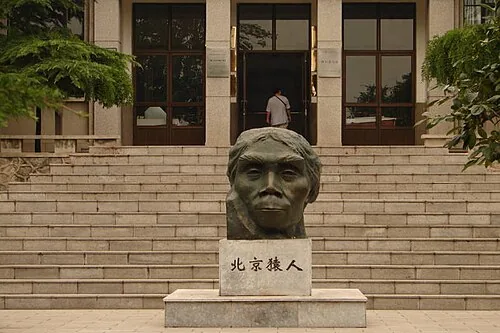
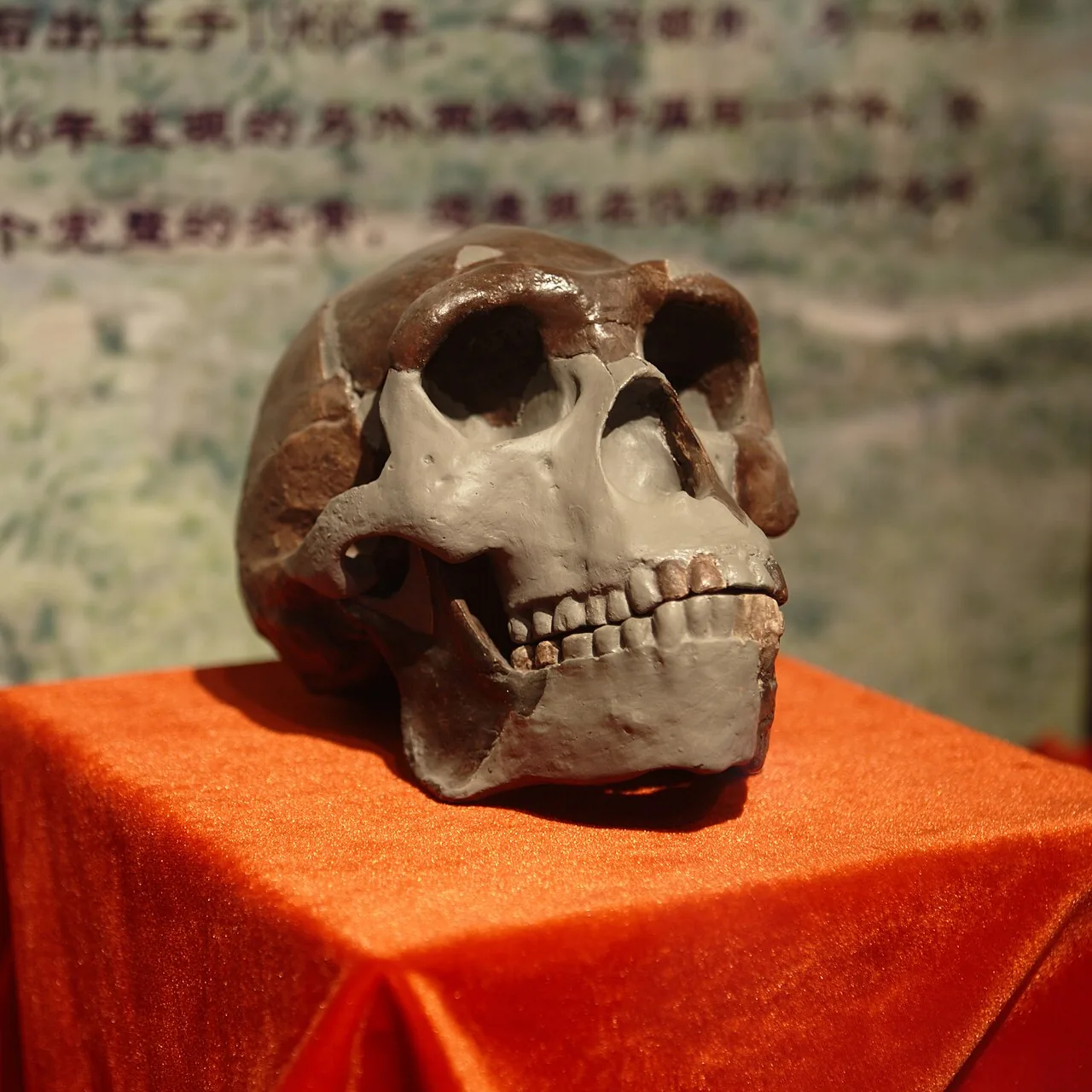
What was Teilhard's role in Peking Man?
Teilhard contributed geological and palaeontological expertise to the research at Zhoukoudian near Beijing; he did not personally discover the first Peking Man skullcap. The Chinese palaeontologist Pei Wenzhong found that skullcap on 2 December 1929. Peking Man is the historic name for the early human fossils now assigned to Homo erectus. Teilhard's contribution belongs within a Chinese and international research enterprise, rather than above it. Beijing Municipal Government, Peking Man account; Tai, 2008
Teilhard's expertise helped connect the fossils to their geological setting, the surrounding deposits and the wider history of Asian mammals and early humans. The name Choukoutien in older publications refers to Zhoukoudian. China's Geological Survey and its Cenozoic Research Laboratory, Chinese researchers including Pei and Jia Lanpo, excavators and international specialists together made the site scientifically legible. A fossil acquires its historical meaning through this accumulated work, not simply at the instant someone lifts it from the ground. UNESCO, Peking Man Site at Zhoukoudian; Tai, study of the adviser and his collaborators
Historian Li-Chuan Tai's 2008 study of Teilhard's correspondence distinguishes the early French museum mission from his later advisory work in China. Dependence on French patrons and reference collections gradually gave way to expertise grounded in Chinese fieldwork and relationships. China was a place where Teilhard learned, revised judgements and became a different kind of scientist. It was not an empty backdrop for a European discovery. Academia Sinica, Tai's article abstract
Was Teilhard involved in the Piltdown hoax?
Teilhard participated in excavations at Piltdown in England and found a canine tooth in 1913, but participation in the dig does not establish participation in the fraud. Piltdown Man was an artificial assemblage of human skull material and modified ape remains, exposed as a forgery in 1953. Teilhard's presence made him a suspect in later historical arguments; no demonstrated case establishes that he created the fake. Isabelle De Groote and colleagues, Royal Society Open Science, 2016
Stephen Jay Gould argued in 1980 that Teilhard and Charles Dawson had collaborated in a prank that escaped control. The case turned partly on apparent anomalies in Teilhard's recollections and correspondence. Antiquity's March 1981 editorial rejected that reading of the letters: confused memories decades later were not evidence of conspiracy. Peter Medawar, otherwise a severe critic of Teilhard, also rejected Gould's accusation in 1981. Georgetown University preserves Kenneth Oakley's letter of 4 August 1981 congratulating Mary and Ellen Lukas on evidence undermining Teilhard's alleged involvement. Oakley had helped expose the original forgery. Antiquity, editorial, 1981, pages 2 to 4; Medawar, Back to Evolution, 1981; Georgetown, Oakley letter
The 2016 investigation compared DNA, tooth morphology, staining, gravel packing and restoration methods. A consistent working method pointed towards Charles Dawson as the likely principal forger; possible accomplices remained unresolved. This is material evidence about manufacture, stronger than speculation about personality, but not a reconstruction of everyone's knowledge. Zhoukoudian yielded genuine evidence of human evolution; Piltdown shows how an anticipated story can seduce a scientific community. De Groote et al., results and discussion
Did Teilhard foresee the internet and AI?
Teilhard anticipated planetary communication and explicitly discussed electronic computers, but did not describe the internet's architecture or modern AI. In The Formation of the Noösphere (1947), he places radio and television beside computers that relieve mental drudgery and accelerate research. Their importance is cognitive: instruments alter what humanity can perceive, remember and investigate together. Clément Vidal's 2021 analysis draws the boundary precisely: Teilhard identified computers and networks but did not take the step of combining them. Teilhard, The Formation of the Noösphere, section C(b), 1947; Vidal, 2021
Jennifer Cobb Kreisberg's A Globe, Clothing Itself with a Brain, published by WIRED on 1 June 1995, presented Teilhard as a precursor of the Net. A named dissenter is the novelist and technology critic Bruce Sterling: his 2012 Essay on the New Aesthetic argues that calling the internet a noosphere can conceal its political problems beneath a poetic metaphor. The disagreement concerns what a connection accomplishes, not whether the cables exist. Kreisberg, 1995; Sterling, 2012
Is the Omega Point another name for the singularity?
Teilhard's Omega Point and a technological singularity answer different questions. A singularity concerns hypothetical changes brought about by machine intelligence or accelerating technological development. Teilhard's Omega concerns the transcendent fulfilment of persons and creation in Christ. Later writers borrow the term for secular or computational futures, as the Encyclopedia of Science Fiction documents. Those adaptations are part of his reception, not interchangeable definitions of his teaching. SFE, Omega Point
What would a Teilhardian question about AI actually be?
A Teilhardian question about AI would concern the quality of the human relations it enables. Our reading: translation, access to knowledge and help with coordination could deepen shared understanding; the same infrastructure could magnify coercion or conformity. A machine that joins databases has not thereby reconciled people. The measure is whether persons become more capable of meeting one another.
What are the strongest objections to Teilhard?
The strongest objections to Teilhard concern the evidence for evolutionary direction, the scientific status of his vocabulary, the place of suffering and the unequal human hierarchies in his own writings. Taking those objections seriously makes it possible to distinguish his achievements from the claims that remain unproved or objectionable.
What is orthogenesis, and does evolution have a direction?
Orthogenesis is the disputed idea of an inherent direction in evolution. Teilhard uses the word in The Phenomenon of Man for a sustained increase in organised complexity and consciousness. His footnote in Part II, chapter I explicitly defends this enlarged usage against biologists who wanted to discard the term. The issue is not whether individual lineages show trends, but whether those trends establish one necessary trajectory for life as a whole. The Phenomenon of Man, page 108 and note
Teilhard's trajectory towards Omega does not follow from natural selection, which explains adaptations without anticipating a spiritual destination. George Gaylord Simpson's 1974 assessment denied an innate tendency towards evolutionary progress or a single overall kind of progress. Peter Medawar's 1961 review challenged the evidential gap between Teilhard's scientific presentation and his conclusions. His words energy and force sharpen the problem when they move from measurable quantities to spiritual meaning without a testable mechanism. Simpson, The Concept of Progress in Organic Evolution, 1974, excerpt reproduced by Léo F. Laporte; Medawar, Mind, 1961, bibliographical record; Review passages reproduced in the biographical reference
Does Teilhard give suffering enough weight?
Teilhard's expansive account of cosmic fulfilment risks making an individual's suffering look like a necessary cost of the whole. His spiritual writings do address suffering and dependence, and his war service rules out a life untouched by catastrophe. Yet biographical courage cannot settle the philosophical problem: a promised final unity does not itself justify harm suffered along the way. Our reading: any humane use of Teilhard must keep the wounded person in view, rather than use Omega to step over that person. Cargas, The Divine Milieu; Grumett, critical theological assessment
What about Teilhard's racism and eugenics?
Teilhard's writings contain racist judgements and support for eugenic ideas which cannot honestly be omitted from an account of universal human unity. John P. Slattery's 2024 study in Horizons traces colonial paternalism, racial hierarchy and increasingly explicit eugenic commitments across his correspondence and essays. Slattery argues that the problem extends beyond isolated lapses. The charge concerns Teilhard's texts, not an assumption that every early twentieth-century scientist must have held identical views. Slattery, The Extent and Impact of Racism and Eugenics, 2024
Teilhard's defenders, including John Haught and Joshua Canzona, have disputed how representative some passages are and whether they should govern the interpretation of his whole project. Slattery's expanded study answers that debate with a wider survey. Our reading: contextualising a hierarchy is different from accepting it. A contemporary account of solidarity must affirm the equal worth of people whom Teilhard's own judgements sometimes failed to treat equally. Slattery, introduction and review of the debate
How does the world read Teilhard de Chardin?
Teilhard is read as an evolutionary visionary, a Christian mystic, an unreliable scientific theorist and a resource for ecological solidarity. His universalism also invites criticism from the people it claims to include. The disagreements cross continents and disciplines.
Why did evolutionary scientists disagree about Teilhard?
Julian Huxley's introduction to the English Phenomenon of Man (1959) welcomed the broad evolutionary frame without accepting supernatural Christianity. Peter Medawar's Mind review (1961) attacked its reasoning and scientific language. Two architects of evolutionary biology make the division still clearer:
- Theodosius Dobzhansky, the Ukrainian-born American geneticist, ends Nothing in Biology Makes Sense Except in the Light of Evolution (1973) by praising Teilhard's integration of Christian faith and evolution. He explicitly acknowledges disagreement with parts of Teilhard's teaching; admiration was not acceptance of the entire system. Dobzhansky, 1973, concluding paragraphs
- George Gaylord Simpson, the American palaeontologist, separates theology's possible validity from its scientific warrant in The Divine Non Sequitur (1973): Teilhard's theology follows neither from his fossil research nor from other premises acceptable as science. Simpson, 1973, original passage reproduced in Laporte's annotated bibliography
The fault line runs through evolutionary science itself: how much can a history of life establish about its meaning? Huxley and Dobzhansky found value in the enlarged frame; Simpson and Medawar resisted the authority claimed for the extrapolation. Huxley, introduction; Medawar, 1961
What does a Taiwanese historian change about the story?
Li-Chuan Tai, at Academia Sinica in Taiwan, used correspondence in her 2008 study to replace the solitary discoverer's story with an institutional and cross-cultural history. Teilhard's knowledge grew through local fieldwork, Chinese and international colleagues, changing funding relationships and competition among scientific institutions. This reading makes a practical difference: the ground on which his thought developed has a history and people of its own. Tai, A French Adviser in the Time of Choukoutien Archaeological Excavation, 2008
How do Teilhard and Sri Aurobindo compare?
Teilhard and Sri Aurobindo both place consciousness within a developing material world and treat human mentality as a stage rather than the last possibility. R. C. Zaehner made the comparison explicit in Evolution in Religion: A Study in Sri Aurobindo and Pierre Teilhard de Chardin (1971). Zaehner, bibliographical record and contents
Teilhard's language remains rooted in creation, incarnation and a personal Christ-Omega. Aurobindo's account describes consciousness involved in matter and its evolutionary emergence towards supramental transformation and divine life on earth. Both take matter seriously; their accounts of what matter is and how transformation occurs differ. Their similarities do not establish a single doctrine or direct intellectual dependence. Sri Aurobindo Ashram, basic principle of Integral Yoga; Isaacs, Teilhard's Christian synthesis
K. D. Sethna, the Indian writer associated with Pondicherry, challenged Zaehner's balance in The Spirituality of the Future (1981). The publisher's description and contents identify disputes over Aurobindo, Vedanta, pantheism and the comparison with Teilhard; the full book was unavailable for this page. A comparison made in Oxford was answered from India. Sethna, 1981, publisher's description and contents
How is Teilhard read in South African religious scholarship?
Ursula King, a British scholar writing in South Africa's Journal for the Study of Religion in 2018, places Teilhard's planetary humanity beside poverty, violence, ecological damage and the need for collaboration. She recalls his research visits to South Africa in 1951 and 1953, while acknowledging that his confidence in science and industrial development can appear excessively optimistic. Her concern is a spirituality capable of shared action in a damaged world. King, Teilhard de Chardin's Vision of Science, Religion and Planetary Humanity, 2018
What happened to Teilhard's ideas in Latin America?
Enrique Dussel, the Argentine philosopher later central to liberation philosophy, engaged Teilhard in writings dated 1964. Marcelo González's reconstruction places this encounter among Dussel's efforts to think Christianity and Latin American history together. González also discusses the Argentine priest Miguel Mascialino's encounter with Teilhard around 1960 as a rediscovery of the Christian message within history. The emphasis shifts from a cosmic endpoint towards historical responsibility. This reception is documented; it does not make Teilhard the author of liberation philosophy. González, La eclosión reflexiva en torno a 1964, in La explosión liberacionista en la filosofía latinoamericana
How did Teilhard influence art, literature and music?
Teilhard's ideas became material for painters, sculptors, novelists and composers. Alfred Manessier's oil painting Offrande de la Terre II ou l'Hommage à Teilhard de Chardin (1961 to 1962), in the Centre Pompidou collection, makes the homage explicit. Henry C. Setter's metal sculpture Omega Point, dedicated at the University of Dayton in September 1973, translates cosmic evolution into a public monument. Centre Pompidou, collection record; University of Dayton, Setter; Dayton archive, dedication
Flannery O'Connor borrowed Everything That Rises Must Converge for a story and collection; Don DeLillo's Point Omega (2010) turns towards exhaustion. In his interview with Thomas DePietro, DeLillo describes Richard Elster's attraction to Teilhard alongside the character's conviction that human consciousness is spent. This is a novelist testing what the vision becomes inside a damaged person. O'Connor's title and its source; DeLillo, interview, 1 February 2010
Edmund Rubbra's Symphony No. 8, Op. 132 bears the subtitle Hommage à Teilhard de Chardin, documented in Chandos's 2007 catalogue. Lucinda Cradduck's Spiritual Dimensions in the Music of Edmund Rubbra (2023) devotes a chapter to that homage. Chandos catalogue, Rubbra recordings; Cradduck, publisher's description and contents
Our reading: Teilhard's international life after death is a history of translations in the broadest sense. Scientists test his claims, Christians test his doctrine, Indian thinkers test the comparison, and Latin American readers ask what the future requires in history. The world's disagreements make his work larger to read, while making simple hero worship less defensible.
What are Teilhard's most famous quotes, and where do they really come from?
Teilhard's quotations need a work, an edition or a named intermediary: online repetition alone is not provenance. The short passages below have been checked in the linked texts. Ellipses indicate an excerpt; translation and editorial presentation matter.
Where does the quotation about discovering fire through love come from?
Teilhard's line includes the words “we shall harness for God the energies of love”. The source is The Evolution of Chastity (1934), collected in Toward the Future, volume XI, pages 86 to 87; the English volume appeared in 1975. The surrounding passage compares learning to direct love with humanity's discovery of fire. The linked reproduction supplies the wording but misdates the essay to 1936; Marie Bayon de la Tour's account supplies the 1934 date. Quoted text, reproduced in 2013; Bayon de la Tour, essay date; ATA, volume XI publication
Did Teilhard write about trusting the slow work of God?
Teilhard's passage begins: “Above all, trust in the slow work of God.” The text is reproduced by Loyola Press's Ignatian Spirituality under Patient Trust. It counsels patience with growth, uncertainty and the intermediate stages of becoming. Treat this online heading as the presentation of an extract, rather than assume it was a freestanding poem carrying that title in Teilhard's manuscripts. Patient Trust, text reproduced by Ignatian Spirituality
What does Teilhard actually say about love and union?
Teilhard writes: “Love alone is capable of uniting living beings”. The sentence continues by explaining that love joins beings through what is deepest in them and therefore fulfils them. The passage is in The Phenomenon of Man, Part IV, chapter II, section 2, Love as Energy, in Bernard Wall's translation. This is the conceptual setting for personal union, rather than a general assurance that any form of togetherness is good. The Phenomenon of Man, Love as Energy
Where does everything that rises must converge come from?
Teilhard uses the exact words “everything that rises must converge” in Faith in Man, an address to the French section of the World Congress of Faiths on 8 March 1947. The passage imagines Christians and Marxists discovering a shared confidence in humanity's future beneath their differences. Read in context, the phrase concerns the possibility of spiritual convergence, not a physical law about rising objects. The address was later collected in his essays on the human future. Faith in Man, concluding section and dated source note
Flannery O'Connor brought Teilhard's phrase into literature through Everything That Rises Must Converge, the title of her 1961 story and her posthumous 1965 collection. Collection, story and title history
Did Teilhard say that we are spiritual beings having a human experience?
The saying “We are not human beings having a spiritual experience; we are spiritual beings having a human experience” has no securely identified Teilhard source in the references checked here. Wikiquote traces competing 1993 attributions to Teilhard and G. I. Gurdjieff, neither supplied with an original source. This is an unresolved attribution, not a verified Teilhard quotation and not proof that Gurdjieff wrote it instead. Its popularity should not substitute for a work and passage. Wikiquote, disputed attribution and bibliographical leads
What is Frank Tipler's Omega Point theory, and how does it differ?
Frank Tipler's Omega Point theory is a speculative physical and computational cosmology, developed in The Physics of Immortality (1994), which reworks the name of Teilhard's spiritual destination. Tipler envisages intelligent life shaping the universe's future so that computational capacity approaches infinity near its final state, allowing the reconstruction of past persons as simulations. Teilhard's divine, personal fulfilment becomes, in Tipler, an argument involving cosmology, information processing and resurrection. Encyclopedia of Science Fiction, Tipler and Omega
- Teilhard: the key issue is creation's convergence in a transcendent Christ-Omega. Tipler: the key issue is a proposed cosmic history enabling effectively unlimited computation.
- Teilhard: personal fulfilment is described through love and spiritual union. Tipler: immortality is connected to the simulation or reconstruction of persons.
- Teilhard: theological and philosophical premises exceed empirical evolutionary biology. Tipler: claims presented through physics require physical scrutiny and do not become established results by borrowing theological names.
William R. Stoeger and South African cosmologist George F. R. Ellis examined Tipler's argument critically in their 1995 response. They challenged the transfer from a mathematical construction to divine personal attributes, and the assumption that a person can be captured and reconstructed as complete information. The scientific status of Tipler's proposal must be assessed through its own assumptions and inferences. Neither accepting nor rejecting that proposal settles Teilhard's theology, and a search result for Omega Point may concern either author. Stoeger and Ellis, A Response to Tipler's Omega-Point Theory, Science & Christian Belief, 1995
Which Teilhard book should I read first?
Our recommendation is to begin with The Mass on the World for Teilhard's voice, The Divine Milieu for the spiritual life, or The Human Phenomenon for the full evolutionary argument. Read for the question each book opens; agreement can wait.
- For a short encounter: The Mass on the World, collected in Hymn of the Universe. A concentrated instance of his movement from a physical landscape to a cosmic prayer. ATA bibliography, Hymn of the Universe
- For work, suffering and faith: The Divine Milieu. Begin here if the personal and spiritual problem interests you more than the proposed structure of cosmic history. Cargas, introduction to the book
- For the main argument: The Human Phenomenon, translated by Sarah Appleton-Weber (1999). Bernard Wall's The Phenomenon of Man (1959) remains historically important, especially for Huxley's introduction. Compare difficult terms rather than silently treating the translations as identical. ATA, editions and translations
- For the collective future: The Future of Man, a collection of essays, rather than a second version of the main book. Its texts develop noogenesis and the choices of an interdependent humanity. ATA, The Future of Man
Pair a section of Teilhard with Medawar's scientific objections, Grumett's theological assessment or Slattery's study of race and eugenics. Ask what a sentence claims, then what supports it. The pleasure of the writing need not carry the burden of proof.
Where is Pierre Teilhard de Chardin buried?
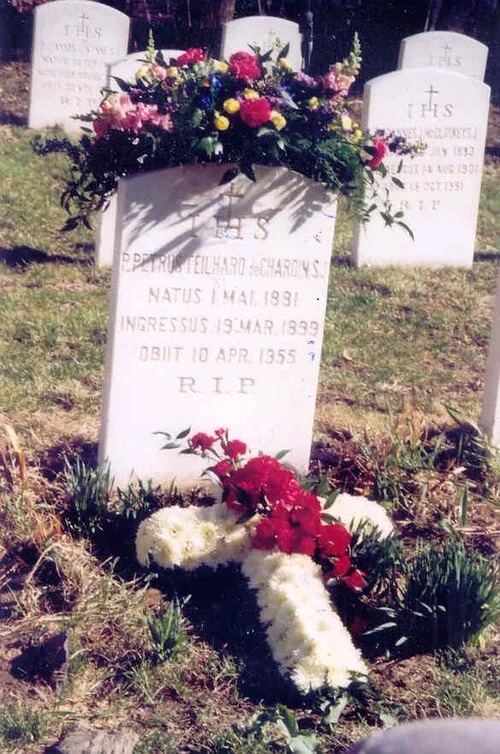
Teilhard de Chardin is buried in the Jesuit cemetery of the former St Andrew-on-Hudson novitiate, on the grounds now occupied by the Culinary Institute of America in Hyde Park, New York. The American Teilhard Association gives the campus address as 1946 Campus Drive and identifies the grave at the back left of the cemetery. Contact campus safety for access arrangements rather than assuming that a visit follows ordinary public cemetery hours. American Teilhard Association, grave and access information
Teilhard died in New York City on 10 April 1955, Easter Sunday. The burial site is up the Hudson, not in the city and not in France. Our reading: the modest stone is a fitting final correction to the scale of the books. The thinker who wrote towards the fulfilment of a universe occupies one place among other names. Nothing about the size of a question exempts a life from ending.

What else do readers ask about Teilhard?
Was Teilhard excommunicated?
Teilhard was not excommunicated; he remained a Jesuit priest despite restrictions on teaching and publication. Mercè Prats's study of the Holy Office archives distinguishes repeated accusations from a formal personal condemnation during his lifetime. The 1962 monitum concerned his writings and was issued after his death. Prats, 2024, pages 136 and 149; Monitum, 1962
Was Teilhard a pantheist?
Teilhard's identification of spiritual significance throughout matter can sound pantheistic, but his Christ-Omega transcends the evolutionary process. Reading God as simply identical with the sum of present things misses that feature. Critics nevertheless dispute whether his account adequately preserves the distinction between God and creation; the answer depends on examining the argument rather than applying a label to its most expansive sentence. Grumett, transcendence and theology
Is orthogenesis the same as evolution?
Orthogenesis adds a claim about evolution's direction; accepting evolution does not require accepting that claim. Teilhard's particular version connects increasing complexity with consciousness. The dispute with Simpson concerns whether local trends justify a necessary direction for the whole. The argument and its scientific objection; Teilhard, page 108; Simpson, progress in evolution, 1974
Did Teilhard give a date for the Omega Point?
Teilhard's Omega is not a dated forecast. The claim concerns the fulfilment and transcendent ground of evolution, not an appointment on a technological calendar. Dates proposed for AI breakthroughs cannot be attributed to Teilhard's concept simply because both discussions concern the future. The Phenomenon of Man, Part IV
Are The Human Phenomenon and The Phenomenon of Man different books?
The Human Phenomenon and The Phenomenon of Man are different English translations of Teilhard's Le Phénomène humain. Appleton-Weber's translation appeared in 1999; Wall's in 1959. Check the translator before following page numbers or comparing quoted wording. ATA bibliography
What remains of Teilhard's idea of love?
Teilhard makes love the energy through which union fulfils persons instead of consuming them. Our reading: the unfinished task is to learn how to direct that energy. More connections, information and power acquire a human purpose when they deepen attention, sustain cooperation and help one person answer another. Love becomes a direction we practise: power gathered into care, closeness that leaves room for a face. Humanity still has to learn what to do with the fire. The Phenomenon of Man, Love as Energy; The Evolution of Chastity, reproduced extract
Which sources and image licences support this page?
Sources consulted on 2 November 2026. Quotations were checked against the linked texts; the fire passage uses the named reproduction. Book previews and catalogue records are identified as such. Passages marked as our reading or our recommendation are editorial interpretation. This independent site has no affiliation with any religious tradition, church or organisation named here.
- Pierre Teilhard de Chardin, The Phenomenon of Man, translated by Bernard Wall. English translation first published 1959; digitised text. Consulted for vocabulary, the argument of Part IV, and the Love as Energy passage. Searchable OCR; OCR can contain errors.
- Teilhard, The Formation of the Noösphere: A Biological Interpretation of Human History. Essay dated 1947, later collected in The Future of Man; transcription in Religion Online’s The Future of Mankind.
- Teilhard, Faith in Man. Address of 8 March 1947, reproduced in Religion Online's The Future of Mankind. Source of the convergence quotation.
- Vladimir Vernadsky, The Biosphere and the Noösphere. American Scientist 33.1, 1945, pages 1 to 12; scanned article, including the term's intellectual history.
- David Grumett, Cult Books Revisited: Pierre Teilhard de Chardin's The Phenomenon of Man. Theology 122.6, 2019, pages 404 to 411. Peer-reviewed manuscript in the University of Edinburgh repository.
- Henri Bergson, Creative Evolution. Arthur Mitchell's English translation, 1911, reproduced by Project Gutenberg. Chapters I and II on finalism, invention and divergent evolution.
- Clément Vidal, Pierre Teilhard de Chardin: A Visionary in Controversy. History and Philosophy of the Life Sciences 43, article 125, 2021. Open scholarly analysis of Bergson, complexity-consciousness and the limits of the internet anticipation.
- Société géologique de France, Marie-Joseph-Pierre Teilhard de Chardin. French professional biography and scientific career.
- American Teilhard Association, Timeline. Life chronology.
- American Teilhard Association, Teilhard's Publications. Collected works, editions and correspondence.
- American Teilhard Association, Teilhard's Grave. Death, burial location and access guidance.
- First China Trip and Mass on the World, 1923 to 1924. Specialist biographical account identifying its print sources and reproducing the prayer's opening.
- Li-Chuan Tai, A French Adviser in the Time of Choukoutien Archaeological Excavation. Bulletin of the Institute of History and Philology, Academia Sinica, 79.1, March 2008, pages 95 to 161. Public abstract and article metadata consulted.
- Beijing Municipal Government, account of Peking Man. 2024; Pei Wenzhong and the first skullcap.
- UNESCO World Heritage Centre, Peking Man Site at Zhoukoudian. Site significance and research context; direct retrieval intermittently restricted.
- Isabelle De Groote and colleagues, New Genetic and Morphological Evidence Suggests a Single Hoaxer Created Piltdown Man. Royal Society Open Science 3, 2016, article 160328. Open full text.
- Holy Office monitum of 30 June 1962 and Holy See clarification of 1981. Document texts reproduced by EWTN.
- Mercè Prats, Pierre Teilhard de Chardin, cible insaisissable du Saint-Office (1931-50). Journal of Modern and Contemporary Christianity 3.1, 2024, pages 133 to 152. Original archival research published by Venice University Press; open full text. Personal condemnation and the decision against an Index entry, note 67.
- Pope Francis, Laudato si'. 24 May 2015, paragraph 83 and note 53, official English text.
- Pope Francis, homily at the Steppe Arena, Ulaanbaatar. 3 September 2023, official English text.
- Jennifer Cobb Kreisberg, A Globe, Clothing Itself with a Brain. WIRED, 1 June 1995; a documented instance of the internet interpretation.
- Bruce Sterling, An Essay on the New Aesthetic. WIRED, 2 April 2012. The author's objection to treating the internet as a noosphere.
- Theodosius Dobzhansky, Nothing in Biology Makes Sense Except in the Light of Evolution. The American Biology Teacher 35.3, 1973, pages 125 to 129; full-text reproduction. Concluding assessment of Teilhard.
- Léo F. Laporte, George Gaylord Simpson: Major Publications. University of California, Santa Cruz. Annotated bibliography reproducing Simpson's arguments in The Divine Non Sequitur (1973) and The Concept of Progress in Organic Evolution (1974).
- Antiquity, Editorial. Volume 55, issue 213, March 1981. Contemporary rebuttal of Gould's Piltdown accusation, including correspondence and recollections.
- Peter Medawar, Back to Evolution. The New York Review of Books, 19 February 1981. Medawar's own rejection of Gould's case against Teilhard.
- Georgetown University Library, Teilhard and the Science of Man. Exhibition catalogue describing Kenneth Oakley's letter to the Lukases, 4 August 1981.
- Peter Medawar, Critical Notice: The Phenomenon of Man. Mind 70.277, January 1961, pages 99 to 106. Bibliographical record; full review inaccessible through this record. Review passages checked in the biographical reference below; not quoted here.
- John P. Slattery, The Extent and Impact of Racism and Eugenics in the Writings of Pierre Teilhard de Chardin, S.J.. Horizons 51.1, June 2024, pages 33 to 71, published online 17 April 2024. Open scholarly article; includes the debate with Haught and Canzona.
- Ursula King, Teilhard de Chardin's Vision of Science, Religion and Planetary Humanity. Journal for the Study of Religion 31.1, Pretoria, 2018.
- R. C. Zaehner, Evolution in Religion: A Study in Sri Aurobindo and Pierre Teilhard de Chardin. Clarendon Press, 1971. Bibliographical record and partial contents.
- K. D. Sethna, The Spirituality of the Future. Fairleigh Dickinson University Press, 1981. Publisher's description and contents; full book not consulted.
- Sri Aurobindo Ashram, Integral Yoga. Primary institutional explanation of Aurobindo's account of consciousness and matter.
- Marcelo González, La eclosión reflexiva en torno a 1964. Chapter in La explosión liberacionista en la filosofía latinoamericana, edited with Luciano Maddonni. Dussel and the Argentine reception.
- Centre Pompidou, Alfred Manessier, Offrande de la Terre II ou l'Hommage à Teilhard de Chardin. Collection record, 1961 to 1962, oil on canvas.
- Nicole L. Craw, Icon on the Lawn. University of Dayton Magazine, 6 May 2026. Henry C. Setter's Omega Point; university archival record of the September 1973 dedication.
- Thomas DePietro, interview with Don DeLillo. Barnes & Noble Review, 1 February 2010. The author on Teilhard and Richard Elster in Point Omega.
- Chandos Catalogue 2007. Publisher's recording catalogue, preserved by Klassik.com; documents Rubbra's Eighth Symphony and its subtitle. Lucinda Cradduck, Spiritual Dimensions in the Music of Edmund Rubbra, 2023, publisher's description and chapter list.
- Harry James Cargas, The Divine Milieu. EBSCO Research Starters; literary overview and publication history.
- Teilhard.com, Harnessing the Energies of Love. 6 May 2013; reproduction with essay and volume reference.
- Marie Bayon de la Tour, Father Pierre Teilhard de Chardin and the Feminine. Address of 19 March 2016, published online 8 June 2024. Relationships, correspondence and the 1934 date of The Evolution of Chastity.
- Wikipedia, Everything That Rises Must Converge. O'Connor's story, collection and title history.
- Ignatian Spirituality, Patient Trust. Loyola Press reproduction of the passage beginning with trust in the slow work of God.
- Wikiquote, disputed Teilhard quotations. Attribution leads, not a substitute for a primary text.
- The Encyclopedia of Science Fiction, Omega Point. Entry updated 11 November 2018. Secular adaptations, speculative fiction and Frank Tipler.
- William R. Stoeger and George F. R. Ellis, A Response to Tipler's Omega-Point Theory. Science & Christian Belief 7.2, 1995, pages 163 to 172; scanned article.
- Wikipedia, Pierre Teilhard de Chardin. Secondary biographical cross-check and route to the scientific reception; consulted 2 November 2026.
- Images 01 to 07: the Yuma/Rama portrait (CC BY-SA 2.0 France); archival photograph (public domain); Summerton's Ordos landscape (CC BY-SA 3.0); Tirira's Zhoukoudian photograph (CC BY-SA 2.0); Yan Li's skull replica (CC BY-SA 3.0); Grentidez's gravestone (CC0); Ɱ's cemetery photograph (CC BY-SA 4.0). Commons API licence records checked; individual credits and licence links accompany each figure. WebP derivatives retain the respective source licences.
- Header abstraction, with an 800-pixel version, made for this page in 2026. © Piet Baudoin. No image of a book cover or a page from Teilhard's writings has been reproduced.