Teachers / No. 013
Who is Sadhguru and what does he teach?
Sadhguru, born Jagadish Vasudev in Mysore in 1957, is an Indian yoga teacher and the founder of the Isha Foundation, whose centre lies below the Velliangiri mountains near Coimbatore. He teaches yoga as union: the boundary between oneself and everything else can fall away, and that is to be experienced, not believed. He offers this as a learnable technique, above all through Inner Engineering and its daily breathing practice, Shambhavi Mahamudra Kriya. Around that teaching stand consecrated temples, mass campaigns for rivers and soil, and a long record of criticism and court cases.
A young man rides his motorcycle up a hill outside Mysore, sits on a rock, and comes down, by his own account, no longer sure where he ends. Everything Sadhguru has built since, from a brick dome to a steel face of Shiva and a movement of millions, rests on that report and on the promise that others can reach it too. This page follows what he teaches, what the studies and courts found, and how the world reads him.
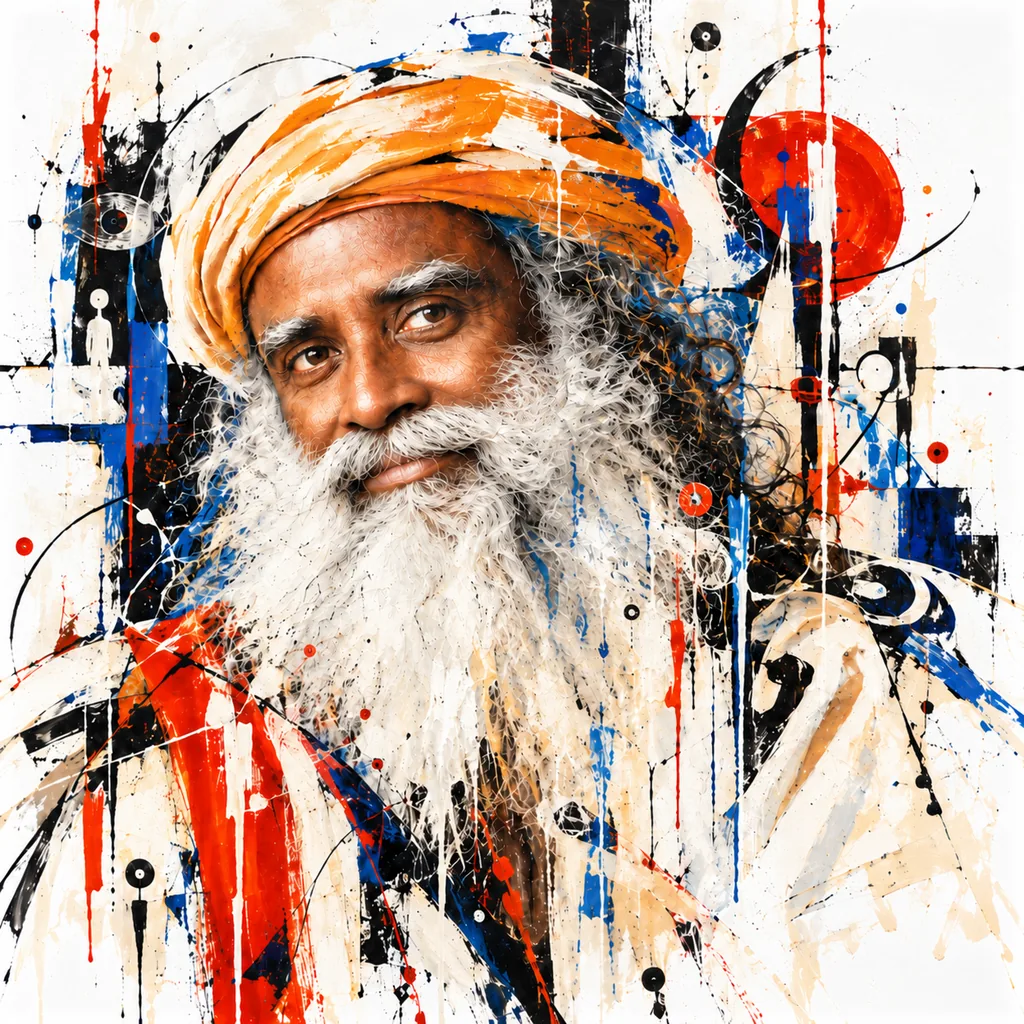
How did Jaggi Vasudev become Sadhguru?
He was born Jagadish Vasudev in Mysore on 3 September 1957, the youngest of five children of Susheela Vasudev and B. V. Vasudev, an ophthalmologist at the Mysuru Railway Hospital. He studied English literature at the University of Mysore. Isha’s own portrait of the young man is unsentimental: “a chronic truant and a boisterous prankster”, later “a lover of motorbikes and fast cars”, and “a young agnostic who became a yogi, a motorcyclist who became a mystic, and a skeptic who became a spiritual guide”. The phrasing is promotional, but it matters: the teacher presents himself as someone who did not start from a creed. [1] [2]
The yoga came early and from outside any temple. According to Arundhathi Subramaniam’s authorised biography, Sadhguru: More Than a Life (2013), the twelve- or thirteen-year-old Jaggi learned hatha yoga, postures and breathing, from Malladihalli Raghavendra Swamiji (1890 to 1996), a Kannada writer and teacher of yoga and Ayurveda who was then about eighty. The same source says Raghavendra had himself learned from a yogi named Palani Swami. That is the origin of a question people often type into search engines, “Was Palani Swami Sadhguru’s guru?”: on the evidence available, Palani Swami was the teacher of his first teacher. [3]
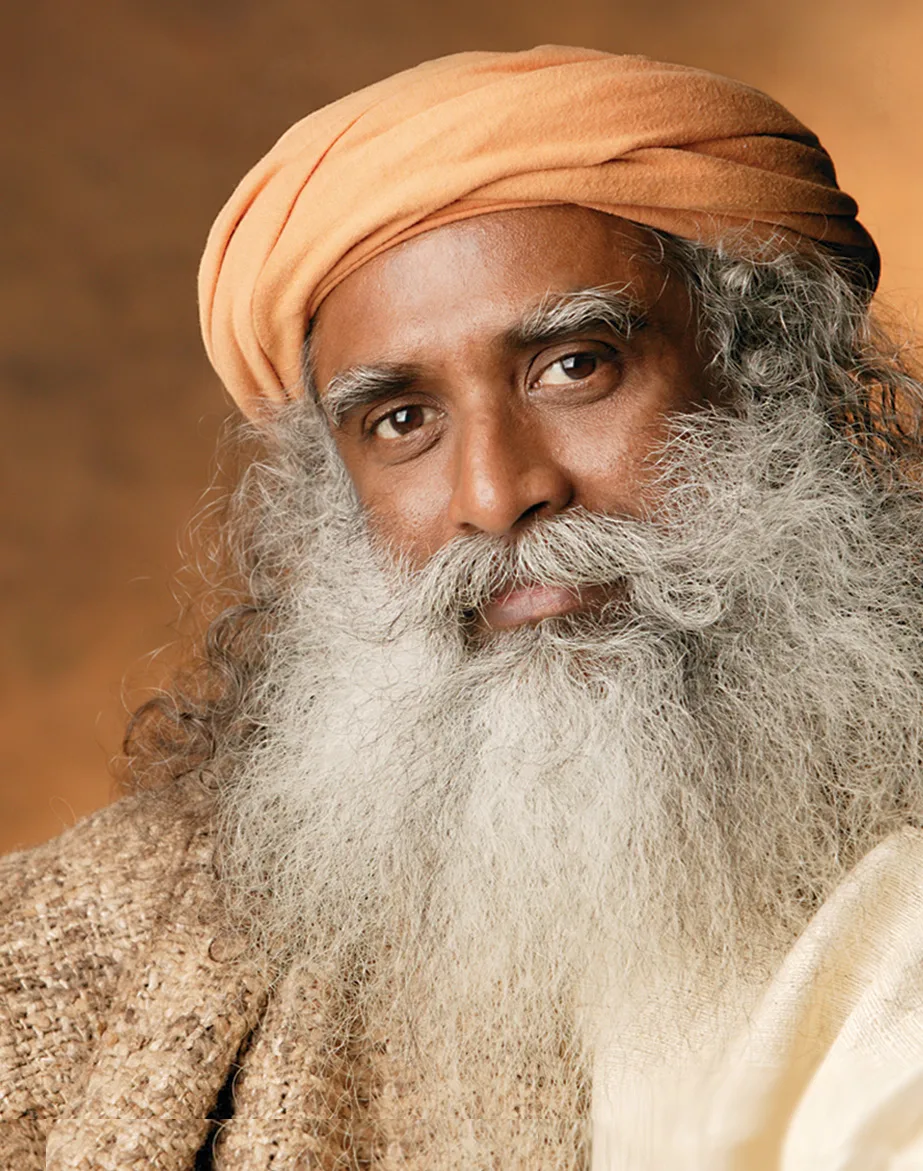
The rock on Chamundi Hill
Wikipedia, drawing on Shaili Chopra’s When I Was 25: The Leaders Look Back (Random House India, 2014) and on Cheryl Simone’s Midnights with the Mystic (2010), dates the turning point to 23 September 1982. Sadhguru’s own account, republished by Isha on 29 October 2026, gives the scene without the date. “One afternoon, I rode up Chamundi Hill in Mysore city”, he says, to “a huge rock which was my usual place”, and sat there “with my eyes open”. Then: “After a few minutes, I didn’t know where I was.” And then the sentence that the rest of his teaching unfolds: “for the first time I did not know what is me and what is not me. What was me was spread all over the place.” [1] [4]
He describes a mistake about time that anyone who has been absorbed will recognise in miniature. “I thought this madness lasted for 5 to 10 minutes but when I came back to my normal way of being, four-and-a-half hours had passed.” He describes tears, “to a point where my shirt was completely wet”, and “every cell in my body” bursting “with ecstasy”. The state returned; “once, this experience happened for 13 days”, and “in about six week’s time, it became like a living reality”. He was twenty-five. [4]
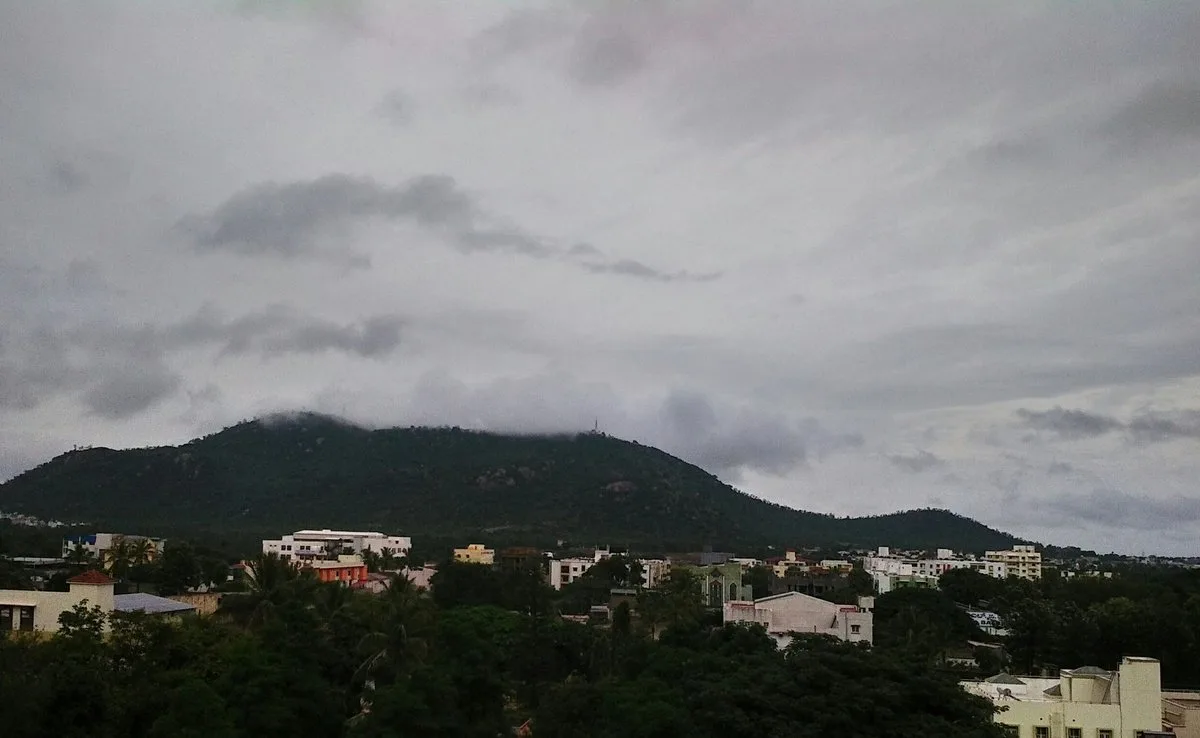
Nothing in that account can be checked from outside. What can be read is its grammar. There is no vision of a deity, no voice, no message to deliver. The content of the experience is a change in where the boundary of “me” falls. Keep that structure in mind, because his later definition of yoga is this afternoon turned into a method.
When did the line between you and what surrounds you last feel thin, and what made it so?
A teacher without a lineage
In 1983 he taught his first yoga class in Mysore. [1] Where his method came from is disputed. Sadhguru’s own explanation is not a chain of teachers but a single contact. He writes that his guru touched him with a stick, that “my physical proximity with my Guru was just for a few minutes”, and that in earlier lives he was known as Shivayogi and then “came back as Sadhguru Sri Brahma” to complete a temple his guru wanted built. “The most dominant factor of my life has been my Guru, and nothing else”, he said in a talk first published in July 2015. These are his claims about previous lives; no historical evidence bears on them either way. [5] [6]
Wikipedia’s article on the Isha Foundation, citing the religion scholar Joanne Punzo Waghorne (2013, p. 285), summarises Isha Yoga as a practice that “does not belong to a lineage”, a paramparā, and says its practitioners believe it is “based on the founding guru’s unique insight”. Wikipedia also records that the classes he gave from 1983, travelling by motorcycle, were “known as Sahaja Sthiti Yoga”. [1] [7]
A different origin has been reported. In Newslaundry on 18 May 2021 the journalist Prateek Goyal wrote: “Vasudev studied under Prabhakar in Gommatagiri near Mysore in 1984.” Rishi Prabhakar had devised Siddha Samadhi Yoga in 1974 in Bengaluru and “had studied under Maharishi Mahesh Yogi in Switzerland before returning to India”. An unnamed yoga teacher told Goyal: “Jaggi and I learned Siddha Samadhi Yoga from Rishi Prabhakar together at Gommatagiri near Mysore”, and “He met his wife there; she was a volunteer and trainee.” Subramanian Reddy, a Siddha Samadhi Yoga teacher, said: “Whatever Sadhguru teaches has been taken from Rishi Prabhakar’s courses.” The article states that “Isha Foundation could not be reached for comment.” The same training appears in a timeline that the blogger Vinaire published on 10 October 2020 after reading Subramaniam’s biography: for 1984 it lists “SSY teacher training under Guruji Rishi Prabhakar”, and for 1985 “Started a center under the direction of Guruji Rishi Prabhakar in Hyderabad”. The training under Prabhakar is thus reported by a named journalist, with named and unnamed witnesses, and repeated in a biographical timeline; the account that practitioners hold, above, speaks of his own insight, not of Prabhakar. [8] [63]
The name he chose answers the question in its own way. Isha published his explanation in October 2026: “The word ‘Sadhguru’ is not a title. It is a description. Sadhguru means ‘uneducated Guru.’” He calls himself “almost hundred percent spiritually uneducated” and says he has not read the Vedas. Whether one hears humility or a way of stepping beyond textual criticism depends on the listener. [9]
Vijji, Radhe and Isha
He married Vijaykumari, called Vijji, in 1984. Their only child, Radhe, was born in 1990; she married the classical singer Sandeep Narayan in 2014. In 1992 he founded the Isha Foundation, and in 1994 bought land near the Velliangiri mountains, some thirty kilometres west of Coimbatore, where the Isha Yoga Center opened that year. [1] [7] [10] [11]
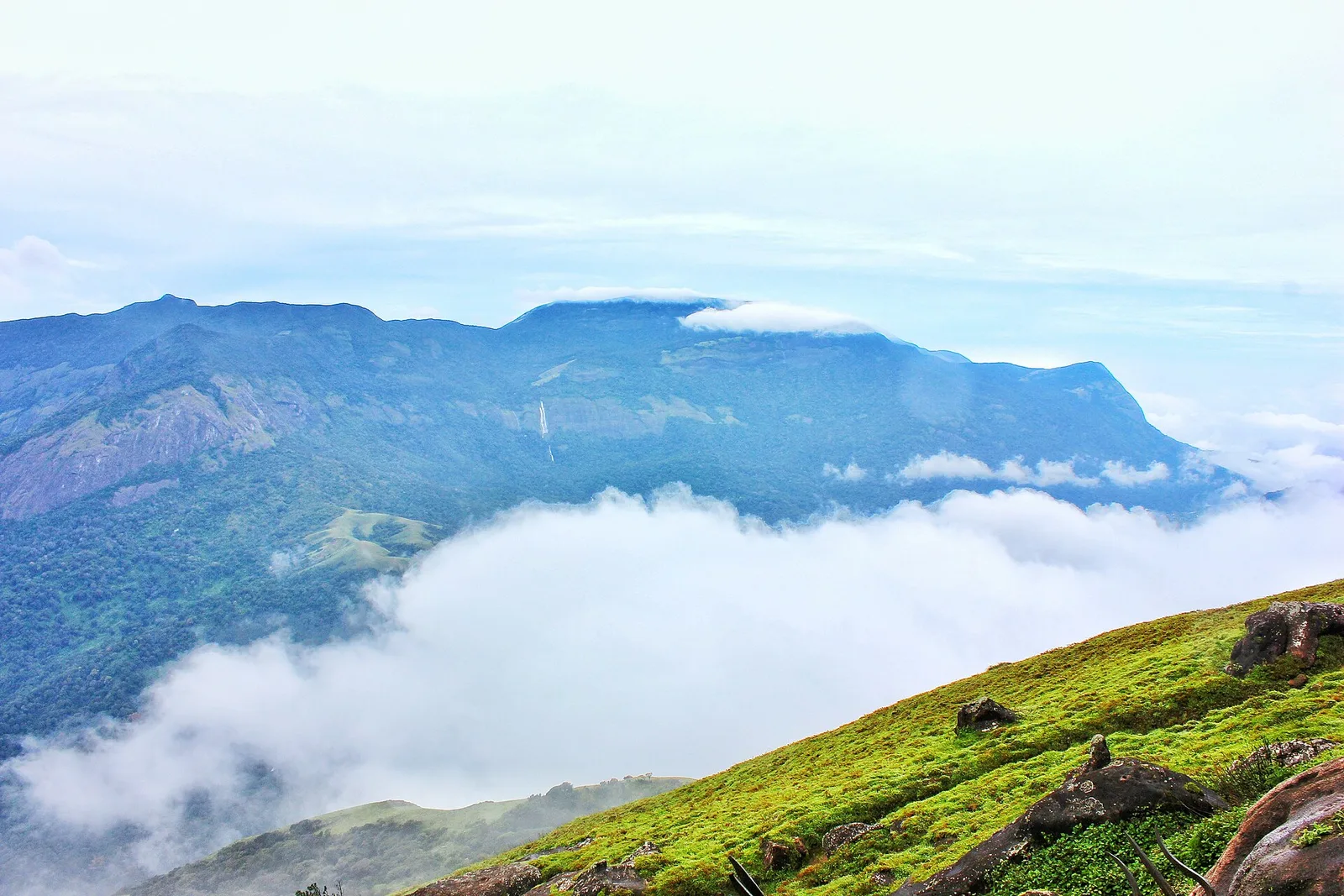
Vijji died on 23 January 1997. Isha dates a talk by Sadhguru to “two days after Vijji’s Mahasamadhi on Thaipoosam (the first full moon of Uttarayana), 1997”; Mahasamadhi is the yogic term for leaving the body consciously, and Isha writes that she died “without any effort and with a big smile on her face”. Wikipedia, citing the New Indian Express of 1997, records that her father filed a complaint alleging that Vasudev had killed her, and that the police later dismissed it. In March 2019 the head of the Congress party’s IT cell, Divya Spandana, raised the old allegation again; The Week headlined that Isha Foundation dismissed it as a “baseless charge”. Three accounts therefore stand side by side: a religious interpretation by the movement, an accusation by her father, and a police decision not to proceed. [1] [10] [12] [64]
Building, honours and reach
The next quarter century was mostly building: the Dhyanalinga in 1999, the Linga Bhairavi in 2010, the Adiyogi bust in 2017, and in the United States a 1,400-acre centre at McMinnville, Tennessee, whose Mahima meditation hall was consecrated on 7 November 2008. [13] [14] [15] [16]
In April 2017 President Pranab Mukherjee presented him with the Padma Vibhushan, India’s second-highest civilian honour. He has written more than thirty books, including three New York Times bestsellers: Inner Engineering: A Yogi’s Guide to Joy; Death; and Karma: A Yogi’s Guide to Crafting Your Destiny. He spoke at the World Economic Forum in 2007, 2017 and 2020, and in 2022 the Swiss public broadcaster SRF reported his visit to the forum in Davos, counting eight million Instagram followers. [1] [17]
What does Sadhguru mean by yoga as union?
Start with something you can do now. Close your eyes and rest one hand on the table. Without moving, try to feel exactly where your hand stops and the wood begins. You will find a zone of pressure and warmth, not a line. Then ask where you stop: at the skin, at the clothes, at the edge of the room you can hear? Sadhguru’s definition of yoga begins in that zone. “The individual experience of who you are has its basis on the boundaries of your sensation”, he says in an Isha talk published in January 2023. What lies inside the sensed boundary feels like me; what lies outside feels like the world. “Yoga is to expand the boundary of your sensation in such a way that you experience the whole universe as a part of yourself.” [18]
From there the definition is short. “The word ‘yoga’ literally means ‘union.’” And: “Everything becomes one. That is union.” He separates it from what most people picture when they hear the word: “Yoga is not about bending and twisting your body or holding your breath.” Instead “it is a mechanism and a technology to get you to that state of experience where you see reality just the way it is.” The argument has three steps: the self is a felt boundary; the boundary can be moved; when it falls away, what remains is unity, which he equates with seeing things as they are. The Chamundi afternoon, “What was me was spread all over the place”, is the first step taken all at once. [4] [18]
What the word can and cannot carry
The Sanskrit noun yoga comes from the verbal root yuj, “to attach, join, harness, yoke”. But the grammarian Pāṇini, in the fourth century BCE, listed two roots with that sound: yujir yoga, “to yoke”, and yuj samādhau, “to concentrate”. Edwin Bryant (2009) notes that traditional commentators read the Yoga Sutras with the second. The first use of the root, in Rigveda 5.81.1, is read as “yoke” or “control”. In other words, “union” is one legitimate sense of the word, not its only or its oldest technical meaning. The Katha Upanishad (6.10 to 11) calls yoga “firm restraint of the senses”; the Bhagavad Gita calls it equanimity in success and failure (2.48) and “skill in action” (2.50). [19]
Scholars who track the word note how far it travels. David Gordon White (2011) writes that “’Yoga’ has a wider range of meanings than nearly any other word in the entire Sanskrit lexicon.” Readings of yoga as union draw especially on the Gita and on Vedantic paths of knowledge. Sadhguru belongs to that family, with a twist that is his own: in his telling, union is not with a personal God, and it is reached not by devotion or study but by a technique applied to the body and its energies. [19]
The body as five elements
The technique starts lower than most Western readers expect. “The body is made of the five elements” or bhutas, earth, water, fire, air and space, he says in a talk published in May 2016, and “the cleansing of these elements, or bhuta shuddhi, is the fundamental process in yoga.” The logic is architectural. If the felt self is built from sensation, and sensation rides on the body, then a practice that reorganises the body’s elements and breath changes the raw material from which the boundary is made. Whether that is physiology or metaphor is precisely where his admirers and critics part. [20]
The entry point Isha offers to anyone is small: Isha Kriya, a “free guided meditation” of about twelve to fourteen minutes (the page gives both figures), which Isha says brings “health, dynamism, peace and wellbeing”. Those are Isha’s own claims. What the practice asks of the body is simple: sitting, breathing, and holding a thought about not being the body. It is the first rung of the same ladder that leads to Inner Engineering. [21]
Where does your sense of yourself end: at your skin, at your family, at your city, or somewhere you have never checked?
What happens in Inner Engineering and Shambhavi Mahamudra, and what do the studies show?
Isha calls Inner Engineering “a technology for wellbeing derived from the ancient science of yoga”. The word technology is chosen with care. Sadhguru defines technology plainly as “doing something the way it works”, and argues that there is one for inner wellbeing too. The promise is not belief, grace or a sudden gift. It is reproducibility: follow the procedure and, so the argument runs, the result follows. [22] [23]
What a participant actually does
The course comes in several formats, in person or as seven online classes followed by a short in-person session at which the central practice is transmitted. Isha calls that practice “the sacred Shambhavi Mahamudra Kriya, a 21-minute practice” and says it is “now practiced by millions worldwide”. Isha does not publish a full description; researchers do. [22]
A study published in Frontiers in Psychology in April 2022 describes the online route. The online lessons include “Upa Yoga (preparatory Hatha Yoga involving body movement and breathwork)”. The completion programme teaches Shambhavi Mahamudra Kriya, which “is performed for 21 min daily and includes multiple controlled breathing techniques (Pranayama), Aum chanting, and the engagement of bandhas (muscular locks in the abdomen and pelvic floor) applied for 15 min. The practice concludes with about 5 min of breath-watching meditation.” [24]
Picture it concretely. Before breakfast someone sits cross-legged on a folded blanket. For a quarter of an hour the breath is shaped in several patterns, the syllable Aum is sounded, and muscles at the base of the abdomen and pelvis are drawn in and held. Then, for five minutes, nothing is done except to watch breathing that is no longer being controlled. Nothing in it requires a belief. That is the point of calling it engineering.
Isha’s programme page lists what the practice is meant to deliver: to “reduce stress”, to “enhance focus, concentration & memory”, to “generate inner peace and fulfillment”, and also to “prevent chronic diseases like asthma, allergies, sinusitis, hypertension, diabetes, obesity”. The page cites no studies for these claims. [22]
Three studies, read slowly
The research record consists of observational studies, and their designs matter more than their headlines. The first, by Christine Tara Peterson, Sarah Bauer, Deepak Chopra, Paul Mills and Raj Maturi, appeared in the Journal of Evidence-Based Complementary & Alternative Medicine in 2017. It followed 142 people, mean age 43, who learned the practice at a three-day retreat and were asked to do it for 21 minutes a day for six weeks. Perceived stress fell and general wellbeing rose between baseline and follow-up. The abstract describes no control group. The paper discloses ties to the Chopra Foundation: Peterson was partly funded by it, Chopra founded it and Mills was its scientific director. [25]
The second is the 2022 Frontiers study from Beth Israel Deaconess Medical Center in Massachusetts, led by Preeti Upadhyay with Balachundhar Subramaniam as corresponding author. Of 375 people who expressed interest, 164 were eligible and 68 completed all three measurements; attrition between baseline and six weeks was 59 per cent. Median scores on the Perceived Stress Scale moved from 13.5 to 12 after the programme and from 11.5 to 8 between the end of the programme and six weeks later. The authors write that “the primary limitation of this study is its observational design” and call for a randomised trial. The baseline-to-post p-value appears as 0.0023 in the abstract and 0.19 in Table 2A, an inconsistency the paper does not resolve. [24]
The third, published in Frontiers in Psychology in February 2025 by Swaminathan and colleagues, followed participants for a year. Of 188 enrolled, 164 gave baseline data and 41 completed the year: a loss of 75 per cent from baseline, or 78 per cent from enrolment. The paper itself gives an attrition rate of 72 per cent, which its own counts do not bear out. Median perceived stress fell from 13 to 7 at six weeks and stayed at 7 at one year; the adjusted reduction was 5.1 points (95 per cent confidence interval 3.5 to 6.8). The authors state: “A limitation of this study is its lack of randomization.” Their affiliation is the Sadhguru Center for a Conscious Planet, and participants were recruited through Isha announcements. [26]
What do these numbers show? That people who choose, and often pay, to learn the practice, and who stay with a study for weeks or a year, report less stress afterwards than before. What they cannot show is that the practice caused the change. Three ordinary forces would produce some fall even if the practice were inert: people enrol when life is hard, and hard periods pass; people who invest time and money expect to benefit; and those who stay in a study are disproportionately those for whom it went well. A randomised trial against another breathing course of equal length and cost is the step the authors themselves call for. Until it exists, the honest summary is neither “proven” nor “debunked” but “promising self-reports from self-selected groups”. [24] [26]
What would convince you that a practice had changed you, rather than your hope that it would?
Engineering and transformation
Here we add our own reading. Sri Aurobindo opens The Synthesis of Yoga with a sentence that sounds like Sadhguru: “In the right view both of life and of Yoga all life is either consciously or subconsciously a Yoga.” He defines yoga as “a methodised effort towards self-perfection” and wants it to become “outwardly conterminous with life itself”; withdrawal from the world can never be its “whole and ultimate object”. Both reject yoga as an escape from life; they differ in the destination. Aurobindo aims to “reunite God and Nature in a liberated and perfected human life”, a transformation of life and even of matter. Sadhguru’s Inner Engineering aims at an inner state, wellbeing that does not depend on circumstances. One wants to change what the world is made of; the other wants to change how it feels to be in it. The first line continues on our page on Sri Aurobindo. [27]
Experience against belief: God, karma and conscious living
A sentence circulates online under his name: “I am not a believer, I am a seeker.” We could not find it verbatim in any source we opened. What he did say, to Bobby Naqvi of Gulf News in 2018, is close and more interesting. “We don’t believe anything”, he said of the Indian tradition as he sees it. “We are seekers.” And: “Belief is something that is made up by somebody and all of us adhere to it.” A seeker is someone who has “consciously admitted that we don’t know and we are seeking.” [28]
The line he draws is unusual. Most debates about religion run along one axis: does God exist, yes or no. Sadhguru turns the axis by ninety degrees. In an Isha article titled “Can I live life without God?” (republished February 2024) he says that, in the usual case, “there is only belief, and what you believe is just social and cultural.” He then redefines the word rather than denying it: “Whatever the source of creation is, that is what God is.” The live question becomes whether one is in contact with that source: “You can either be in access or not in access to God.” And the practical consequence: “if you are aware, conscious and in direct contact with the source of creation, you would live absolutely well.” [29]
Does Sadhguru believe in God?
On his own terms, he does not answer the question as asked, and says so. In a piece first printed in Isha’s magazine Forest Flower in August 2017, he is asked whether he has experienced God. “I know this piece of life in its entirety, from its origin to its ultimate. And that is all I know.” Then: “If I talk about myself, some people think I’m talking about God. These are all their interpretations.” And: “I’m only talking about myself.” The answer is neither the theist’s yes nor the atheist’s no. It is a claim to knowledge of the self so complete that, in his phrase from another talk, “if you know this piece of life, you know everything that is worth knowing in this cosmos.” [9] [30]
Take an example from the floor beneath you. You do not believe the floor will hold you; you stand on it, and your weight is the test. Sadhguru wants the question of the divine to be like that: a matter of standing, not of assent. The image has a consequence. An experience of “access” is available only to the one who has it. A teacher who reports it cannot show it; a student who has not had it cannot check it. The demand to trust experience over belief therefore ends, for most people at the beginning, in trusting someone else’s report of experience. Whether that differs from belief, each reader must settle.
Which of your firmest convictions have you tested in your own experience, and which did you receive from people you trust?
Karma as memory
Karma, in popular use, means moral bookkeeping: good deeds earn good outcomes, bad deeds bad ones. Sadhguru strips the idea of judge and ledger. “Karma means memory”, he says in a 2022 Inner Engineering text, “action and memory”. “Past action exists only in the form of memory”, and that memory is not only in the mind: “every cell in the body carries its own memory.” Karma, in this reading, is not punishment from outside but a pattern carried inside. [31]
Watch it happen in a small scene. A driver cuts in front of you. Before any thought, the jaw tightens, the hand moves to the horn, words arrive. None of that was decided. It was the past arriving early, the accumulated memory of many such moments running its program. That is karma in Sadhguru’s sense. The opposite is not virtue but freedom: the moment, however short, in which the old pattern is noticed and something else becomes possible.
What conscious living means
“Responsibility means your ability to respond”, he is quoted as saying in a Gulf News preview of a Dubai event, written by Suchitra Bajpai Chaudhary in November 2018. It does not mean “accepting blame for things you have done or not done.” The definition moves responsibility from the past to the present. In an Isha article republished in 2024 he presses the point harder: “stress is your creation”, and “right now your mind is the boss and you are the slave.” “The source of happiness is within you but right now, the stimulus is outside.” [23] [32]
Put these together and conscious living has a precise meaning in his vocabulary. It is the replacement of compulsive reaction, karma as memory acting on its own, by response chosen in the moment. Inner Engineering is the method; responsibility is the stance; unity is the horizon, because a person who experiences the world as part of himself has, in his argument, no reason to react against it. “Unless you do the right things within yourself, the right things will not happen.” [23]
“Conscious” in this usage does not mean “ethically informed”, nor intellectual reflection. It means a quality of presence in action. The test is not what you think about the driver who cut in, but whether the hand reached the horn before you did.
Which reaction of yours today was a choice, and which was a memory acting on its own?
Shiva as Adiyogi, Patanjali, and “tat tvam asi”
Sadhguru places the origin of yoga not in a book but in a person. “In the yogic culture, Shiva is not known as a god, but as the Adiyogi or the first yogi”, he says in an Isha article of February 2024. In his telling, “over fifteen thousand years ago” Shiva attained enlightenment; seven people prepared themselves for eighty-four years to receive his teaching; and “on the banks of Kanti Sarovar, a lake that lies a few kilometers above Kedarnath”, he transmitted it to them. They became “the seven celebrated sages who are today known as the Saptarishis”, each carrying one aspect of yoga, and the day “the Adiyogi transformed himself into the Adi Guru”, the first teacher, is “today known as Guru Purnima.” [33]
He calls this yogic lore, and it should be read as lore: a story of origin, not a historical record. It makes yoga older than every text and religion, and so the property of none. It makes Shiva a human being who discovered something rather than a god to be worshipped. The 34-metre Adiyogi bust is this story in steel. Its height, says Wikipedia, “symbolizes the 112 possibilities to attain to moksha”, liberation, and also the 112 chakras that, in this system, the human body is said to have. [15] [33]
Patanjali: stillness, not union
The text most often called the classical source of yoga says something different. The Yoga Sutras attributed to Patanjali are dated by Philipp Maas to about 400 CE; others place them in the first or second century. Sutra 1.2 reads yogaś citta-vṛtti-nirodhaḥ: “Yoga is the restriction of the fluctuations of mindstuff”, in the translation of Woods, or “the inhibition of the modifications of the mind” in Taimni’s. Sutra 1.3 follows: “Then the Seer is established in his own essential and fundamental nature.” [34]
The metaphysics underneath is the decisive point. Patanjali’s system inherits from Sāṃkhya a dualism of puruṣa, pure consciousness, the witness, and prakṛti, everything else, including mind, emotion and matter. The name of the goal is kaivalya, usually translated “isolation”: the Seer no longer disturbed by the movements of the mind. Here yoga is not the joining of the self with everything. It is the unhooking of the self from everything it is not. [34]
So the two pictures pull in opposite directions. In Sadhguru’s, the boundary of the self expands until it includes the universe: “Everything becomes one.” In Patanjali’s, the self withdraws its false identification with the world until it stands alone in its own nature. Sadhguru’s “union” belongs, in our reading, to a different line, closer to the non-dual readings of Vedanta and to the Shaiva and hatha traditions; a fourteenth-century hatha text such as the Yogabīja already speaks of yoga as the union of inner currents. When Sadhguru says that yoga “literally” means union, he is choosing one of the word’s histories, a respectable one, and presenting it as the only one. [18] [19] [34]
“Tat tvam asi” laid beside his words
In the sixth chapter of the Chāndogya Upanishad, the teacher Uddālaka Āruṇi instructs his son Śvetaketu through a series of lessons. At 6.12 he has him split the fruit of a banyan tree, then one of its tiny seeds, and asks what he sees. Nothing, says the son. That finest essence you cannot see, says the father, is what the great tree stands on. Then comes the refrain, which closes each lesson from 6.8 onward. In Joel Brereton’s transliteration: sa ya eṣo ‘ṇimaitadātmyam idaṃ sarvaṃ tat satyaṃ sa ātmā tat tvam asi śvetaketo iti. R. E. Hume’s translation (1931), which Brereton calls typical: “That which is the finest essence, this whole world has that as its soul. That is Reality (satya). That is Ātman (Soul). That art thou, Śvetaketu.” The whole teaching is on our page on Uddalaka Aruni. [35] [36]
Brereton, writing in the Zeitschrift der Deutschen Morgenländischen Gesellschaft in 1986, noticed a grammatical problem the famous translation hides. In “tat tvam asi”, tat is neuter, while tvam, “you”, here refers to a man, and the “finest essence” (aṇimā) is masculine. If the sentence meant “you are that finest essence”, Vedic usage would require sa tvam asi. His solution: tat is used adverbially, as it often is in Vedic prose, meaning “in that way”. He translates: “That which is this finest essence, that the whole world has as its self. That is the truth. That is the self. In that way are you, Śvetaketu.” Patrick Olivelle’s translation (2008) follows him: “And that’s how you are, Śvetaketu”; so does Wendy Doniger (2010). Lipner (2000) notes that Brereton concedes “That you are” remains possible. [35] [36]
The difference is not pedantry. “You are that” asserts identity; “in that way are you” asserts a likeness of condition: as the tree stands on an invisible essence, so does he. Adi Shankara, the Advaita teacher usually placed in the eighth century, read the refrain as identity, and as a sentence that does work: “Through such sentences as ‘Thou art That’ one knows one’s own Atman, the Witness of all the internal organs”, he writes in the Upadeśasāhasrī. Madhva, the dualist, read the same syllables as atat tvam asi, “you are not that”. See also our page on Adi Shankara. [36]
We found no talk or text in which Sadhguru comments on tat tvam asi. What follows is our comparison, not his position. His Chamundi report, “what was me was spread all over the place”, sounds like Shankara’s identity reading lived as an event: the boundary falls and the self is everything. But three differences remain. First, the Upanishad states a fact about Śvetaketu that is true whether or not he feels it; the banyan stands on its essence whether anyone splits the seed. Sadhguru’s yoga aims at the experience, and treats unexperienced truth as mere belief. Second, Uddālaka teaches by argument and example, and for Shankara the sentence itself, rightly heard, is the means of knowing. Sadhguru distrusts sentences and offers a technique of body and breath. Third, Brereton’s “in that way are you” makes the refrain a comparison rather than a dissolution of the looker, closer to the quiet breath-watching at the end of Shambhavi than to the ecstasy on the rock. [4] [35]
Say both versions to yourself: “you are that” and “in that way are you”. Which one changes how you see the person next to you?
The Dhyanalinga, Linga Bhairavi and Adiyogi: places and their art
Isha’s campus at the foot of the Velliangiri hills is the clearest statement of what Sadhguru thinks a sacred space should do, and it makes three different statements at once. Walk from the gate and you pass a stone column covered in other people’s symbols, enter a dark dome around a black stone, cross to a triangular shrine where a goddess receives offerings, and end beneath a colossal steel face against the mountains. Silence, devotion and spectacle: each space proposes a different relation between a person and what is larger than him.
The Dhyanalinga: a room that asks nothing
The Dhyanalinga was consecrated on 24 June 1999; Isha marked “27 years of Dhyanalinga Consecration Day” on 24 June 2026. Sadhguru calls it “the mission of three lifetimes”, the temple his guru wanted. The consecration “took over three years of very intense work” and, Isha writes, was left incomplete at one stage when Vijji died in January 1997. [2] [5] [12] [13]
What it asks of visitors is almost nothing. “The Dhyanalinga requires no pooja, prayer or worship”, Isha states; it is “a profound meditative space that does not subscribe to any particular belief or faith”. Visitors are asked to sit, gaze at the linga, close their eyes and “stay for at least 15 minutes”. The object is a black granite linga in which, Isha says, “the energies of all seven chakras are raised to the peak and locked to prevent dissipation over time.” Twice a day, from 11:50 to 12:10 and from 17:50 to 18:10, there is Nada Aradhana, “an offering of sound”. [13]
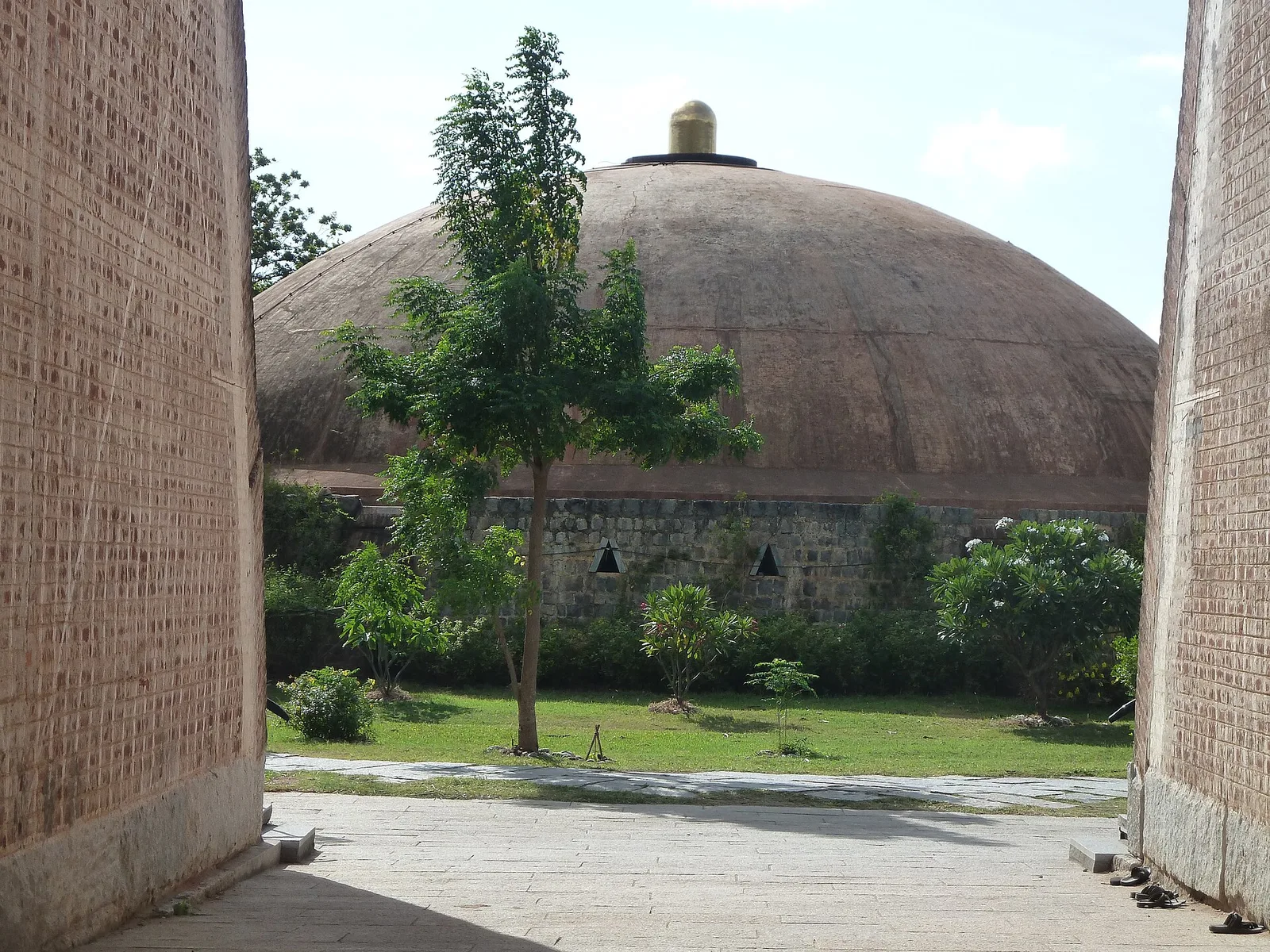
A dome in compression
The building around it is a piece of engineering worth reading closely, because its two descriptions disagree. Isha’s account, published in 2017, says the dome is “33 feet in height and 76 feet in diameter” and “stands without a single pillar of support”; that it “is made of 250,000 bricks and weighs about 700 tons”; and that building it “without the use of any steel, concrete, or cement was the whole challenge”. It is “a section of an ellipse” because “a linga is also an ellipsoid”, and “a nine-foot hole” at the top lets hot air out. [37]
The Auroville Earth Institute, which designed the dome, gives the engineer’s version. Work started on 21 November 1998 and “the dome was completed 9 weeks later, the 31st January 1999”. The section is “a segmental ellipse of 22.16 m diameter and 7,90 m rise”; “around 214,000 fired bricks were laid”; the weight is “around 570 tons”, of which about 150 tons is granite placed on the haunches. “No reinforce concrete had been used in any part of the building”, and the stability was studied “in order to have only compression forces”. But the mortar was a stabilised earth mortar, “over stabilised” at “13 to 13.37% of cement and 19% of lime”. [38]
So the reader holds two texts. The figures differ (214,000 bricks or 250,000; 570 tons or 700), and the claim of “no cement” meets an engineer’s mix that contains a little of it in the joints. Both agree on what matters structurally: no steel, no reinforced concrete, a shape chosen so that every brick is pressed, never pulled. This places the Dhyanalinga in the family of the Roman Pantheon, which Wikipedia still calls “the world’s largest unreinforced concrete dome”, 43 metres across. Nearly nineteen centuries apart, both buildings solve the same problem the same way, and both leave an opening at the crown. [37] [38] [39]
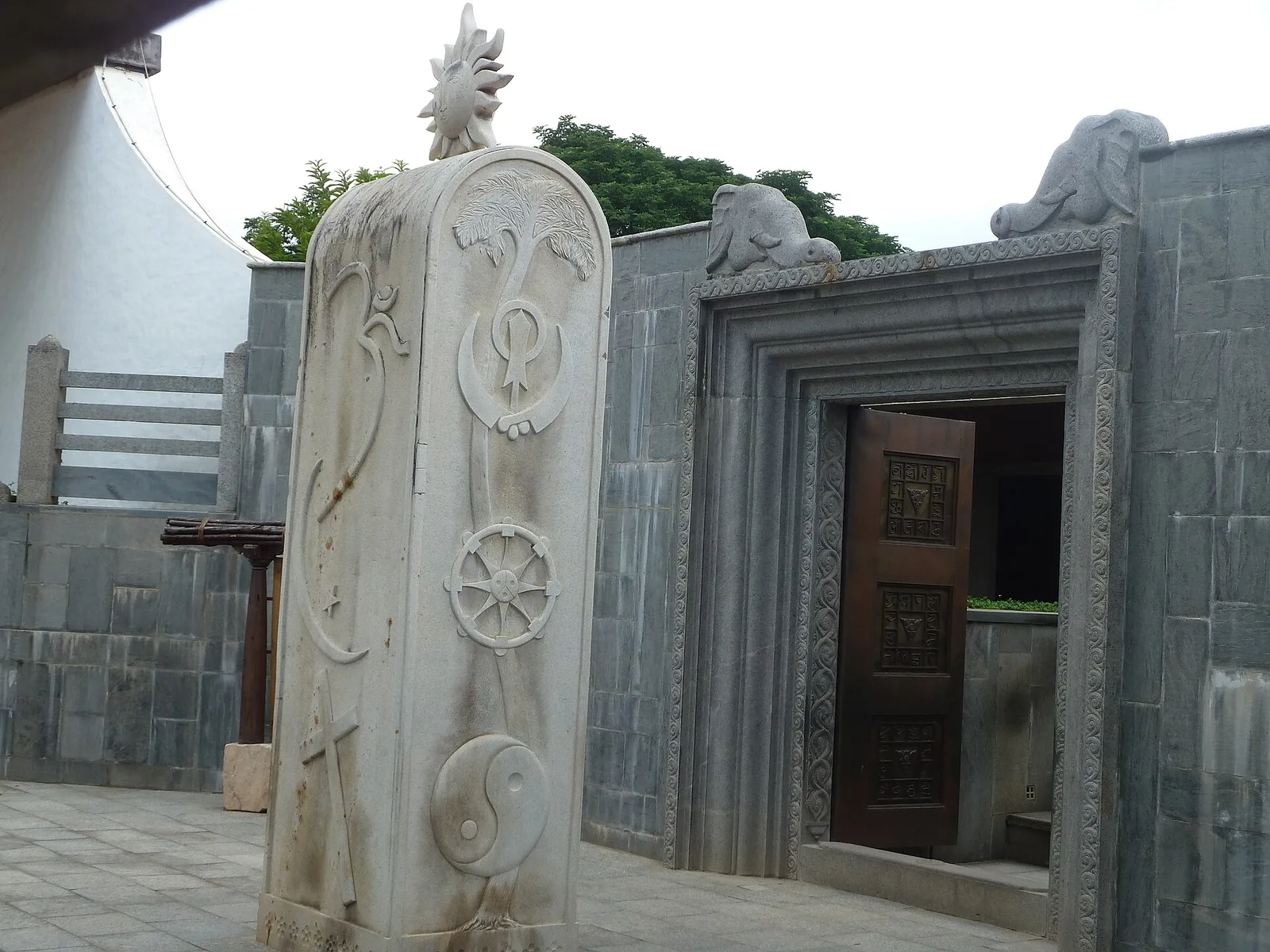
At the entrance stands the Sarva Dharma Sthamba, carved, as the photograph above shows, with the symbols of nine traditions. Read with the instruction inside, that the space “does not subscribe to any particular belief”, the pillar makes a programme visible: every tradition is acknowledged at the door, and none is enacted within. [13]
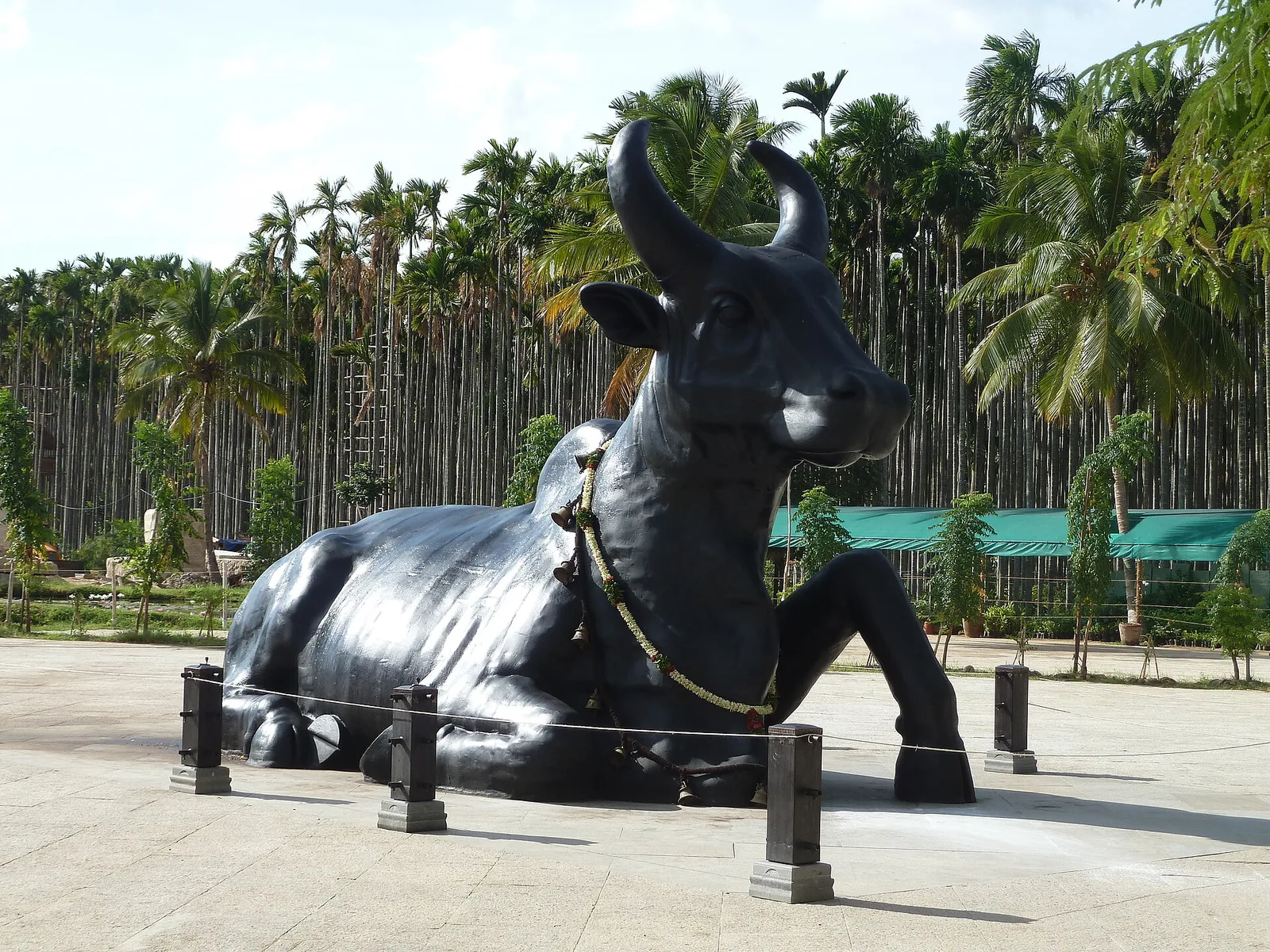
Linga Bhairavi: a goddess who receives
The Linga Bhairavi was consecrated on “the auspicious full moon day of January 2010”, on Thaipusam. Isha describes “the eight-feet tall Devi” as “a powerful feminine energy form” in “a triangular-shaped abode at the Velliangiri Foothills”. Unlike the Dhyanalinga, it is a place of ritual: there are timings for abhishekam, the bathing of the deity, and offerings, which Isha calls “an opportunity for joyous surrender”. [11] [14]
The contrast is deliberate and instructive. At the Dhyanalinga, nothing is given and nothing is asked; you sit and the space is meant to work. At the Bhairavi, the visitor brings, pours and receives. Sadhguru’s teaching is often summarised as “experience, not belief”, but his campus shows a more generous view of human beings: some will meet what is larger than them in stillness, and others in devotion, and he built for both.
Adiyogi: the face that faces the hills
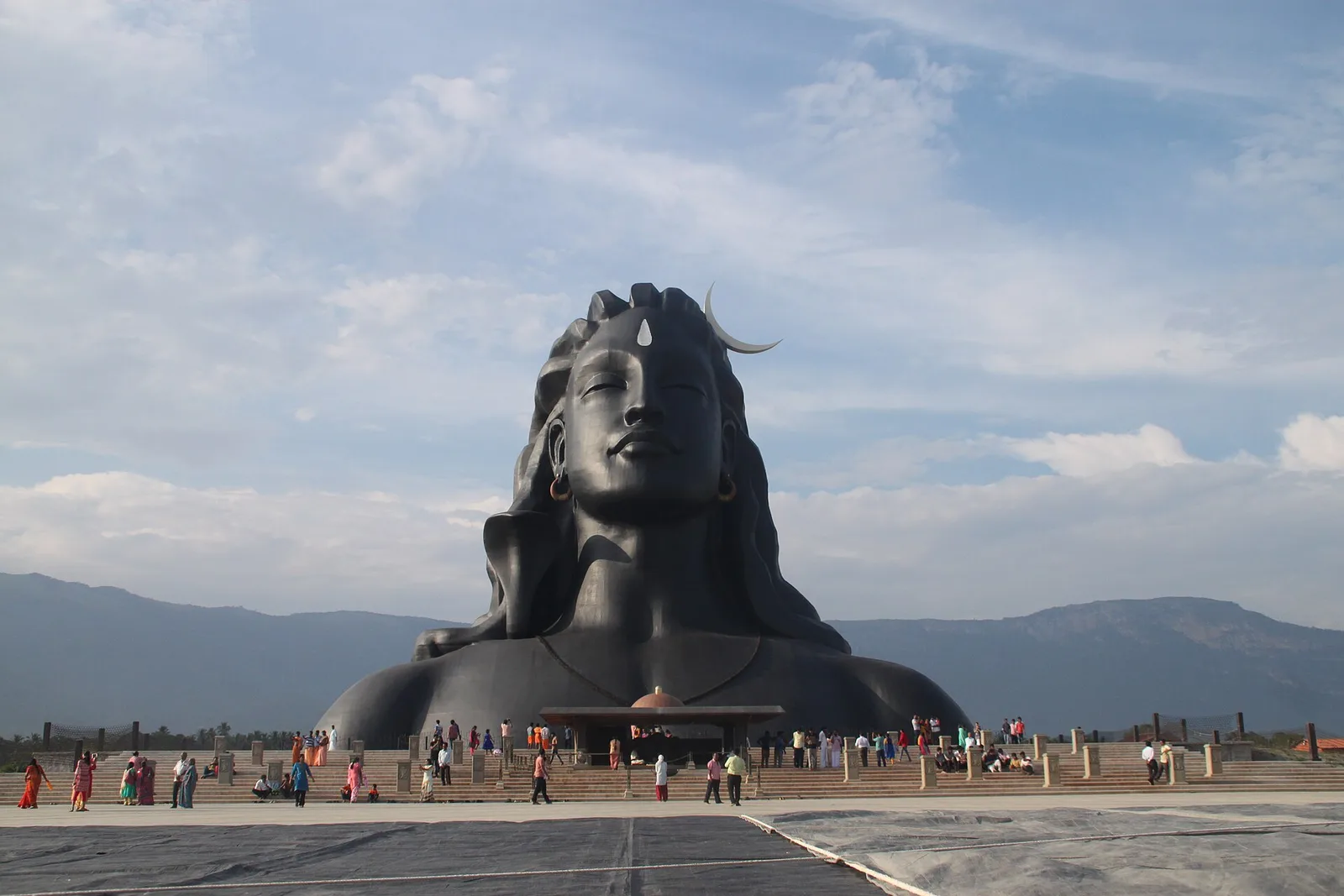
The Adiyogi is 34 metres tall, 45 long and 25 wide, made of steel and weighing around 500 tonnes. Prime Minister Narendra Modi inaugurated it on Maha Shivaratri, 24 February 2017. Guinness World Records verified it on 11 March 2017 as the “largest bust (sculpture)”, measuring 34.24 metres high. A 112-foot copy at Chikkaballapura in Karnataka followed on 15 January 2023. The investigative site Newslaundry reported in May 2021 that the bust was inaugurated despite lacking planning approval; we found no independent document to confirm or refute that claim. [15] [40] [41]
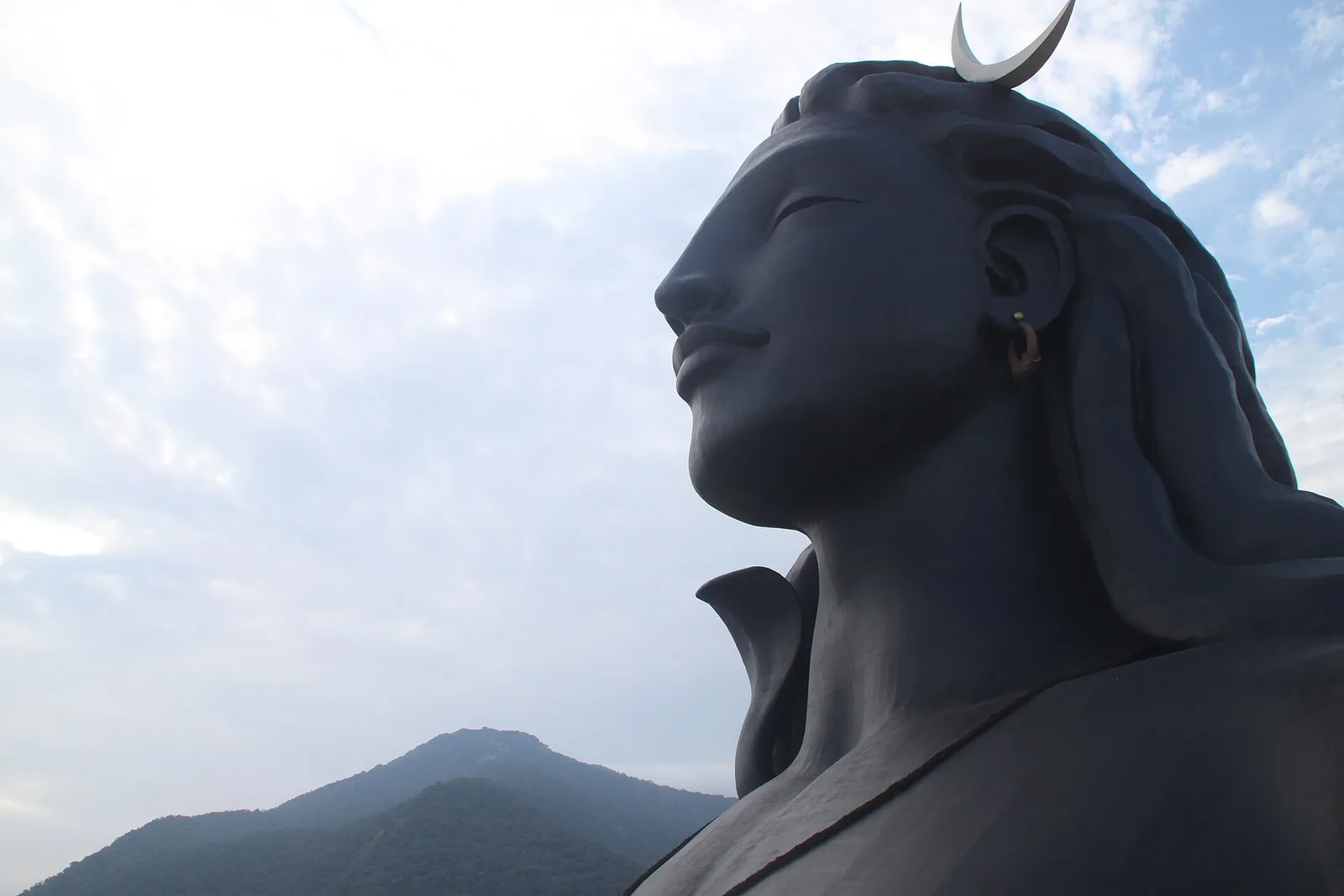
The aesthetics of the Adiyogi run against those of the Dhyanalinga. The linga is a form without a face; the bust is all face. The dome is dark and inward; the bust stands in the open and is designed to be seen from far away and photographed. One makes the visitor quieter; the other makes the visitor small. That a single teacher built both says something true about a movement that wants to be a meditation hall and a mass movement at once.
Art for a room of silence
This is our reading, built from what the spaces themselves state. A meditation space that “does not subscribe to any particular belief” cannot rely on the images that belief supplies: no narrative scenes, no saints, no text to be read. What it can use is what the Dhyanalinga already uses. Form without figure, an ellipsoid rather than a face. Material that shows how it stands, brick in compression. Light from a single opening above. Sound in time, the twice-daily offering, rather than images in space. And a threshold, the carved pillar at the door, that names the traditions once so that the room need not.
The closest parallel in modern Western art is the Rothko Chapel. Built around the work of Mark Rothko, it contains, in its own words, “14 murals created by American artist Mark Rothko”, calls itself “a spiritual space” that draws visitors “of all faiths”, and asks guests to “respect the silent, contemplative atmosphere”. Rothko’s dark fields and the Dhyanalinga’s black stone solve the same problem by the same refusal: they withhold a subject so that the person in front of them becomes the subject. A colossal bust can draw people to the threshold. Inside, the art that suits the room is the art that steps back. [42]
Which place in your life makes you quieter without telling you what to believe, and what is it made of?
Rally for Rivers, Cauvery Calling and Save Soil, and their critics
From 2017 the teacher of inner wellbeing became the face of three environmental campaigns. Each asked large numbers of people for a simple act, and each met specialists who said the problem was not simple. The pattern is worth seeing whole.
Rally for Rivers, 2017
Rally for Rivers was a 2017 campaign “intended to build widespread support for river revitalisation efforts across India”. Supporters were asked to give a missed call to a number; the policy proposal was to plant trees along a one-kilometre strip beside India’s rivers. On 13 September 2017 the organising committee of India Rivers Week, among them Himanshu Thakkar, called the rally “superficial optics”. In Down To Earth on 17 October 2017, Soujanya Shrivastava of the Centre for Science and Environment pointed out that agroforestry along rivers “will be profitable only in areas where the rivers are close to a timber market”. [1] [43] [44]
Cauvery Calling, 2019
In July 2019 the campaign narrowed to one river. Isha’s own explanation describes a plan for 242 crore trees, about 2.42 billion, across a third of the Kaveri basin; it says the river has declined by 40 per cent in fifty years, that a mature tree holds about 3,800 litres of water in the soil (Isha gives no source for this), and that farmers’ incomes could rise three to eight times through agroforestry. [45]

On 23 January 2020 the environmental news service Mongabay, in a report by Nanditha Chandraprakash republished by Eco-Business, laid out the scientists’ objections. Donations of 42 rupees per sapling had raised enough for more than 46 million saplings. Shishir Rao, an ecologist at the University of Georgia, said that without addressing the root causes of river degradation, “Rally for Rivers is completely missing the point”. Fellows of the Ashoka Trust for Research in Ecology and the Environment (ATREE), among them Sharad Lele and Jagdish Krishnaswamy, warned that “deep-rooted, fast-growing species like eucalyptus have been shown to consume a lot of water”, and that streams were drying mainly because groundwater was overpumped. An Isha spokesperson replied: “Direct communication is not a problem for us if we are approached directly. We too approach environmental and agricultural scientists directly. If queries are posed through media, we respond through media.” Isha told the Swiss broadcaster SRF in 2022: “Bei jedem Schritt wurden die lokalen ökologischen Besonderheiten berücksichtigt” (“At every step, local ecological particularities were taken into account”). SRF printed the reply and added: “Die Redaktion hält an ihrer Darstellung fest” (“The editors stand by their account”). [17] [46]
In September 2019 Leo F. Saldanha of the Environment Support Group wrote, for the Coalition for Environmental Justice in India and more than ninety organisations, to the actor Leonardo DiCaprio. The letter, reported by Scroll on 25 September 2019, said the campaign “presents, rather simplistically, that the river can be saved by planting trees”. In the Karnataka High Court, a public interest petition questioned the fundraising; in January 2020 the court ordered Isha to disclose what it had collected, and on 24 March 2021 a bench of Chief Justice Abhay S. Oka and Justice Suraj Govindaraj gave Isha Outreach a month to obtain relief from the Supreme Court, which it had approached. We did not find the outcome of that appeal. [7] [47] [48]
Save Soil, 2022
In 2022 Sadhguru rode a motorcycle for 100 days from London to India to draw attention to soil degradation; announcing the ride at Mahashivratri on the night of 1 March 2022, he gave its scale as “30,000 km, 27 nations, 100 days”. On 27 July 2022 UN News reported the warning of the UN Food and Agriculture Organization (FAO) that “90 per cent of the Earth’s precious topsoil is likely to be at risk by 2050”. At the fifteenth conference of the parties of the UN Convention to Combat Desertification in Abidjan, Côte d’Ivoire, he said on 11 May 2022: “This must end with action and action in such a way that it is implementable,” and “Across the world, not a single nation has a minimum of 3%”, referring to organic matter in agricultural soil. On 11 March 2022 the prime minister of St Kitts and Nevis, Timothy Harris, signed a memorandum with Conscious Planet, the organisation behind the campaign, “to ensure our food security, the good health of our people”. Wikipedia records that views of the campaign were divided. Chris Lang, founder of the environmental watchdog REDD-Monitor, told Vice in June 2022: “Sadhguru perfectly fits in this global greenwashing movement.” [1] [49] [50] [65] [66] [67]

The three campaigns share a structure that explains both their reach and their critics. Each converts a complex system, a river basin, a nation’s soils, into a single act a person can do today: a phone call, a sapling, a signature. That is exactly the move of Inner Engineering, which converts the problem of wellbeing into a daily practice. In the inner domain, the simplification is the method. In hydrology, where sand mining, dams and pumps are the causes, critics argue it can become a substitute for the harder work. The evidence so far does not settle which it is.
Criticism, accusations and the courts
The record here is long. What follows separates four kinds of statement that are easily blurred: what an accuser alleged, what a court decided, what journalists reported, and what Isha said in reply. Where a court ruled, its ruling is given with the court, the date and the outcome.
The habeas corpus petitions of 2016 and 2024
S. Kamaraj, a retired professor of Tamil Nadu Agricultural University in Coimbatore, alleged that his two daughters, Geetha, known in the ashram as Maa Mathi, and Latha, known as Maa Maayu, were being held at the Isha Yoga Center and had been brainwashed; he also alleged that their food and medicine had been tampered with. An earlier petition by both parents had been dismissed by the Madras High Court in 2016, after a report by the Principal District Judge, who, according to the High Court order quoted by BOOM Live, “has categorically mentioned in his report that there is no truth in the allegation, and that the detenues (sisters) are staying at the Foundation on their own will”. [7] [51]
On 30 September 2024 the Madras High Court directed the Coimbatore police to report on criminal cases connected with the foundation, and on 1 October about 150 police personnel went to the centre. On 3 October the Supreme Court, under Chief Justice D. Y. Chandrachud with Justices J. B. Pardiwala and Manoj Misra, transferred the petition to itself and stopped further police action; The News Minute reported the Chief Justice saying, “You cannot let an army or police into an establishment like this.” On 1 October Isha had stated: “We do not ask people to get married or take up monkhood as these are individual choices.” [51] [52]
On 18 October 2024, in Isha Foundation v. S. Kamaraj and Others, SLP (Crl) No. 13992/2024, the Supreme Court closed the habeas corpus petition. The two women, aged 42 and 39, told the bench they lived at the ashram by choice, faced no coercion and were free to travel; their parents had visited them several times. The bench held that “the purpose of habeas corpus was fulfilled”, that no further directions from the High Court were needed, and that “that aspect of the matter will remain closed”. Orally, the Chief Justice said: “These proceedings cannot be to malign people and malign institutions,” and to the father’s counsel: “When you have grown children who are majors, you cannot file a complaint to control their lives.” [53]
The same hearing recorded what the ruling did not cover. For the State of Tamil Nadu, Senior Advocate Siddharth Luthra told the court that police had noticed regulatory lapses during their visit, including the absence of an internal complaints committee and an X-ray licence that had expired. The court clarified that closing the habeas corpus matter did not affect other regulatory compliance; Mukul Rohatgi, for Isha, said any such requirements would be met. Solicitor General Tushar Mehta supported Isha. [53] [54]
Two facts stand beside the case. In March 2024 the police reported that six people had gone missing from the ashram since 2016, of whom five had been traced; BOOM found it unclear whether the sixth had been found or whether Isha had any role. And on 6 September 2024 a doctor of Isha’s mobile medical team was arrested for allegedly assaulting twelve girls at a government school in Thondamuthur, a separate criminal matter. [51] [52]
Isha Home School and the defamation cases
Three separate matters are easily run together here. The first began with a video. On 24 February 2024 the YouTuber Shyam Meera Singh uploaded a video which, according to the National Herald, drew on allegations from parents of former students and unnamed former employees. According to the National Herald, the Supreme Court had in 2024 directed police to investigate “allegations of sexual abuse of minor girls at a school run by” Isha Foundation. On 1 July 2025 the National Herald reported that police had filed a closure report: the investigating team “claims to have questioned 61 students, 13 people working at the centre since 2017”, and “None of them corroborated the allegations as per the report submitted to the Supreme Court, according to media reports.” The paper thus relied on other media, not on an official statement. [55]
The second is a complaint by a couple living in the United States. In April 2025 The News Minute reported their allegation that their daughter had been sexually abused by a physical training teacher at Isha Home School between 2007 and 2010; she later filed a complaint with the Tamil Nadu police. Isha called the allegations “coordinated, vested, and failed attacks”. The third is a case under India’s child protection law (POCSO), registered in 2025 against four Isha Foundation staff members and a former student; Wikipedia, our source for both, does not link it to the couple’s complaint. [7]
Isha has also gone to court as plaintiff. In March 2025 Justice Subramonium Prasad of the Delhi High Court ordered Shyam Meera Singh’s video removed as based on “entirely unverified material”. On 19 March 2026 the court granted Isha an interim injunction against the Tamil weekly Nakkheeran and Google over videos it called defamatory, and in August 2026 extended the order to dozens more videos. [7] [55]
Buildings, forests and the pollution board
The Isha campus lies beside the Bolampatty Reserve Forest. In an investigation published on 17 May 2021, Newslaundry’s Prateek Goyal reported that a forest officer had flagged obstruction of elephant routes in 2012, that India’s national auditor, the Comptroller and Auditor General, had criticised the forest department in 2017, and that, by the article’s reconstruction, Isha had built about 63,380 square metres between 1994 and 2011 without approval from the Hill Area Conservation Authority. A June 2020 status report to the National Green Tribunal placed the site beside, not on, a designated elephant corridor. Isha did not answer the questions in detail, warning that “should you slander the foundation, you will do so at your own risk.” [7] [41]
On 19 November 2021 the Tamil Nadu Pollution Control Board issued a show-cause notice seeking to prosecute the foundation for structures built between 2006 and 2014 in the Velliangiri foothills “without obtaining prior environmental clearance”. In December 2022 the Madras High Court quashed the notice, holding that Isha “came within the definition of an educational institution” and so was exempt, under 2014 amendments to the environmental rules that Isha argued applied retrospectively. [56]
The board appealed two years later. At a hearing on 14 February 2025, Justices Surya Kant and N. Kotiswar Singh asked: “What prevented authorities from approaching this court in time? When the State comes belatedly, we become suspicious.” For the state, Advocate General P. S. Raman said approval granted in 2012 had been made subject to environmental clearance: “They said they do not need an environmental clearance.” On 28 February 2025 the same bench dismissed the appeal in Tamil Nadu Pollution Control Board v. Isha Foundation. It directed that “no coercive steps be taken” regarding the existing construction, clarified that the order “should not be considered a precedent for regularising illegal constructions”, and said that “if there is any need for expansion in future, let permission be sought from competent authority”. [56] [57] [58] [59]
On 13 July 2026 Newslaundry’s Akshay Deshmane, working with The News Minute, reported on previously unpublished documents showing that, while the case was pending, Isha’s representative had written to the Union environment ministry, and that the High Court relied on two clarifications by ministry officials; the public record does not explain why one of them was issued. The report includes no response from Isha. [60]
Mercury, an eclipse, a student and politics
On 8 February 2018 Sadhguru tweeted: “Responsible usage of mercury for medicinal and yogic purposes must be allowed.” On 26 February 2018 Dr Sumaiya Shaikh, writing for the Indian fact-checking site Alt News, set out the evidence of mercury’s toxicity and showed that his claim to solidify mercury at room temperature contradicts chemistry: pure mercury is liquid at room temperature and is solid only in compounds. His remarks on the bodily effects of a lunar eclipse were also criticised. In Mathrubhumi on 7 March 2018, in an essay titled “Science is not your enemy”, Shashi Tharoor gave him as an example: Sadhguru, he wrote, “warned in 2015 against eating during a lunar eclipse”, because “there is a distinct change in the way cooked food is before and after” such an event. We did not find an Isha reply on mercury or on the eclipse. [1] [61] [68]
In April 2019, at an event in London, he called a Muslim student a “Taliban”, and afterwards apologised. According to The Week of 5 April 2019, he said “It is not in my heart to insult anybody”, that the video had been “mischievously edited”, and that he had used “Taliban” in the sense of “ardent student”. The London School of Economics Students’ Union replied: “We do not believe the video was ‘mischievously edited’.” [62]
Politically, critics have described his views as Hindu nationalist and aligned with the Bharatiya Janata Party; in 2019 he spoke in support of the Citizenship Amendment Act. He himself says he belongs to no party and that “party membership should be cancelled because this is becoming a tribe”. [1]
What his side says
Isha’s general answer, as given to SRF in 2022, is that the criminal allegations “ein ordnungsgemässes Gerichtsverfahren durchlaufen” (“went through proper court proceedings”) and that the courts found them “für nicht zutreffend” (“not to be accurate”). For his supporters, the October 2024 ruling, with its remark about proceedings meant “to malign people and malign institutions”, is the decisive word. For his critics, buildings in a forested foothill, exemptions won in court and the Solicitor General’s support tell a story about power. Both readings use the same documents. [17] [53]
How do you hold admiration for a teacher and an unresolved accusation against his institution at the same time, without letting one erase the other?
How does the world see Sadhguru?
The Indian state has honoured him repeatedly: the Padma Vibhushan in 2017, the Prime Minister at the Adiyogi’s inauguration, the Indian Navy hosting the Save Soil journey in 2022, the Solicitor General arguing beside Isha in 2024. For his biographer, the poet Arundhathi Subramaniam, he is, in Isha’s paraphrase of her book, “a contemporary mystic and guru who seems to have lived the intensity of several lifetimes in one”. [1] [2] [15] [53]
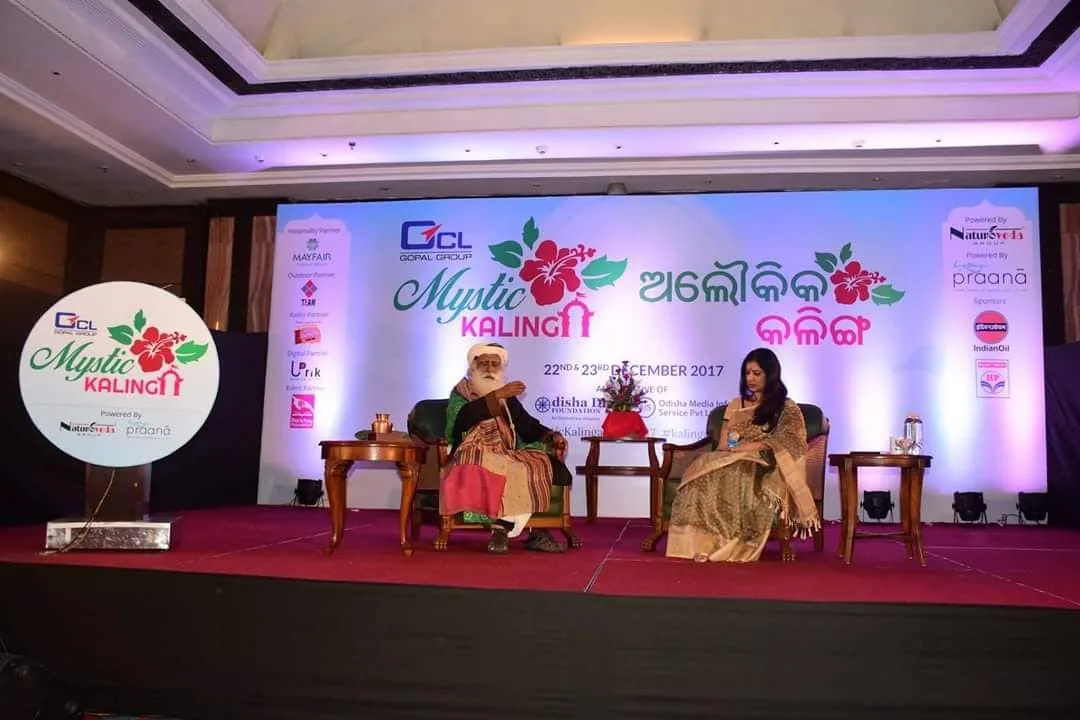
Indian critics speak from science, ecology and the university. Sumaiya Shaikh of Alt News (2018) on mercury; the ecologists of ATREE and Shishir Rao in Mongabay (2020) on rivers; Himanshu Thakkar and the India Rivers Week committee (2017) on the rally. Prerna Dhoop, a former assistant professor at NALSAR University of Law in Hyderabad, told Newslaundry in 2021 that his answers to students at a 2018 event were “extremely simplistic and one-sided”, and warned that his “considerable control over important communication channels” combined power, prestige and privilege in a way that could “create disaster in our liberal democracy and diverse society”. [8] [43] [46] [61]
In the Gulf, Gulf News in the United Arab Emirates gave him a long interview in 2018, in which he said that “Indians are incapable of becoming fanatical”. In Europe, the Swiss broadcaster SRF framed him in 2022 as a guest of the World Economic Forum in Davos and asked Nina Rageth, a scholar of religion at the University of Zurich, to assess him: “ein grandioser Redner” (“a brilliant speaker”), she said, but “kein Naturwissenschaftler” (“not a natural scientist”). In Africa, at the UN desertification conference in Abidjan in May 2022, the convention’s executive secretary, Ibrahim Thiaw, thanked him. In the Caribbean, the governments of St Kitts and Nevis and several of its neighbours signed Save Soil memoranda in March 2022. [17] [28] [49] [50]
Read against the teachers who carried Indian yoga to a global audience before him, his place becomes clearer. Swami Vivekananda wrote Raja Yoga for the mind and meditation; Paramahansa Yogananda taught Kriya Yoga in the West; Maharishi Mahesh Yogi spread a single technique, Transcendental Meditation, that researchers went on to study. Sadhguru combines elements of all three: a method offered without a creed, a breath-based kriya, and a technique submitted to measurement, with environmental campaigns added. Ramana Maharshi stands at the other pole: no institution, no technique to sell, and a single question about the self. The comparison is ours.
Admirers hear a teacher who made inner work sound practical; critics hear a communicator whose reach outruns his evidence. Both, as Rageth did, take the speaker seriously. [17]
Questions people ask about Sadhguru
Who is Sadhguru and what does he teach?
Sadhguru, born Jagadish Vasudev in Mysore in 1957, is an Indian yoga teacher who founded the Isha Foundation in 1992 near Coimbatore. He teaches yoga as union, the falling away of the boundary between oneself and everything else, as a learnable technique: Inner Engineering and its 21-minute practice, Shambhavi Mahamudra Kriya. [1] [18] [22]
What does Sadhguru mean by yoga as union?
He says the sense of who you are rests on “the boundaries of your sensation”, and that yoga expands that boundary “in such a way that you experience the whole universe as a part of yourself”: “Everything becomes one. That is union.” The Sanskrit root yuj can mean “to yoke” or “to concentrate”; union is one of its senses, not the only one. [18] [19]
How does Sadhguru distinguish experience from belief?
For him, belief is “made up by somebody” and adopted, “social and cultural”; a seeker has “consciously admitted that we don’t know”. Experience is direct contact, which he describes as being “in access or not in access” to the source of creation. [28] [29]
Does Sadhguru believe in God?
He neither affirms nor denies God in the usual sense. He says “Whatever the source of creation is, that is what God is”, and asked whether he has experienced God, answers that he knows “this piece of life in its entirety” and is “only talking about myself”. [29] [30] [33]
What does conscious living mean for Sadhguru?
It means acting by response rather than by compulsion. He defines karma as “memory”, “action and memory” carried even in the body’s cells, and responsibility as “your ability to respond”, not blame. Conscious living is noticing the old pattern in time to respond differently. [31] [32]
How does Sadhguru’s view relate to tat tvam asi?
We found no text in which he comments on the phrase from Chāndogya Upanishad 6.8.7. In our comparison, his self “spread all over the place” resembles Shankara’s reading, “you are that”, while Joel Brereton (1986) and Patrick Olivelle read “in that way are you”. The Upanishad states a truth independent of experience; Sadhguru’s yoga aims at the experience. [4] [35] [36]
Is Sadhguru vegetarian?
He advocates vegetarian food. According to Wikipedia, citing Arundhathi Subramaniam’s biography (2010, pages 216 to 217), when he travels and no vegetarian food is available, he eats seafood. [1]
Who was Sadhguru’s wife?
He married Vijaykumari, known as Vijji, in 1984; their daughter Radhe was born in 1990. Vijji died on 23 January 1997. Isha describes her death as Mahasamadhi, a conscious leaving of the body; her father filed a complaint accusing Vasudev of killing her, which police later dismissed. [1] [10] [12]
Who was Sadhguru’s guru?
As a boy of twelve or thirteen he learned hatha yoga from Malladihalli Raghavendra Swamiji, who had himself learned from a yogi named Palani Swami. Sadhguru speaks of a guru who touched him with a stick in a previous life. Newslaundry reported in 2021 that he studied Siddha Samadhi Yoga in 1984 with Rishi Prabhakar, who had studied under Maharishi Mahesh Yogi; Isha could not be reached for comment, and its practitioners hold that his method rests on his own insight. [3] [5] [7] [8]
What is Shambhavi Mahamudra, and does science support it?
A 21-minute daily practice of controlled breathing, Aum chanting and muscular locks, ending with five minutes of watching the breath. Studies from 2017, 2022 and 2025 report lower self-rated stress afterwards, but none was randomised, two lost most participants, and their authors call for controlled trials. [24] [25] [26]
What happened in the Isha Foundation habeas corpus case?
A father alleged that his two adult daughters were held at the Isha Yoga Center. On 18 October 2024 the Supreme Court of India closed the petition after the women, aged 42 and 39, said they lived there freely; it clarified that other regulatory compliance was unaffected. [53]
How this connects to my larger vision
For me, the most useful idea in Sadhguru’s work is the claim that inner wellbeing is a skill, not a gift handed to a lucky few. If that is even partly true, it changes what technology is for. I want tools, AI among them, that do for attention what medicine did for the body: give ordinary people access to a depth that used to belong to monasteries and retreats. His line between belief and seeking matters to me too. A seeker admits he does not know and goes to look; that is also the right attitude toward machines that are changing faster than our ideas about them. And a teacher is measured twice, by what his methods do in a single life and by how his institutions act in the world. Both belong on a page like this, side by side, so the reader can weigh them. The question I take from him is the one I ask of everything we build: does it widen the boundary of what a person feels as himself? [28]
Sources and image credits
Every source below was opened for this page on 2 or 3 November 2026. Sources published by Isha Foundation or Sadhguru are marked as party sources. Accusations are reported as accusations, with the court, date and outcome where a court ruled. Comparisons introduced as our reading are editorial interpretation, not Sadhguru’s position.
This independent art site has no affiliation with Sadhguru, Isha Foundation or any religious organisation.
Commons image records were checked through the Wikimedia Commons API on 3 November 2026. Each caption names the work or place, maker, date, source and licence. The portrait and the abstract opening image were made for this site and are not photographs of Sadhguru or works by Isha Foundation.
- Wikipedia, Sadhguru. Biography, honours, criticism and political views; its account of 1982 cites Shaili Chopra, When I Was 25: The Leaders Look Back (Random House India, 2014), and Cheryl Simone, Midnights with the Mystic (2010); consulted 3 November 2026.
- Isha Foundation, Sadhguru. The movement’s own biography page, undated; consulted 3 November 2026. Party source.
- Wikipedia, Malladihalli Raghavendra. His dates, his teacher Palani Swami and the young Jaggi Vasudev; consulted 3 November 2026.
- Isha Foundation, Sadhguru’s enlightenment experience on Chamundi Hill, 29 October 2026. His own account. Party source.
- Isha Foundation, Shivayogi, 3 November 2017. Sadhguru’s account of earlier lives and his guru. Party source.
- Isha Foundation, Sadhguru about his guru, 13 February 2024, first printed in Forest Flower, July 2015. Party source.
- Wikipedia, Isha Foundation. History, programmes, controversies and court cases; consulted 3 November 2026.
- Prateek Goyal, Propped by press and politicians: how Jaggi Vasudev became Sadhguru, Newslaundry, 18 May 2021.
- Isha Foundation, The Meaning of “Sadhguru”, 29 October 2026. Party source.
- Isha Foundation, Vijji. The movement’s page on Vijaykumari Vasudev, undated. Party source.
- Isha Foundation, Linga Bhairavi, Coimbatore, visitor page; consulted 3 November 2026. Party source.
- Isha Foundation, Dhyanalinga consecration: when the divine descends, 3 November 2017. Party source.
- Isha Foundation, Dhyanalinga, visitor page; consulted 3 November 2026. Party source.
- Isha Foundation, Linga Bhairavi consecration, 3 November 2017. Party source.
- Wikipedia, Adiyogi Shiva bust. Height, inauguration, symbolism and planning questions; consulted 3 November 2026.
- Isha Foundation, Isha Institute of Inner-sciences, USA, visitor page; consulted 3 November 2026. Party source.
- Mirella Candreia, Yogalehrer Sadhguru: ein indischer Guru besucht das WEF, SRF, 25 May 2022. In German; translations ours.
- Isha Foundation, What is Yoga, part 2, 2 January 2023. Sadhguru on yoga as union. Party source.
- Wikipedia, Yoga. Etymology of yuj and the history of hatha yoga; consulted 3 November 2026.
- Isha Foundation, Bhuta Shuddhi: the fundamental technology of yoga, audio, 8 May 2016. Party source.
- Isha Foundation, Isha Kriya, guided meditation page; consulted 3 November 2026. Party source.
- Isha Foundation, Inner Engineering, programme page; consulted 3 November 2026. Party source.
- Isha Foundation, Doing the right things with yourself, 13 February 2024. Party source.
- Preeti Upadhyay, Balachundhar Subramaniam and others, Beth Israel Deaconess Medical Center, observational study of perceived stress after the online programme, Frontiers in Psychology, 2022.
- Christine Tara Peterson, Sarah Bauer, Deepak Chopra, Paul Mills and Raj Maturi, study of 142 people practising Shambhavi Mahamudra Kriya for six weeks, Journal of Evidence-Based Complementary and Alternative Medicine, 2017. PubMed record 29228793.
- Swaminathan and others, Sadhguru Center for a Conscious Planet, one-year observational study of perceived stress, Frontiers in Psychology, February 2025.
- Sri Aurobindo, The Synthesis of Yoga, introduction: Life and Yoga, Complete Works, volumes 23 to 24, Sri Aurobindo Ashram.
- Bobby Naqvi, interview with Sadhguru, “Indians are incapable of being fanatics”, Gulf News, updated 5 November 2018.
- Isha Foundation, Can I live life without God?, 13 February 2024. Party source.
- Isha Foundation, Has Sadhguru experienced God?, 2 January 2023, first printed in Forest Flower, August 2017. Party source.
- Inner Engineering, On karma and memory, 5 June 2022. Party source.
- Suchitra Bajpai Chaudhary, Chance to explore life’s concerns with Sadhguru in Dubai on Friday, Gulf News, 1 November 2018.
- Isha Foundation, The First Yogi, 13 February 2024. Sadhguru on Shiva as Adiyogi and the Saptarishis. Party source.
- Wikipedia, Yoga Sutras of Patanjali. Dating, sutras 1.2 and 1.3 in translation, Samkhya and kaivalya; consulted 3 November 2026.
- Joel P. Brereton, “Tat Tvam Asi” in Context, Zeitschrift der Deutschen Morgenländischen Gesellschaft 136, no. 1 (1986), pages 98 to 109. Listed by the University of Texas Sanskrit programme.
- Wikipedia, Tat Tvam Asi. Chandogya Upanishad 6.8.7, Brereton, Olivelle, Doniger, Lipner, Shankara and Madhva; consulted 3 November 2026.
- Isha Foundation, The Dhyanalinga dome, 3 November 2017. Party source.
- Auroville Earth Institute, Dhyanalinga. The brick dome, its dimensions and the mortar specification.
- Wikipedia, Pantheon, Rome. The unreinforced concrete dome and its oculus; consulted 3 November 2026.
- Guinness World Records, Largest bust sculpture.
- Prateek Goyal, How Sadhguru built his Isha empire illegally, Newslaundry, 17 May 2021.
- Rothko Chapel, Visit the Rothko Chapel; consulted 3 November 2026.
- South Asia Network on Dams, Rivers and People (SANDRP), Will this rally help the rivers?, 13 September 2017.
- Ishan Kukreti, A cure worse than the disease, Down To Earth, 17 October 2017.
- Isha Foundation, Why Sadhguru chose the Cauvery, 28 July 2026. Party source.
- Nanditha Chandraprakash, Mass tree planting along India’s Cauvery river has scientists sceptical, Mongabay, republished by Eco-Business, 23 January 2020.
- Scroll, report on the letter from Indian environmental groups to Leonardo DiCaprio about Cauvery Calling, 25 September 2019.
- LiveLaw, Cauvery Calling case: Isha Outreach moves Supreme Court against Karnataka High Court order, 24 March 2021.
- Free Press Journal, Sadhguru at the UNCCD COP15 in Abidjan, 11 May 2022.
- St Kitts and Nevis Information Service, Save Soil memorandum, 12 March 2022.
- Ritika Jain, explainer on the Isha Foundation habeas corpus case and missing persons, BOOM Live, 4 October 2024.
- The News Minute, Supreme Court restrains police action against Jaggi Vasudev’s Isha Foundation, 3 October 2024.
- LiveLaw, Proceedings can’t be to malign institutions: Supreme Court closes habeas corpus petition against Isha Yoga Centre, 18 October 2024.
- Lakshmi Subramanian, SC dismisses the habeas corpus petition against Sadhguru’s Isha Yoga Foundation, The Week, 18 October 2024.
- National Herald, Police give Sadhguru’s Isha Foundation clean chit in sexual abuse case, 1 July 2025.
- Scroll, Supreme Court upholds quashing of the pollution board notice to Isha Foundation, 28 February 2025.
- ETV Bharat, SC pulls up TNPCB over appeal against order quashing notice to Isha Foundation, 14 February 2025.
- Debayan Roy, Supreme Court upholds quashing of show cause notice to Isha Foundation, Bar and Bench, 28 February 2025.
- LawBeat, SC upholds Madras HC’s decision to quash TNPCB’s notices against Isha Foundation, February 2025.
- Akshay Deshmane, How the Union government helped Isha Foundation win a case against the Tamil Nadu pollution board, Newslaundry with The News Minute, 13 July 2026.
- Sumaiya Shaikh, Scientific research ascertains mercury toxicity, Alt News, 26 February 2018.
- The Week, Sadhguru apologises to Muslim student he called Taliban, 5 April 2019.
- Vinaire, Sadhguru: His Life, blog post with a timeline, 10 October 2020.
- The Week, Congress IT cell chief rakes up old murder charge against Sadhguru; Isha Foundation dismisses it as 'baseless charge', March 2019 (5 March in the web address, 7 March on the page).
- UN News, FAO warns 90 per cent of Earth's topsoil at risk by 2050, 27 July 2022.
- Free Press Journal, Isha Mahashivratri: Sadhguru announces 30,000 km lone motorcycle journey from London to India to save soil, 2 March 2022.
- Pallavi Pundir, This Climate Guru Is a Celebrity in the US. In India, He's Accused of Destroying a Forest, Vice, 23 June 2022. Internet Archive copy; the original address no longer works.
- Shashi Tharoor, Science is not your enemy, Mathrubhumi, 7 March 2018.