Teachers / No. 004
Maharishi Mahesh Yogi
Maharishi Mahesh Yogi was an Indian meditation teacher who founded the international Transcendental Meditation movement, connecting a personally taught practice with books, teacher training and a worldwide institutional network. The organisation describes TM as a silent mental practice done sitting comfortably with closed eyes. Official account of TM method and origins
This guide separates biography, practice, artistic reception and evidence. It follows the same teacher through the Beatles, David Lynch, the research literature and the questions surrounding the movement.
What did Maharishi actually bring to the world?
Maharishi's distinctive achievement was to turn a meditation teaching into a repeatable international teaching organisation: introductory talks, personal instruction, trained teachers, follow-up and an expanding network of institutions. The movement describes this as the revival and systematic presentation of Vedic knowledge. A historical account can establish that organisation and its influence without adopting its claims about enlightenment or a universal science of consciousness. TM's account of origins; historical overview
Three subjects are often collapsed into one: the man, the basic TM practice, and the much wider movement that grew around him. His books, advanced programmes, educational institutions and political initiatives extend beyond a twenty-minute sitting. A benefit someone reports from meditation does not automatically validate every claim associated with the wider organisation. Conversely, a disputed institutional claim does not tell us what every practitioner experiences. programmes, teaching and criticism; encyclopedic account
His early biography is less secure than his later public career. Sources disagree about his birth year and some details of his education. The dependable route is to identify him as an Indian teacher who studied with Swami Brahmananda Saraswati, began a public teaching mission in the 1950s, and died in the Netherlands on 5 February 2008. This guide leaves the uncertain birth date unresolved rather than selecting a convenient number. biographical sources and conflicting dates
From Guru Dev's disciple to an international movement
- Before 1953: studied and worked with Brahmananda Saraswati, known as Guru Dev, the Shankaracharya of Jyotir Math. Guru Dev Legacy Trust
- 1950s: developed his public teaching mission and began taking the meditation programme abroad. The official account places international travel by 1958. TM history
- 1963: published Science of Being and Art of Living, a principal exposition of his outlook. publication history
- 1967 to 1968: met the Beatles in Britain; their subsequent stay at Rishikesh made the teaching internationally visible. Ajoy Bose, Penguin excerpt; visit chronology
- 1970s onward: the movement expanded into universities, the Science of Creative Intelligence, advanced TM-Sidhi practice and broader social programmes. institutional history
- 1991 to 2008: based his later work at Vlodrop in the Netherlands; died there in 2008. later life
What is the teaching, in plain words?
Effortlessness is central to the account
TM is described by its organisation as a silent mental practice undertaken sitting comfortably with closed eyes. It distinguishes the method from concentrating, watching the breath, trying to empty the mind and mindfulness practice. A mantra is used, but the movement presents the way it is used as something learned personally, not recovered by selecting an appealing word from an online list. That describes the organisation's method and teaching conditions, rather than establishing exclusive ownership of meditation in general. official explanation; course structure
The usual schedule is about twenty minutes twice daily. In Maharishi's account, the mind settles toward quieter levels and an experience of pure consciousness; regular practice is intended to support activity after meditation. The setting is therefore compatible with ordinary working and family life. Its description as effortless does not mean that every participant will have the same experience, or that the practice requires no regular commitment. practice overview; teaching and origins
Being and activity
Science of Being and Art of Living connects an unchanging ground of awareness with action in the world. His commentary on the Bhagavad-Gita similarly interprets meditation as compatible with effective action. These are religious and philosophical explanations of why meditation matters. Terms such as pure consciousness, Being and Vedic science should not be silently converted into established findings of contemporary physics merely because scientific language appears alongside them. philosophy and principal publications
A lineage, and a substantial modern expansion
His teacher, Brahmananda Saraswati, occupied a traditional Hindu monastic office. Maharishi served him before building a worldwide movement of his own. The connection is documented, but it does not mean Guru Dev personally founded every later TM institution or taught every programme that eventually used his image. The historical distinction becomes particularly important when the basic meditation course is discussed together with advanced techniques, health systems or proposed political transformations. Guru Dev Legacy Trust; current organisational account
How to start, without confusing a description with instruction
The current official route is an introductory information session followed, if chosen, by a course with a certified teacher and subsequent follow-up. The course page explains the staged learning process. Check the current fee and what support it includes before enrolling. This is a description of how the organisation offers TM, not this art site's recommendation of a paid course or a replacement for an actual instructor. TM course; certified teachers
What people say: creativity, research and controversy
British musicians, with different responses
The Beatles' reception was never a single unanimous verdict. Ajoy Bose's account distinguishes George Harrison's enthusiasm, Paul McCartney's interest, Ringo Starr's short stay and John Lennon's more conflicted experience. Their visit became a powerful cultural event partly because a globally famous band appeared to be seeking something outside the machinery of fame. The music and the disillusionment both belong to the record. Bose, Across the Universe, excerpt
Looking back in an interview with David Lynch, McCartney said, “It was inspirational.” He described songwriting in the intervals between meditation sessions. The transcript is published by the TM organisation, a relevant interest to disclose, and it recalls a visit decades earlier. Its strength is its specific first-person account of work and atmosphere; it does not establish a general law that TM produces artistic originality. McCartney interview transcript
An American filmmaker's creative practice
David Lynch writes, “Ideas are like fish.” In Catching the Big Fish he uses depth as a metaphor for finding ideas, and describes learning TM in Los Angeles in 1973. The book connects meditation with his working process; it does not make his films direct illustrations of Maharishi's doctrine or promise that another person's art will improve. publisher's excerpt from Lynch
The David Lynch Foundation, founded in 2005, carries that enthusiasm into programmes for particular communities. Its website describes work with students, veterans and survivors of violence, as well as fundraising and research. This documents a consequential institutional afterlife in the United States. Its description of benefits is an interested organisation's account and should be assessed alongside independent reviews, rather than used as the sole measure of effectiveness. foundation mission and history
What independent research can and cannot establish
A 2014 systematic review by Madhav Goyal and colleagues examined meditation programmes in clinical populations using active controls. It found insufficient evidence for mantra meditation programmes on the psychological stress and well-being outcomes examined, while finding some benefits for mindfulness programmes. That is a dated review with defined inclusion criteria, not a verdict on every later trial or every reason a person meditates. Its distinctions prevent evidence for one practice from being automatically assigned to another. Goyal and colleagues, JAMA Internal Medicine
The US National Center for Complementary and Integrative Health describes a varied research field with limitations in study quality and reporting, and notes that adverse experiences can occur. Its discussion is about meditation and mindfulness broadly, not an endorsement of every claim made for TM. The appropriate question is specific: which method, for which outcome, compared with what, and in which population? Meditation should not be presented here as a guaranteed treatment or a reason to postpone needed care. NCCIH evidence overview
The claims beyond an individual's meditation
The movement's advanced programmes and accounts of a collective Maharishi Effect extend to claims about social peace, crime and extraordinary abilities. These are separate propositions from whether a sitting feels restful. The biographical and encyclopedic accounts record controversy around yogic flying and large-scale social claims. Neither celebrity testimony nor a study of an individual's blood pressure would by itself demonstrate collective causation or supernatural flight. controversies and programmes; encyclopedic account
Conduct, power and conflicting accounts
Accounts of the Beatles' departure include allegations of sexual advances and disputes over what happened. Mia Farrow's memoir and later accounts by others cannot responsibly be collapsed into either an established judicial finding or a rumour conclusively disproved. Judith Bourque subsequently described a relationship with Maharishi, complicating the public image of celibacy. These are attributed allegations and recollections; the sources also record denials or different understandings by participants. biography, allegations and cited memoirs
Fees, organisational wealth and the relationship between secular presentation and Hindu ritual have also generated criticism. The current foundation describes itself as nonprofit and identifies Tony Nader as Maharishi's successor at the head of international TM organisations. Those are useful organisational facts, but nonprofit status does not itself settle questions about pricing, institutional power or the validity of advertised results. Maharishi Foundation, organisation and finances; history and criticism
A specific historical example is Malnak v. Yogi. In 1979 the US Third Circuit affirmed a judgment against an SCI/TM course taught in New Jersey public high schools, treating the course and accompanying puja as religious activity under the Establishment Clause. The case concerned that curriculum and its circumstances, not a prohibition on private meditation. court opinion, preserved by Columbia University
Which books should you read first?
Science of Being and Art of Living, 1963
This is the first substantial statement to read for Maharishi's own framework. It explains the relationship he proposes between underlying Being, meditation and everyday activity. Read it as an exposition of his outlook, rather than as a modern systematic review of efficacy. A contemporary course may explain how the movement teaches the practice, but the book reveals the wider philosophical ambition behind its public message. publications and development of the book
Bhagavad-Gita: A New Translation and Commentary, 1967
His commentary covers the first six chapters, rather than the entire eighteen-chapter text. It connects his meditation teaching with an influential scripture and stresses the relationship between inner realisation and action. It is one interpreter's commentary. Readers interested in the Gita as a whole should keep that limited coverage and interpretive standpoint visible rather than assume every English edition presents the same argument. Gita commentary and publication history
Read reception beside the teacher's own books
Lynch's Catching the Big Fish is a short, accessible account of meditation and creativity from an artist's perspective. Bose's Across the Universe places the Beatles' stay within a broader cultural history. Neither book is a meditation manual or independent proof of the movement's health claims. Pairing a primary exposition with a practitioner's memoir and an evidence review keeps these different questions from merging. Lynch; Bose; Goyal review
The teacher and art: a retreat became a recording history
The strongest artistic link is the body of songs written during and around the Beatles' 1968 stay. The visit provided time, relative privacy, acoustic guitars and a new daily routine. Bose describes both its productivity and the tensions within the group. The resulting work cannot be attributed to meditation alone: the same setting included friendships, travel, homesickness and personal uncertainty. The evidence supports a fertile context for composition rather than a single cause. Bose's account; songwriting and visit history
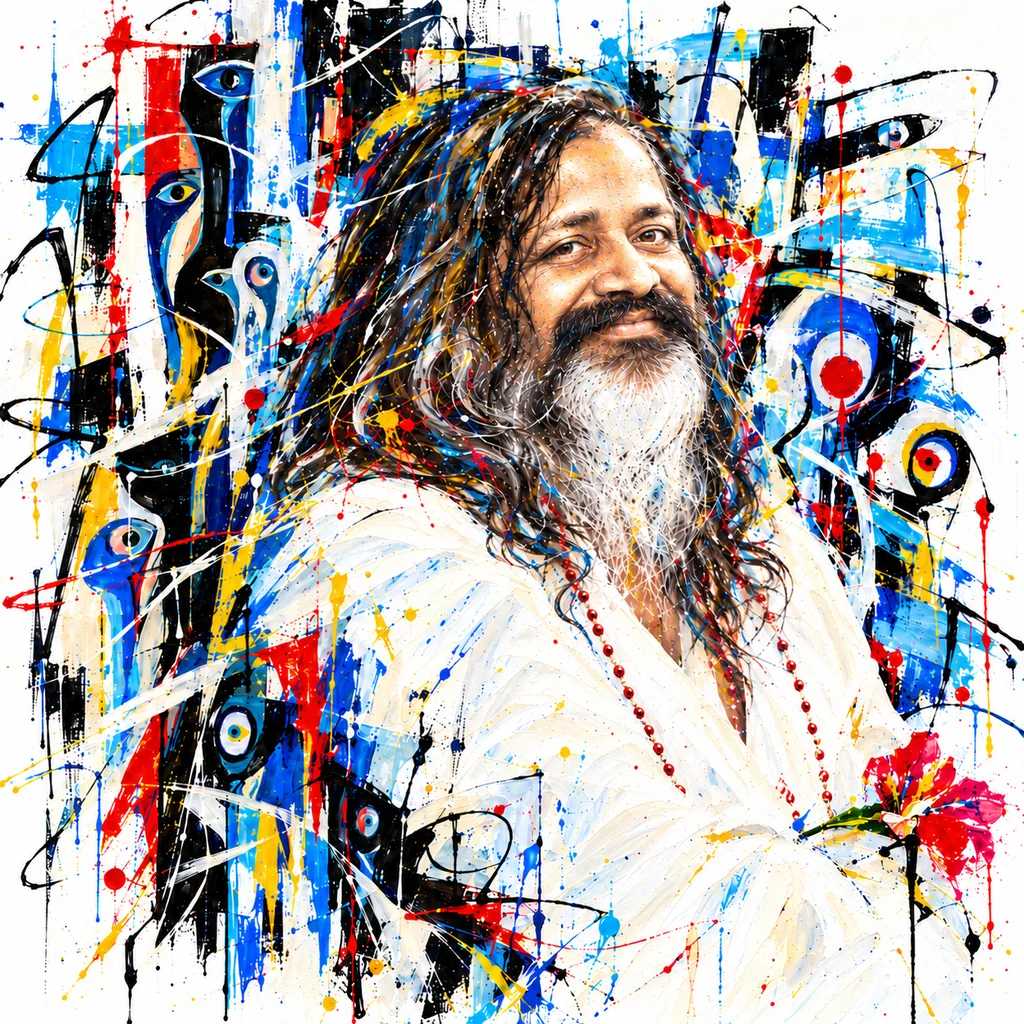
Our reading of Baudoin's portrait follows the steady face through a field of splashes, lines and small eyes. Its dense surrounding activity makes an interesting visual counterpart to the theme of stillness amid action. That is our interpretation of this painting, not a documented teaching device or an image approved by Maharishi. The portrait was made for this independent art site.
Places, centres and retreats today
Rishikesh: the former ashram associated with the Beatles is a historical destination. It should be distinguished from a current TM teaching centre or residential course: visiting the place where a famous retreat occurred does not reproduce that retreat. Check current access through local visitor authorities before travelling. The documented 1968 stay is the historical reason for the site's international fame. history of the visit and site
Prayagraj and Vlodrop: his funeral took place at Allahabad, now Prayagraj, while Vlodrop in the Netherlands was his later headquarters and place of death. These are different stages of the biography, not interchangeable claims about where he taught the Beatles or trained under Guru Dev. A historical association is not a guarantee that a headquarters admits casual visitors. later life, death and funeral
Learning and residential options: the official TM website provides a centre finder, course information, follow-up and links for learning in residence. Confirm the teacher, dates, current cost and residential conditions directly with the provider. This page has no affiliation with TM organisations, the David Lynch Foundation or any retreat operator, and names them as subjects and sources in the teacher's continuing history. official learning and residential links; course information
Questions people ask about Maharishi Mahesh Yogi
Who was Maharishi Mahesh Yogi?
Maharishi was an Indian teacher who developed the international Transcendental Meditation movement after studying with Brahmananda Saraswati. He began teaching publicly in the 1950s and died at Vlodrop in the Netherlands on 5 February 2008. Sources disagree about his birth date. Biographical overview
What is Transcendental Meditation?
TM is the movement's name for a silent meditation practice undertaken comfortably seated with closed eyes, usually for about twenty minutes twice daily. Its official explanation distinguishes it from concentration, breath observation and trying to empty the mind. Personal instruction is part of the organisation's teaching model. Practice overview; Method description
How can a beginner learn it?
The official route starts with an information session and continues, if chosen, with a course taught by a certified teacher and follow-up support. Check current fees and arrangements with the provider. This page describes that route and does not supply a mantra, initiation or personal recommendation. Official course information
Which Maharishi book should I read first?
Start with Science of Being and Art of Living for his own framework. His 1967 Bhagavad-Gita commentary covers the first six chapters. Lynch's Catching the Big Fish is a useful practitioner account of creativity, with a different purpose from either a teaching manual or an independent research review. Publications; Lynch
Who was Guru Dev?
Guru Dev was Maharishi's teacher, Swami Brahmananda Saraswati, the Shankaracharya of Jyotir Math from 1941 until his death in 1953. Maharishi's subsequent international movement drew authority from this relationship. Guru Dev and Maharishi are different people, with different public careers. Guru Dev Legacy Trust
Where can I visit or find a retreat today?
Rishikesh contains the former ashram associated with the Beatles' visit; Prayagraj is connected with Maharishi's funeral, and Vlodrop with his later headquarters. For current courses and residential learning, use the official centre and course information. Confirm access rather than assuming every historical location is a working retreat. Places; Current learning options
Why did the Beatles visit him?
They went to Rishikesh in 1968 to study and practise meditation after meeting him in Britain. Their responses differed, and the stay became a productive songwriting period as well as a source of later controversy. It should not be reduced to either universal devotion or unanimous rejection. Ajoy Bose's account
Does research prove all the movement's claims?
No. Evidence must be assessed by method, population, outcome and comparison group. A 2014 review found insufficient evidence for mantra meditation on the psychological outcomes it examined; that is a limited, dated finding. Individual benefits do not establish claims about collective world peace, extraordinary powers or guaranteed treatment. Goyal review; NCCIH overview
What controversies should a reader know about?
The record includes disputed accounts of sexual conduct, questions about fees and institutional power, and criticism of extraordinary or collective-effect claims. These require attributed, specific evidence; allegations should not be restated as judicial findings. Separate Maharishi's conduct, a person's meditation experience and the wider organisation's claims. Controversies and cited sources
Sources and image credits
Sources opened and read for this page on 26 October 2026. Institutional biographies document a community's account; scholarship and reference works provide comparison. Interpretations marked as ours belong to this independent art site.
Portrait © Piet Baudoin. Painted for this site and supplied by the artist; all rights reserved. No historical photograph or third-party artwork is reproduced.
- Maharishi Foundation, What is Transcendental Meditation?, method and origins
- Wikipedia, Maharishi Mahesh Yogi, public career, publications and controversies
- Encyclopedia.com, Maharishi Mahesh Yogi, reference entries on biography and the movement
- Guru Dev Legacy Trust, Biography, institutional account of Brahmananda Saraswati
- Ajoy Bose, Across the Universe, excerpt The Beatles and their Time in India, Penguin India, 28 May 2018
- Wikipedia, The Beatles in India, visit, songwriting and reception
- Maharishi Foundation UK, current course, teaching structure and follow-up information
- Maharishi Foundation, nonprofit organisation, finances and leadership
- Paul McCartney interviewed by David Lynch, transcript at TM Blog, 29 April 2010
- David Lynch, Catching the Big Fish: Meditation, Consciousness, and Creativity, publisher description and excerpt
- David Lynch Foundation, mission, history and programmes
- Madhav Goyal and colleagues, Meditation Programs for Psychological Stress and Well-being: A Systematic Review and Meta-analysis, JAMA Internal Medicine (2014)
- US National Center for Complementary and Integrative Health, Meditation and Mindfulness: Effectiveness and Safety
- Malnak v. Yogi, 592 F.2d 197, Third Circuit Court of Appeals (1979), opinion preserved by Columbia University