Teachers / No. 007
Ramana Maharshi
Ramana Maharshi (1879 to 1950) was a Tamil spiritual teacher at Arunachala in southern India whose central practice, self-enquiry, directs attention towards the sense of being an “I” rather than towards the thoughts associated with it. Sri Ramanasramam, instructions Biographical dates and setting
The familiar question is easy to repeat and easy to misunderstand. This guide follows what enquiry asks a person to do, the role of devotion and silence, the books that preserve the teaching, and the different ways visitors and scholars have understood it.
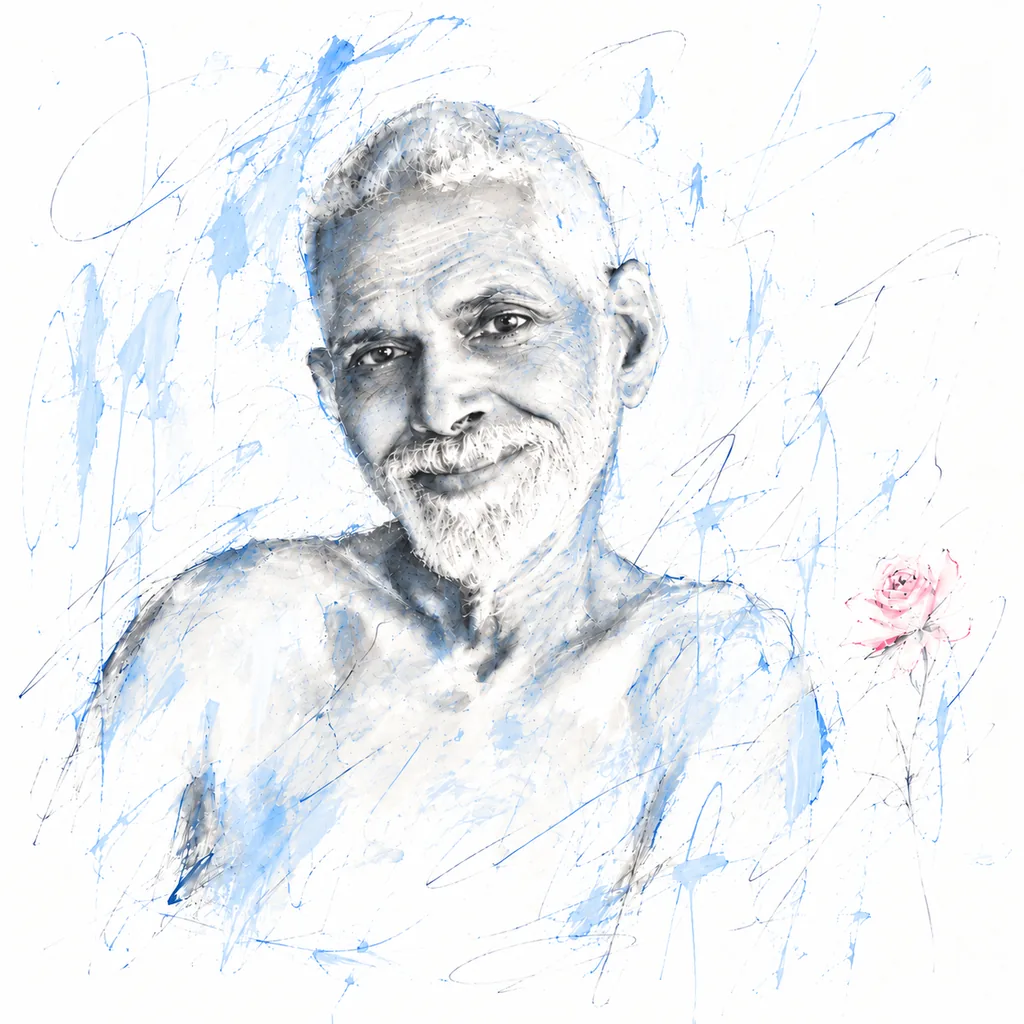
What does self-enquiry actually investigate?
Self-enquiry is not a search for a better description of your personality. Ramana’s question turns towards the subject to whom descriptions, perceptions and worries appear. His teaching distinguishes the ego, the thought that identifies itself with a particular body and story, from the Self, understood as fundamental awareness. This distinction belongs to his nondual religious account of reality. It is not a scientific finding that a particular kind of introspection proves an immortal entity exists. University teaching module
The practical point is the direction of attention. A worry normally leads into its content: what might happen, what somebody meant, what should be done. Enquiry asks to whom the worry appears and then examines that sense of self. Ramana’s texts describe returning attention to its source, rather than endlessly answering one thought with another. Understanding that change of direction is more useful at first than collecting increasingly elaborate definitions of consciousness. Self-Enquiry, referenced primary passages
Our reading is that two questions should remain separate: what the instructions ask the practitioner to attend to, and whether the metaphysical account offered for the result is convincing. Keeping both visible allows a reader to understand the practice without making premature claims about experience. Forsthoefel’s study likewise distinguishes Ramana’s cross-cultural appeal from the philosophical frameworks through which admirers have interpreted him. Forsthoefel, scholarly abstract
From Tiruchuli to Arunachala
- 1879: born Venkataraman in Tiruchuli, Tamil Nadu, on 30 December. The title by which he became known came later. Biographical cross-check
- 1896: as a teenager in Madurai he underwent an intense confrontation with the fear of death, later described as the recognition of the Self. He left home for Arunachala and remained in its vicinity for the rest of his life. The interpretation of the experience is his and his community’s. Official timeline
- 1899 to 1916: Virupaksha Cave became a principal residence; he later moved to Skandashram. Early written answers to visitors developed into short instructional texts. Caves and early teaching
- 1907: the Sanskrit scholar Ganapati Muni recognised him as a teacher and proposed the name Bhagavan Sri Ramana Maharshi. Ganapati Muni’s visit
- 1922 onward: his mother died; the community at the foot of the hill grew around her burial shrine into Sri Ramanasramam. The development of the ashram
- 1927 to 1939: important verse texts and the conversations later collected as Talks gave the teaching a substantial written record. Works and recorded conversations
- 1950: he died on 14 April after illness. His samadhi, or burial shrine, remains within the ashram. Final years; Shrines and halls
How do you begin, and what goes wrong?
Follow the sense of self, not an autobiography
The ashram’s instructional text gives a specific movement: when a thought arises, investigate to whom it has arisen; the reply points towards oneself, and attention then turns to the source of that self-sense. The intended result is not a verbal conclusion such as being a profession, a body or a bundle of memories. The text describes the questioning itself eventually subsiding. Mechanical repetition can therefore miss the action the words are meant to prompt. Who Am I?, adapted official text
For a first reading, follow the short text slowly enough to distinguish the arising thought, the ownership attributed to it and the attention directed towards its owner. That is our editorial way of parsing the instruction, not an additional initiation technique. David Godman’s interview stresses that merely obtaining an intellectual answer is different from the inward investigation Ramana describes. A sentence about awareness can itself become another object of thought. Godman on understanding and practising enquiry
Temporary quiet is not the whole claim
Godman distinguishes a temporarily quiet mind from the permanent change Ramana called liberation. This matters because a peaceful sitting can otherwise be treated as proof that the entire teaching has been realised. His interpretation presents sustained attention and the exhaustion of outward tendencies as important, while giving grace a decisive role. These are explanations within the teaching’s framework, not guarantees about the time a practice will take or independent clinical descriptions of mental states. Effort, stillness and the role of grace
Breath, devotion and everyday life
The official instructions describe breath regulation, repetition of divine names and devotional meditation as aids that can steady attention. They distinguish that temporary steadiness from enquiry into the root of the mind. Consequently, Ramana should not be reduced to a teacher who rejected every devotional or preparatory practice. The practical literature includes different approaches for different capacities, while continuing to present self-enquiry as direct. A short internet quotation rarely carries all of those qualifications. Aids and the limits of breath control
Nor does the instruction require everyone to imitate his teenage departure from home. The primary passages gathered by Arunachala Ashrama discuss enquiry through the ordinary sense of acting and existing, rather than making geographical withdrawal its defining operation. Our reading is that the distinction between the historical life and the instruction protects both: a dramatic biography need not become a universal prescription. The question concerns identification, even where responsibilities and activity continue. Primary passages on enquiry
Silence, surrender and the question of freedom
Why was silence so important?
Visitors often described an unusual peace in Ramana’s presence. Such reports are central to his reception, but should be attributed to the people who experienced them. His survival as a teacher of silence alongside a large archive of recorded conversation is not contradictory: speech could clarify a question, while admirers understood presence itself as instruction. Silence here is neither a prohibition on speaking nor sufficient evidence that every silent person possesses the knowledge devotees attributed to him. Brunton’s retrospective testimony
Enquiry and surrender
Surrender approaches the same problem through relinquishing the claim to be an independent doer, rather than through analysing its source. The source texts connect devotion, knowledge and the subsiding of the ego. Their language of the Heart refers to the centre or source of awareness within the teaching, not simply to an anatomical organ. Treating these terms as interchangeable with modern physiological descriptions would obscure what the texts actually assert. Passages from Self-Enquiry, Maharshi’s Gospel and verse works
Is everything predetermined?
Arvind Sharma’s article identifies a philosophical tension between Ramana’s teaching and modern confidence in effort and free will. This is a better entry than either declaring that people can control every outcome or concluding that effort is pointless. Enquiry asks about the identity of the agent who claims freedom or complains of destiny. That relocation of the question may be illuminating, but whether it resolves every ethical and philosophical difficulty remains a matter for argument. Sharma, article extract
The books: what to read and what each preserves
Who Am I? and Self-Enquiry
Start with Who Am I?, also known as Nan Yar?, which developed from answers to Sivaprakasam Pillai. It is brief enough to reread while checking the instructions against their context. Self-Enquiry, or Vicharasangraham, is a separate early text. Titles and translations can look similar in online collections, so check the work’s name and translator instead of assuming every page called self-enquiry reproduces the same booklet. Official introduction to Who Am I?; Referenced works and bibliography
Upadesa Saram and Forty Verses on Reality
Upadesa Saram, commonly translated as The Essence of Instruction, and Ulladu Narpadu, or Forty Verses on Reality, compress arguments into verse. They are useful after the introductory booklet because they place action, devotion, thought and reality in a more concentrated relation. A prose paraphrase can help, but it is not a substitute for checking the translated verse to which a commentator refers. Their compactness makes context particularly important. Authored works; Verse citations
Talks and later editorial collections
Talks with Sri Ramana Maharshi records conversations from 1935 to 1939 through Munagala Venkataramiah. It shows answers changing with questions and questioners. David Godman’s later work offers thematic selection and interpretation for modern readers. The distinction is editorially important: a conversation record, an authored poem and a later anthology are different kinds of evidence. A helpful anthology can make an entry easier while also obscuring the original occasion if citations are removed. Talks and compilations; Godman’s approach
What do visitors and scholars say?
Britain: Paul Brunton’s A Search in Secret India, published in 1934, introduced Ramana to a much wider English-language readership. In his later notebooks Brunton called him “the one Indian mystic who inspired me most”. The sentence describes a writer’s allegiance and remembered encounter. It does not require the reader to adopt Brunton’s claims of continuing inward contact. His testimony matters as a major channel through which a local teacher became internationally known. Notebooks, India, part 1; The 1934 book
India, Britain and Iraq: the ashram’s Mountain Path recalls the Tamil poet Muruganar and Western residents alongside other devotees. Its account says the British former officer A. W. Chadwick felt, “I have come home”, and describes S. S. Cohen, an Iraqi Jewish seeker, arriving in 1936. Such accounts record how a community remembers belonging. They should be read as devotional recollections, with attention to who is speaking, rather than as a uniform experience shared by all visitors. The Mountain Path, 2026, on devotees
Switzerland and comparative psychology: C. G. Jung discussed Ramana in his introduction to Heinrich Zimmer’s collection. The biographical reference records his insistence that Ramana be understood within Indian forms of holiness, rather than as an isolated marvel. This is an interpretive frame, not evidence that Jung became an initiated disciple. It also raises a question still relevant to international reception: what disappears when a teacher is extracted from language, place and religious culture? Jung, Zimmer and their reception
American scholarship: Thomas Forsthoefel examines both the appeal of holiness and the perennialist interpretations through which Indian and Western readers have approached Ramana. Perennialism seeks an underlying common core in religious experience. That lens can encourage dialogue, while also making different traditions seem more alike than their texts warrant. The study’s abstract is evidence of a scholarly question and approach, not access to every argument in the full article. Forsthoefel, Horizons
A sympathetic witness can also be a critic
Brunton’s notebooks preserve criticism of the ashram alongside continued reverence for Ramana. He distinguishes difficulties with people around the teacher from his judgement of the teacher himself, regrets earlier criticisms and rejects a report that he had sued Ramana. This is more historically useful than polishing their relationship into unbroken institutional harmony. It shows that admiration, separation and disagreement could coexist within one influential witness’s account. Retrospective clarifications; Brunton’s account of estrangement
A modern misconception concerns succession. The biographical record distinguishes people inspired by Ramana from a formally authorised lineage: he appointed no successor. Later teachers’ claims to inherit his insight therefore need their own evidence. The same caution applies to presenting immediate intellectual recognition as equivalent to the sustained enquiry described in the source texts. Scholarly and devotional interpreters do not all resolve that issue in the same way. Lineage and later reception; Practice and its claimed completion
Poetry, portraits and the camera
Ramana’s own poetry is the strongest art connection. The ashram describes the Marital Garland of Letters as a hymn requested by devotees for their alms rounds. Its language presents the individual soul as a bride and Arunachala as the bridegroom. That devotional imagery complicates a purely intellectual portrait of self-enquiry. The Five Hymns to Arunachala use longing, landscape and surrender as well as philosophical language; they are works to read as poetry, not merely containers for doctrines. Origins and language of the hymns
Henri Cartier-Bresson photographed the final period around Ramana’s death. The International Center of Photography holds a 1950 funeral photograph, credited as a gelatin-silver print and a gift from the photographer. Its catalogue title contains a geographical error, placing Tiruvannamalai in Sri Lanka; the ashram’s records locate it in Tamil Nadu, India. A collection record verifies an object’s existence but does not make every inherited catalogue label reliable. ICP collection record; Ashram location
What can you visit at Arunachala today?
Sri Ramanasramam’s visitor guide identifies Ramana’s samadhi, the Old Hall where he received visitors, his mother’s shrine and the Nirvana Room associated with his last days. It also describes the route towards Skandashram. These are distinct historical spaces, not interchangeable names for one retreat centre. The ashram remains a place of worship and study, so a visit involves entering a living community as well as seeing sites associated with a twentieth-century teacher. Official visitor guide
Accommodation requests, current access and the ashram’s daily activities should be checked directly with its office. Its official directory also lists satsang groups beyond India, providing a route for people who want shared reading without travelling to Arunachala. A listed local group is not evidence of an authorised spiritual successor. Our distinction is practical: choose between a pilgrimage, an extended stay and a local reading group according to the kind of encounter you actually seek. Accommodation and contact; Satsang directory
Questions people ask about Ramana Maharshi
Who was Ramana Maharshi?
Ramana Maharshi was a Tamil spiritual teacher, born Venkataraman in 1879, who lived near Arunachala after arriving there in 1896. He became known for self-enquiry, silent presence and a community that developed into Sri Ramanasramam. He died in 1950. Official timeline
What is his teaching in plain words?
Investigate the self that claims thoughts and experiences as its own. Ramana taught that this ego is not the fundamental Self, which he understood as awareness. That is his religious and philosophical account of reality, rather than an established scientific conclusion. University teaching module
How do I start self-enquiry?
Read the short official Who Am I? text first. Its instruction is to notice to whom a thought appears and then turn attention towards that sense of self, rather than pursuing the thought’s story. Repeating the question mechanically is different from the inward attention it describes. Official instructions
Which book should I read first?
Begin with Who Am I? and then consider Forty Verses on Reality or Upadesa Saram. Talks with Sri Ramana Maharshi offers a much larger record of answers to different visitors. Our reading order separates a short introduction, authored verse and recorded conversation. Who Am I?; Works and collections
Where are his ashram and samadhi?
Sri Ramanasramam is at Tiruvannamalai in Tamil Nadu, India, at the foot of Arunachala. Its visitor guide describes Ramana’s samadhi, the Old Hall, his mother’s shrine and the Nirvana Room. Check access and accommodation with the ashram before planning a stay. Visitor guide
Who were his students, and did he appoint a successor?
Important associates included Ganapati Muni, Muruganar, A. W. Chadwick and Arthur Osborne. Ramana appointed no formal successor, so later influence should be distinguished from authorised succession. A teacher’s use of his name does not by itself establish a lineage. Associates and succession; Devotee recollections
Is self-enquiry just repeating a mantra?
The primary texts distinguish enquiry into the source of the self-sense from mere verbal repetition. They also recognise mantra and devotional practice as possible aids to concentration. An intellectual answer or a temporary quiet state is not the entire transformation the teaching claims. Referenced primary passages; Godman’s explanation
Can I study his teaching outside India?
The official ashram site lists satsang centres and offers publications, audio and other resources. These can support shared study without a trip to Arunachala. Check an individual group’s current arrangements and distinguish its activities from claims of spiritual authorisation. Official satsang directory
Sources and image credits
Sources opened and checked on 26 October 2026. The comparison uses Wikipedia, the official ashram and the scholarly Cambridge abstracts by Sharma and Forsthoefel. Those abstracts and extracts are identified as such; the full journal articles were not available. Devotional testimony is attributed, and our readings are marked. This independent art site has no affiliation with this teacher, any lineage or any organisation mentioned here.
- Wikipedia, Ramana Maharshi, biographical and lineage cross-check
- Sri Ramanasramam, official site
- Sri Ramanasramam, life timeline
- Sri Ramanasramam, Who Am I? and instructions
- Arunachala Ashrama, Self-Enquiry, passages with work references
- David Godman, an interview on self-enquiry
- Sri Ramanasramam, Hymns
- Sri Ramanasramam, Visiting Us
- Sri Ramanasramam, satsang centres
- Paul Brunton, Notebooks, India, part 1
- Paul Brunton, Notebooks, The Profane and the Profound
- The Mountain Path, October to December 2026
- International Center of Photography, Cartier-Bresson funeral photograph, 1950
- Arvind Sharma, Predetermination and Free Will in the Teaching of Ramana Maharsi, Religious Studies
- Thomas A. Forsthoefel, Weaving the Inward Thread to Awakening, Horizons
- INFLIBNET, Indian Religion and Philosophy, university teaching module