Thinkers / No. 004
Adi Shankara: what does Tat Tvam Asi mean?
For Adi Shankara, the early medieval systematiser of Advaita Vedanta, Tat Tvam Asi means that the consciousness which is your essential self is identical with brahman, the nondual reality on which everything depends. Neil Dalal, Shankara, section 4.2
The claim concerns essential identity, not a person's body or ego becoming the ruler of the universe. Shankara develops it through commentary, argument and a method of teaching that distinguishes what changes from what supposedly remains constant. Read his account of error before turning his conclusion into a slogan about everything being one. Brahmasutra commentary, introduction, translated by George Thibaut
Begin with a mistaken identity
Our reading exercise: describe a familiar misperception, then separate the thing perceived, what you attributed to it, and the correction that followed. Shankara's introduction to the Brahmasutra commentary makes mistaken superimposition central to ordinary identity. We attribute bodily and mental characteristics to the self, and awareness to what is not itself aware. The exercise opens that argument without asking you to assume its whole conclusion. Thibaut, introduction to the commentary, pages 3–9
What makes the argument distinctive is its diagnosis of an everyday habit. Statements about being tall, injured, successful or confused appear to attach different kinds of property to the same first-person identity. Shankara treats this as a mixture of subject and object, rather than proof that the subject literally acquires every property of the body or mind. His liberation is meant to correct that fundamental misidentification. Brahmasutra commentary, introduction
Shankara in a short timeline
- Approximately eighth century CE: this is the usual scholarly orientation. The familiar 788–820 dates compete with earlier proposals, including Hajime Nakamura's 700–750. There are no dependable contemporary biographical records fixing his complete life. Dalal, life and works.
- Traditional early life: later hagiographies place his birth at Kaladi in present-day Kerala, describe early renunciation and extensive journeys, and associate him with Govinda as teacher. These narratives were composed centuries later and require a different evidential status from his philosophical writings. Dalal, sources for the life.
- Philosophical work: commentaries on the Upanishads, Bhagavad Gita and Brahmasutras become the core of his intellectual legacy. His independent Upadeshasahasri is another major source. Hundreds of other attributed works raise separate authorship questions. Dalal, textual corpus.
- Later Advaita: Padmapada and Sureshvara develop his teaching; later Bhamati and Vivarana schools disagree over aspects of ignorance and knowledge. The lineage preserves argument as well as authority. Sangeetha Menon, Advaita Vedanta.
- Circa 1904: the Ravi Varma image reproduced below represents Shankara with disciples. It documents much later visual reception, not his historical appearance. Commons work record.

Self, world and knowledge
Atman, ego and the witness
Atman is the self in the sense Shankara seeks to clarify; ahamkara is the ego or I-making function associated with mind and individuality. Memories, roles, sensations and plans differ, while his account maintains that awareness is presupposed by their appearing. The witness is therefore not another mental personality observing the first. It names consciousness considered apart from the changing conditions with which it is habitually identified. Dalal, consciousness and personal identity
The commentary's argument against treating the self as a newly produced effect is that someone must already be present as knower for proof, doubt and denial to occur. Denying the self presupposes a denier. This does not automatically establish every subsequent claim about brahman; it explains why Shankara treats awareness as foundational to inquiry instead of as an object that must first be discovered elsewhere. Brahmasutra commentary I.1.1
What the identity statement does
Ordinarily, you refers to a finite person and that may refer to the ground of the world. Taken with all their ordinary qualifications, the terms seem incompatible. Shankara's interpretation removes limiting bodily, mental and cosmic descriptions, identifying the awareness underlying the person with the existence underlying objects. The conclusion is identity at the level he regards as essential, not an enlargement of the personal ego into a cosmic individual. Brahmasutra commentary I.1.4, I.1.10–12 and discussion of Chandogya 6
The method compares continuity with discontinuity. A pot changes into another clay form while clay remains; waking gives way to dreaming while, on his account, awareness remains. Distinguishing what persists from what changes is meant to disclose dependence, not merely collect two similar experiences. Later Advaita develops technical accounts of secondary implication, but Dalal cautions that Shankara's own methods should not be mechanically reduced to later formulations. Dalal, section 4.2
What it means to call the world less than ultimately real
Shankara argues that an effect has no independent existence apart from its cause. Clay objects have different names and uses, but do not add a second substance to clay. Applied to brahman and the universe, the model makes ordinary things dependent, rather than independently self-grounding. The analogy is not a licence to ignore their practical functions: a pot and a lump do not perform the same task. Brahmasutra commentary II.1.14
The distinction between empirical and ultimate standpoints is crucial. At the empirical level, people, actions, perception and consequences are available for ordinary dealings. At the ultimate level, Shankara denies an independently existing plurality alongside brahman. These are not two separate universes of equal status. Their asymmetry explains why claims made in one register can be misleading when read as statements in the other. Brahmasutra commentary II.1.14 and its discussion of experience before knowledge
Shankara also rejects the idea that the external world is merely the private projection of an individual's mind. In his criticism of Buddhist idealist arguments, ordinary cognition is treated as disclosing external objects, and waking experience differs from dreams. The mistake he targets is attributing independent ultimate reality to what is dependent, rather than accepting the everyday existence of other people as a personal fantasy. Overview of his realism and Buddhist criticism; Dalal, metaphysics.
Brahman, God and devotion
The distinction between unqualified brahman and Ishvara, the Lord understood with cosmic attributes, lets Shankara discuss devotion and creation without assigning ultimate reality an intrinsic change. Ishvara belongs to an account of the world as ordered and intelligible; brahman considered ultimately has no limiting attributes. The two should not be portrayed as rival gods or as independently existing substances. Menon, brahman, jiva, Ishvara and maya
Maya and avidya explain appearance and misapprehension, but their relation generates later disagreements. The Bhamati and Vivarana schools do not simply supply interchangeable terminology. Their debates include where ignorance is located and how liberating knowledge occurs. This is one reason to distinguish Shankara's own commentaries from a textbook system assembled out of several centuries of Advaita. Menon, history and later schools
Knowledge and preparation
Shankara gives ethical and attentional preparation a serious role. Discrimination, detachment, restraint and a desire for liberation prepare someone to investigate the text's meaning. Yet action cannot produce an eternal self that, by definition, is already present. Knowledge removes ignorance; it does not manufacture brahman. This distinction underlies his disagreement with approaches that make liberating knowledge a product of ritual action alone. Brahmasutra commentary I.1.1 and I.1.4
Listening, reflection and contemplation form a teaching process: hearing the relevant statements, resolving doubts through reasoning, and assimilating their implications. The text is treated as a means of knowledge, while reasoning tests interpretations and removes obstacles. This makes Shankara a philosopher who uses argument within a commitment to Upanishadic authority, rather than someone claiming to derive nonduality entirely from religiously neutral premises. Brahmasutra commentary I.1.3–4
Liberation is accordingly described as recognition rather than a future achievement added to the self. Dalal distinguishes this from a temporary mystical union or a moment of mental blankness. The difficulty is philosophical: how can a cognition occurring in time remove ignorance about what is held to be timeless? Later interpreters disagree over the precise work of contemplation and the relation between a teacher's words and immediate understanding. Dalal, liberation and contemplative methods
What people say: an influential and disputed philosopher
Neil Dalal at the University of Alberta calls Shankara a “systematizer of Advaita Vedānta, not a founder.” That formulation gives Gaudapada and earlier Upanishadic teachers their due without diminishing Shankara's distinctive synthesis. Japanese scholar Hajime Nakamura's earlier dating proposal and Karl Potter's chronology show that even basic biographical orientation is still an argument from indirect evidence rather than a recovered birth certificate. Dalal, life and works
Russian scholar Natalia Isayeva's Shankara and Indian Philosophy places him among Indian intellectual traditions rather than treating Advaita as an isolated revelation. Her publisher describes an analysis of his relation to prior and contemporary systems. That historical approach matters because his writings repeatedly construct opponents and answer objections: Vedantic identity is articulated through debate, including disagreement with Buddhist and other Brahmanical positions. Isayeva, book description and contents
Critics within Vedanta reject the account of difference as dependent appearance. Ramanuja's qualified nondualism and Madhva's dualism preserve distinctions differently; Advaita's claim that the self is brahman is therefore not a proposition accepted by every Vedantic school. The Wikipedia benchmark also records the accusation that Advaita concealed Buddhist ideas. Such charges belong to polemical reception and need to be distinguished from the narrower historical question of influence. Shankara, criticism and Buddhist comparisons
Anantanand Rambachan's The Advaita Worldview develops a contemporary account centred on the meaning of nonduality and its implications. The publisher presents it as an interpretation engaging issues of knowledge, creation and the relationship of the world to brahman. Its existence demonstrates continuing constructive argument within the tradition, rather than a single uncontested modern version of Shankara. Rambachan, publisher description
A striking international reader was Austrian physicist Erwin Schrödinger. Dutch historian Thijs Latten's study reconstructs the route through Schopenhauer and Deussen and argues that Shankara's Advaita, rather than an undifferentiated Indian wisdom, shaped Schrödinger's identity doctrine. Latten discusses both philosophical use and consolation. This is evidence of reception across disciplines, not a claim that quantum theory experimentally proves Shankara's account. Latten, Schrödinger's Doctrine of Identity
Which Shankara works and translations should you read?
The commentaries and the independent teaching work
The Upanishads, Bhagavad Gita and Brahmasutras form Vedanta's threefold textual foundation. Shankara's commentaries interpret them as converging on nonduality. The Upadeshasahasri, usually rendered A Thousand Teachings, is an independent teaching work rather than a verse-by-verse commentary. Our suggested route is to begin with its account of instruction, then compare a short Upanishad commentary with the densely argumentative Brahmasutra text. Dalal, corpus and English translations
For a free primary source, Thibaut's nineteenth-century Brahmasutra translation is public domain. Start with Shankara's introduction on superimposition and I.1.1–4; the long translator's introduction is separate editorial material, not Shankara speaking. For modern study, Sengaku Mayeda's translation of A Thousand Teachings is listed in Dalal's bibliography. Choosing it first is our reading recommendation, not a scholarly ranking of every translation. Thibaut primary text; English translations.
Works attributed to him need their own evidence
The popular Vivekachudamani and numerous hymns belong to a larger attributed corpus whose authorship is debated. A work circulated under Shankaracharya's name need not have been written by the commentator of the Brahmasutras; later holders of that title complicate attribution. This does not make the works uninteresting, but it changes what they can prove about this historical thinker's exact views. Shankara, works and attribution
Shankara, beauty and the image of a teacher
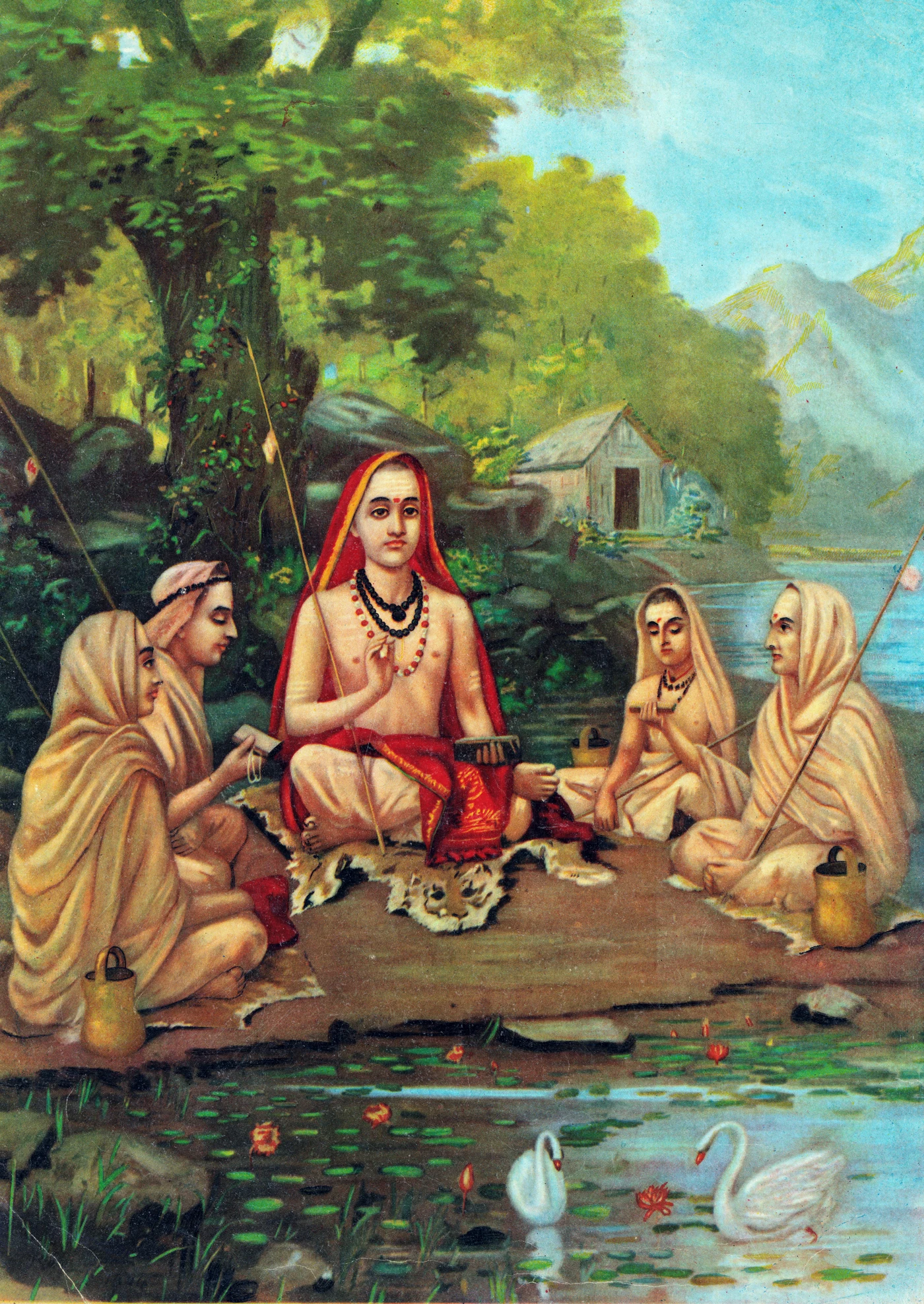
The Ravi Varma print gives a documented artistic afterlife: a teacher is placed among pupils, making transmission visible. Its circa 1904 date is far removed from the medieval thinker. Our reading is that the grouping can prompt attention to teaching as a relation among people, which complements the philosophical texts' repeated concern with instruction; it cannot authenticate the participants' historical appearance. Commons, artist, title, date and medium
Shankara's arguments about perception do not amount to a systematic theory of fine-art beauty. Later texts and hymns attributed to him introduce other devotional and aesthetic registers, but their authorship must be established before they can be used as direct evidence of his own aesthetics. The secure connection here is a philosophy of perception and a documented artistic reception, rather than a claim that he prescribed an abstract visual style. Corpus and disputed attribution
Our proposed nondual sculpture would present several apparent compartments within a continuous material or space, allowing viewers to discover that their boundaries do not produce separate substances. It borrows from the clay and jar-space arguments. The analogy remains partial: every actual sculpture has forms and relations, whereas Shankara's ultimate brahman is not a finite object with attributes that a sculpture could literally reproduce. Brahmasutra commentary II.1.14; Jar-space commentary, Karika III.
What survives beyond the slogan
Shankara's legacy includes a sustained method for relating consciousness, language and dependence, as well as institutions and devotional memories associated with his name. The four principal monasteries and extensive journeys belong to traditions whose historical details require scrutiny. His texts provide firmer evidence for assessing the philosophical achievement: he develops a nondual reading of inherited sources while answering rival accounts of self, action and world. Institutional and intellectual legacy; Isayeva.
Questions people ask about Adi Shankara
How does Adi Shankara explain Tat Tvam Asi?
He reads it as the identity of your essential consciousness with brahman, the ground of everything. The identity excludes the finite bodily and mental qualifications of the ordinary person. It does not mean that the individual ego becomes an omnipotent being. Brahmasutra commentary I.1.4 and discussion of Chandogya 6
What is Advaita Vedanta according to Adi Shankara?
It is a nondual interpretation of the Upanishads in which atman is brahman and the experienced world has no independent existence apart from brahman. Liberation comes through knowledge that removes misidentification. Ethical preparation and reasoning support inquiry, while Upanishadic statements provide its distinctive authority. Brahmasutra commentary I.1.1–4
How does Shankara distinguish the Self from the ego?
The ego is associated with the changing individual mind and its sense of being a doer or owner. The Self is consciousness, presupposed by the knowing of those mental states. Shankara diagnoses ordinary identity as a superimposition of bodily and mental characteristics on that self. Commentary, introduction on superimposition
What does the identity of atman and brahman mean for Shankara?
It means that the reality of the self and the reality underlying the world are numerically one, rather than two substances that later merge. Differences belong to limiting descriptions within experience. Knowledge is meant to remove those mistaken identifications, not create an identity that was previously absent. Brahmasutra commentary I.1.4 and II.1.14
What kind of art can represent Shankara's nonduality?
Our suggestion is a work in which apparently separate forms disclose one continuous material or space. It interprets the clay and jar-space analogies rather than representing brahman literally. The Ravi Varma print is a documented later representation of Shankara himself, which is a different kind of artistic connection. Historical print; Jar-space analogy and commentary.
When did Adi Shankara live?
Most scholarly accounts place him around the eighth century CE. The often repeated 788–820 dates are not secure, and Nakamura argued for 700–750. His philosophical writings are firmer evidence than the hagiographies composed centuries later. Dalal, life and works
Which Shankara book and translation should I read first?
Our suggested first book is Upadeshasahasri, A Thousand Teachings, in Mayeda's translation. For a free public-domain alternative, read Shankara's introduction and opening discussion in Thibaut's Brahmasutra commentary. Keep the translator's long introductory essay separate from the translated primary text. Translation bibliography; Thibaut text.
How is Shankara's philosophy practised?
Its teaching method involves listening, reflection and contemplation, supported by discrimination, restraint and detachment. Knowledge removes ignorance about an already present self; practice does not manufacture brahman. That makes sustained understanding more central than chasing a temporary altered state. Brahmasutra commentary I.1.1–4
Does Shankara say the world is just an illusion?
He denies the world's independent ultimate reality while retaining an empirical standpoint in which perception, action and consequences operate. Calling everything a private fantasy misses this distinction. His position is a philosophical account of dependence and knowledge, not permission to disregard the practical existence of other people. Brahmasutra commentary II.1.14
Sources and image credits
Sources consulted on 26 October 2026. Primary texts, later interpretations and this page’s proposed art exercises are distinguished above. Image rights are linked in their captions.
- Neil Dalal, Shankara, Stanford Encyclopedia of Philosophy (2021)
- Shankara, Brahmasutra commentary, translated by George Thibaut, Sacred Books of the East 34 (1890); public-domain primary text, archive OCR
- Sangeetha Menon, Advaita Vedanta, Internet Encyclopedia of Philosophy
- Wikimedia Commons, Raja Ravi Varma, Srimad Guru Adi Shankaracharya, circa 1904; public-domain rights record
- Wikipedia, Adi Shankara: benchmark overview and cited bibliography
- Natalia Isayeva, Shankara and Indian Philosophy, SUNY Press description and reviews
- Anantanand Rambachan, The Advaita Worldview, SUNY Press description
- Thijs M. K. Latten, Schrödinger’s Doctrine of Identity, Berichte zur Wissenschaftsgeschichte (2025)
- Mandukya Upanishad, Gaudapada Karikas and Shankara commentary, translated by Manilal N. Dvivedi (1894; 1909 printing); public-domain primary translation