Teachers / No. 002
Swami Vivekananda
Swami Vivekananda (1863 to 1902) was an Indian Hindu monk and disciple of Ramakrishna who taught Practical Vedanta, addressed the 1893 Parliament of Religions in Chicago and founded the Ramakrishna Mission. Belur Math biography
Read the speeches beside the institutions and images they helped create. This guide connects the four paths, service, international reception and the questions a first reader needs answered.
Why does the 1893 speech still matter?
Vivekananda's Chicago appearance matters because a Hindu monk addressed a largely Western audience in his own voice, explaining a living religious tradition rather than appearing only as an object of missionary or Orientalist description. Harvard's Pluralism Project locates the encounter within Americans' earlier fascination with Indian thought and their limited personal acquaintance with Hindus. His subsequent lectures turned an appearance at a congress into a sustained exchange. Harvard Pluralism Project
His opening address on 11 September 1893 is brief enough to read whole. It thanks the gathering, celebrates hospitality and condemns sectarian violence. The later Paper on Hinduism develops the larger argument about the soul, religious experience and different paths. Reading only the famous greeting misses the philosophical claims; reading only the philosophy misses the performance of welcome that made his appearance memorable. Chicago addresses, full texts
He was neither the only Hindu participant nor an elected spokesman for every Hindu community. His speeches present a particular, expansive interpretation of Hinduism, shaped by Ramakrishna, colonial India, Western education and his own travels. An encyclopedic account therefore calls his teaching a creative transformation, rather than a transparent repetition of an unchanged ancient system. Encyclopedia of Religion, hosted by Encyclopedia.com
A short timeline: Calcutta, Chicago and Belur
His family combined professional success with religious and intellectual interests. His father, Vishwanath Datta, was an attorney; his mother was Bhuvaneshwari Devi. His father's death in 1884 left the family in financial difficulty while Narendra struggled to find work. The official biography places that crisis alongside Ramakrishna's final illness, when the young disciples shared nursing duties. This gives the later emphasis on service a biographical setting beyond an abstract theory of charitable action. Belur Math, early life and difficulties
- 1863: born Narendranath Datta on 12 January in Calcutta, now Kolkata. His education included Western philosophy, literature and science. Belur Math biography
- 1881 to 1886: met Ramakrishna, questioned his claims, and eventually became his disciple; Ramakrishna died in 1886. biographical chronology
- Late 1880s to 1893: monastic life and travel through India preceded his journey to America, supported by Indian admirers and patrons. Belur Math
- 1893: addressed the World's Parliament of Religions in Chicago, followed by teaching in America and Europe. Harvard
- 1897 to 1898: founded the Ramakrishna Mission on 1 May 1897; acquired the Belur site in 1898. institutional history
- 1902: died at Belur Math on 4 July, aged thirty-nine. Belur Math
After Ramakrishna's death, the young disciples lived at Baranagar and took formal monastic vows in 1887. Vivekananda's later travels brought him into contact with poverty and regional differences across India. The official account identifies support from Chennai disciples and the Raja of Khetri for the journey to America, which began from Mumbai on 31 May 1893. The transatlantic exchange rested on Indian fundraising and patronage before it acquired Western supporters. Belur Math, brotherhood and journey
What does Practical Vedanta mean?
The divinity of the person is a claim with consequences
In Vivekananda's account, the deepest identity of a person is not exhausted by body, social position or changing thought. He describes spiritual life as manifesting a divinity already present. This is a Vedantic religious claim about the Self, not a scientific finding about human biology. Its ethical consequence is that dignity belongs to the person encountered, including someone poor, excluded or unable to offer anything in return. Vivekananda, The Four Paths of Yoga; Belur Math's account of his message
Four paths, suited to different temperaments
He distinguishes work, devotion, mental discipline and knowledge as routes that can be combined. Karma yoga concerns action without possessive attachment to its reward; bhakti yoga develops devotion; raja yoga concerns the disciplined mind; jnana yoga asks what the Self is through discrimination and inquiry. The classification makes room for different starting dispositions instead of requiring every seeker to have the same emotional or intellectual style. Yoga here extends beyond postures to a programme aimed at liberation. The Four Paths of Yoga
Service belongs inside spiritual life
His institution gave practical form to this claim. The Ramakrishna Mission joined monks and lay people in education, medical work, rural development and disaster relief. Its foundation in 1897 matters because it placed organised service alongside personal illumination in a modern monastic movement. The official biography explicitly presents the two as compatible responsibilities, rather than making social work merely a recruitment device for meditation. Belur Math, founding of the Mission
Acceptance, experience and a difficult universalism
At Chicago he argued for more than grudging tolerance. His speeches present religions as different approaches to spiritual truth and insist on realisation rather than assent to propositions alone. Yet they also describe Hinduism as especially capable of explaining that diversity. That combination creates an enduring question: can an inclusive framework fully respect other religions if it interprets their claims through its own philosophical categories? The question arises from the speeches themselves. Chicago addresses
A practical beginning
Our suggested first week is to read the short Chicago addresses, choose one of the four paths for closer study, and connect that reading with a small, regular responsibility toward another person. This is an editorial study plan, not Vivekananda's prescribed seven-day course. His own concise account allows the paths to work together; the Mission's history demonstrates why inquiry need not be detached from public usefulness. Four Paths; Belur Math
What people say, from India to Europe and America
The power of a voice on the page
The French writer Romain Rolland heard musical force in the prose: “His words are great music.” Belur Math's anniversary biography reproduces his comparison with Beethoven and Handel. This is reception by a literary reader at a distance, not a recording of the Chicago delivery. Rolland's language helps explain why later admirers encounter Vivekananda as an orator even when their direct experience consists of reading translated or edited texts. Anniversary biography quoting Rolland
The same biography records the American philosopher William James's description, “Paragon of Vedantists,” and names the German scholar Paul Deussen and Oxford philologist Max Müller among his admirers. Harvard's account independently documents James's friendship with Vivekananda and his two speaking engagements at Harvard. These are specific intellectual contacts; they do not imply that every thinker accepted his metaphysics or that the university endorsed his religion. Belur Math anniversary account; Harvard Pluralism Project
India: confidence, education and national memory
Vivekananda returned to India with a message addressed to the condition of its people, not simply with stories of Western applause. The official biography highlights education, the position of women, poverty and the need to translate Vedanta into daily life. His reception as a national figure is inseparable from colonial conditions: presenting Indian thought as intellectually serious also challenged an imperial hierarchy of cultures. Belur Math, return to India and contributions
Irish-born Margaret Noble, known as Sister Nivedita, became a disciple and devoted herself to girls' education in Kolkata. Josephine MacLeod, Sara Chapman Bull and the Seviers were among the Western friends or disciples who supported the work in different ways. Their roles show how the movement grew through teaching, money, travel and relationships as well as speeches. They should not be reduced to a decorative list of famous converts. Belur Math, disciples
What scholars question
The Encyclopedia of Religion treats Practical Vedanta as a creative reworking shaped by several encounters: Ramakrishna's religious life, Brahmo reform, Western rationalism and colonial representations of India. That challenges a familiar misconception that his system simply reproduces an uncontested ancient consensus. It also makes his relationship to Ramakrishna a historical question: institutional service and global public argument developed in a different setting from his teacher's conversations at Dakshineswar. Encyclopedia of Religion
His legacy also raises political questions. Universal acceptance, Hindu self-assertion and national regeneration coexist in the record; later political uses do not automatically tell us his intention in every passage. His Chicago speeches attack fanaticism, while his Indian addresses call for strength and collective renewal. Read the particular text and audience before turning him into either an uncomplicated secular liberal or a spokesman for every later nationalist programme. Chicago texts; institutional biography
Which books should you read first?
The Chicago addresses
Begin with the complete group of Parliament speeches, rather than a quotation graphic. Their occasions differ: opening welcome, explanation of Hinduism, discussion of religious difference and a final appeal against destruction. Belur Math publishes them together, making it possible to distinguish the short address that made his name from the fuller argument. This is the most economical introduction to his public voice. Speeches at the Parliament
Karma Yoga, Raja Yoga, Bhakti Yoga and Jnana Yoga
Choose Karma Yoga for work and attachment, Raja Yoga for the mind and meditation, Bhakti Yoga for devotion, and Jnana Yoga for philosophical inquiry. These titles are gateways into different parts of a larger body of lectures and writing, not four compulsory memberships. His short Four Paths statement explains the intended relationship between them. Read historical claims about science as claims made in their period. works and publication history; Four Paths
Biography and the Complete Works
The official reading list includes Vivekananda: A Biography, the life written by his Eastern and Western disciples, Reminiscences, and Marie Louise Burke's Swami Vivekananda in the West: New Discoveries. Use a biography to keep the travels in order, then follow dated letters and lectures in the Complete Works. This avoids treating a private letter, a public polemic and a systematic exposition as interchangeable kinds of evidence. Belur Math's recommended reading
The teacher and art: an emblem that explains a programme
Vivekananda designed the Ramakrishna Order's emblem. Its symbols have an explicit explanation: waves stand for work, the lotus for devotion, the rising sun for knowledge, the encircling serpent for yoga and awakened kundalini, and the swan for the supreme Self. Here a graphic image carries his synthesis of paths in a form that can be apprehended at once. These meanings come from the institution's account, not a free symbolic reading imposed by this page. Belur Math, emblem and explanation
Belur Math's Vivekananda temple supplies another artistic afterlife. The ground-floor shrine contains a marble relief, while the upper storey houses a marble Om in Bengali script. Built on his cremation site, it joins portraiture, sacred lettering and memorial architecture. Its institutional history also records the slow fundraising that delayed completion, a reminder that monuments emerge through practical decisions as well as spiritual ideals. Vivekananda temple
His cultural life also included singing and poetry. Biographical accounts identify his musical ability as important in his encounters with Ramakrishna; the published corpus includes poems alongside speeches, letters and essays. That evidence supports a connection between teaching and artistic expression. It does not justify attributing a single visual style to him or claiming that every modern image of a turbaned monk records his own aesthetic preferences. biography and writings
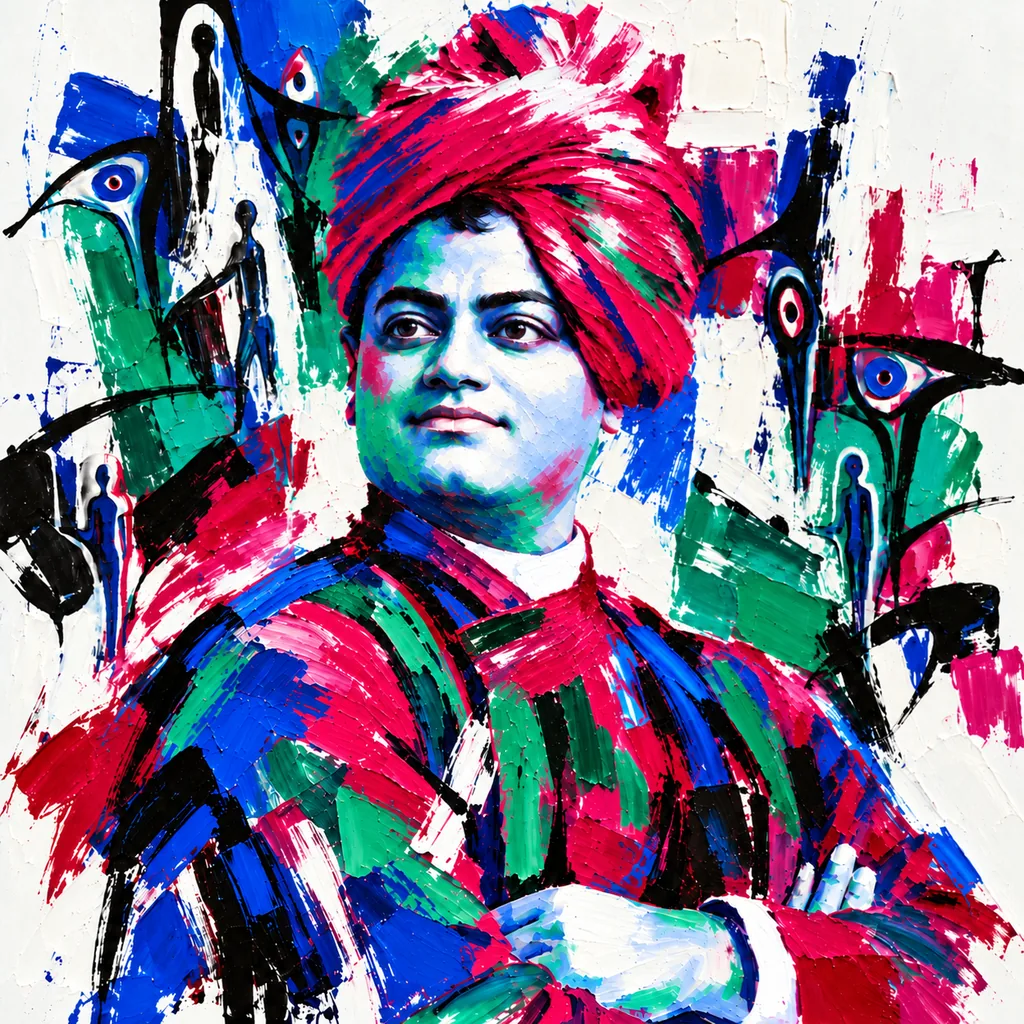
Our reading of Baudoin's portrait centres on the bright red turban against green and blue passages. The recognisable head and folded arms give the energetic marks a human anchor. This is a contemporary painted interpretation for the site; its repeated eyes and silhouettes are the painter's visual vocabulary, not an illustration of a meditation instruction left by Vivekananda.
Places, centres and the continuing institution
Belur Math, West Bengal: begin with the monastery beside the Ganga, his room and the Vivekananda temple on the cremation site. The temple is the appropriate answer to a search for his samadhi memorial. The monastery's visitor and accommodation information should govern any planned stay; a functioning religious institution does not imply unrestricted access to every building or the availability of a casual overnight retreat. temple guide; Belur Math visitor information
Centres beyond India: the Ramakrishna Math, Mission and associated Vedanta centres preserve different aspects of his work through worship, classes, libraries and service. The official site provides contact information for centres and distinguishes accommodation enquiries from general correspondence. Check the particular centre's programme before expecting an English-language talk, meditation session or residential retreat. The enduring network is a documented institutional legacy, not proof that every local programme is identical. Belur Math, organisation and centre links
Ramakrishna is his principal teacher; Sarada Devi and the other early disciples belong to the living community in which the order developed. Vivekananda did not create Hinduism or invent meditation. His distinctive contribution was to formulate a public interpretation, organise a durable movement and connect spiritual discipline with service across national boundaries. This art site has no affiliation with that movement or its centres. official biography; historical overview
Questions people ask about Swami Vivekananda
Who was Swami Vivekananda?
Vivekananda was an Indian Hindu monk, born Narendranath Datta in 1863, who became a disciple of Ramakrishna and founded the Ramakrishna Mission in 1897. His 1893 Chicago addresses helped introduce his interpretation of Vedanta to a wider international public. He died at Belur Math in 1902. Belur Math biography
What was his main teaching?
He taught that spiritual life manifests the divinity of the Self through work, devotion, mental discipline and knowledge. Practical Vedanta connects that religious claim with responsibility toward other people. It is a philosophical and spiritual position, not an experimentally demonstrated description of every person. The Four Paths of Yoga
How can a beginner start practising his ideas?
Our suggested introduction is to read the Chicago addresses, study one of the four paths and connect the reading with a regular act of useful service. This is an editorial starting plan rather than a historical course prescribed by Vivekananda. His own account allows the paths to be combined. Four Paths
Which Vivekananda book should I read first?
Begin with the Chicago addresses for his public message. Choose Karma Yoga for work, Raja Yoga for meditation, Bhakti Yoga for devotion or Jnana Yoga for inquiry. Use a biography alongside the Complete Works to keep dates and audiences in view. Chicago texts; Recommended reading
What did he say at Chicago in 1893?
His opening welcome celebrated religious hospitality and condemned sectarianism. Later addresses explained his account of Hinduism, religious experience and the relationship between paths. Reading the full group gives a more accurate picture than treating the famous greeting as the whole speech. Full Parliament addresses
Where can I visit his memorial or attend a centre?
His temple at Belur Math stands on his cremation site. The monastery's website also provides links and contact information for its wider network of centres. Confirm local programmes and accommodation directly, since a temple visit and a residential retreat require different arrangements. Vivekananda temple; Belur Math
Who was his teacher, and who were his students?
His principal teacher was Ramakrishna. Sister Nivedita, Josephine MacLeod, Sara Chapman Bull and the Seviers were among his Western disciples or close supporters, with different responsibilities. The order also developed through his Indian brother monks and disciples. Belur Math, disciples and monastic work
Did Vivekananda invent yoga or speak for all Hindus?
No. He interpreted existing traditions and was one of several Hindu participants at the Parliament. His influential synthesis should be read as a particular modern account, shaped by his teacher, education and historical circumstances, rather than a statement that every Hindu school accepts in all details. Encyclopedia of Religion
What is his connection with art?
He designed the Ramakrishna Order's emblem, using waves, lotus, sun, serpent and swan to represent a synthesis of spiritual paths. His memorial temple also contains a marble relief and a Bengali Om. These documented works offer firmer ground than speculative claims about an artistic style named after him. Emblem; Temple
Sources and image credits
Sources opened and read for this page on 26 October 2026. Institutional biographies document a community's account; scholarship and reference works provide comparison. Interpretations marked as ours belong to this independent art site.
Portrait © Piet Baudoin. Painted for this site and supplied by the artist; all rights reserved. No historical photograph or third-party artwork is reproduced.
- Belur Math, Swami Vivekananda, institutional biography and reading list
- Harvard University Pluralism Project, Vivekananda at the Parliament
- Swami Vivekananda, Speeches at the Parliament of Religions, Chicago, 1893, full texts at Belur Math
- Encyclopedia.com, Vivekananda, including Encyclopedia of Religion and Oxford reference entries
- Wikipedia, Swami Vivekananda, chronology, publications and references
- Swami Vivekananda, The Four Paths of Yoga, Complete Works, volume 8
- Belur Math, Emblem, design by Vivekananda and explanation of its symbols
- Belur Math, About Swami Vivekananda, 150th anniversary biography and attributed assessments
- Belur Math, Swami Vivekananda Temple, memorial history and design