
Thinkers / No. 011
Who was Meister Eckhart, and what did he teach?
Meister Eckhart (about 1260 to 1328) was a German Dominican friar who twice held the chair of theology at Paris and preached in German. He taught that God speaks his Word in the ground of the soul, and that whoever lets go of self-will and every why finds no distance there between seer and seen: “The eye with which I see God is the same with which God sees me.” Accused of heresy, he appealed to the pope at Avignon and died, probably in 1328, before any verdict. On 27 March 1329 a papal bull condemned 28 of his propositions. Griffioen, Stanford Encyclopedia of Philosophy, section 1; Sermon IV, translated by Claud Field, 1909
The title Meister is not a guru’s honorific. It renders the Latin magister, the rank of a fully qualified university master. Eckhart wrote his scholarly works in Latin and his sermons and short treatises in Middle High German, and the Latin works have still never been fully translated into English. This page follows him from the priory in Erfurt to the papal court, explains his key words in plain language, gathers how readers from Kyoto to Delhi to Rome have read him, and ends with what to read first and where to stand in the rooms he knew. SEP, introduction and section 3
What happened in Eckhart’s life, from Tambach to Avignon?
Meister Eckhart’s life ran from a Thuringian village to the summit of medieval learning and ended in a trial far from home. The dates below are the ones the sources agree on; where they differ, both readings are given. SEP, Life; The Eckhart Society, Eckhart: The Man
- About 1260: Born, most likely in or near Tambach, close to Erfurt. Little is known of his family; the old claim of a noble family rests on a misreading of archives, and there is no basis for the first name Johannes that some sketches give him. Wikipedia, Early life
- Late teens: Enters the Dominican priory in Erfurt. The Eckhart Society gives the age as fifteen; Wikipedia places it around 1278, at about eighteen. Eckhart Society; Wikipedia, Career
- Before 1280: Probably studies at Cologne; the influence of Albert the Great on his formation suggests he was there before Albert’s death in 1280. SEP, citing Sturlese 2013
- 1293 to 1294: Lectures on the Sentences of Peter Lombard in Paris. On 18 April 1294 he preaches the Easter sermon at the church of St Jacques, the first certain date of his life. Eckhart Society
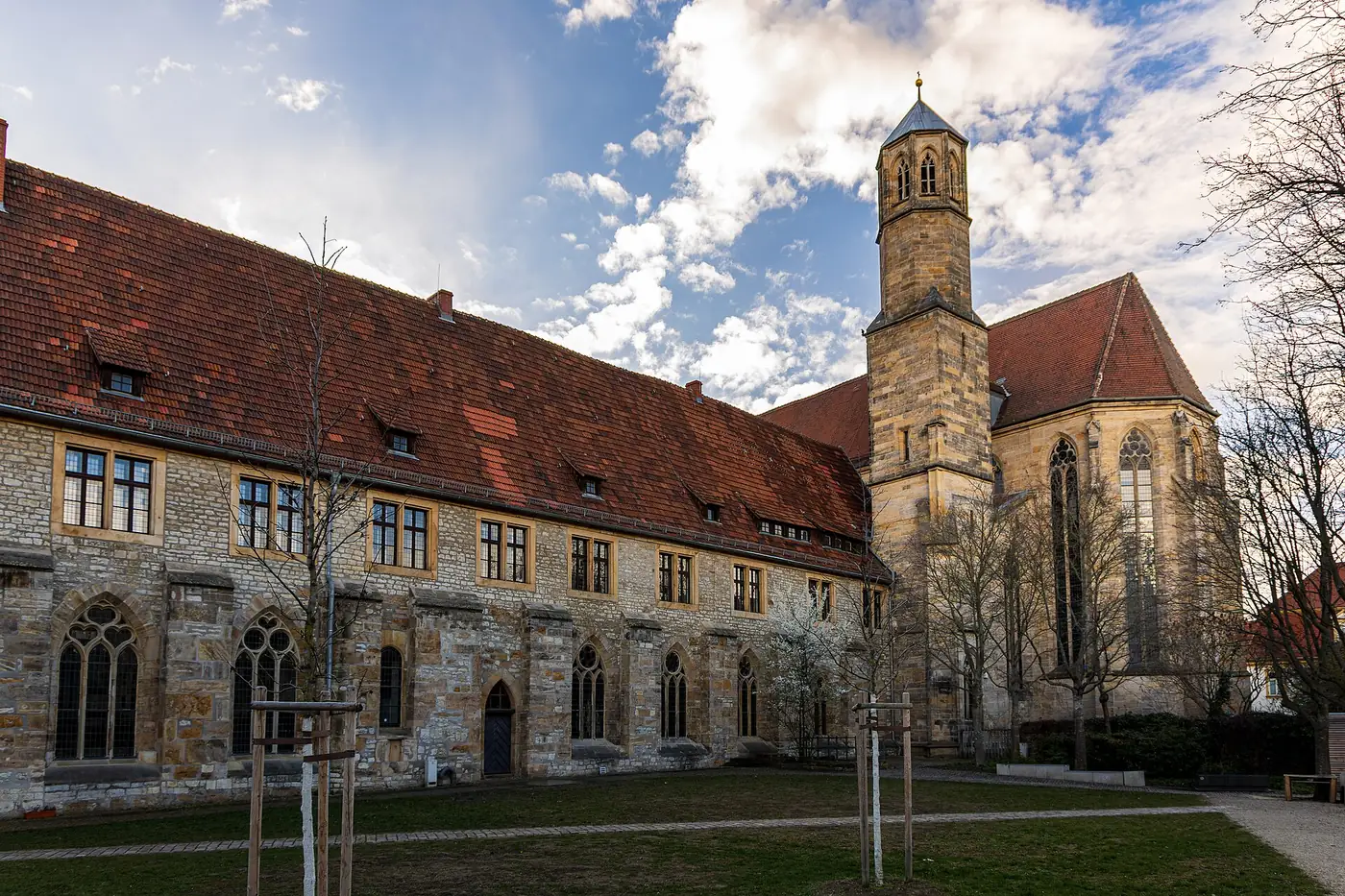
- 1294 to about 1298: Prior of Erfurt and vicar of Thuringia. To the novices and young friars there he gives the Talks of Instruction. Erfurt Tourismus, Prediger Church
- 1302: Returns to Paris as magister actu regens, holder of the external Dominican chair, then the summit of a scholastic career. SEP
- 1303 to 1311: First provincial of the new province of Saxony, responsible for at least 47 houses in eastern and northern Germany and the Low Countries; he founds three convents for women. SEP
- 1311: Called back to Paris for a second term as master, a distinction previously granted only to Thomas Aquinas. SEP, citing McGinn and Ruh
- 1313 to 1323: Strasbourg, as special vicar of the Master General. He counsels Dominican nuns and Beguine houses, and many of the German sermons date from these years. Eckhart Society
- 1323 to 1326: Cologne, teaching at the Dominican studium, where Johannes Tauler and Henry Suso come into contact with him. Two Dominicans who were themselves accused of corruption compile lists of suspect sentences; in 1326 a list of 74 propositions reaches Archbishop Henry II of Virneburg, and on 26 September Eckhart appears before the diocesan commission. SEP
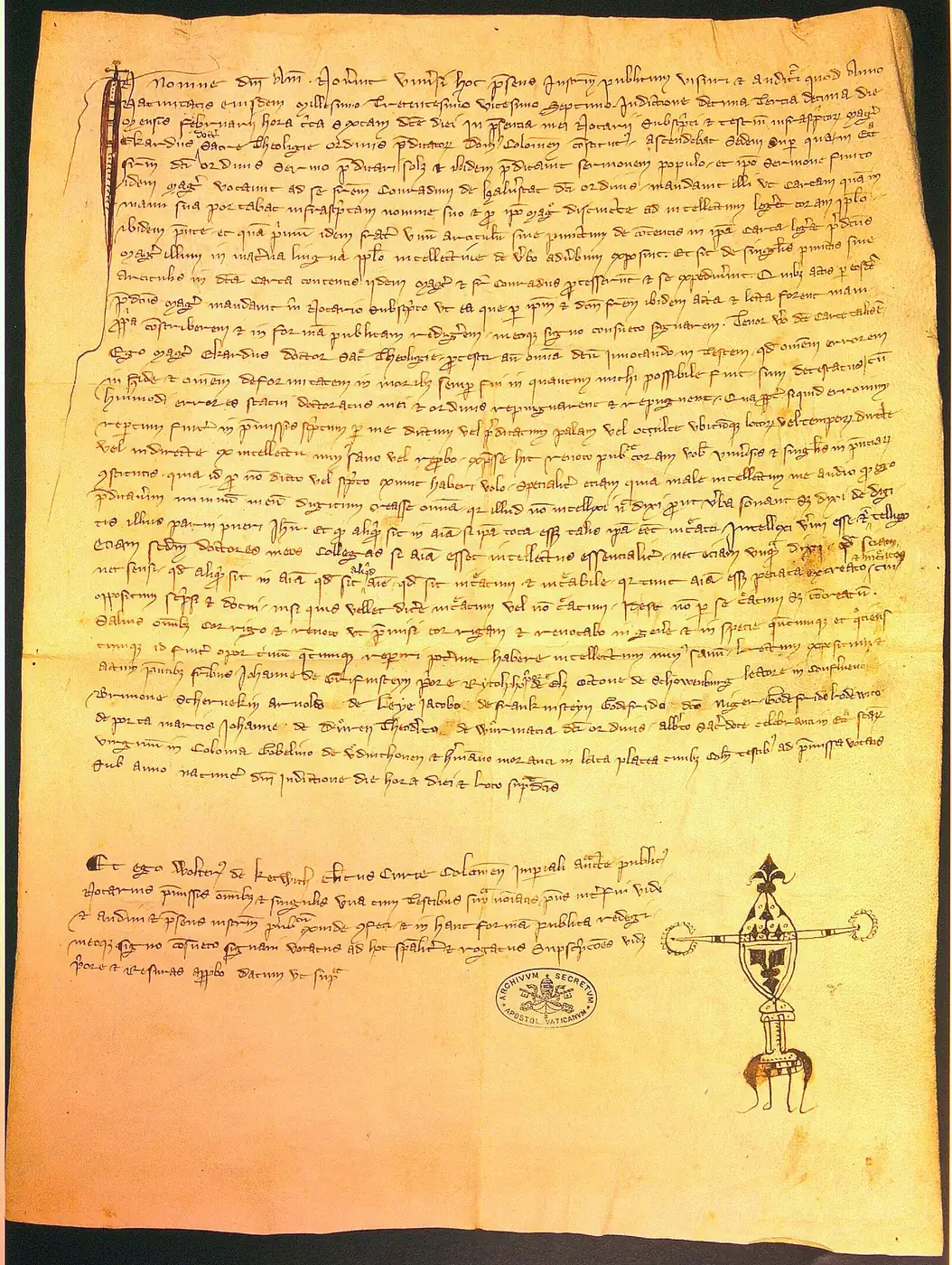
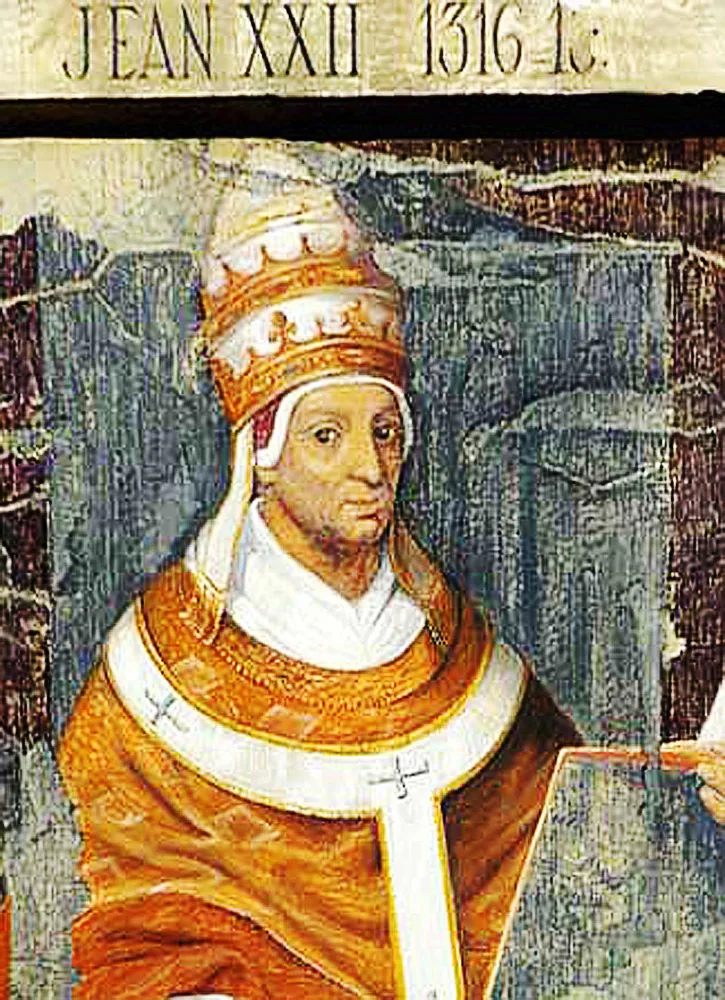
- 1327: On 13 February a notary in Cologne records his public declaration that he rejects any error that may be found in his words. In spring he sets out for Avignon to appeal to Pope John XXII; the Eckhart Society says he walked the 500 miles. Commons record of the notarial instrument; Eckhart Society
- 1328: Dies, probably in Avignon and most likely on 28 January, while the papal commission is still at work. SEP, citing Senner 1997
- 1329: On 27 March John XXII issues the bull In agro dominico, condemning 28 articles at different levels of severity. SEP

The most human moment in that chronology is the last journey. A man in his late sixties, who had spent his life teaching that one should hold on to nothing, travelled to Avignon to defend the words he had preached, and died there with the case still open. He had already argued that an error of the intellect is not heresy, since heresy is a matter of the will. SEP, on the Cologne defence
The condemnation arrived when he could no longer answer it, and for centuries his name stood in its shadow. Yet the texts outlasted the verdict. Our reading: the last journey fits what he preached about acting âne warumbe, without a why. He defended his words with no prospect of seeing them vindicated, and six centuries later philosophers, composers and novelists returned to exactly the sentences his own age had found hardest. Wikipedia, Rediscovery and modern popularisation
What did Meister Eckhart teach?
Meister Eckhart taught that the deepest truth about a human being is found within, in a ground of the soul where God is born and where nothing separates the soul from God. His most distinctive teaching is that the eternal birth of the Word from the Father is “now born in time, in human nature”, and that this birth can take place in the depths of anyone in whom nothing stands in the way. John Orme Mills OP, His Teachings, The Eckhart Society
The ground of the soul and the little spark
Eckhart called the bare, intellective core of the soul its grunt, its ground: higher than memory, reason or will, “neither this nor that”, which he described as uncreated and eternal and as related to God not by analogy but directly. He gave it many images: a little castle, a temple, a nobleman, and a vünkelin, a little spark. SEP, sections 6 and 9.1 In Maurice Walshe’s translation he says: “There is a power in the soul which touches neither time nor flesh, flowing from the spirit, remaining in the spirit, altogether spiritual.” And of the birth: “Here God enters the soul with His all, not merely with a part: God enters here the ground of the soul.” German sermons 7 and 1, trans. Walshe, via The Eckhart Society
Read in the first person, the teaching is startling and simple. Whoever looks inward all the way does not arrive at a small private self but at a life that is seeing itself. Eckhart puts the condition plainly: “Since it is God’s nature not to be like anyone, we have to come to the state of being nothing in order to enter into the same nature that He is.” German sermon 7, trans. Walshe
God and the Godhead
Beyond God as Father, Son and Spirit, Eckhart speaks of the Godhead, the silent unity in which nothing is done and nothing can be said. In the passage D. T. Suzuki quotes: “God works, the Godhead does no work, there is nothing to do; in it is no activity.” The ground of the soul reaches into that unity, beyond even God understood in three persons. Suzuki, Mysticism: Christian and Buddhist, chapter 1; SEP, section 9.1
The eternal now
For Eckhart the birth does not happen in a remembered past or a hoped-for future. Eckhart says: “God makes the world and all things in this present now.” Whoever would receive the highest truth must be “without before and after [...] receiving the divine gift in the eternal Now”. Eckhart quoted by Suzuki; German sermon 4, trans. Walshe
The scholar behind the preacher
Eckhart was a scholastic of the first rank, not a visionary who had left reason behind. He combined Augustinian and Dionysian Christian Neoplatonism, shaped by Proclus and the Liber de causis, with the Aristotelianism of the universities. After Aristotle, the author he cites most often in his Latin works is the Jewish philosopher Maimonides; Bernard McGinn wrote that “no Christian author of the Middle Ages [...] knew Maimonides better or reflected greater sympathy for his view”. The line also runs back towards Plotinus: the philosopher Karl Albert placed Eckhart in the philosophical mysticism of Parmenides, Plato, Plotinus, Porphyry and Proclus. SEP, section 2; Wikipedia, Eckhart as a mystic
He also lived close to a more dangerous current. Marguerite Porete, whose Mirror of Simple Annihilated Souls shares his images of the spark of the soul, poverty of spirit and the annihilated self, was burned in Paris in 1310; the following year Eckhart shared a residence with her inquisitor, William of Paris. Whether he read her book is still debated. SEP, section 2
What are the Opus tripartitum and the Parisian Questions?
The Opus tripartitum, the Three-Part Work, is the vast Latin project behind the sermons, and only part of it survives. Of the first part, the Work of Propositions, planned to hold more than a thousand propositions, only the prologue illustrating the first proposition exists; the second, the Work of Questions, is lost; the third, the Work of Commentaries, survives with a prologue, six commentaries and fifty-six sermons, on Genesis (twice, once as a Book of the Parables of Genesis), Exodus, Wisdom, Ecclesiasticus and the Gospel of John. Recent manuscript finds date much of it to before 1310. The short Parisian Questions come from his first Paris chair, 1302 to 1303. Wikipedia, Latin works and Career; SEP, list of works
Why does Eckhart call God understanding rather than being?
Eckhart says both, and the tension is deliberate. The prologue to the Work of Propositions opens with “Esse est deus”, existence is God, subtly reversing Thomas Aquinas’s emphasis on God as being itself. Yet in the first Parisian Question he says “it is not my present opinion that God understands because he exists, but rather that he exists because he understands.” The two meet in the Word that the Father speaks: in God the act of speaking and what is spoken are the same, and that Word is the centre of his philosophical theology. SEP, on being and intellect
Is creation an act of God’s knowing?
For Eckhart creation begins in God’s understanding. He read the “In principio” that opens both Genesis and the Gospel of John not only as the beginning of time but as the principle, the Word, in which all things have their origin and ground. In that Word creatures exist virtually, esse virtuale, a mode of being he calls “prior and more eminent” than their formal being in the world, because it is eternal and unchanging while existence in time is transient and mutable. SEP, on the Word and creation
What is Eckhart’s doctrine of analogy?
Eckhart’s analogy is sharper than Aquinas’s: creatures have no being of their own, not even a derived one, only being borrowed from God. In his sermons and lectures on Ecclesiasticus he writes: “[E]very created being radically and positively possesses existence, life, a wisdom from and in God, not in themselves as a created being.” The analogy can also be reversed. If God is the overflowing fullness of being, creatures are nothing; if being is the first created thing, God lies beyond it as pure understanding. That is how he can call God both being and non-being without contradicting himself. SEP, on analogy
How did Eckhart read the Bible?
Eckhart read Scripture as philosophy in hidden form. In the Commentary on John he holds that “everything that is true, whether in being or knowing, in scripture or in nature, proceeds from one source and one root of truth.” Scripture “parabolically intimates in hidden fashion […] what we [elsewhere] prove and declare about matters divine, ethical and natural”, so the preacher’s task is to bring the hidden meaning out. His parabolic method lifts single words and phrases out of their story and glosses them one by one, a method the Stanford entry suggests was intentionally disruptive, meant to shake listeners out of their complacency. SEP, on his hermeneutical approach
What does “the eye with which I see God” mean?
Eckhart’s sentence “The eye with which I see God is the same with which God sees me” means that in the ground of the soul, knowing God is not one thing looking at another. Claud Field’s 1909 translation continues: “My eye and God’s eye is one eye, and one sight, and one knowledge, and one love.” Sermon IV, True Hearing, trans. Field
The line just before it gives the condition: “If my eye is to discern colour, it must itself be free from all colour.” The famous saying is therefore not a boast but a consequence of emptiness. Only an eye with no colour of its own can see every colour; only a soul free of its own images can receive God without turning God into one more image. Wikipedia calls the sentence Eckhart’s most famous single quotation, often cited by readers in other traditions as a point of contact with Christian mysticism. Editions number the sermons differently, so one sentence can appear under several sermon numbers; Field calls this sermon True Hearing, after its text, “Whoso heareth Me shall not be confounded.” Field, Sermon IV; Wikipedia, Modern spirituality; SEP, on sermon numbering
What are Abgeschiedenheit and Gelassenheit?
Abgeschiedenheit, detachment, and Gelassenheit, letting-be or releasement, are Eckhart’s names for the inner freedom that makes the birth in the soul possible. The Stanford Encyclopedia calls them negative virtues: they do not add a new achievement to the self but take away the attachments that keep God and the soul apart. Eckhart devoted a treatise to the first, Von abegescheidenheit, On Detachment. SEP, section 9.2 and list of works
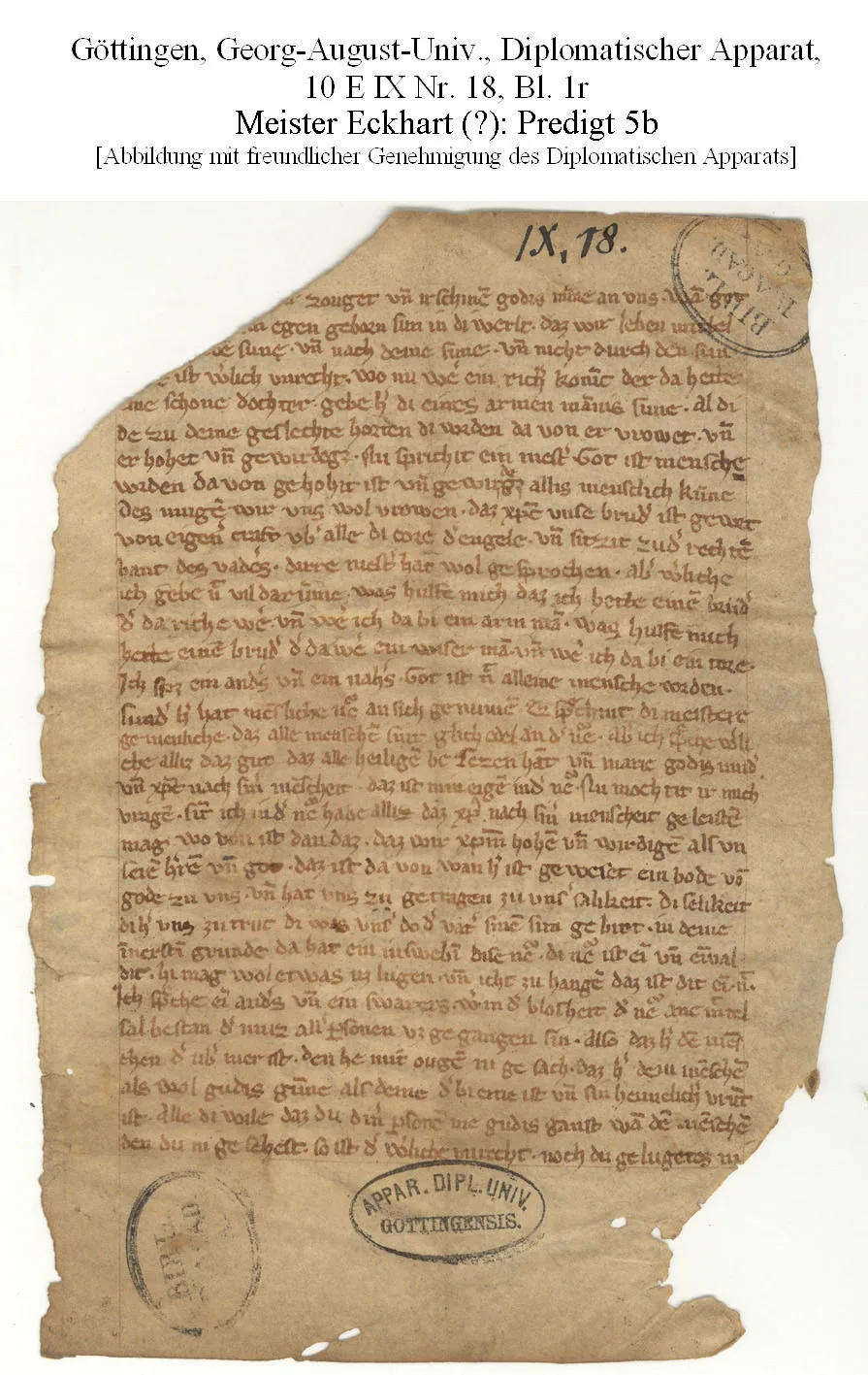
Detachment is not a technique. “Whoever seeks God in a special way gets the way and misses God, who lies hidden in it”, he preached; even prayer, fasting and vigils become obstacles when one clings to them as one’s own work. What he asks is simpler and harder: “Go right out of yourself for God’s sake, and God will go right out of Himself for your sake.” In the Talks of Instruction he calls it “a fair trade and an equal exchange: to the extent that you depart from things, thus far, no more and no less, God enters into you”. SEP, quoting German sermons 5b and 2; Talks of Instruction, via The Eckhart Society
Detachment is freedom in action, not flight from it. The Stanford entry describes it as letting go of the “mine-ness” of one’s actions, a poverty of spirit that Eckhart understood as true freedom: to act in each moment “freely and anew”. The word Gelassenheit later had a life of its own when Martin Heidegger adopted it for his philosophy, which has tended to obscure what Eckhart himself meant by it. SEP, sections 3 and 9.2
How do you live Eckhart’s teaching in an ordinary life?
Eckhart’s answer is that the inward turn leads back into work, company and action, not away from them. To the novices in Erfurt he said that whoever possesses God rightly “possesses him in all places: on the street, in any company, as well as in a church or a remote place or in their cell”, and that this “cannot be learned by taking flight”. Since no one can live without works, “he must learn to possess God in all things”. Talks of Instruction 6 and 7, trans. Walshe, via The Eckhart Society
Why did Eckhart prefer Martha to Mary?
In his sermon on Martha and Mary, Eckhart reverses a long tradition of reading. Mary, sitting at the feet of Jesus, had stood for the higher contemplative life. Eckhart praises Martha, busy with guests and housework, as one “so well grounded in her essence that her activity was no hindrance to her”, who lives “with things and not in them”; Mary, he suggests, “sat there a little more for her own happiness than for spiritual profit”. The sermon is numbered 86 by Quint and 9 by Walshe. SEP, section 9.3 John Orme Mills calls the result a spirituality of the active life, “a mysticism of everyday life” in Bernard McGinn’s phrase. Mills, The Eckhart Society
The discovery within is therefore not a door out of the world. It changes the way one cooks, writes, governs a province or receives a guest, so that ordinary life itself is transformed rather than left behind. The Master of the Dominican Order read Martha as the preacher: inwardly free, and therefore available for service. Bruno Cadoré OP, letter of 12 September 2012
What does it mean to live without a why?
Eckhart says the soul in its ground acts as God acts, âne warumbe, without a why: its deeds are done for their own sake, not as a means to a reward, not even to holiness or heaven. SEP, section 9.1 “If you seek God and seek Him for your own profit and bliss, then in truth you are not seeking God.” German sermon 11, trans. Walshe
Our reading of the Martha sermon: what Eckhart takes away is not purpose but payment. Martha keeps her whole attention on the guest and the work in front of her, not on what the work will earn, and in that sense she acts without a why. Eckhart places the weight on being rather than on results: “We should not think that holiness is based on what we do but rather on what we are, for it is not our works which sanctify us but we who sanctify our works.” Talks of Instruction, via The Eckhart Society
Was Meister Eckhart a heretic?
Meister Eckhart was never declared a heretic: the bull In agro dominico of 27 March 1329 condemned 28 propositions drawn from his works, but nowhere in the bull or its accompanying documents was he himself called a heretic. SEP, section 1
The road there was long. The first list of suspect sentences, from the Book of Divine Consolation, was drawn up by two Dominicans who accused Eckhart only after they themselves had been accused of corruption; one of them was later found guilty of being a false accuser. The Franciscan archbishop of Cologne, Henry II of Virneburg, took up their list of 74 propositions in 1326, a trial that Bernard McGinn calls unprecedented for the late Middle Ages. At Avignon the papal commission reduced the list to 28 articles and judged them heretical “as the words sound”, that is, read literally and out of context. They concern the eternity of the world, God’s glory shining even in evil, and the identity of the soul with the Son of God. The bull ranked them by severity and treated eleven more mildly than the rest. It was sent to Cologne to be published, so that “the hearts of the simple” would not be misled. SEP, section 1, citing Senner and McGinn; Wikipedia, introduction
Has the Catholic Church rehabilitated Eckhart?
The Dominican Order asked for a fresh look, and Rome answered that no rehabilitation was needed because Eckhart had never been condemned by name. The General Chapter of 1980 set up a commission of scholars, whose work showed, in the words of the Master of the Order, that the bull “did not condemn his doctrine, and certainly not the person himself”. Cadoré, letter of 2012 In 2010 it became known that the Vatican had replied in a letter of 1992. Timothy Radcliffe, then Master of the Dominicans, summarised it: the order was told “that there was really no need since he had never been condemned by name, just some propositions which he was supposed to have held, and so we are perfectly free to say that he is a good and orthodox theologian.” Wikipedia, on the 1992 letter
Pope John Paul II quoted him in 1985: “Did not Eckhart teach his disciples: ‘All that God asks you most pressingly is to go out of yourself – and let God be God in you’?” In 2012 the Master of the Order, Bruno Cadoré, wrote that “it is now widely accepted that Eckhart is a reliable theologian and spiritual guide”, and called him “a providential bridge between classical Christian spirituality and modern currents of spirituality.” The Eckhart Society, sayings; Cadoré, letter of 12 September 2012
Was Eckhart a Christian or a pantheist?
Meister Eckhart was a Christian theologian, and the Stanford Encyclopedia argues that he need not be read as a pantheist or even a panentheist. In his account the universe reflects the rationality of the divine mind and depends on it entirely, yet it is not identical with God. SEP, section 6
The question keeps returning because his language is so bold. He speaks of a ground of the soul that is uncreated, of becoming nothing to enter God’s nature, and of an eye shared by God and the soul. Our reading: those who hear in this a single reality behind all things hear something that is in the text; the scholarly point is that Eckhart frames that unity inside the Christian doctrine of creation, the Trinity and grace. Carl Jung read him differently again, as a Christian Gnostic whose Godhead “represents an absolute coincidence of opposites”. Wikipedia, Carl Jung His Dominican successors in 2012 placed him firmly in the line of Thomas Aquinas, whose memory he defended in Paris. Cadoré, 2012
How does the world read Meister Eckhart?
Meister Eckhart is read today as a scholastic philosopher in Germany, as a reliable spiritual teacher by his own order, as a Christian counterpart to Zen in Japan and to Advaita in India, and as a guide to the inner life by a broad popular readership in English. Few medieval thinkers are so widely quoted outside the academy, and so often out of context, as the Stanford entry puts it. SEP, introduction
How did Eckhart’s writings survive the condemnation?
Eckhart’s writings survived first through his students and then, for a long time, under another man’s name. Johannes Tauler and Henry Suso, his more circumspect Dominican disciples, carried the teaching on; Suso, later beatified, described the highest philosophy as a philosophia spiritualis in his widely read Horologium Sapientiae and took Eckhart to embody it. From the sixteenth to the nineteenth century Eckhart was largely forgotten, and for centuries his writings were known only from sermons printed in old editions of Tauler’s sermons, at Leipzig in 1498 and at Basel in 1521 and 1522. Franz Pfeiffer’s edition of the German sermons and treatises in 1857 renewed the interest, and from 1886 Henry Denifle was the first to recover the Latin works. The German works survive in over 200 manuscripts, the Latin ones in only a handful. Wikipedia, Influence and study; SEP, on Suso
How do German scholars read Eckhart?
In German, Eckhart has been both a national property and a philosophical problem. Franz von Baader and Hegel made him “the father of modern speculation”, and his relevance in German thought was, in one scholar’s words, “unmatched in the German intellectual sphere in the second half of the nineteenth and for much of the twentieth century”. The National Socialists abused him as the ancestor of a uniquely German Christianity; the Stanford entry answers that there is nothing particularly German about his theology. SEP, section 3 The foundation of all serious work is the critical edition published by Kohlhammer in Stuttgart from 1936: the German works edited by Josef Quint and Georg Steer, the Latin works by a team that includes Loris Sturlese, now joined by a Latin-German study edition by Sturlese and Elisabeth Rubino (2016 to 2018). SEP, bibliography
How do the Vatican and the Dominicans read him?
Rome’s position since 1992 is that Eckhart was never condemned by name, and his order treats him as one of its great teachers. Bruno Cadoré wrote in 2012 that many Dominicans now use Eckhart and the Rhineland mystics in dialogue with Buddhism. He quotes the Dominican Donagh O’Shea, who first read Eckhart because a friend from Zen circles urged him to: “I had gone around the world to discover my own house.” Cadoré, 2012
How is Eckhart read in Japan?
Japanese Zen thinkers read Eckhart as the Western mystic closest to their own tradition. D. T. Suzuki’s Mysticism: Christian and Buddhist (1957) set his “pure nothingness” beside the Buddhist emptiness, sunyata. Wikipedia, Buddhist modernism Suzuki observed that “while some Indian thought is described as nihilistic, Eckhart has never been accused of this, though he is not sparing in the use of words with negative implications, such as ‘desert,’ ‘stillness,’ ‘silence,’ ‘nothingness.’” Suzuki, Meister Eckhart and Buddhism Shizuteru Ueda, son of a Buddhist priest and a Zen practitioner, was steered towards the medieval mystics by his teacher Keiji Nishitani in Kyoto and wrote his doctorate at Marburg on Eckhart; his 1965 book Die Gottesgeburt in der Seele und der Durchbruch zur Gottheit confronts Eckhart’s mystical anthropology with the mysticism of Zen. He is counted in the third generation of the Kyoto School. Wikipedia, Shizuteru Ueda Not everyone agrees: the philosopher Reiner Schürmann accepted certain similarities but disputed Suzuki’s claim that the sermons come very close to Buddhist thought. Wikipedia, Buddhist modernism
How is Eckhart read in India?
The Indian comparison begins with a German. In Mysticism East and West (1926), the Marburg theologian Rudolf Otto set Eckhart beside Adi Shankara and found “the most extraordinary analogy” in the Godhead that abides above the personal God, as Brahman stands to the Lord, Ishvara. Both, he argued, are teachers of salvation for whom the way is knowledge. Otto, Mysticism East and West, English translation 1957, OCR text The religion scholar Richard King later argued that Otto’s real aim was “to establish the superiority of the German mysticism of Eckhart over the Indian mysticism of Sankara”. Vivekananda’s modern Vedanta has also been compared with Eckhart. Wikipedia, Neo-Vedanta Ananda K. Coomaraswamy, the historian of Indian art, went furthest: he wrote that Eckhart’s sermons might well be called an Upanishad of Europe, and that “there was a time when Europe and Asia could and did actually understand each other very well.” Coomaraswamy, The Transformation of Nature in Art, chapters 1 and 2 Arthur Schopenhauer had already compared Eckhart with Buddhism, Sufism and the Upanishads in 1844. SEP, section 3; Arthur Schopenhauer
Is Eckhart compared with Ibn Arabi, Rumi and Laozi?
Yes: comparative scholars regularly set Eckhart beside Ibn Arabi and Rumi, and his work has been compared with Sufism, Taoism, Zen, Confucianism, Advaita Vedanta and Kabbalah, with studies by Reza Shah-Kazemi (2006) and Zarrabi-Zadeh (2016) among them. Zhuangzi and Zhu Xi appear in the same list, which makes Eckhart a natural neighbour of Laozi for comparative readers. Eckhart himself read Avicenna and Averroes, and Kurt Flasch speaks of his “spirit of Arabic philosophy”. The Stanford entry calls him a significant touchstone for comparative mysticism today. SEP, sections 2 and 3
How is Eckhart read in Spain, Italy, France and Latin America?
In the Spanish-speaking world one route to Eckhart runs through Japan: a book by Ueda appeared as Zen y filosofía in Barcelona in 2004. Wikipedia, Shizuteru Ueda In Italy, the Catholic daily Avvenire reported in 2024 on a French book of conversations in which the Norwegian Nobel laureate Jon Fosse names Eckhart among his guides. Righetto, Avvenire, 25 July 2024 In France, Antoine Sénanque’s 2023 novel Croix de cendre follows Eckhart after his second departure from Paris. Wikipedia, In popular culture Among the sources opened for this page, we found no dated Latin American reading we could verify, and leave that gap visible.
How is Eckhart read in the English-speaking world?
English readers came to Eckhart through translation and through psychology. The first English translation of the German sermons appeared in 1909; Bernard McGinn, Oliver Davies and the translator Maurice Walshe shaped the modern Eckhart in English. SEP, section 3; The Eckhart Society, suggested reading The psychoanalyst Erich Fromm drew on him throughout his work, and Eckhart shaped Dag Hammarskjöld’s idea of spiritual growth through selfless service in Markings. Wikipedia, Psychology and psychoanalysis The Eckhart Society in Britain, a registered charity, held its twenty-fifth annual conference in 2013. The Eckhart Society
Which artists and modern teachers build on Eckhart?
Meister Eckhart lives on in music, literature, sculpture and popular spirituality, often far from the pulpit where he first spoke. These are the connections we could verify.
- John Adams, composer. The third movement of Harmonielehre (1985) is called “Meister Eckhardt and Quackie”. The title came from a dream in which Adams saw his newborn daughter Emily, nicknamed Quackie, riding on the shoulders of the medieval mystic and whispering the secret of grace into his ear. Berliner Philharmoniker, programme note; Wikipedia, for the date
- Jon Fosse, novelist and playwright, Nobel Prize in Literature 2023. According to Avvenire, his Catholic wife and his reading of Meister Eckhart and Nicholas of Cusa brought him closer to Catholicism, and he entered the Church in 2013. Avvenire, 2024
- Ananda K. Coomaraswamy, art historian. His book The Transformation of Nature in Art gives a whole chapter to Meister Eckhart’s view of art, written so that Indian and European readers could meet in the same text. Coomaraswamy, chapter 2
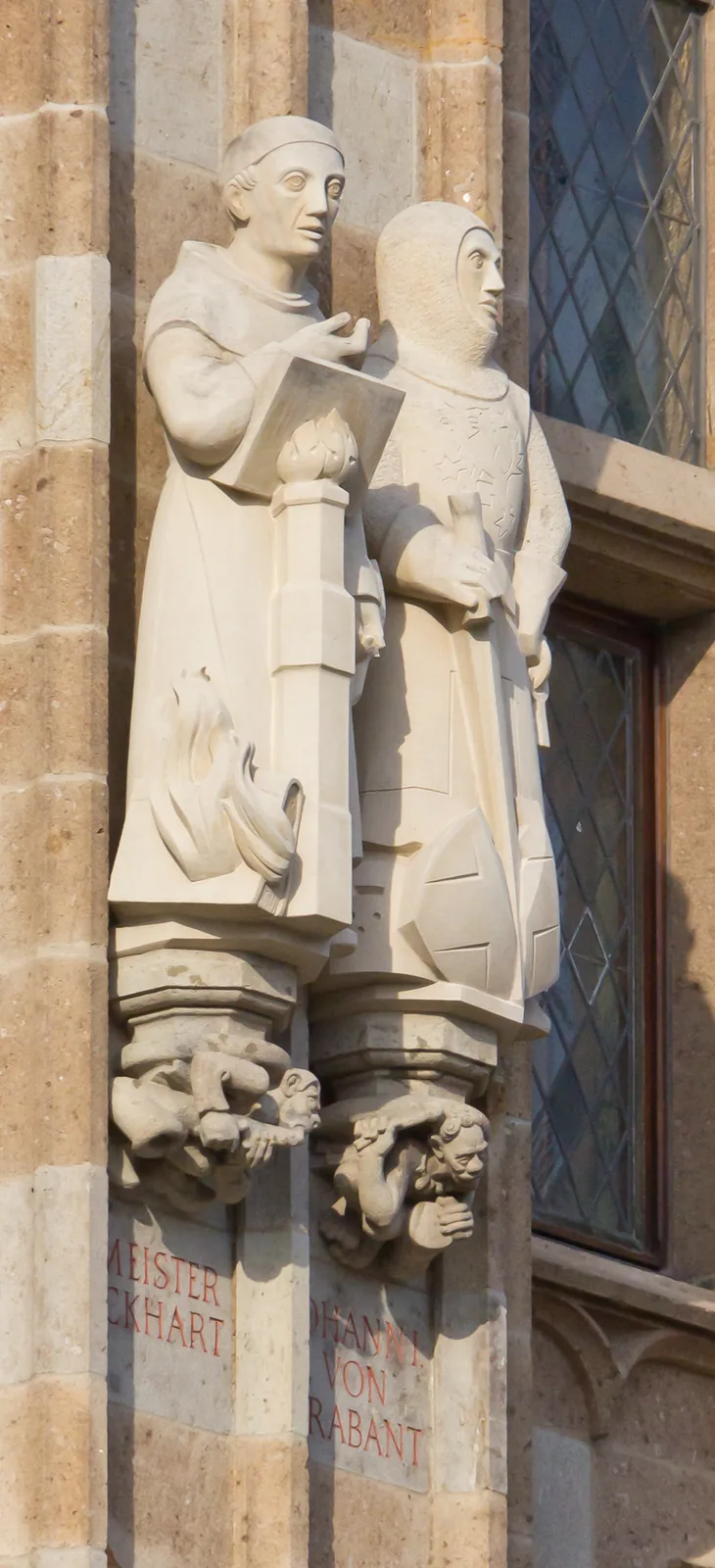
- Elisabeth Perger, sculptor, born 1960. Her figure of Meister Eckhart stands on the town hall tower in Cologne, beside John I, Duke of Brabant. Commons record
- Eckhart Tolle, author of The Power of Now. He changed his first name to Eckhart, according to some reports in homage to the medieval mystic; in a later interview he said he had seen the name on the cover of a book in a dream. Wikipedia, Eckhart Tolle The Power of Now quotes Meister Eckhart: “Time is what keeps the light from reaching us.” Wikipedia, In popular culture
- Martin Heidegger and Erich Fromm, twentieth-century thinkers. Heidegger adopted the word Gelassenheit; Fromm drew on many of Eckhart’s themes across his work. SEP; Wikipedia

Which Eckhart translation and which sermons should you read first?
For a first reading, our suggestion is Oliver Davies’s Selected Writings in Penguin Classics (1994), followed by Maurice Walshe’s Complete Mystical Works for all the German sermons in one volume. Davies is on the Eckhart Society’s list for newcomers, and the Society quotes the sermons in Walshe’s translation; the list also names the two Paulist Press volumes edited by Bernard McGinn with Edmund Colledge (1981) and Frank Tobin (1987); those include Latin works and Eckhart’s own defence. For understanding rather than reading, McGinn’s The Mystical Thought of Meister Eckhart (2001) offers a full interpretation across the Latin and German works. The Eckhart Society, suggested reading
Three practical warnings help. Sermon numbers differ between editions: Walshe numbers one way, the critical edition of Josef Quint another, so the sermon on Martha and Mary is 9 in Walshe and 86 in Quint. The Latin works have never been completely translated into English. And for German readers the Deutscher Klassiker Verlag edition with Niklaus Largier’s commentary is, in the Stanford entry’s words, extremely helpful. SEP, introduction and bibliography A free, older English text is Claud Field’s 1909 selection, now in the public domain. Field, Meister Eckhart’s Sermons
Which sermons first? Our order follows what the sources single out:
- The cycle of four sermons on the eternal birth (Walshe 1 to 4), which John Orme Mills says sums up nearly all the most important aspects of Eckhart’s teaching on spiritual maturity. Mills
- The sermon on Martha and Mary (Walshe 9, Quint 86), for the life of action. SEP, section 9.3
- The Talks of Instruction, given to the novices in Erfurt, the most practical of his works. Erfurt Tourismus
- The treatise On Detachment, and the Book of Divine Consolation, the text from which the first accusations were drawn. SEP, list of works and section 1
Ursula Fleming, whose work the Master of the Dominicans later credited with encouraging the fresh look at Eckhart’s orthodoxy, was told by her teacher Marco Pallis: “Don’t try to understand him. Just go on reading him.” Mills, The Eckhart Society
Where can you visit Meister Eckhart’s places?
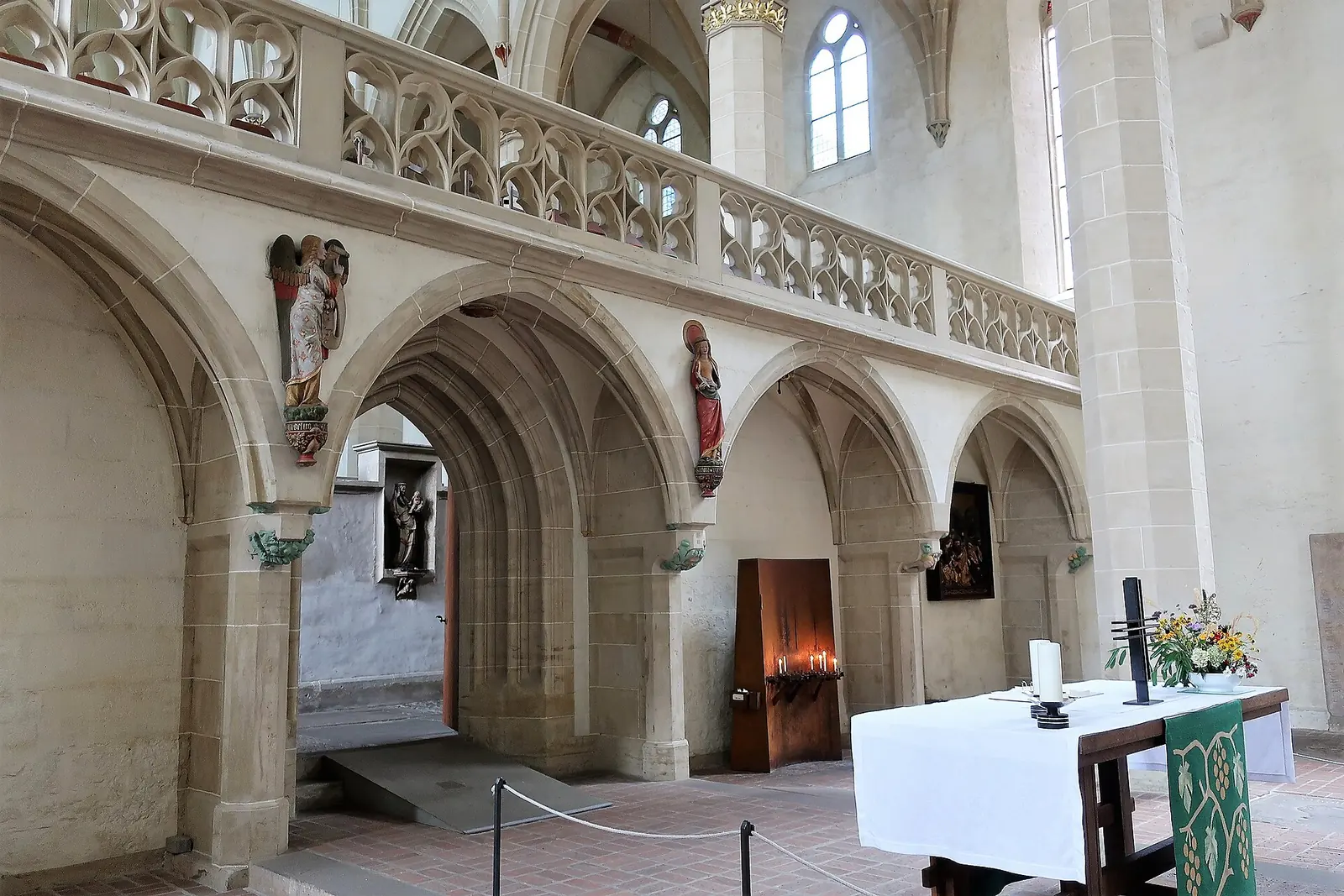
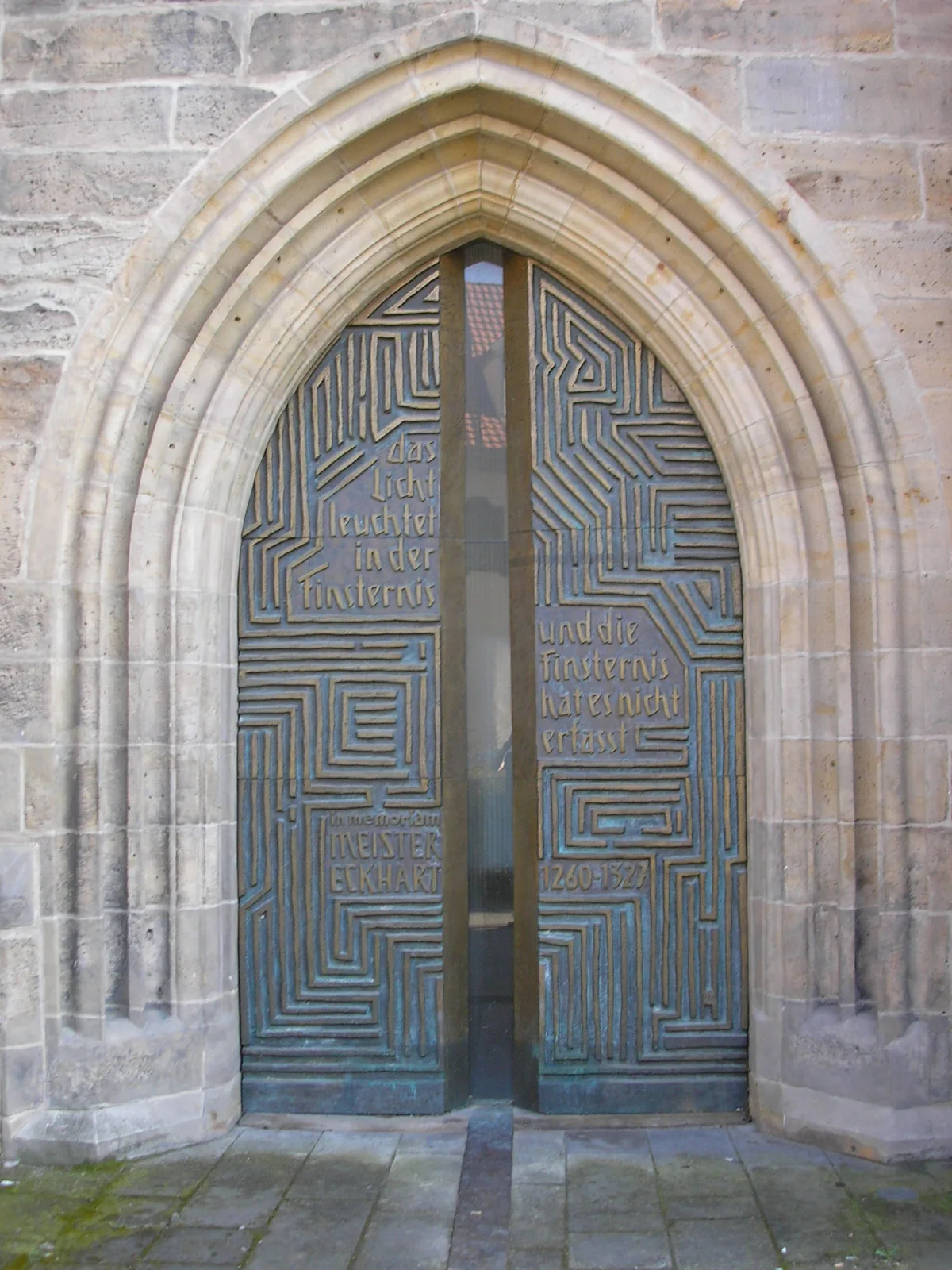
The one place where you can still stand in rooms Meister Eckhart knew is the Predigerkirche and the former Dominican priory in Erfurt. The Protestant congregation that owns them says the high choir of the church and the rooms of the priory are the only authentically preserved places of his work. Evangelische Predigergemeinde Erfurt, Meister Eckhart in Erfurt
Erfurt: the Predigerkirche and the priory
The Predigerkirche is an early Gothic hall church built by the Dominicans in the thirteenth and fourteenth centuries; Eckhart was prior here and gave the Talks of Instruction here. The east wing of the priory, with the chapter house and refectory, survives from that period; look for the choir stalls of 1280, the medieval stained glass of the north aisle and the Death of the Virgin in the sedilia niche of the high choir. The church is open from April to October, Tuesday to Saturday from 11:00 to 16:00 (in April from 12:00) and Sunday from 12:00 to 16:00; from November to March visits are arranged through the parish office, Predigerstraße 4, 99084 Erfurt. Erfurt Tourismus The church became Lutheran after the Reformation, and its bell tower was added between 1447 and 1488. Wikipedia, Predigerkirche The congregation keeps Meister Eckhart days, with retreat days, readings, dance theatre and a pilgrim cycle route in its programme archive. meister-eckhart-erfurt.de
Paris, Strasbourg and Cologne
In Paris, the first certain date of his life is an Easter sermon at the church of St Jacques on 18 April 1294. In Strasbourg he worked among Dominican nuns and Beguines; he visited the convents of St. Katharinental, Ötenbach and Unterlinden. Eckhart Society; SEP In Cologne, where he taught and was tried, look up at the town hall tower for Elisabeth Perger’s statue of him, and go down into the crypt of St Andreas, where the sarcophagus of Albert the Great stands, the Dominican whose influence the Stanford entry traces in Eckhart’s formation. Commons, town hall tower; Commons, St Andreas crypt

Avignon: what Eckhart saw and what you will see
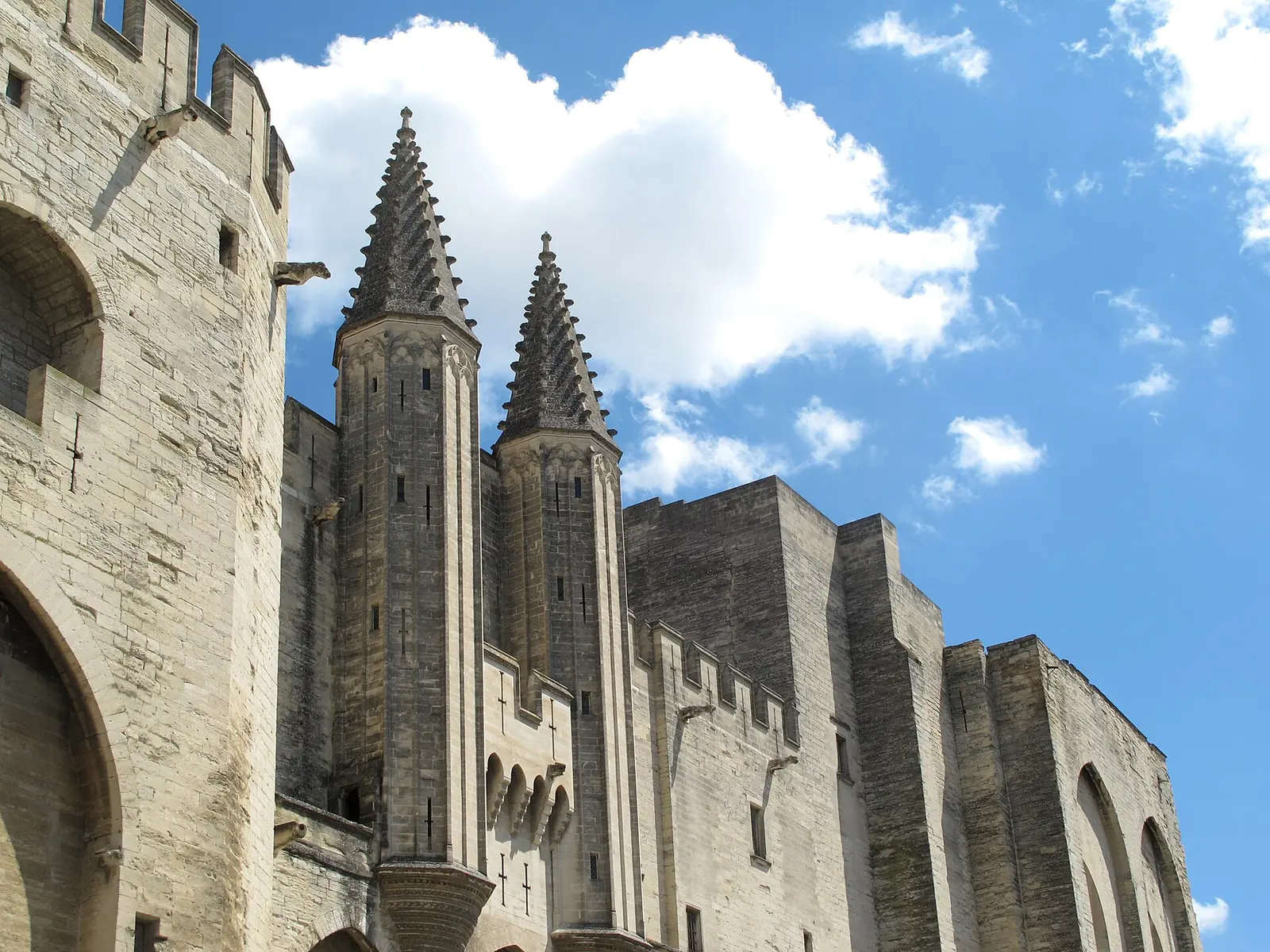
The Palais des Papes that visitors see today was begun after Eckhart’s death. Pope John XXII, who judged his case, set up a magnificent establishment in Avignon, but the rebuilding of the old bishops’ palace into the present one began in earnest under Benedict XII (1334 to 1342) and continued until 1364. Clement V, the first Avignon pope, had lived as a guest in the Dominican monastery of the city. The palace has been a UNESCO World Heritage Site since 1995. Wikipedia, Palais des Papes Standing before it, you look at the power that judged him, in a form he never saw.
What else do readers ask?
Is Meister his first name?
No. Meister is a title, the German form of the Latin magister, the highest university degree of his day. His name was Eckhart von Hochheim; the first name Johannes found in some biographies has no basis in the sources. SEP; Wikipedia
Was Meister Eckhart excommunicated or burned?
No. He died, most likely on 28 January 1328, before the papal verdict; the bull of 1329 condemned 28 propositions but did not declare him a heretic, and the Vatican confirmed in a letter of 1992 that he had never been condemned by name. SEP; Wikipedia
How many sermons and treatises by Eckhart are genuine?
The critical edition counts 123 German sermons, numbered 1 to 117 because six exist in two versions, and accepts only four German treatises as genuine, the longest being the Talks of Instruction; Franz Pfeiffer had printed seventeen treatises as Eckhart’s in 1857. Wikipedia, Attribution of works
Which Meister Eckhart book should I buy first?
Our suggestion is Oliver Davies’s Selected Writings (Penguin, 1994) as a compact start, then Maurice Walshe’s Complete Mystical Works. The Paulist Press volumes by McGinn, Colledge and Tobin add Latin works and his defence. The Eckhart Society
Sources and image credits
Sources opened and checked on 1 November 2026. Primary texts are quoted in the translation named beside them; scholarly summaries, reference works and press reports are identified as such. Where the Eckhart Society and the Stanford Encyclopedia differ on a date, both are given. Sentences marked as our reading or our suggestion are interpretation. This independent site has no affiliation with the Dominican Order, the Eckhart Society or any organisation named here.
- Amber L. Griffioen, Meister Eckhart, Stanford Encyclopedia of Philosophy. First published 1 May 2023. Life, influences, teaching, reception and bibliography.
- Wikipedia, Meister Eckhart. Consulted 1 November 2026. Early life, the 1992 letter, modern reception and popular culture.
- The Eckhart Society, Eckhart: The Man. Biography and John Orme Mills’s reading of the Talks of Instruction and the Martha sermon.
- John Orme Mills OP, His Teachings, The Eckhart Society. Paper of 2002, published with minor edits.
- The Eckhart Society, Some of Eckhart’s Sayings. Sermons in Maurice Walshe’s translation, and John Paul II’s words of 1985.
- The Eckhart Society, Suggested Reading. List for newcomers.
- Bruno Cadoré OP, Master of the Order of Preachers, letter to the Eckhart Society. Dated Rome, 12 September 2012; read at the 2013 conference.
- Meister Eckhart’s Sermons, translated by Claud Field. London, about 1909; public domain text at the Christian Classics Ethereal Library. Sermon IV, True Hearing.
- Wikiquote, Meister Eckhart. Used to locate the eye saying in Field’s translation and to check disputed quotations.
- Rudolf Otto, Mysticism East and West. German original 1926; English translation by Bertha L. Bracey and Richenda C. Payne, Meridian edition 1957; scanned OCR text, chapters on Eckhart and Sankara.
- Ananda K. Coomaraswamy, The Transformation of Nature in Art. First published by Harvard University Press, 1934; scanned OCR text of the 1956 Dover reprint, chapter Meister Eckhart’s View of Art.
- D. T. Suzuki, Mysticism: Christian and Buddhist, chapter Meister Eckhart and Buddhism. 1957; online reproduction. Also listed in the Sacred Texts Archive index.
- Wikipedia, Shizuteru Ueda. Biography and bibliography.
- Wikipedia, Eckhart Tolle. Name change and his later interview about it.
- Berliner Philharmoniker, programme note on John Adams’s Harmonielehre. Undated programme note.
- Roberto Righetto, Ai francesi piace il Jon Fosse mistico, Avvenire. 25 July 2024, in Italian.
- Erfurt Tourismus, Prediger Church. Opening hours and highlights; check before travelling.
- Evangelische Predigergemeinde Erfurt, Meister Eckhart in Erfurt. In German.
- Wikipedia, Predigerkirche, Erfurt. Building history.
- Wikipedia, Palais des Papes. Building history and UNESCO status.
- Image 01: Predigerkirche, Erfurt. Photograph: Nilaxus, 26 March 2026. Commons file record; CC BY-SA 4.0.
- Image 02: Interior of the Predigerkirche. Photograph: Klaus Bärwinkel, 16 August 2022. Commons file record; CC BY-SA 4.0.
- Image 03: Meister Eckhart portal, Predigerkirche. Photograph: Michael Sander, 3 April 2009. Commons file record; CC BY-SA 3.0.
- Image 04: Fragment of German sermon 5b. Reproduction: Georg-August-Universität Göttingen, 2010. Commons file record; CC BY 3.0.
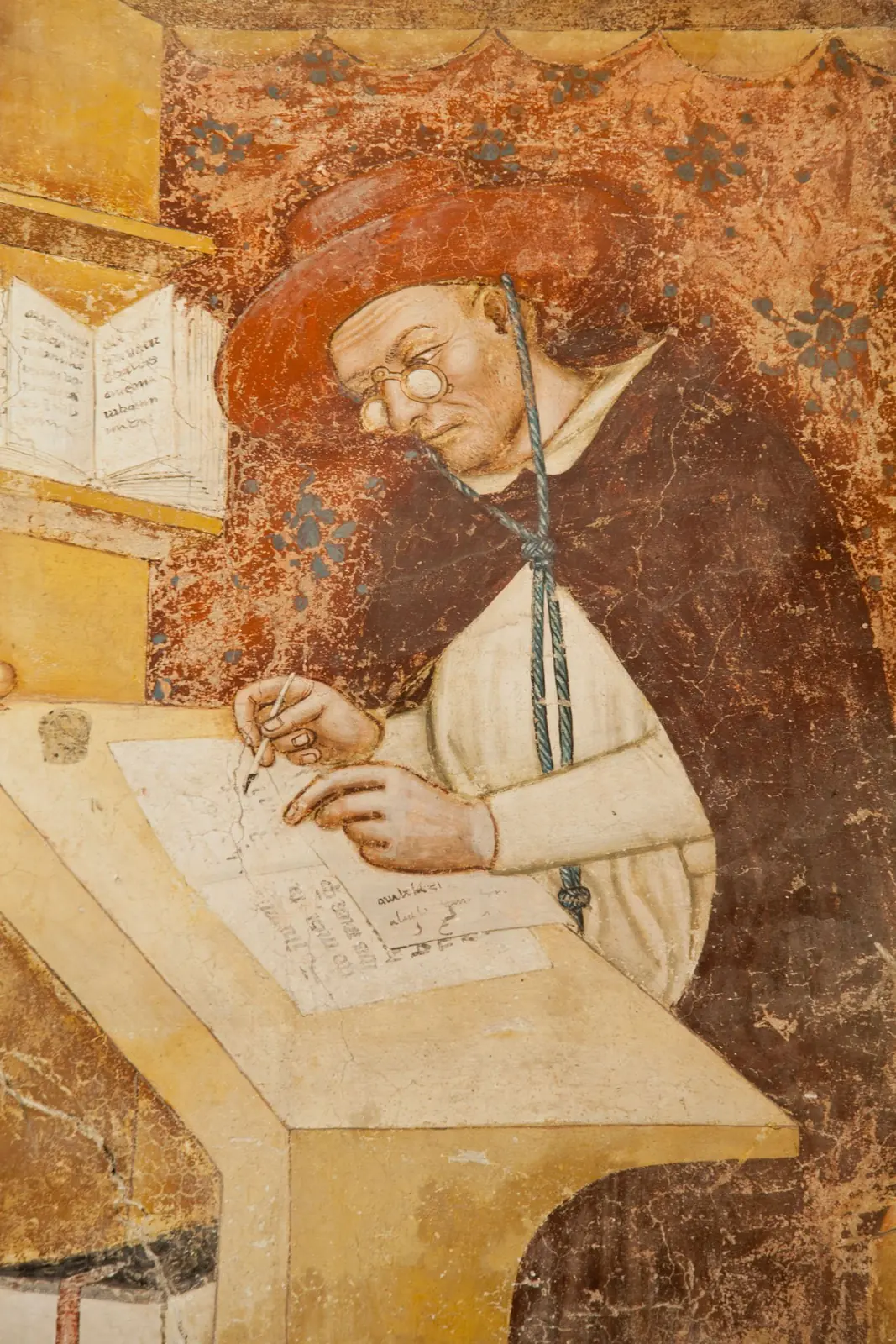
- Image 05: Tommaso da Modena, Hugh of Saint-Cher, 1352, Treviso. Public domain. Commons file record.
- Image 06: Notarial instrument of 13 February 1327, notary Wolter von Kettwig. Public domain. Commons file record.
- Image 07: Miniature of John XXII, 1316, Palais du Roure archives, Avignon. Unknown artist. Public domain. Commons file record.
- Image 08: Palais des Papes, Avignon. Photograph: Acediscovery, June 2012. Commons file record; CC BY 4.0.
- Image 09: Elisabeth Perger, Meister Eckhart, town hall tower, Cologne. Photograph: Raimond Spekking, 4 July 2012. Commons file record; CC BY-SA 4.0.
- Header image, with an 800-pixel version: generated for this page in 2026, an original abstraction rather than a historical image. © Piet Baudoin.