Artists / No. 018
Who was Paul Klee, and what is his art about?
Paul Klee (1879 to 1940) was a painter, draughtsman and teacher, born near Bern to a German father, who taught at the Bauhaus from 1921 to 1931 and left close to nine thousand works. [2] [1] His art is about how things come into being rather than how they look: a line that goes for a walk, colours that sound together like voices in a fugue, signs halfway between writing and picture. His own sentence of 1920 holds the whole programme: “Kunst gibt nicht das Sichtbare wieder, sondern macht sichtbar”, art does not reproduce the visible, it makes visible. [4] What looks like a child’s drawing is the end of a long, deliberate craft, and what looks playful often carries war, exile and illness inside it.
This page follows Klee’s life as one continuous line, then slows down where the work asks for it: the April days in Tunisia when he became a painter, the theory he wrote and taught, the music under the pictures, six famous works seen one at a time, the years of “degenerate art” and the flood of late work. It also corrects three common mistakes, gives practical advice on looking, and shows how readers from Calcutta to Tokyo and Tunis have seen him. For the circles around him, read Der Blaue Reiter, Bauhaus and his friend Wassily Kandinsky. Quotations are in the original language with our translation; every fact carries a source.
A life drawn as one line
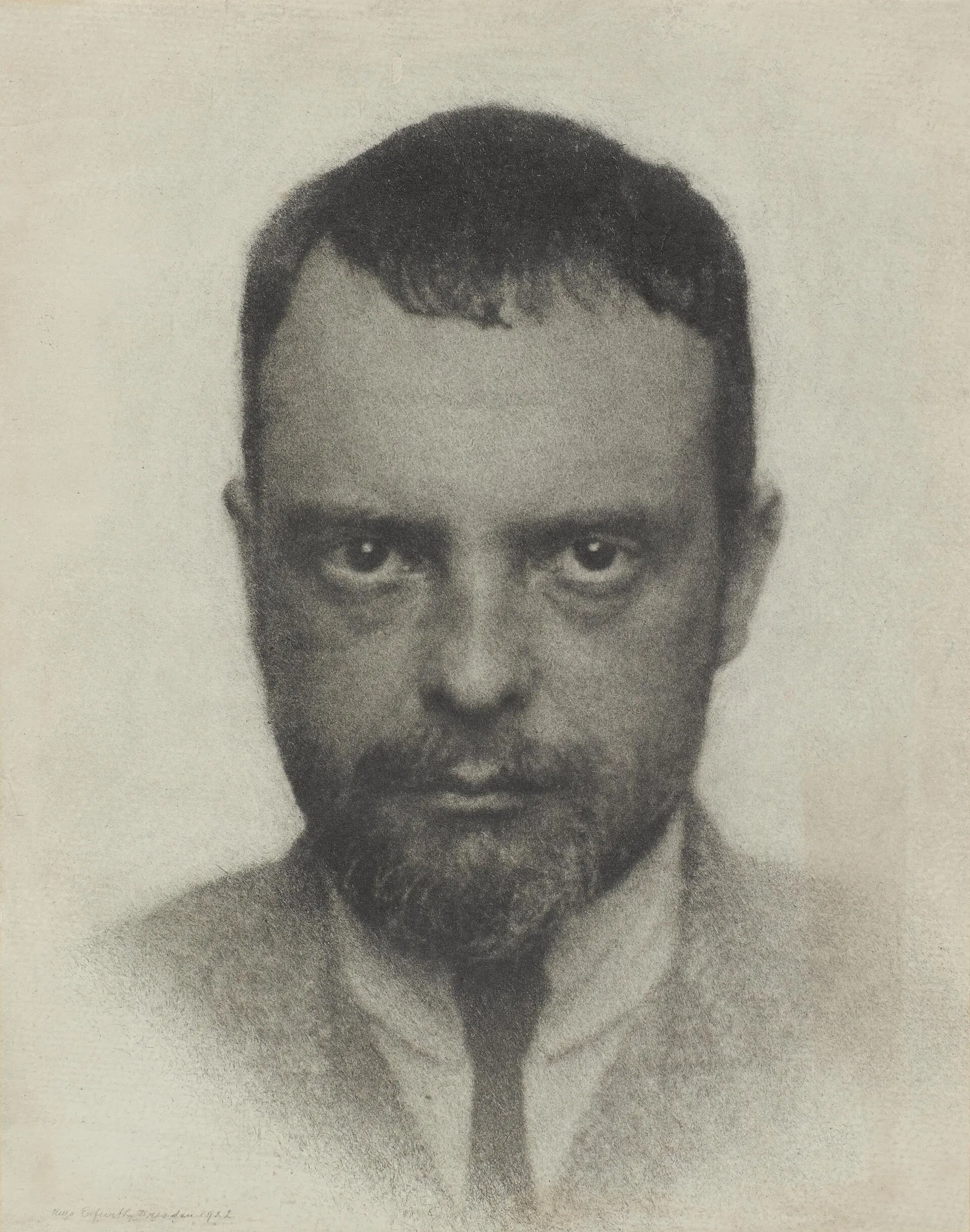
Paul Ernst Klee was born on 18 December 1879 in Münchenbuchsee, a village outside Bern, the second child of Hans Wilhelm Klee, a German music teacher from Tann in the Rhön, and Ida Marie Frick, a Swiss singer. [2] The family moved into Bern in 1880. The boy took violin lessons from the age of seven and played so well that at eleven he was allowed to sit in, as an extraordinary member, with the orchestra of the Bernische Musikgesellschaft. His school notebooks are full of caricatures; his parents wanted a musician. That double gift, a trained ear and an untrained hand that would not stop drawing, runs through everything that follows. In April 1898 he began a diary, and in September of that year, against his parents’ wishes, he left Switzerland for Munich to study art. [2]
The Munich academy turned him away at first, so he studied graphic art at Heinrich Knirr’s private school; in 1900 he entered Franz von Stuck’s class at the academy and left after five months. [1] [2] A six-month journey through Italy with the sculptor Hermann Haller, from October 1901 to May 1902, gave him three lasting lessons, among them the constructive number secrets of Renaissance Florence and, in the aquarium at Naples, the fantasy of natural forms. [2] Back in Bern he lived with his parents until 1906, earned his keep as a violinist and concert reviewer, attended anatomy lectures, and etched the bitter, precise Inventionen of 1903 to 1905; in 1904, in the Munich print room, the illustrations of Beardsley, Blake and Goya left a lasting mark on him, as did the prints of James Ensor. [2] On 15 September 1906 he married the pianist Lily Stumpf and moved to Munich, where she earned the money with piano lessons and he kept house and, from 1907, looked after their son Felix. [1] [2]
The breakthrough into company came in 1911. In January he met Alfred Kubin, who encouraged him to illustrate Voltaire’s Candide and became his first serious collector; through Kubin he met the critic Wilhelm Hausenstein; that year he joined the circle around Kandinsky and Franz Marc, and in February he began the handwritten catalogue of his own works that he kept for the rest of his life. [2] In the second exhibition of the Blaue Reiter, in Munich in 1912, he showed seventeen works on paper. [1] In April 1912 he visited Robert Delaunay in his Paris studio and later translated Delaunay’s essay on light for the magazine Der Sturm. [2] Until then Klee was a draughtsman. Then, in April 1914, came the journey to Tunisia, which the next section follows day by day.
The war broke the circle. Macke fell on the western front on 26 September 1914. Klee, a German citizen through his father, received his call-up on 5 March 1916, and that same day learned that his friend Franz Marc had been killed at Verdun. [1] [2] He was lucky: from January 1917 he served as a paymaster’s clerk at the flying school in Gersthofen near Augsburg, far from the front, where he was asked to photograph crashed planes; in pictures such as Blumenmythos of 1918, birds begin to fall like paper aeroplanes. In his diary he wrote a sentence that explains much of the next decade: “Je schreckensvoller diese Welt, desto abstrakter die Kunst, während eine glückliche Welt eine diesseitige Kunst hervorbringt”, the more terrible this world, the more abstract the art, while a happy world brings forth an art of this world. [2] Paradoxically the war made his name. Herwarth Walden’s Sturm gallery showed him in 1916 and 1917 and bought work from him; by 1919 he had a contract with the Munich dealer Hans Goltz, who in May 1920 opened a retrospective of 362 works. [1] [2]
On 29 October 1920 Walter Gropius called him to the Bauhaus in Weimar; he began teaching in January 1921, ran the bookbinding, metal, glass painting and weaving workshops in turn, and from 1923 taught form in the preliminary course. [2] In 1924 he gave a lecture in Jena, and with Kandinsky, Feininger and Jawlensky formed the Blue Four, whose work Galka Scheyer carried to America. When the school moved to Dessau in 1926 he shared a master’s house with the Kandinskys. In 1931 he left the Bauhaus for a professorship at the Düsseldorf academy. [1] [2]
Two years later it was over. In 1933 a Nazi paper called him a “galizischer Jude”, a Galician Jew, his house in Dessau was searched, and on 21 April he was dismissed. He refused to answer the slander, and wrote to his sister on 6 April: “Wenn es auch wahr wäre, daß ich Jude bin und aus Galizien stammte, so würde dadurch an dem Wert meiner Person und meiner Leistung nicht ein Jota geändert”, even if it were true that I am a Jew and came from Galicia, it would not change the value of my person or my work by one iota. [2] To his class he said goodbye with one sentence: “Meine Herren, es riecht in Europa bedenklich nach Leichen”, gentlemen, Europe smells alarmingly of corpses. On 23 December 1933 the Klees emigrated, and on Christmas Eve they were in Bern. [2]
He was home, and still a foreigner. Klee had grown up in Bern but inherited his father’s German citizenship. His first request for naturalisation, in spring 1934, was refused: an agreement of May 1933 required German citizens to have lived in Switzerland for five uninterrupted years. [2] In 1935 the first signs of a severe illness appeared, later diagnosed as scleroderma, a disease that hardens the skin and the organs. Medical records are missing, so the diagnosis remains hypothetical, and the name of the disease as it is now used for him appeared in the specialist literature only fourteen years after his death. [1] [2] In 1936 he managed 25 works. Then something unexplained happened: 264 works in 1937, 489 in 1938, and in 1939 a catalogue of 1,253 numbers by the count of the Zentrum Paul Klee, 1,254 by another count, more than three a day. [1] [2] His second request went in during 1939 and was granted on 19 December, despite a police report that called his work “eine Beleidigung gegen die wirkliche Kunst”, an insult to real art. The Bern city council was to decide on 5 July 1940. Klee died on 29 June 1940 in a clinic at Muralto near Locarno, one week before the sitting, a German citizen to the end. [2]
In 1946 his son Felix had a text of 1920 carved on the stone at the Schosshalde cemetery in Bern: “Diesseitig bin ich gar nicht fassbar / Denn ich wohne grad so gut bei den Toten / Wie bei den Ungeborenen / Etwas näher dem Herzen der Schöpfung als üblich / Und noch lange nicht nahe genug.” In this world I cannot be grasped at all, for I live just as well with the dead as with the unborn, somewhat closer to the heart of creation than usual, and still not nearly close enough. [2] The estate went through a long dispute between a foundation and Felix, settled in 1952; since 2005 the Zentrum Paul Klee in Bern, designed by Renzo Piano, holds about four thousand works. [2]
Tunisia, 1914: the day colour took hold
On 3 April 1914 Klee set off from Bern with two painter friends, August Macke and Louis Moilliet, by way of Lyon and Marseille to Tunis. From there they went out to Saint-Germain, now Ezzahra, Sidi Bou Saïd, Carthage, Hammamet and, at the end, the holy city of Kairouan, before returning through Palermo, Naples, Rome and Milan. [2] [9] Moilliet hardly painted on the journey. Klee was the only one who kept a diary, and the first entry from the African shore is still the best description of the light: “Die Sonne von einer finsteren Kraft. Die farbige Klarheit am Lande verheißungsvoll. Macke spürt das auch.” The sun of a dark power. The coloured clarity on land full of promise. Macke feels it too. [2]
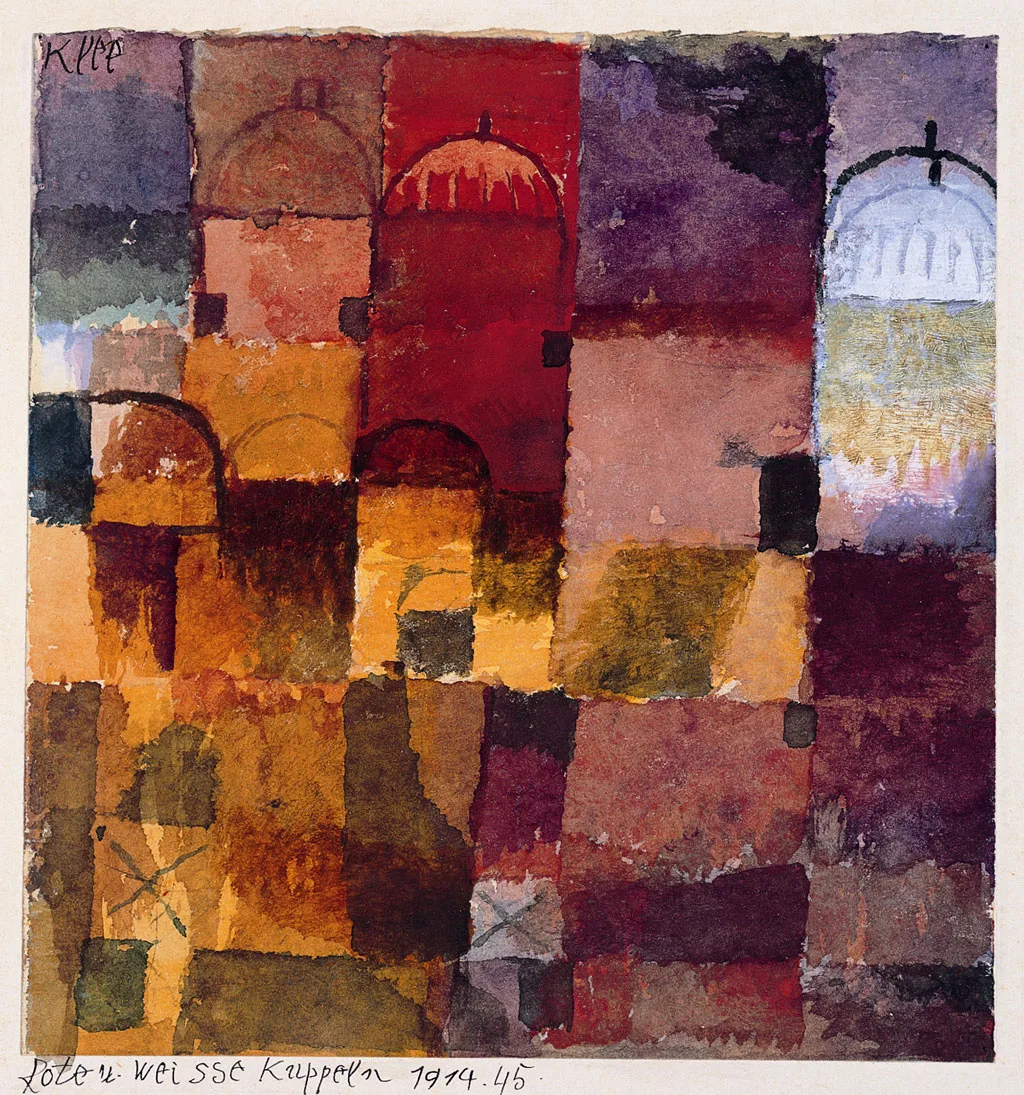
On 16 April, in Kairouan, he wrote the entry that every book on Klee quotes: “Die Farbe hat mich. Ich brauche nicht nach ihr zu haschen. Sie hat mich für immer, ich weiß das. Das ist der glücklichen Stunde Sinn: ich und die Farbe sind eins. Ich bin Maler.” Colour has me. I need not chase after it. It has me for ever, I know that. That is the meaning of this happy hour: colour and I are one. I am a painter. [2] [7] Moderna Museet in Malmö took its title from the passage for the collection presentation Paul Klee, Possessed by Color, built around Kairuan, vor dem Thor, and quotes it: “Color possesses me. I don’t have to pursue it. It will possess me always, I know it.” [8]
Read the grammar of that entry slowly. The subject of the first sentence is not Klee but colour. He does not take hold of colour; colour takes hold of him, and the act of becoming a painter is described as a passive one, almost a surrender. Then comes the strangest clause: ich und die Farbe sind eins. Not “I mastered colour” or “I understood colour” but a statement of identity, the seer and the seen with no gap between them. For a man who had spent fifteen years drawing in black and white, this is not a technical discovery. It is a change in where the self ends. The watercolours he painted in those days show the same thing on paper: the town is no longer a view in front of a viewer but a weave of tinted squares, each patch of paper allowed to glow, the outlines of a dome or a camel left in as small signs inside the colour rather than drawn over it. [1] The grammar of the method was borrowed: the light of North Africa set down in the manner of Cézanne, with the Cubist form of Delaunay. [3] [2]
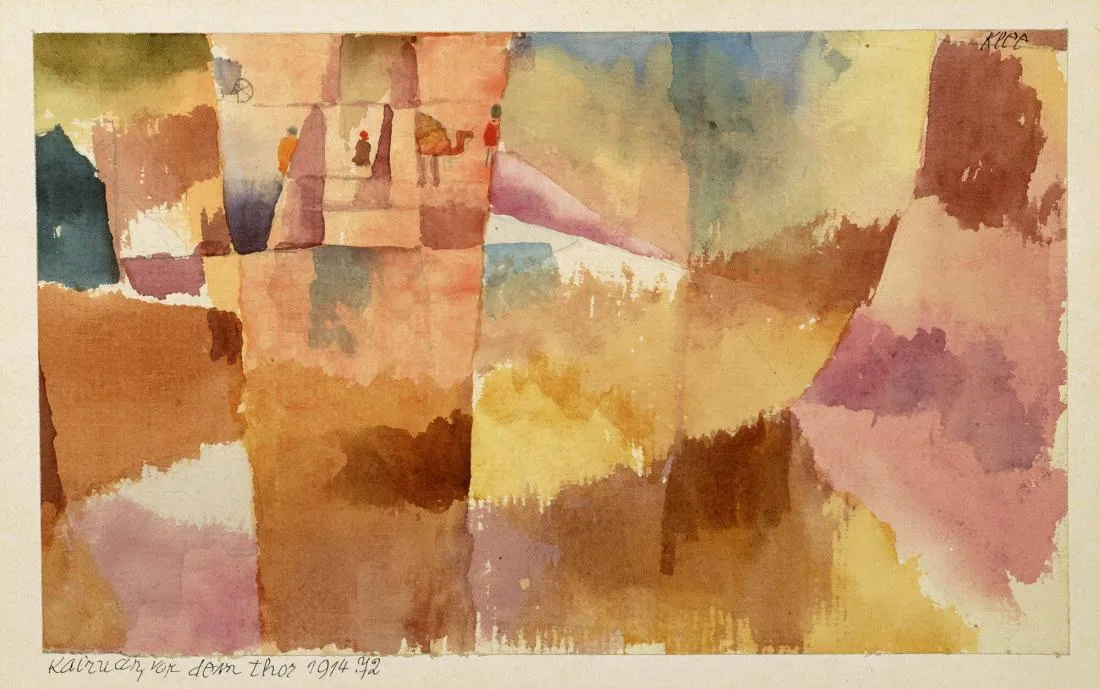
A caution belongs here. Klee kept his diary until December 1918, and in that year he edited it, opening it with a section of childhood memories; his biographer Susanna Partsch points out that he shaped the diaries to give the public the image he wanted. [2] The Kairouan entry is the cornerstone of the legend that he became a painter in a single afternoon. It may have been sharpened later. That does not make it false. It makes it a statement Klee chose to stand by, and the pictures of 1914 and after bear it out: from Tunisia on, colour carries his work.
For the centenary in 2014 the Tunisian daily Kapitalis quoted the Kairouan sentence in French: « La couleur me possède… La couleur et moi sommes un. Je suis peintre. » [9] Klee went once more to North Africa, to Egypt in the winter of 1928, and wrote to Lily that he had brought back different impressions from Tunis and was convinced “daß Tunis viel reiner ist”, that Tunis is much purer. [2]
When did something you had studied for years suddenly have you, instead of you having it?
How Klee thought: making visible
Klee wrote more about art than almost any painter of his century, and he wrote it in a way that can still be used. Four texts carry the core: the Schöpferische Konfession (Creative Confession) of 1920, the lecture in Jena of 1924, the Pädagogisches Skizzenbuch (Pedagogical Sketchbook) of 1925, and the thousands of pages of notes he wrote for his Bauhaus classes. Read in that order, they show a painter turning instinct into something he could pass on. In his own words, as the English edition of the sketchbook quotes him: “When I came to be teacher, I had to account explicitly for what I had been used to doing unconsciously.” [10]
The Creative Confession, 1920
The Schöpferische Konfession appeared in 1920 in a collection of artists’ statements, Tribüne der Kunst und der Zeit, volume XIII, published by Erich Reiss in Berlin, on pages 28 to 40. [4] Klee had been asked to write about graphic art; painting was reserved for Max Pechstein. [5] That is why the text starts with drawing, and why its first sentence is about drawing before it is about all art: “Kunst gibt nicht das Sichtbare wieder, sondern macht sichtbar. Das Wesen der Graphik verführt leicht und mit Recht zur Abstraktion.” Art does not reproduce the visible but makes visible. The nature of graphic art leads easily, and rightly, to abstraction. [4]
The first sentence is often quoted as a slogan. It is better read as an instruction. A camera reproduces the visible: what is in front of it ends up on the plate. Klee asks a different question: what is there that cannot yet be seen, and how do I bring it into view? The elements he names are modest, “Punkte, lineare, flächige und räumliche Energien”, points, and linear, planar and spatial energies. And he adds a law that every student of drawing has felt: the purer the graphic work, the more weight it gives to these elements, the worse it is equipped to show visible things realistically. [4] Abstraction, in this account, is not a style one chooses. It is where drawing goes when it is honest about its means.
Then comes the most famous passage, though it is rarely quoted in full. Klee proposes a small journey: “Entwickeln wir, machen wir unter Anlegung eines topographischen Planes eine kleine Reise ins Land der besseren Erkenntnis. Über den toten Punkt hinweggesetzt sei die erste bewegliche Tat (Linie).” Let us develop, let us make a small journey into the land of better understanding, laying out a topographical plan. Past the dead point, let the first movable act be set down (line). [4] What follows is a walk in which every event is also a kind of mark. A short stop to catch breath: the broken line. A look back at how far we have come: counter-movement. A river is in the way, we take a boat: wave movement. Further up there would have been a bridge: a row of arches. On the other side we meet a like-minded companion; at first we agree, the lines converge, then differences appear and two lines run on independently. An unploughed field: a plane crossed by lines. A dense wood, where the companion loses his way and runs in circles like a dog. Fog over a new stretch of river: a spatial element. Basket weavers going home with their cart: the wheel. A child with the merriest curls: the spiral. Lightning on the horizon: the zigzag. Above us, still, the stars: “die Punktsaat”, the sowing of points. [4]
Try it with a pencil and you see what Klee is doing. He is not illustrating a landscape. He is showing that every kind of line already is an experience: hesitation, regret, crossing, meeting, parting, getting lost. The walk ends with a sentence that turns suddenly personal: the lightning recalled a fever curve. “Eines kranken Kindes … Damals.” Of a sick child … Back then. [4] A line is never only a line. It can carry a memory nobody else knows.
The third part adds a rule that sounds technical and is in fact ethical: “Die Elemente sollen Formen ergeben, nur ohne sich dabei zu opfern. Sich selber bewahrend.” The elements should make up forms, but without sacrificing themselves. Keeping themselves. [4] In a Klee the dot remains a dot even when it becomes an eye, and the square stays a square even when it is a house. Nothing is swallowed by the whole. That is why the pictures can be read two ways at once, as image and as construction, and why they never look like illustrations.
The fourth part is about time. Lessing’s Laokoon had made much of the difference between arts of time, such as poetry and music, and arts of space, such as painting. Klee dismisses it: “Und bei genauerem Zusehen ist’s doch nur gelehrter Wahn. Denn auch der Raum ist ein zeitlicher Begriff.” Looked at closely, it is only learned delusion. For space too is a temporal concept. When a point becomes movement and line, that takes time; so does a line moving into a plane. Is a picture made all at once? No, it is built piece by piece, “nicht anders als ein Haus”, no differently from a house. “Und der Beschauer, wird er auf einmal fertig mit dem Werk? (Leider oft ja.)” And the viewer, is he finished with the work all at once? (Sadly, often yes.) [4] He concludes with a sentence that holds the centre of his thinking: “Auch das Kunstwerk ist in erster Linie Genesis, niemals wird es als Produkt erlebt.” The work of art too is first of all genesis; it is never experienced as a product. [4]
He then describes how the eye moves. Like a grazing animal, it feels its way across the picture: “Dem gleich einem weidenden Tier abtastenden Auge des Beschauers sind im Kunstwerk Wege eingerichtet.” For the eye of the viewer, which feels its way like a grazing animal, paths are laid out in the work. In music there are channels for the ear, he adds, and in drama both. “Das bildnerische Werk entstand aus der Bewegung, ist selber festgelegte Bewegung und wird aufgenommen in der Bewegung (Augenmuskeln).” The pictorial work came out of movement, is itself fixed movement, and is taken in through movement (the eye muscles). [4]
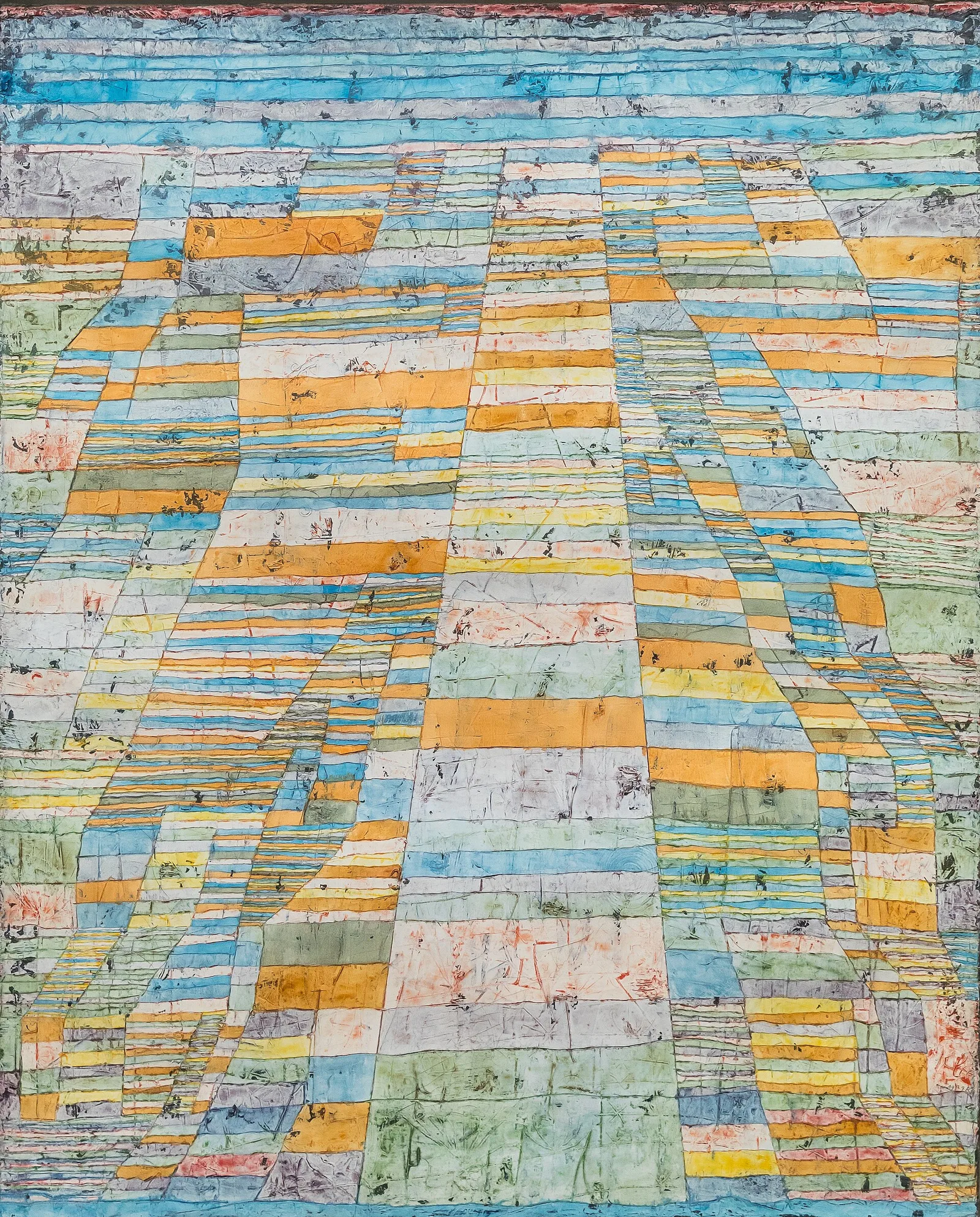
The fifth part names what this movement uncovers. Earlier, Klee writes, painters showed things that could be seen on earth, things one liked to see or would have liked to see. Now the reality of visible things is laid open, together with the belief “daß das Sichtbare im Verhältnis zum Weltganzen nur isoliertes Beispiel ist, und daß andere Wahrheiten latent in der Überzahl sind”, that the visible, in relation to the whole world, is only an isolated example, and that other truths are latently in the majority. [4] There is a scholarly twist here. László Glozer, working on the history of the text, found that a printing error put “Realität” where Klee had written “Relativität”, the relativity of visible things, an allusion to Einstein. [5] Read that way the sentence becomes sharper: what we see is one case among many possible ones.
Three thought experiments make the point concrete, and they are worth doing yourself. A man of antiquity sits in a boat and enjoys it. A modern man walks across the deck of a steamer and experiences six movements at once: his own steps, the course of the ship, the current of the river, the rotation of the earth, its orbit, and the orbits of moons and stars around it. Result: “ein Gefüge von Bewegungen im Weltall, als Zentrum das Ich auf dem Dampfer”, a structure of movements in the universe, with the self on the steamer at its centre. A blossoming apple tree is roots, rising sap, trunk, the cross-section with its annual rings, blossom, fruit, core with seeds: “Ein Gefüge von Zuständen des Wachstums”, a structure of states of growth. A sleeping man is circulation, breath, the work of the kidneys, a world of dreams: “Ein Gefüge von Funktionen zur Ruhe geeint”, a structure of functions united into rest. [4] The ordinary picture of each, a man on deck, a tree, a sleeper, is one moment cut out of a process. Klee wants to paint the process.
The last part puts art in its place: “Kunst verhält sich zur Schöpfung gleichnisartig.” Art relates to creation as a parable does. It is always an example, as the earthly is an example of the cosmic. The freeing of the elements, their grouping, the breaking down and rebuilding of the whole on several sides at once, “die bildnerische Polyphonie”, pictorial polyphony, the creation of rest by balancing movement: these are high questions of form, but not yet art in the highest circle. “Im obersten Kreis steht hinter der Vieldeutigkeit ein letztes Geheimnis und das Licht des Intellekts erlischt kläglich.” In the highest circle, behind the ambiguity, stands a last secret, and the light of the intellect goes out miserably. [4] And then, unexpectedly, humour: art should carry ethical seriousness “und zugleich koboldisches Kichern über Doktoren und Pfaffen”, and at the same time goblin giggling at doctors and priests. “Die Kunst spielt mit den letzten Dingen ein unwissend Spiel und erreicht sie doch!” Art plays an unknowing game with the last things, and reaches them all the same. At its best it helps you to cast off your shell, “dich auf Momente Gott zu wähnen”, to imagine yourself God for moments. [4]
Gestaltung over Gestalt
German has two words where English has one. Gestalt is the finished shape, the form as it stands. Gestaltung is the shaping, the form in the act of being made. Klee called his Bauhaus teaching “Bildnerische Gestaltungslehre”, a theory of pictorial shaping, not of shapes. [12] The choice is the Confession in one word: the work is genesis, never product. A useful test is to look at any form around you, a leaf, a staircase, a handwritten word, and ask not what it is but how it came to be: which force pushed, which resisted, where it paused. That is the question Klee taught. It is also why, in a short essay of 1923, Wege des Naturstudiums (Ways of Studying Nature), he could call nature a “sine qua non” of artistic work, the starting point that remains however freely the artist transforms it. [2] [11] Nature, for Klee, is not a model to copy but a process to continue.
Our reading, not Klee’s: the same intuition, form as the visible trace of a becoming rather than a fixed thing, runs through the Indian philosopher Sri Aurobindo, whose The Future Poetry gives whole chapters to “Poetic Vision and the Mantra” and “The Form and the Spirit”. [30] There is no evidence that the two knew of each other. The kinship lies in the question both ask of a form: what is coming through it.
Teaching at the Bauhaus
At the Bauhaus Klee taught for ten years, first in Weimar and from 1926 in Dessau. His colour theory began as a polemic. In a short text of October 1920, Farbe als Wissenschaft (Colour as Science), he attacked the measuring colour system of the chemist Wilhelm Ostwald and argued that colour values are relative. [2] In the Jena lecture of 26 January 1924, given at the Kunstverein Jena during an exhibition of his work, he put it in a single example: where measure and weight show no difference, say between a pure yellow and a pure red surface of equal size and brightness, “bleibt immer noch die eine wesentliche Verschiedenheit bestehen, die wir mit den Worten gelb und rot bezeichnen”, there remains the one essential difference that we name with the words yellow and red. [2] Line can be grasped with a ruler, light and dark with a scale; colour is first of all quality, and only secondly weight and measure. [2] You can count a line and weigh a grey; a colour you have to meet.
In the same lecture he developed the image of a tree, its roots and its crown, with the artist as the trunk in between, the mediator whose task is “aus der Tiefe Kommendes zu sammeln und weiterzuleiten”, to gather what comes from the depth and pass it on. What reaches the crown has been changed on the way up. Klee’s phrase for that change is “Wiedergeburt der Natur im Bilde”, the rebirth of nature in the picture. [2] It is a modest picture of the artist, and a precise answer to the charge that his pictures look nothing like the world: no one expects a crown to look like its roots. The lecture was published only in 1945, after his death, as Über die moderne Kunst (On Modern Art); one of its lines, “uns trägt kein Volk”, no people carries us, would later travel far. [2] [5]
For the series of Bauhaus books he condensed his course into the Pädagogisches Skizzenbuch, volume 2, published in 1925, edited by Walter Gropius and designed by László Moholy-Nagy, in the same series as Kandinsky’s Point and Line to Plane. Sibyl Moholy-Nagy translated it into English in 1953, and it is still in print. The book opens with the image the world remembers: a dot that goes for a walk, freely, without a goal, and by shifting forward becomes a line. [10]
The sketchbook is only the visible tip. Klee left some 3,900 loose pages of teaching notes, which the Zentrum Paul Klee showed in 2012 in the exhibition Meister Klee! Lehrer am Bauhaus and put online as a searchable database. [12] [13] Earlier, the Swiss artist Jürg Spiller had edited the notes into two large volumes, published in 1956 and 1964; the first is known in English as The Thinking Eye. [10] The art historian Marcel Franciscono warned that Spiller’s arrangement was “extensive but drastically rearranged”. [11] For the reader today, the database is the honest source; the books are a readable map.
It helps to compare. Kazimir Malevich also reduced painting to its elements, but he went to the zero point and stayed there, a square on white. Klee went to the dot and let it walk. One sought the end of form, the other its beginning. That is our reading, and the pictures support it.
Which finished thing in your life would look different if you saw it as something still being made?
Painting as polyphony
Klee could have been a professional musician, and kept music beside him to the end of his life. For him Bach and Mozart were the greatest composers; he disliked Wagner, Bruckner and Mahler. [2] His friend Wilhelm Hausenstein wrote in 1919 that perhaps Klee’s whole attitude could only be understood by a musical person, “wie Klee selbst einer der köstlichsten Geiger von Bach und Händel ist, die je über die Erde gingen”, as Klee himself is one of the most delightful violinists of Bach and Handel who ever walked the earth, and called him “dem deutschen Klassiker des Kubismus”, the German classic of Cubism, in whose work the musical side of the world had become the companion, perhaps even the subject, of an art not unlike a composition written in notes. [2]
The link is not a metaphor of mood, the vague claim that pictures “sing”. It is structural. Klee borrowed one specific idea from music: polyphony, several independent voices sounding at once, each keeping its own line, together making a whole. In the Confession it appears as “die bildnerische Polyphonie”. [4] In a Bach fugue you can follow the soprano, or the bass, or hear them together, and each hearing is true. In a Klee you can follow the grid of colour, or the drawn line over it, or the rhythm of the dots, and each is a complete voice. That is the musical version of his rule that the elements make forms without sacrificing themselves.
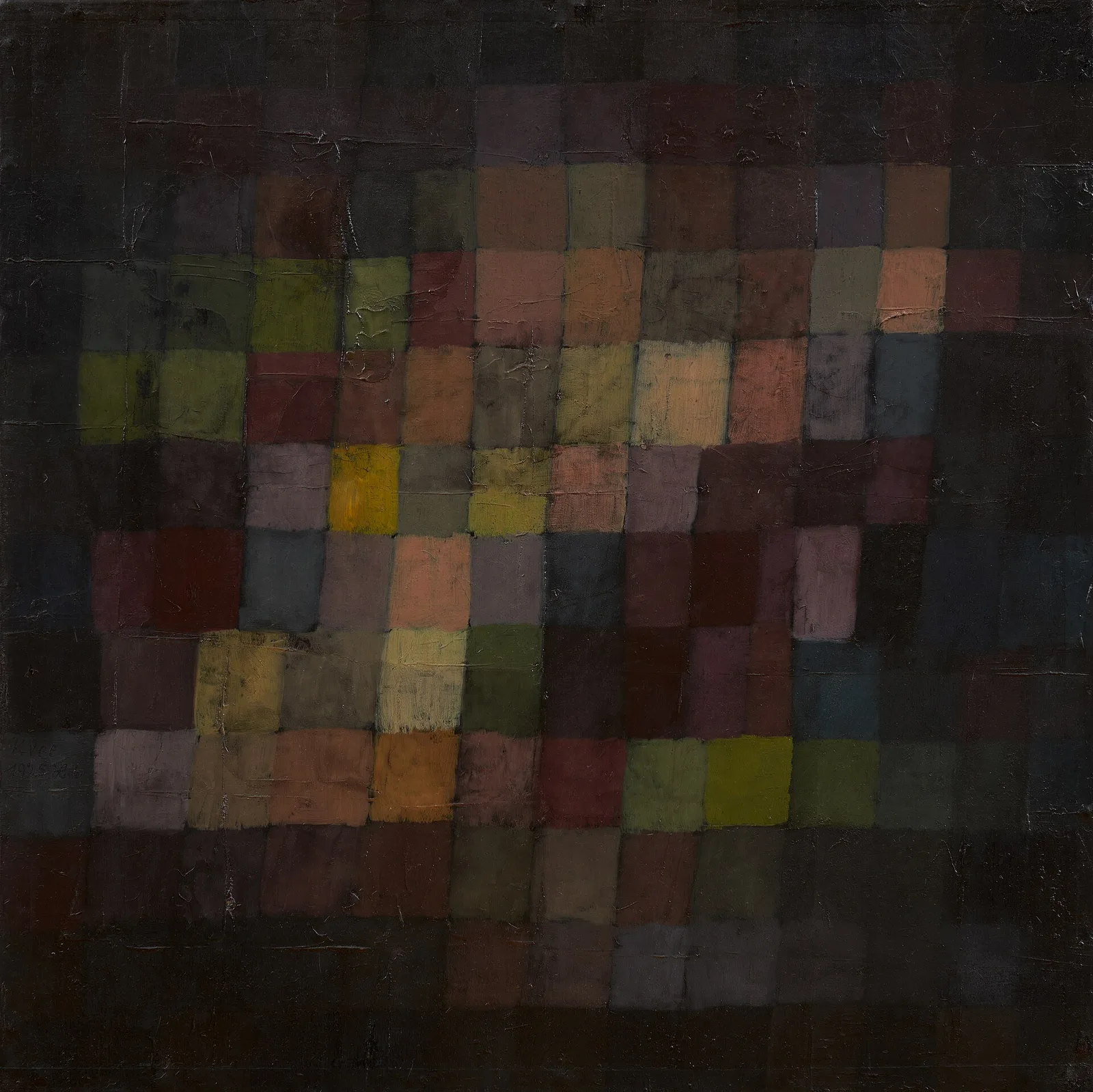
Maria O’Shea’s study of his polyphonic painting, written at the National College of Art and Design in Dublin in 1994, follows the idea through the work. His Bauhaus course notes include an analysis of a three-part passage by Bach; in 1921 he painted Fuge in Rot (Fugue in Red), in which the same shape repeats in shifting tones like a subject passing through the voices; and the late masterpiece Ad Parnassum of 1932 takes its title from Johann Joseph Fux’s Gradus ad Parnassum of 1725, the classic textbook of counterpoint. [14] The painting is a climb to the mountain of the Muses, and also a lesson in counterpoint.
Alter Klang, above, is a good place to hear what this means. There is no melody here, no figure. There is a field of small squares, each a different temperature of colour, darker at the edges and lighter towards the middle, like a chord that swells and fades. You do not look at it; you listen across it. The squares are like notes held at the same time, and the slow movement from dark to light is a crescendo.
Musicians have listened back. The Zentrum Paul Klee keeps some 450 scores inspired by his work. Giselher Klebe wrote Die Zwitschermaschine, metamorphoses on the picture, performed at Donaueschingen in 1950; Gunther Schuller wrote Seven Studies on Themes of Paul Klee in 1959 and 1960, with movements on Alter Klang and the Twittering Machine; Peter Maxwell Davies wrote Five Klee Pictures in 1962; and Edison Denisov followed in 1985. [2] Karlheinz Stockhausen called Klee his most important teacher of composition and gave a copy of Das bildnerische Denken to his friend Pierre Boulez, for whom Klee became central after he saw an exhibition of the work in Avignon in 1947. [2] A painter who learned from Bach became a teacher of composers.
If this week were a score, which voices are playing at once, and which one have you stopped hearing?
Six works, looked at one by one
No six pictures can stand for nine thousand. These are the six people meet first, on posters and museum walls, and each opens a different door. Look first; read after.
Twittering Machine, 1922
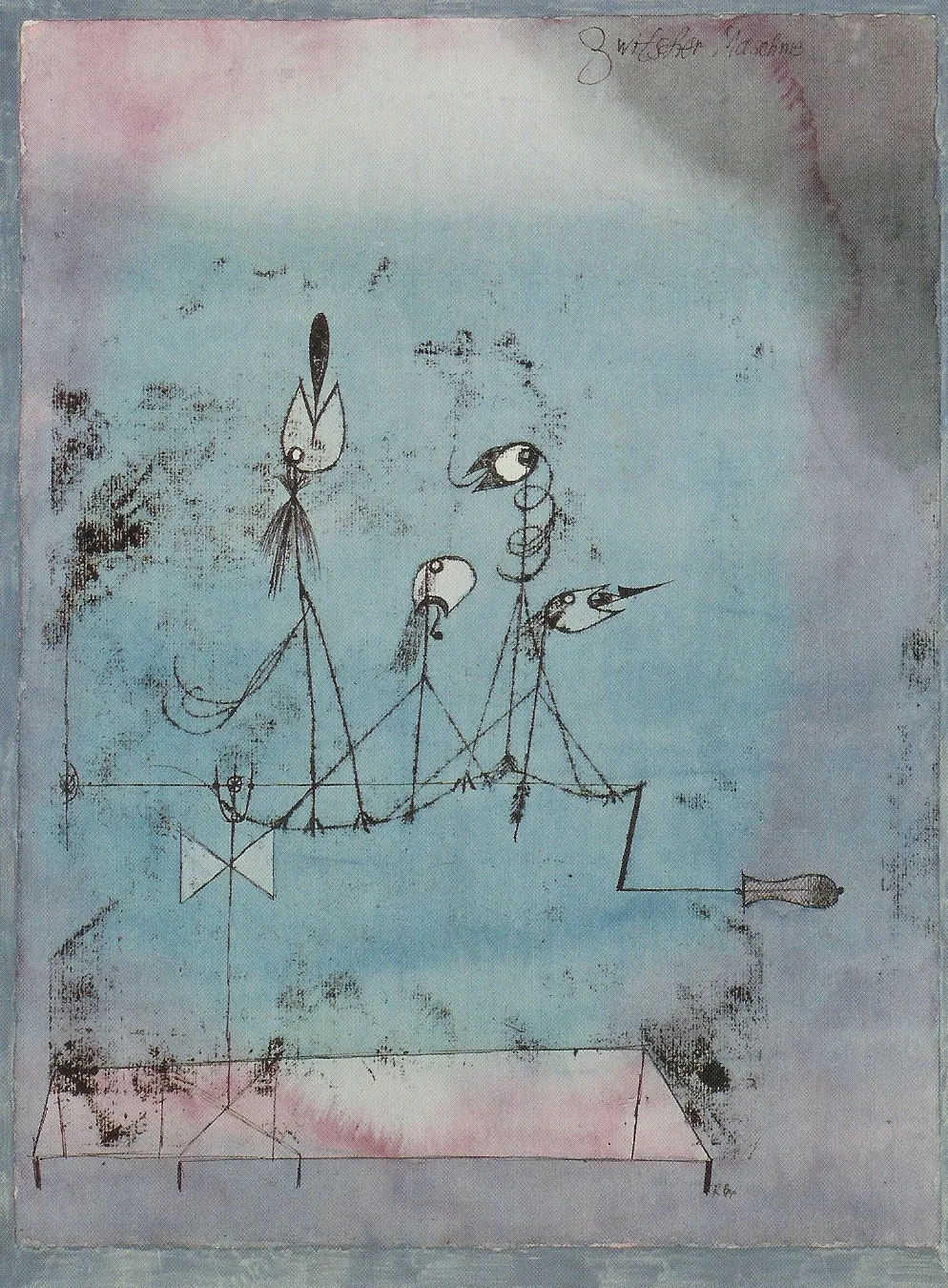
Four birds stand on a wire, or a branch shaped like a sine wave, each with its beak open and something sticking out of it, a tongue or a sound. The wire bends down at the right into a crank. Turn the crank, the picture suggests, and the birds will sing. Below them hangs a pale rectangle, and the blue of the ground fades into pink at the top, like night turning to dawn. [17] The line has the soft, slightly smudged edge of the Ölpause, the oil transfer method Klee invented, a tracing made through a sheet coated with oil paint. [2] [15]
Few pictures have been read in so many ways. A newspaper in 1941 compared it to the nonsense of Lewis Carroll. The critic Kay Larson, in 1987, saw “a fierce parable of the artist’s life among the philistines”, birds forced to chirp on command. The art historian Otto Karl Werckmeister placed it in Klee’s long interest in “the formal equation between animal and machine, between organism and mechanism”. The philosopher Arthur Danto, in 1997, read it as a joke about the futility of machines. [17] All four readings are possible because Klee leaves the joint between bird and machine exactly undecided. Is it a machine that imitates birds, or birds that have been turned into a machine? The year is 1922, four years after a war fought with machines that flew.
The picture has its own history. It hung in the Nationalgalerie in Berlin, was removed as “degenerate”, sold abroad through the Berlin dealer Karl Buchholz, and reached the Museum of Modern Art in New York in 1939. [2] [17] According to a magazine profile of 1987, it became a favourite picture for children’s bedrooms, and it has inspired more than a hundred compositions. [17]
Angelus Novus, 1920
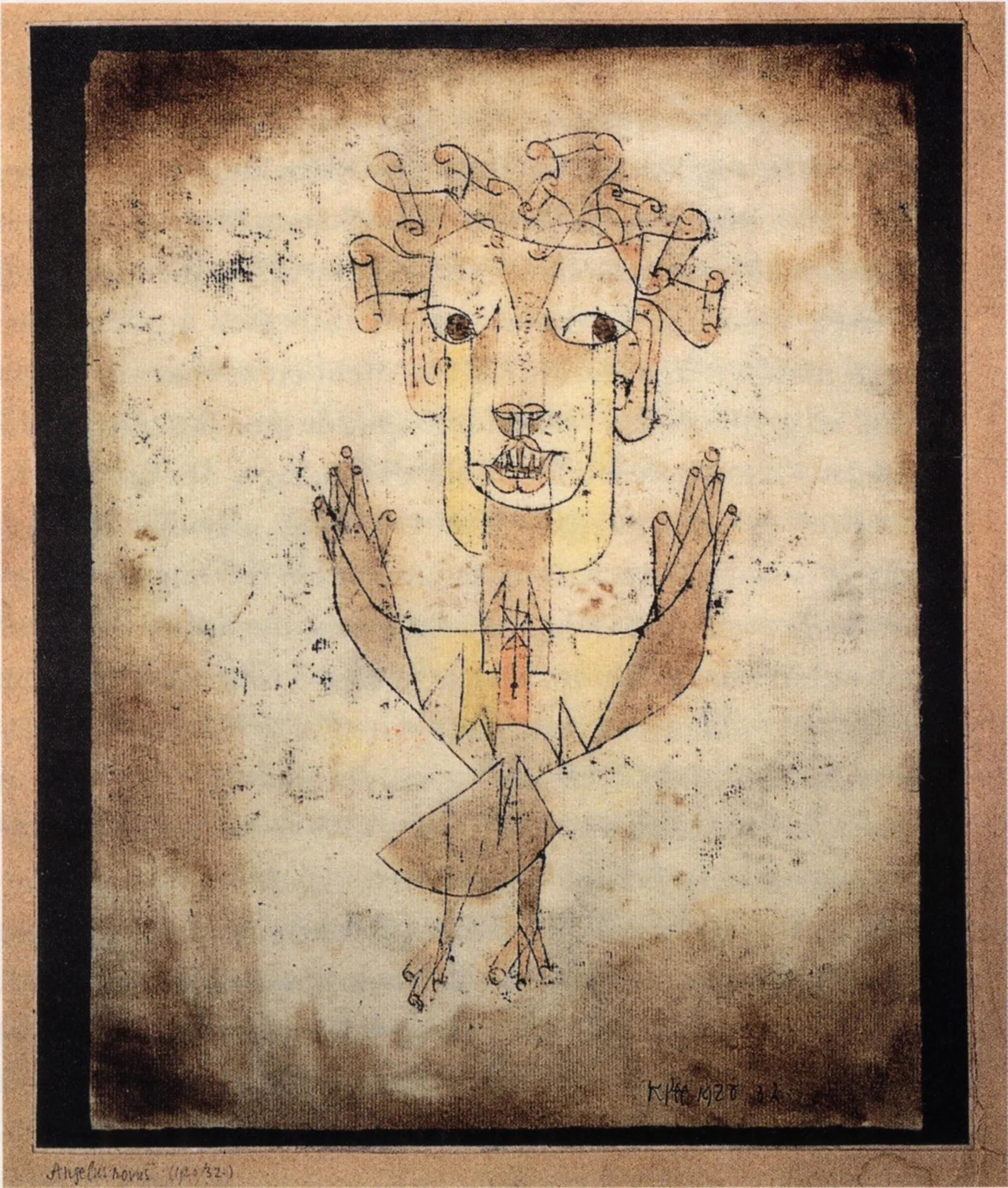
A small sheet, made with the same oil transfer method: an angel with scrolls for hair, eyes wide, mouth open, hands raised like wings. The philosopher Walter Benjamin bought it in 1921, took it with him into exile in Paris in 1933, and before he fled further entrusted it to Georges Bataille, who hid it in the Bibliothèque nationale. Benjamin took his own life in Spain in September 1940. After the war the sheet went to Theodor Adorno and then, as Benjamin had wished, to his friend Gershom Scholem in Jerusalem; it is now in the Israel Museum. [15]
The picture is famous because of what Benjamin wrote about it in 1940, in the ninth of his theses on the concept of history: “There is a painting by Klee called Angelus Novus. An angel is depicted there who looks as though he were about to distance himself from something which he is staring at. His eyes are opened wide, his mouth stands open and his wings are outstretched. The Angel of History must look just so. His face is turned towards the past. Where we see the appearance of a chain of events, he sees one single catastrophe, which unceasingly piles rubble on top of rubble and hurls it before his feet. He would like to pause for a moment so fair, to awaken the dead and to piece together what has been smashed. But a storm is blowing from Paradise, it has caught itself up in his wings and is so strong that the Angel can no longer close them. The storm drives him irresistibly into the future, to which his back is turned, while the rubble-heap before him grows sky-high. That which we call progress, is this storm.” [16]
Look again after reading it, and notice what Benjamin added. In Klee’s sheet there is no storm, no rubble and no back turned to the future; the angel faces us. Benjamin read his own historical despair into a drawing that is as much comic as tragic, with its curled hair and its teeth. That is not a misreading so much as proof of how open the image is. Werckmeister in 1997 counted it among the “icons of the left” and discussed Benjamin’s use of it as a main reason for its fame. [15] In 2015 the American artist R. H. Quaytman discovered something underneath: Klee had pasted his angel over an 1838 engraving by Friedrich Müller, after Lucas Cranach’s portrait of Martin Luther. [15] The new angel stands, literally, on the reformer.
Senecio, 1922
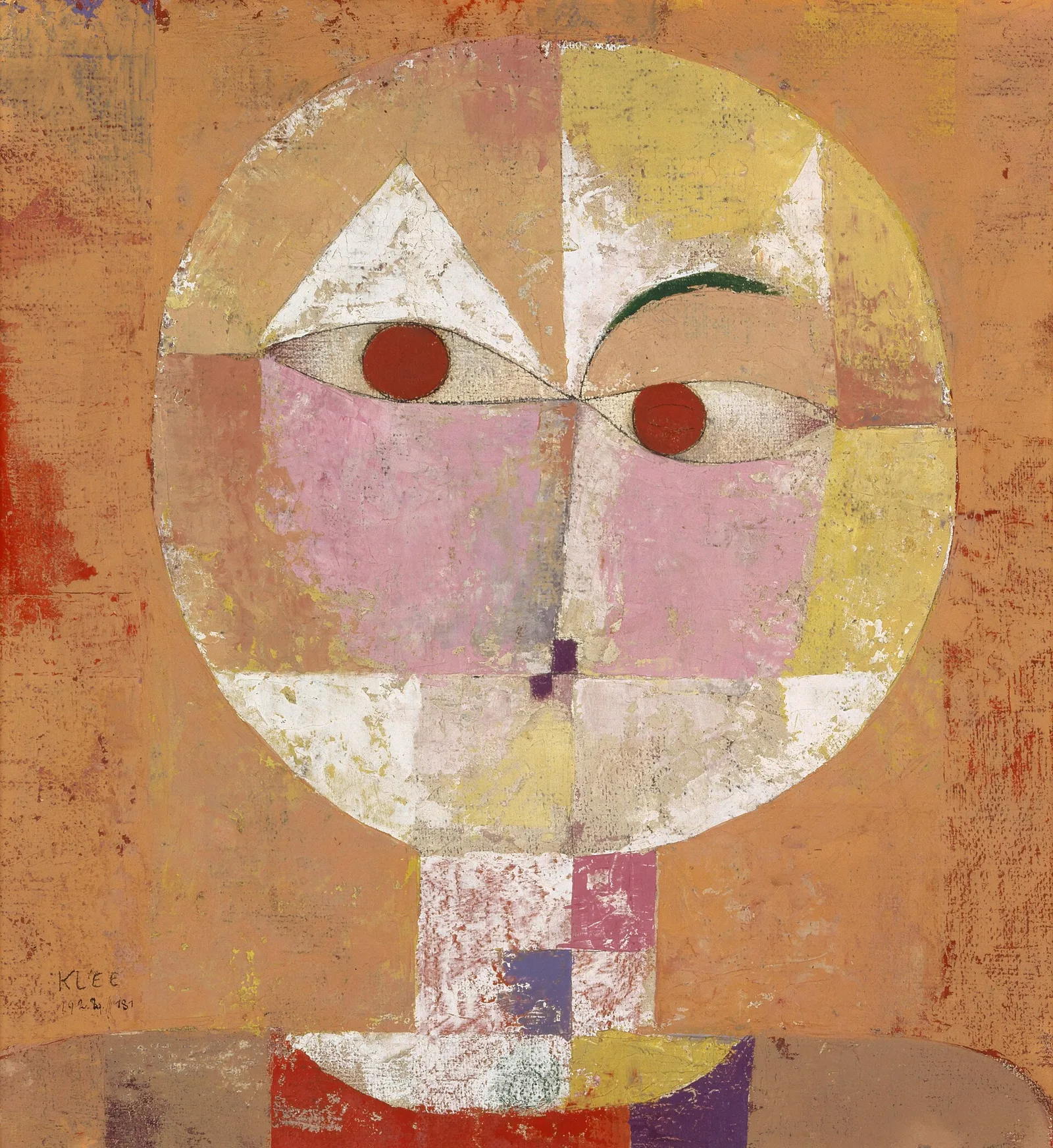
A face, almost a moon, divided into rectangles of orange, pink, yellow and white. The flat squares within the circle look like a mask or the patches of a harlequin’s costume. A triangle over the left eye and a green arc over the right give the impression of one raised eyebrow. [18] The picture is also known as Head of a Man Going Senile; Senecio is also the name of a plant genus, and the harlequin patches have been linked to a performer of that name. [18]
Do one thing: cover the left half with your hand, then the right. Each half is a different person. One eye looks at you; the other has already slid away. The face is not a portrait of anyone. It is a portrait of the moment attention starts to wander, built from nothing but a circle, a grid, two red dots and two lines. That is the Confession’s rule in practice: every element stays itself, the circle stays a circle and the dots stay dots, and still a face appears.
Ad Parnassum, 1932
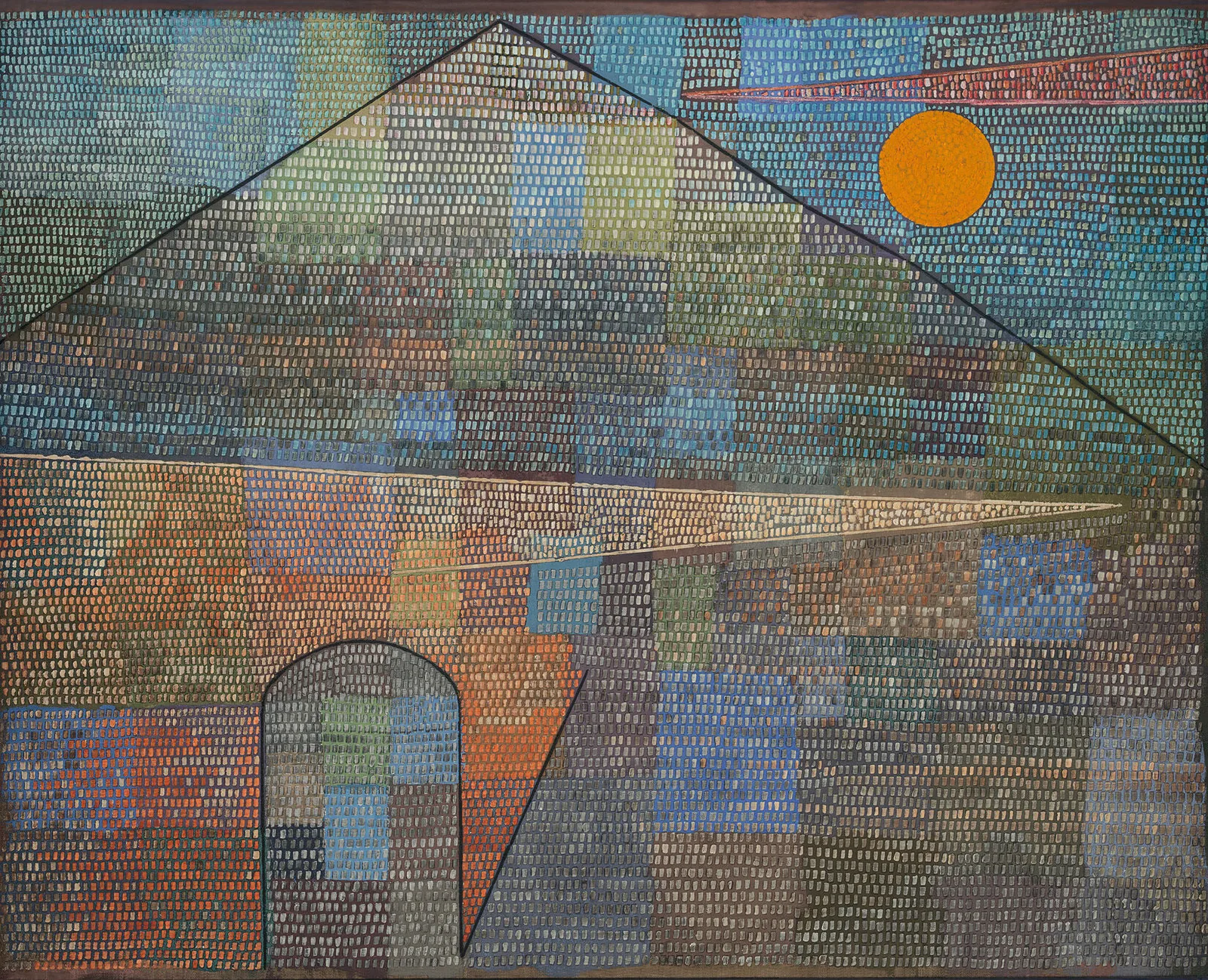
Painted in Düsseldorf in 1932, at 100 by 126 centimetres one of the largest pictures Klee ever made. The surface is built from thousands of small stamped dabs of colour laid over a grid of fields, and over them runs a single black line: a mountain, or a pyramid, with a door at its foot and an orange sun above. The title names Parnassus, the seat of Apollo and the Muses; the picture is also counted as a memory of his journey to Egypt. [2] And, as O’Shea showed, it is a nod to Fux’s textbook of counterpoint, Gradus ad Parnassum. [14]
Stand back and the dots melt into soft squares of colour; come close and each dab is separate, a voice in a choir. The black line does the opposite: it is the one voice that never blends. That is polyphony made visible. The door is low, at the bottom left, and the climb begins there.
Insula dulcamara, 1938
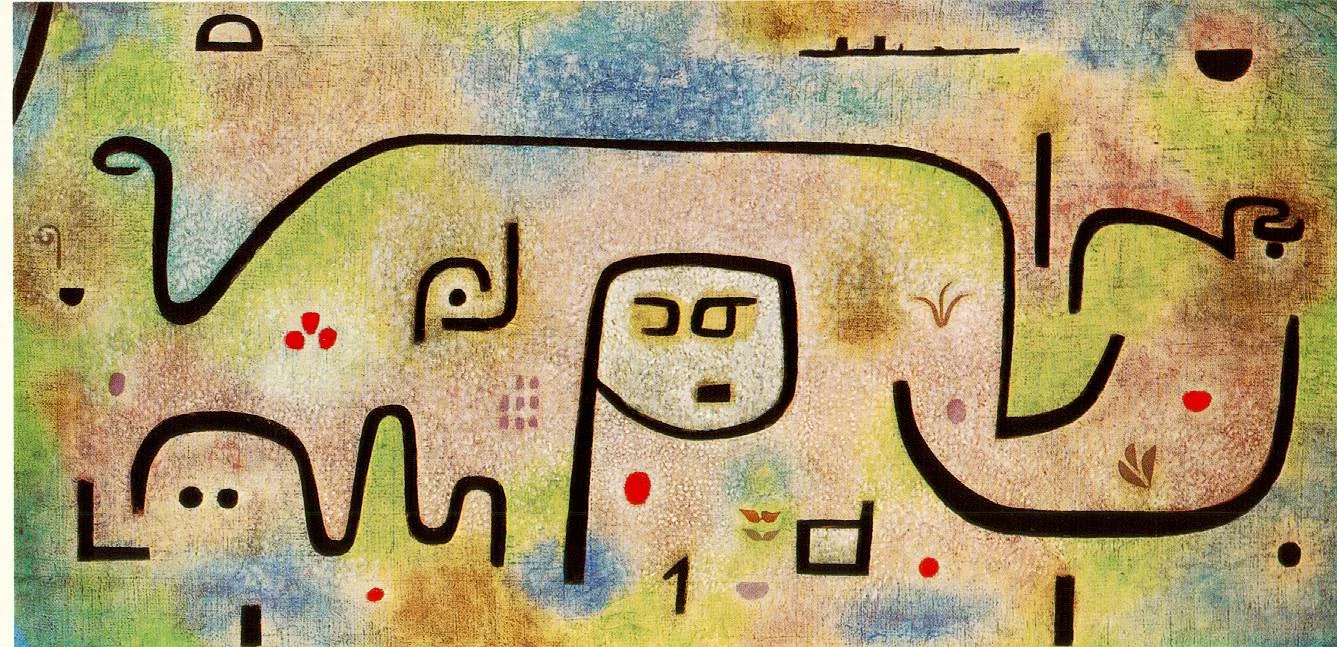
At 88 by 176 centimetres, painted on newspaper glued to burlap, this is again one of his largest works, and a key to the late style. [2] From 1938 Klee worked with thick black signs that look like hieroglyphs: a line can be a coastline, a profile, a letter. In the middle sits a white face with black-rimmed eye sockets, read as a symbol of death. [2] The title means the bittersweet island. The colours of the ground are spring colours, pale green, rose and blue; the signs over them are heavy and final. Sweet underneath, bitter on top, and you need both to read it.
Writing had entered the pictures twenty years before. Klee wrote poems all his life, drafting them in his diary and in a blue notebook he titled, mockingly, Geduchte (Pomes), and published none; a selection appeared in 1960. [3] In the watercolour Einst dem Grau der Nacht enttaucht (Once Emerged from the Grey of Night) of 1918, a poem he probably wrote himself is set letter by letter into small squares of colour, the two stanzas parted by a strip of silver paper, the verses written out by hand on the mount above. The words are both the subject and the material of the picture. [2] [3] In our reading, the black signs of 1938 are that same alphabet, grown large and no longer spelling anything.
Death and Fire, 1940
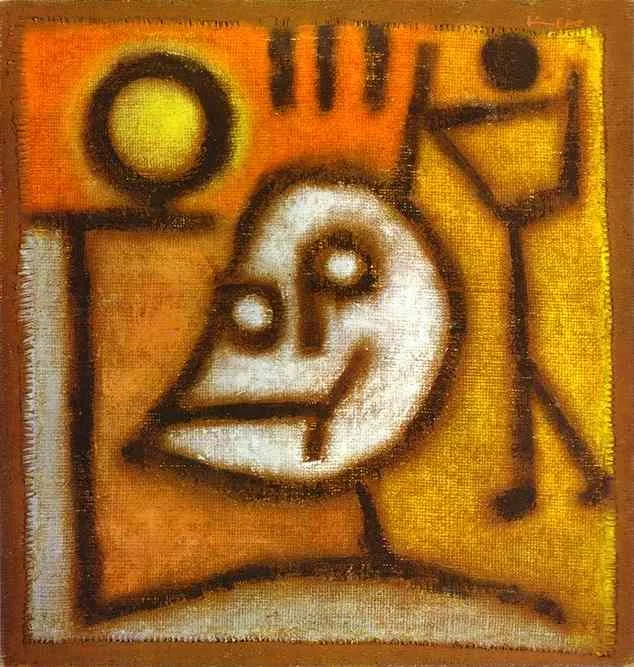
One of the last paintings, from the year he died. A white face, half skull, half mask, floats in a field of orange; at the right a stick figure strides away, and a yellow sun sits in the upper corner. Look at the face again: the German word Tod, death, is written into it, with the letters turned, and it can be read a second time in the picture as a whole, the raised arm as T, the sun as O, the head as D. [19] In 2010 two physicians, Jeffrey Aronson and Manoj Ramachandran, wrote about scleroderma in Paul Klee in the Journal of the Royal Society of Medicine, and the late paintings are often read through the suffering it caused. [19] Yet the figure walks. The sun is still there. Klee did not paint death as an end but as something one passes, with a word written on its face so that you can read it, and keep going.
Which of these six would you hang where you see it every morning, and what does that choice say about the year you are in?
Degenerate art, exile and the late flood
In 1933, the year he lost his post, Klee made 482 works. One of them is a dark self-portrait called von der Liste gestrichen, struck off the list: closed eyes, a pressed mouth, and a large X running through the back of the head. [2]
On 19 July 1937 the exhibition Entartete Kunst, “degenerate art”, opened in Munich, and later travelled to Berlin, Leipzig, Düsseldorf and Salzburg. Klee was represented with seventeen works by one count and fifteen by the count of the Zentrum Paul Klee, among them Sumpflegende (Swamp Legend) of 1919. [2] [1] That picture, now in the Lenbachhaus in Munich, later became one of the best-known restitution claims for a work by Klee, settled in 2017 after 26 years. [3] [2] To insult them further, the organisers placed sheets from the psychiatrist Hans Prinzhorn’s collection of art by psychiatric patients next to works by Kirchner, Klee, Nolde and others. [2] From August 1937 German museums were emptied: 102 works by Klee were confiscated and sold abroad, many through the Berlin dealer Karl Buchholz, who sent them to his New York branch run by Curt Valentin. [1] [2] That is one route by which Klee reached American collections; the exhibition Klee and America of 2006 and 2007 traced his influence on the Abstract Expressionists there. [2] For that story, read Abstract Expressionism.
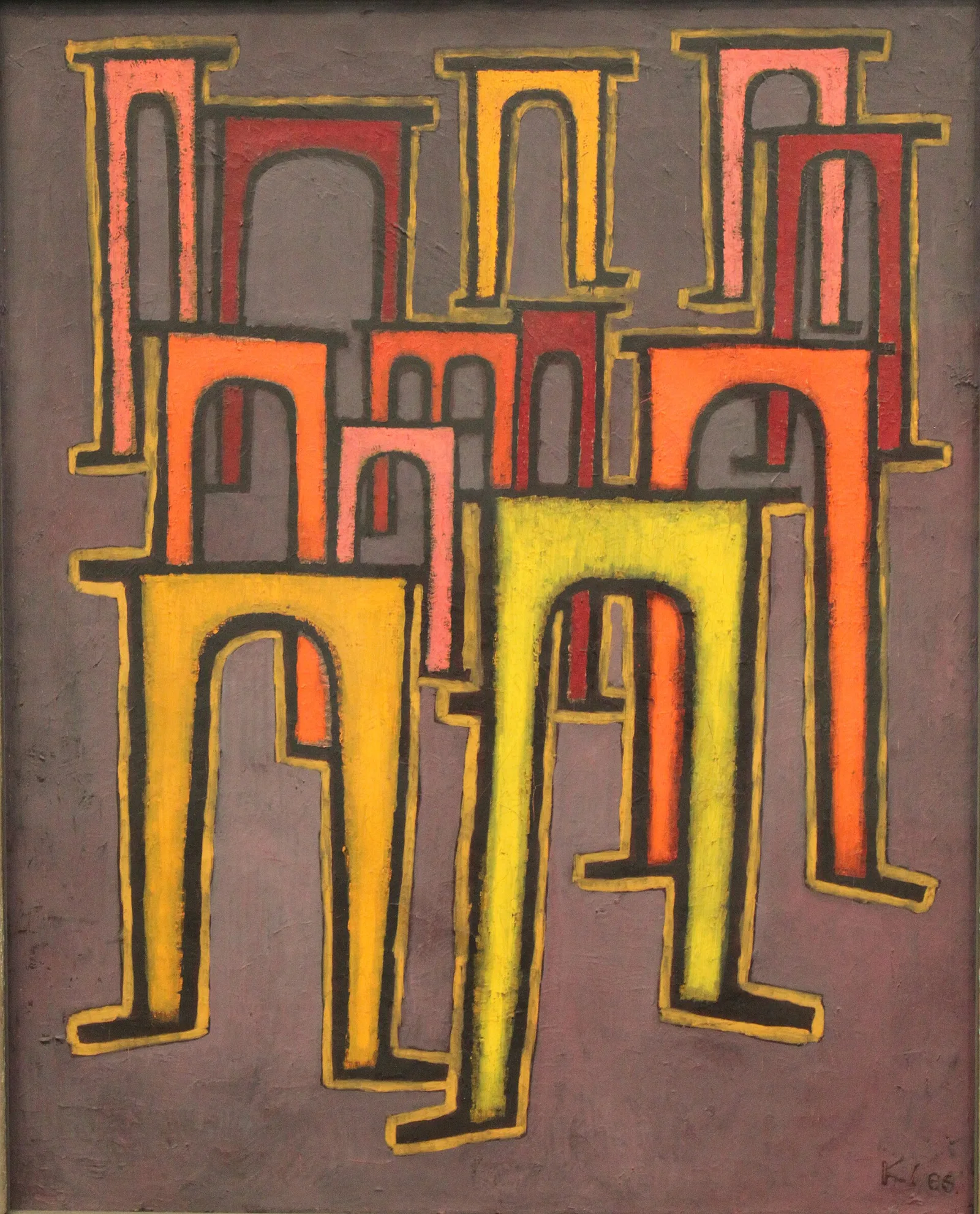
Klee answered the way he knew. Revolution des Viadukts, painted in 1937 and now in Hamburg, is one of his best-known pictures and is read as his contribution to antifascist art: the arches of a viaduct step out of line, refuse to be one more link in the chain, and walk off on their own legs. [2] Look at them closely: each arch has a different colour and a different stride. A viaduct exists to carry a single straight road; these arches have decided to carry themselves. There is no slogan, no figure of a dictator, and the point is unmistakable.
Then came the illness, and against it the flood. From the spring of 1937, despite the hardening of his skin, he worked again, and the format changed. [2] Visits helped. In 1933 he had at last met Picasso, whom he greatly admired, in his Paris studio; in 1937 Picasso came to Bern, arrived late and looked at the work for a long time without comment, and that visit and one from Kandinsky encouraged him. [3] [2] The lines thickened into black bars, the pictures grew larger, the signs simpler and heavier, as if a man who could no longer make small precise movements had decided to make large certain ones. About eighty angels date mainly from 1938 to 1940, among them Engel, noch weiblich (Angel, Still Female) of 1939. An exhibition in Essen and Hamburg in 2013 described them as “geflügelte Mischwesen, halb Mensch halb Himmelsbote”, winged hybrids, half human, half messenger of heaven, a transitional form between earthly and unearthly existence, often placed close to devils in a philosophy that knew no fixed opposition of good and evil. [2]
On 16 February 1940 the Kunsthaus Zürich opened Paul Klee. Neue Werke, the only presentation of the late work he designed himself. The press attacked it, and Carola Giedion-Welcker, who visited him in Bern shortly before his death, found him angry and upset, because the attacks threatened his naturalisation. [2] On 10 May he went to a sanatorium in Ticino; he died on 29 June. On the easel he left an unsigned picture, later called Der Todesengel (The Angel of Death), a comparatively realistic still life of flowers, a green jug, a sculpture and an angel, with the moon apart on a dark ground. He had had himself photographed in front of it on his sixtieth birthday, and it is thought he saw it as his legacy. [2]
What would you make if you knew your hands had five years left?
Childlike, naive, surrealist? What specialists say
Three labels follow Klee around, and each holds a grain of truth wrapped in a misunderstanding. The German Wikipedia lists his work under Expressionism, Constructivism, Cubism, Primitivism and Surrealism at once, which says enough: every label fits a part, none fits the whole. [2]
“A child could do that”
Klee anticipated the objection and answered it in his diary in 1909. The primitive impression of his work, he wrote, comes from “letzte professionelle Erkenntnis”, ultimate professional knowledge, which is “das Gegenteil von wirklicher Primitivität”, the opposite of real primitiveness. [2] He did take children seriously. He kept some of his own childhood drawings and entered them in his catalogue of works; of the hand puppets he made for his son Felix between 1916 and 1925, thirty survive in Bern, and those he left out of the catalogue. [2] In a text of 1912 he defended “the primitive stammerings of an art such as you are more likely to find in ethnographic museums or at home, in your children’s bedrooms”, and said the drawings of the mentally ill deserved to be taken “extremely seriously, a great deal more so than any picture gallery”. [21] After Hans Prinzhorn published his book on the art of psychiatric patients in 1922, Klee, Kandinsky and Max Ernst all drew on it. [2]
But taking children seriously is not drawing like a child. Marcel Duchamp put the difference well in 1949: the first reaction to a Klee, he wrote, is the pleasant discovery of what any of us could have done by drawing as we did in childhood; a second look reveals a technique founded on great maturity of thought, a deep understanding of watercolour and a personal method in oil, and a fertility that never shows signs of repetition. [2] A child does not keep a catalogue of nine thousand works, write a theory of the line, or paint a polyphonic grid of stamped dots. The simplicity is the result, not the starting point.
The naive mystic, and the market
The second label is quieter and more persistent: Klee as the gentle, otherworldly sage, a little apart from history. The image is partly his own work: Susanna Partsch reads the edited diaries and the epitaph “Diesseitig bin ich gar nicht fassbar”, which he treated as his programme, as the artist shown as he wished to be seen. His friend Will Grohmann, whose monograph appeared in 1954, wrote about him without critical distance and agreed his text with the artist. A new phase of research began only in the mid-1970s with Jürgen Glaesemer and Christian Geelhaar, and Wolfgang Kersten’s critical edition of the diaries in 1988 completed the turn. [2]
The sharpest challenge came from Otto Karl Werckmeister. In The Making of Paul Klee’s Career, 1914 to 1920, published by the University of Chicago Press in 1989, he traced how Klee changed, in the eyes of the public, “from an idiosyncratic abstract individualist to a metaphysical storyteller to mystical sage”, an image promoted by critics and dealers “acting in cooperation with the artist himself”, which succeeded first in the war-weary art world of 1916 to 1918 and then in what Werckmeister calls the pseudo-revolutionary art world of 1919 to 1920. [6] Werckmeister does not say the work is false. He says that the legend of the unworldly Klee was made, in part by Klee, in exactly the years in which he became a success, and the dates bear him out: Walden’s purchases in 1918, the Goltz contract of 1919, the retrospective of 1920. [2] How much of the sage was strategy remains an open question. The man who wrote about the last secret also negotiated contracts and edited his diary. Both are true, and the pictures are no less for it.
A surrealist?
The Surrealists wanted him. In 1925 Klee had his first solo exhibition in France, 39 watercolours at the Galerie Vavin-Raspail from 21 October to 14 November, with a preface by Louis Aragon and a poem by Paul Éluard. From 14 to 25 November two of his pictures hung in the first Surrealist exhibition at the Galerie Pierre, beside Arp, de Chirico, Ernst, Masson, Miró, Man Ray and Picasso. But he was never accepted as a member. [2] André Breton gave one of his 1921 pictures a new title in a catalogue, chambre spirit; the critic René Crevel called him a dreamer. Grohmann answered in Cahiers d’Art that Klee stood firmly on his feet: “Er ist in gar keiner Weise ein Träumer; er ist ein moderner Mensch, der als Professor am Bauhaus lehrt.” He is in no way a dreamer; he is a modern man who teaches as a professor at the Bauhaus. Joan Miró remembered the outcome: “Masson und ich haben zusammen Paul Klee entdeckt. […] Doch Breton verachtet ihn.” Masson and I discovered Paul Klee together. […] But Breton despises him. [2]
The difference is method. Surrealism wanted the unconscious to speak without control, through automatic writing and dreams. Klee prized intuition, but he built: grids, counterpoint, stamped dots, a theory of line taught to hundreds of students. His fantasy is constructed, the way a fugue is constructed. The Surrealists recognised a kindred strangeness; they did not share his discipline.
How to look at a Klee, and where to see one
In the Creative Confession Klee recalls the painter Feuerbach’s remark that understanding a picture takes a chair, so that tired legs do not disturb the mind. [4] Many of his works are small, Angelus Novus measures 31.8 by 24.2 centimetres, and they reward a different kind of attention than a large canvas does. [15] Here is a way to look that follows his own ideas.
- Start with the title, then forget it. Klee’s titles are part of the work: a joke, a clue, a small poem, as in von der Liste gestrichen or Engel, noch weiblich. Read it, look away from it, and come back to it at the end. In our reading, Hauptweg und Nebenwege, one of the layered stripe pictures of 1929, is a field of colour bands until the title turns it into a road with side paths. [2]
- Follow one line from start to finish. Pick any drawn line and travel along it with your eye, as in the walk of the Confession: where it hesitates, where it turns back, where it crosses another. You are retracing the movement that made it. [4]
- Separate the voices. Look only at the colour, ignoring the drawing; then only at the drawing, ignoring the colour; then only at the texture of the ground, gauze, burlap, newspaper, plaster. Each is a voice in the polyphony. Then let them sound together. [14]
- Find the element that keeps itself. A dot that is also an eye, a square that is also a house, a letter that is also a body. Klee wanted the elements to make forms without sacrificing themselves; spotting the moment where something is two things at once is the pleasure of his work. [4]
- Look at the year. Klee kept his catalogue by hand, year by year, from 1911 until his death, so a date tells you where you are in a lifetime of work; in 1939 a sick man was making more than three works a day. [2] [1]
- Come back. Klee described the viewer as someone who stops and leaves, like the artist, and returns if it was worth it. [4] A Klee seen twice, a week apart, is a different picture.
If you know the scribbled, written-over surfaces of Cy Twombly or the signs of the COBRA painters, a late Klee such as Insula dulcamara is a good place to compare marks that look like writing but cannot be read. And if Hilma af Klint made you wonder how a painter shows what cannot be seen, Klee is the one who wrote down a method for it.
What is the last thing you looked at for longer than a minute without a screen, and what did the second minute show you that the first did not?
Where to see Klee
The centre of the world for Klee is Bern. The Zentrum Paul Klee, designed by Renzo Piano and opened in 2005, holds about four thousand works, including Insula dulcamara and Death and Fire, and the archive of his teaching notes; the Kunstmuseum Bern has Ad Parnassum. [2] [12] The Kunstmuseum Basel has Senecio. [18] In Lucerne the Sammlung Rosengart has a well-known Klee department, and the Albertina in Vienna and the Museum Berggruen in Berlin hold important groups. [2]
In Germany the Kunstsammlung Nordrhein-Westfalen in Düsseldorf, the city where he last taught, began with Klee: in 1960 the state of North Rhine-Westphalia bought 88 of his works from the private collection of the American collector G. David Thompson. [29] The Museum Ludwig in Cologne has Hauptweg und Nebenwege, the Hamburger Kunsthalle Revolution des Viadukts. [2] The Moderna Museet in Sweden holds Tunisian watercolours, among them Kairuan, vor dem Thor. [8] In the United States, the Museum of Modern Art in New York has the Twittering Machine, and the San Francisco Museum of Modern Art holds the large Klee collection of Carl Djerassi. [17] [2] Angelus Novus is in the Israel Museum in Jerusalem. [15] Works on paper are sensitive to light and are not always on view, so check with the museum before you travel for one picture.
How the world sees Klee
In Germany the first verdicts came from fellow artists. Oskar Schlemmer, later his colleague at the Bauhaus, wrote in his diary in September 1916: “Klees Tat ist ganz wunderbar. In einem Minimum von Strich kann er seine ganze Weisheit offenbaren. Er ist alles; innig, zart, und vieles andere Beste, und dies vor allem: er ist neu.” What Klee does is quite wonderful. In a minimum of line he can reveal his whole wisdom. He is everything: intimate, tender, and much else of the best, and above all this: he is new. [2] In Britain Herbert Read, in A Concise History of Modern Painting (1959), called the published notebooks “the most complete presentation of the principles of design ever made by a modern artist” and the Principia Aesthetica of a new era of art, with Klee in a role like Newton’s in physics. [11] In France the philosopher Gilles Deleuze took up Klee’s line from the Jena lecture, “uns trägt kein Volk”, no people carries us, as “the people are missing”, in the second of his books on cinema, Cinéma 2: L’image-temps (1985) [31]: the artist does not address a people that exists, but helps one to come into being. [20] [5]
The most interesting readings, though, come from further away, because Klee’s work travelled before he did. The Austrian art historian Stella Kramrisch, who taught Indian and European art at Rabindranath Tagore’s university at Santiniketan from 1921 to 1923, invited the Bauhaus to send paintings and graphics to Calcutta. In December 1922 the exhibition opened at the 14th annual exhibition of the Indian Society of Oriental Art, with over 250 works by Bauhaus teachers and students, Klee among the masters, shown beside the artists of the Bengal School, and is often described as an entry point of modernism into India. [22] A generation later the Indian painter V. S. Gaitonde, one of the great abstract painters of Asia, began in the 1950s with small works that drew, in the words of the critic Alexandra Bregman in 2014, “inspiration from the linear strokes and shapes of Paul Klee”; Gaitonde himself noted that Klee’s small formats suited painting in his parents’ home. [23]
Japan came to Klee early and stayed. The first Klee exhibition in Japan opened at the Seibu department store’s SSS Hall in Tokyo on 14 October 1961, with about a hundred works lent by the Kunstmuseum Bern. [24] The poet Tanikawa Shuntarō wrote poems to Klee’s pictures, published as Klee no ehon (Klee’s Picture Book) by Kodansha in 1995. In 2017 Isamu Murakami recalled meeting Klee first as a choir singer, in a piece set to one of those poems, and only then the paintings: the poems showed him a way of looking. A German selection of Tanikawa’s Klee poems appeared in 2008. [25] [26] In 2013 the Zentrum Paul Klee devoted an exhibition to the relation running the other way, Vom Japonismus zu Zen, from Japonisme to Zen, which showed Klee as a mediator between Japanese tradition and Western modernism, and traced the interest in calligraphy and Zen in his late work. [2]
China is part of his own story. Between 1917 and 1923 Klee read Chinese poetry in translation, and wrote to his wife in 1917: “J’ai le temps de lire beaucoup, et je deviens de plus en plus chinois”, I have time to read a great deal, and I am becoming more and more Chinese. [27] Decades later the Chinese composer Tan Dun answered with a piece named after his late picture, Death and Fire, in 1992. [2] In Latin America the Argentine composer Roberto García Morillo wrote Tres pinturas de Paul Klee as early as 1943, three years after Klee’s death. [2]
In the Arab world Klee is remembered as a painter whose eye was opened there. In April 2014 the Tunisian daily Kapitalis, in an article by Anouar Hnaïne, followed the centenary of the journey: a celebration initiated by the late Hamadi Chérif and organised by the Goethe-Institut, the Swiss and German embassies, the DAAD and Espace Sadika, where seven contemporary Tunisian artists, Fatma Charfi, Mouna Jemal Siala, Wadi Mehiri, Houda Ghorbel, Othman Taleb, Sana Tamzini and Sadika Keskès, showed work on Klee’s stay. [9] In 2021 the Louvre Abu Dhabi, with the Centre Pompidou, opened its first exhibition of the year on abstraction and calligraphy, on the idea that the calligraphy of Asia and North Africa fed the universal language abstract artists were looking for; Klee hung there beside Dia Azzawi, Lee Ufan and eL Seed, and the presentation noted that he travelled to the region at two distinct periods of his career, both critical junctures in his style. [28] Seen from there, Klee’s signs are not a European invention. They are a European painter learning to look at writing as image, something calligraphers had known for centuries.
Put these readings together and a pattern appears. In Europe Klee is often read as a philosopher-painter, a teacher, a witness to catastrophe. In India, Japan, Tunisia and the Gulf he is read as a bridge: someone who took what he saw in other traditions seriously, and turned it into a language that could travel back.
Questions people ask about Paul Klee
What is Paul Klee’s most famous painting?
The best-known works are Twittering Machine (1922, Museum of Modern Art), Angelus Novus (1920, Israel Museum), made famous by Walter Benjamin, Senecio (1922, Kunstmuseum Basel) and Ad Parnassum (1932, Kunstmuseum Bern). [17] [15] [18] [2]
What art movement was Paul Klee part of?
Klee belonged to the circle of Der Blaue Reiter from 1911 and taught at the Bauhaus from 1921 to 1931, but no single movement contains him; his work has been placed under Expressionism, Cubism, Constructivism, Primitivism and Surrealism. [1] [2]
Why does Paul Klee’s art look childlike?
Klee reduced his means on purpose; in 1909 he wrote that the primitive impression of his work comes from “ultimate professional knowledge”, the opposite of real primitiveness. He studied children’s drawings seriously but did not imitate them. [2] [21]
What did Klee mean by taking a line for a walk?
In his Creative Confession of 1920 and his Pedagogical Sketchbook of 1925, Klee treated a line as a point in motion, so that every kind of line, broken, looping, zigzag, records a movement and an experience, like steps on a walk. [4] [10]
What does “art does not reproduce the visible, it makes visible” mean?
It is the first sentence of the Creative Confession of 1920: art does not copy what the eye already sees, but brings into view what is otherwise hidden, such as movement, growth, time and the forces behind a form. [4]
Who were Paul Klee’s influences?
The most important were music, above all Bach and Mozart; the prints of Blake, Goya and Ensor in his early years; the Renaissance architecture of Florence and the sea creatures of Naples on his Italian journey; Robert Delaunay’s colour; his friends Kandinsky, Marc and Macke; the light of Tunisia, painted in the manner of Cézanne; and the art of children and of psychiatric patients. [2] [3] [21]
Was Paul Klee Swiss or German?
He was born and grew up near Bern but held German citizenship through his father; he applied for Swiss citizenship after returning in 1933, and died in 1940 one week before the Bern council was to decide. [2]
How did Paul Klee die?
He fell ill in 1935 with what has been identified, without surviving medical records, as scleroderma, worked intensely despite it, and died on 29 June 1940 in Muralto, near Locarno in Switzerland, aged sixty. [1] [2]
What is Angelus Novus about?
Klee’s 1920 monoprint shows an angel with wide eyes and spread hands; Walter Benjamin, who owned it, made it the “angel of history”, who sees the past as one catastrophe while the storm of progress drives him into the future. [15] [16]
Where can you see Paul Klee’s work?
The largest collection is at the Zentrum Paul Klee in Bern, with about four thousand works; important groups are in Basel, Bern, Düsseldorf, Lucerne, Vienna, Berlin, New York and San Francisco. [2] [29]
How many works did Paul Klee make?
His own catalogue lists close to nine thousand works, among them 733 panel paintings, 3,159 coloured sheets and 4,877 drawings; in 1939 alone he catalogued 1,253 or 1,254 works, depending on the count. [2] [1]
How this connects to my larger vision
For me, Klee’s first sentence of the Creative Confession holds the whole task: art does not reproduce the visible, it makes visible. I want the same from AI. A machine that copies the surface of the world gives us more pictures; a tool that helps a person see what was already alive inside him gives us more life. Klee cared more for Gestaltung, the shaping, than for the finished shape, and I see technology the same way: never finished, growing with the people who use it. In Kairouan the colour took hold of him and he wrote that he and the colour were one. That is the moment I hope our work can bring someone to, where the line between maker and material, and between one person and another, grows thin. The test I keep is simple: does a picture, a sentence or a machine bring someone closer to himself, and so closer to the other? [4] [2]
Sources and image credits
Every source below was opened on 3 November 2026. German and French quotations are verbatim from the source cited; the English translations are ours unless the source gives one. The images are public domain works from Wikimedia Commons, credited in each caption; the image at the top was made for this page and is not a work by Paul Klee.
- Zentrum Paul Klee, Paul Klee biography. Study in Munich, marriage, the Blaue Reiter exhibition of 1912, Tunisia 1914, military service, the Goltz retrospective, Düsseldorf, dismissal, illness, the 1937 confiscations, the output of 1939, death.
- Wikipedia (German), Paul Klee. Family, schooling, Munich, Italy, the Blaue Reiter, Tunisia diary, the war, Bauhaus, Jena lecture, Paris 1925, Egypt, 1933, emigration, naturalisation, the late work, Entartete Kunst, estate, collections, music, reception, research history.
- Wikipedia (English), Paul Klee. Dates and overview, the Tunisian watercolours after Cézanne, Picasso in 1933 and 1934, the visits of Kandinsky and Picasso, the poems and Geduchte, Einst dem Grau der Nacht enttaucht, and the restitution claim for Swamp Legend.
- Paul Klee, Schöpferische Konfession, in Tribüne der Kunst und der Zeit XIII, Erich Reiss, Berlin 1920, pages 28 to 40; full text on Wikisource.
- László Glozer, report in the Wissenschaftskolleg zu Berlin yearbook 1987/88. The commission for the Confession, the misprint Realität for Relativität, the Jena lecture and “uns trägt kein Volk”.
- University of Chicago Press, O. K. Werckmeister, The Making of Paul Klee’s Career, 1914 to 1920 (1989). Publisher’s description.
- Diaries of Note, “Color and I are one”. The Kairouan entry of 16 April 1914 in English.
- Moderna Museet, Paul Klee: Possessed by Color. The Kairouan quotation and the Tunisian watercolours.
- Anouar Hnaïne, “Sur les traces de Paul Klee en Tunisie”, Kapitalis, 10 April 2014. The route and the centenary in Tunisia; French text.
- Wikipedia (English), Pedagogical Sketchbook. Bauhaus book No. 2, Gropius and Moholy-Nagy, the 1953 translation, the dot on a walk, Klee on becoming a teacher, The Thinking Eye.
- Wikipedia (English), Paul Klee Notebooks. Spiller’s edition, Franciscono’s criticism, Herbert Read’s judgement, Wege des Naturstudiums.
- ArtHist.net, Zentrum Paul Klee announcement, 2012. The Bildnerische Gestaltungslehre, about 3,900 pages, the exhibition Meister Klee! Lehrer am Bauhaus and the online database.
- Swissinfo, “Zentrum Paul Klee in Bern präsentiert den Bauhaus-Lehrer Paul Klee”, 8 August 2012.
- Maria O’Shea, Klee, his ascent of Parnassus: an exploration of his polyphonic painting, thesis, National College of Art and Design, Dublin, 1994. Bach in the course notes, Fuge in Rot, Fux and Ad Parnassum.
- Wikipedia (English), Angelus Novus. Technique and size, Benjamin’s ownership and the route to Jerusalem, Quaytman’s discovery of 2015, Werckmeister 1997.
- Walter Benjamin, On the Concept of History (1940), thesis IX, English translation by Dennis Redmond, Marxists Internet Archive.
- Wikipedia (English), Twittering Machine. Medium, size, MoMA, the readings of Larson, Werckmeister, Danto and the Hartford Courant, the musical settings.
- Wikipedia (English), Senecio. Composition and alternative title.
- Wikipedia (English), Death and Fire. Medium, the letters of Tod, the illness, Aronson and Ramachandran 2010.
- Carlos Ramírez Vargas, article in Daimon. Revista Internacional de Filosofía, no. 92 (2024), pages 7 to 20. Deleuze and Klee’s “the people are missing”.
- LaM, Lille Métropole Musée d’art moderne, Paul Klee, Between Two Worlds (2021 to 2022). Klee’s text of 1912 on children’s and psychiatric art.
- Google Arts and Culture, story on the Bauhaus in Calcutta, 1922. Kramrisch, the Indian Society of Oriental Art, over 250 works, Klee among the masters.
- Alexandra Bregman, “VS Gaitonde: Painting as Process”, Asian Art Newspaper, 5 November 2014.
- Archive of exhibitions in Japan, the first Paul Klee exhibition, Seibu SSS Hall, Tokyo, 14 October to 14 November 1961.
- Isamu Murakami, Monosus Magazine, reading club no. 12, 8 May 2017. Tanikawa Shuntarō, Klee no ehon, Kodansha 1995.
- Perlentaucher, 7 September 2015. Tanikawa’s Klee poems in German, Fels der Engel (2008).
- University of Zurich, China and the West chronology, entry for 1917 to 1923. Klee’s reading of Chinese poetry and his letter to his wife of 1917.
- David Zwirner, “Paul Klee in Group Exhibition at Louvre Abu Dhabi”, on the exhibition of 17 February to 12 June 2021 with the Centre Pompidou.
- Kunstsammlung Nordrhein-Westfalen, history of the collection. The purchase of 88 works by Klee in 1960.
- Sri Aurobindo, The Future Poetry, contents, Savitri.org. Chapters “Poetic Vision and the Mantra” and “The Form and the Spirit”.
- Wikipedia (English), Cinema 2: The Time-Image. Gilles Deleuze, Cinéma 2, L’image-temps, Les Éditions de Minuit, 1985.