Artists / No. 006
Hilma af Klint
Hilma af Klint (1862 to 1944) was a Swedish painter who began a major body of non-figurative spiritual images in 1906, rethinking how painting could represent forces beyond the visible world. Hilma af Klint Foundation: biography and chronology
Was she the first abstract painter, and what do the spirals and circles actually mean? Begin with the images as sequences, then compare the artist’s purposes with the claims later made for her. The story includes collaborators, limited early audiences, a major museum rediscovery and a market that requires unusually careful distinctions.
How to look before decoding the symbols
Our first exercise is to follow a transformation. Find a circle, spiral or plant-like form and ask whether it seems to grow, divide, meet another form or change direction. Then compare that movement with a second painting from the same series. Do not begin by treating every colour as an isolated word in a secret dictionary. You may see a relationship clearly without being able to translate it into a sentence. Describe what repeats and what changes before deciding what the sequence means.
Moderna Museet explicitly warns against assigning a definite, unambiguous meaning to every symbol. Its guide links spirals with evolution, blue and yellow with feminine and masculine principles, and the letters W and U with matter and spirit, while insisting on context. Those are elements of af Klint's symbolic world, not universal psychological truths. A meaningful reading therefore moves between an individual sign and the larger arrangement in which it appears. Moderna Museet: symbols
Our second exercise is to compare a close detail with the whole painting. In a very large work, a small letter or curling line can have the intimacy of a notebook while the complete surface addresses the body at a much greater scale. Ask how those two registers coexist. This is our interpretation of a viewing problem, rather than an instruction to feel overwhelmed. A sequence can also matter more than its most recognisable isolated image.
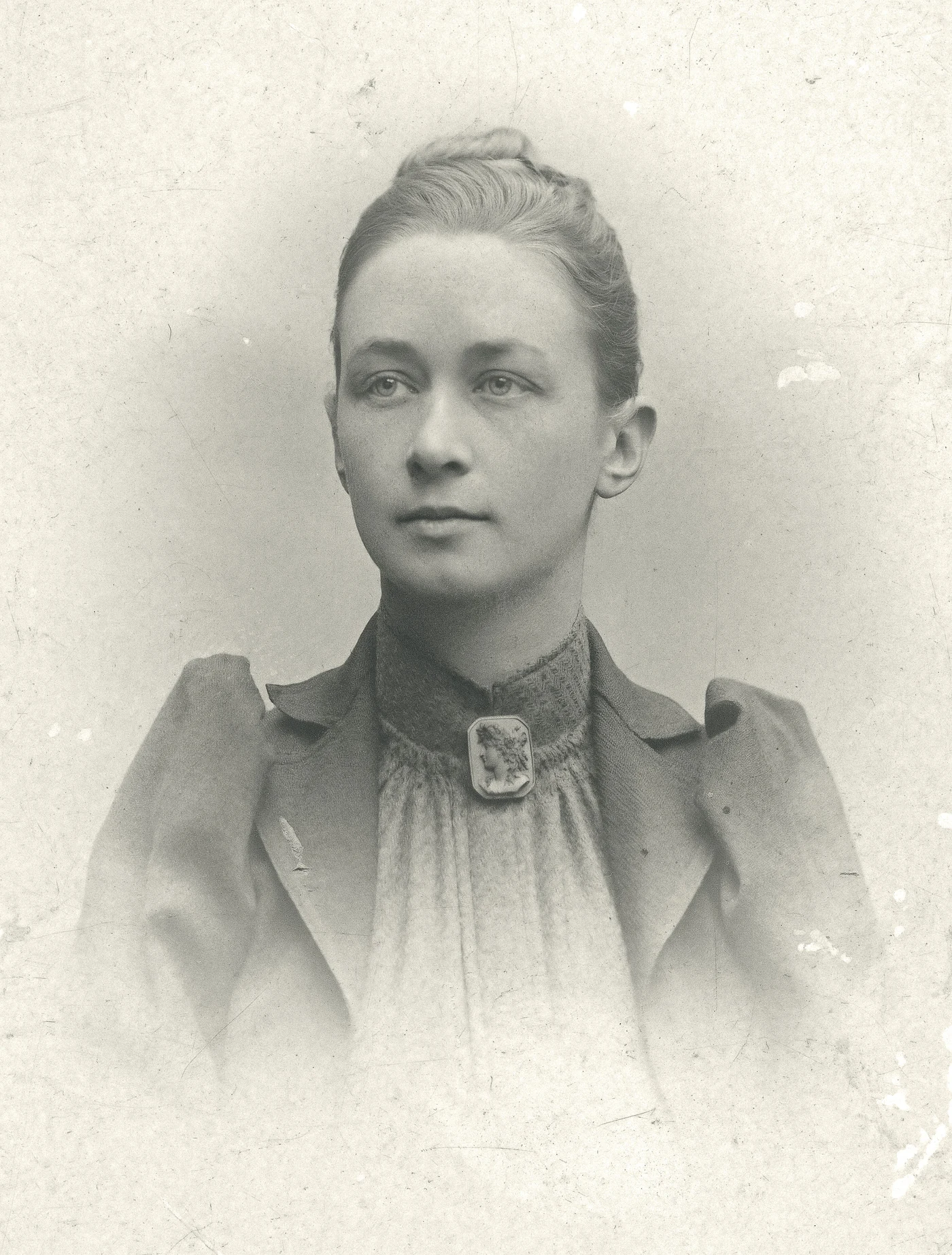
A short timeline of work and delayed recognition
- 1862 to the 1880s. Born on 26 October 1862 at Karlberg Palace near Stockholm, af Klint trained at the Royal Academy of Fine Arts. Landscapes, portraits and other conventional paintings supported an established professional practice. Hilma af Klint Foundation: biography and chronology
- 1896. She joined Anna Cassel, Cornelia Cederberg, Sigrid Hedman and Mathilda Nilsson in The Five, a spiritual group whose meetings included automatic writing and drawing. Hilma af Klint Foundation: biography and chronology
- 1906 to 1908. She began Paintings for the Temple in November 1906 and produced its first 111 pictures by April 1908. The Ten Largest and Evolution belong to this first period. Moderna Museet: topics and central works
- 1908 to 1915. A four-year interruption preceded renewed work. The cycle concluded in 1915 with 193 paintings, including The Swan, The Dove and the Altarpieces. Moderna Museet: topics and central works
- 1916 to the 1920s. Parsifal, The Atom, studies of plants and investigations of world religions extended the practice. Visits to Dornach and engagement with anthroposophy informed a later shift towards watercolour. Hilma af Klint Foundation: biography and chronology Moderna Museet: topics and central works
- 1932 to 1944. She marked notebooks with instructions delaying access for 20 years after her death. She died on 21 October 1944; her nephew Erik inherited roughly 1,300 paintings and 124 notebooks. Hilma af Klint Foundation: biography and chronology
- 1986 to 2013. LACMA's The Spiritual in Art helped introduce the work internationally. Moderna Museet's major retrospective in 2013 travelled to Berlin, Málaga and Humlebæk. Hilma af Klint Foundation: biography and chronology Moderna Museet: A Pioneer of Abstraction
- 2018 onwards. The Guggenheim's Paintings for the Future became the museum's best-attended exhibition, according to the Foundation. Later presentations, including the pairing with Mondrian in London and The Hague, continued to reframe the history. Hilma af Klint Foundation: biography and chronology Kunstmuseum Den Haag: Forms of Life
What was af Klint trying to make visible?
Spiritual knowledge as an artistic task
Af Klint understood important parts of her work as a commission communicated through spiritual intermediaries. The Foundation situates spiritualism, theosophy, Rosicrucianism and later anthroposophy within the intellectual climate of her time. These movements offered ways of relating religious life to scientific discoveries and a world extending beyond unaided vision. The documented fact is that she held and explored such beliefs. Her account of receiving messages does not establish the existence or authority of the beings she described. Hilma af Klint Foundation: biography and chronology
Our reading is to take the purpose seriously without requiring the viewer to share the belief. A scientific diagram, a religious image and a painting can all organise the unseen, but they make different kinds of claim. Af Klint's pictures invite questions about the relationship between a visual structure and the knowledge it promises. Does a sequence clarify an idea, produce a sensation of growth, or demand an explanatory text? Those questions preserve both visual judgement and historical specificity.
Automatic practice and conscious interpretation
The Five recorded messages and drawings through group practices. The Foundation describes a later disagreement about af Klint's claimed leadership and the group's dissolution. Moderna Museet also distinguishes the first phase of the Temple paintings, experienced as directly guided, from the later phase in which her own interpretations played a larger role. The work was therefore neither one unchanged trance technique nor simply a solitary invention detached from collaborative practice. Hilma af Klint Foundation: biography and chronology Moderna Museet: topics and central works
Our inference is that collaboration and individual authorship need separate questions. Who participated in a meeting, who drew a particular sheet, who developed a symbol and who executed a large painting are not interchangeable matters. The named women deserve a place in the history, while object-specific attribution requires more than the fact of belonging to the same circle. This is also a useful check on the appealing myth of a completely isolated visionary.
A series can carry the argument
Paintings for the Temple comprises groups and sequences rather than a single style applied 193 times. Moderna Museet explains its governing ambition as unity beyond the apparent world's divisions. In The Ten Largest, the movement runs through childhood, youth, adulthood and old age; in The Swan, changing degrees of abstraction explore polarities. The late Altarpieces gather earlier concerns into images of descent into matter and ascent towards spirit. These are the museum's historical explanations of the programme. Moderna Museet: topics and central works
Our looking suggestion is to make a simple comparison across three images: identify what stays fixed, what reverses and what disappears. A pair of recognisable creatures may become a circle or divided field. Does that shift make their relationship clearer or more ambiguous? This is a way of testing the sequence's visual intelligence rather than deciding in advance that geometry must be more advanced than representation.
Was she the first abstract painter?
Her non-figurative paintings beginning in 1906 challenge a standard history centred on Kandinsky, Mondrian and Malevich. Moderna Museet explicitly places her alongside those protagonists and their shared engagement with spiritual thought. That establishes her significance in early abstraction; it does not settle every possible definition of first. A date of production, a date of exhibition and the documented influence of an image are different historical measures. Our reading is that a richer account can acknowledge the early work without turning modern art into a race with one winner. Moderna Museet: A Pioneer of Abstraction Wikipedia: Hilma af Klint
What people say in museums, galleries and the market
Sweden: a pioneer, with a changing biography
Moderna Museet's 2013 retrospective called her a pioneer of abstraction and brought about 200 works into a presentation supported by notebooks and diaries. Its touring history extended the argument to Germany, Spain and Denmark. The Foundation's newer biography supplies an important correction to absolute secrecy: spiritually interested audiences knew of the work, and her chronology records exhibitions in theosophical and anthroposophical contexts. The two accounts should be read with attention to their dates and scope. A restriction on broad public access is not the same as never showing anyone anything. Moderna Museet: A Pioneer of Abstraction Hilma af Klint Foundation: biography and chronology
Britain and the Netherlands: a disputed comparison
Tate Modern and Kunstmuseum Den Haag's Forms of Life joined af Klint and Mondrian through nature, evolution, spirituality and the possibilities of abstraction. The Hague's account explicitly treats them as separate artists who never met. Its emphasis on scientific discoveries and flower studies broadens the discussion beyond a contest over which painter reached abstraction earlier. Our reading is that comparison becomes useful when it preserves differences of method and purpose as well as similarities. Kunstmuseum Den Haag: Forms of Life
Laura Cumming's 2023 review was much more sceptical. She admired aspects of the exhibition but questioned whether some af Klint works functioned as “theological diagrams” rather than paintings that exceeded their message. This is a named critic's objection, not a settled classification. It gives a viewer a precise challenge: describe what the visual experience contributes beyond an explanation of the belief system. Laura Cumming, The Guardian, 23 April 2023
New York and London: a leading gallery and a museum acquisition
David Zwirner presented an eight-work Tree of Knowledge sequence, dated 1913 to 1915, in New York and London. Its London announcement states that the group was acquired by Glenstone Museum in Maryland. That is evidence of a specific series moving through a major gallery into a museum, rather than proof that the main Temple paintings are freely available to collectors. The page gives no sale price, so none should be inferred from the exhibition's prestige. David Zwirner: Tree of Knowledge
Swedish auctions: results and a future estimate
For a realised benchmark, Mjältens kraft, known in English as The Power of the Spleen (1931), sold at Stockholms Auktionsverk on 25 November 2019. The lot archive records a SEK1.6 million hammer price; the auction house's results announcement reports SEK1.96 million as the sale total. Anna Brady's 20 October 2026 market report identifies this work as the artist's auction record. Keeping the house's local-currency figures avoids confusing hammer and total prices or imposing an undocumented dollar conversion. Stockholms Auktionsverk: Mjältens kraft, 25 November 2019 Stockholms Auktionsverk: results report, 26 November 2019 Anna Brady, The Art Newspaper: market report, 20 October 2026
At this page's date, Bukowskis has announced Ser III No. 5 (1920) for 19 November 2026 with an estimate of SEK6 million to SEK8 million. This is a future auction, not a new realised record. The house describes the rarity of abstract paintings reaching auction. The announcement supports a statement about scarcity and a planned sale; it cannot establish its eventual result. Bukowskis: Ser III No. 5 announcement, 20 October 2026
A more conventional object provides a different comparison: Bukowskis sold the signed 1886 Still life on 12 December 2024 for a hammer price of SEK220,000. The lot describes an oil painting measuring 90 by 69 centimetres and gives provenance and a catalogue-raisonné reference. Our inference is that the label af Klint covers distinct object categories and histories. Neither a still life's result nor the estimate for a rare abstraction supplies a universal price per painting. Bukowskis: Still life, 12 December 2024
Seven images within a changing project
Primordial Chaos, No. 16, 1906 to 1907
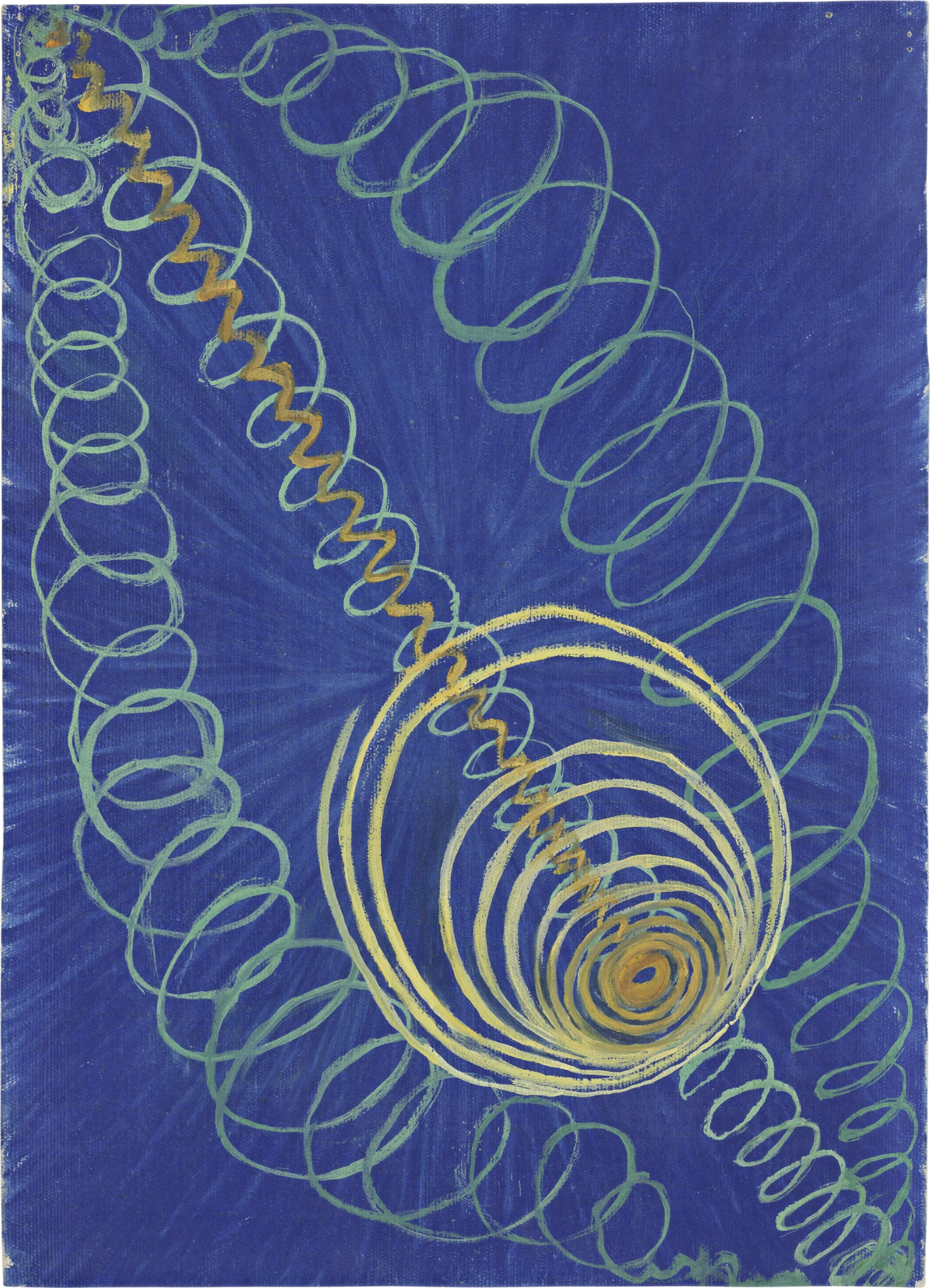
This early group begins the Temple cycle's attempt to give form to an unseen order. Our exercise is to locate a spiral and follow how it relates to nearby smaller signs. Do the marks suggest movement, growth or a notation that wants to be read? Those are questions to test, rather than declarations that the picture has one immediately available message. The work's identity and date follow the opened Commons file; the cycle's chronology follows the Foundation. Wikimedia Commons Hilma af Klint Foundation: biography and chronology

The Ten Largest, No. 7, Adulthood, 1907
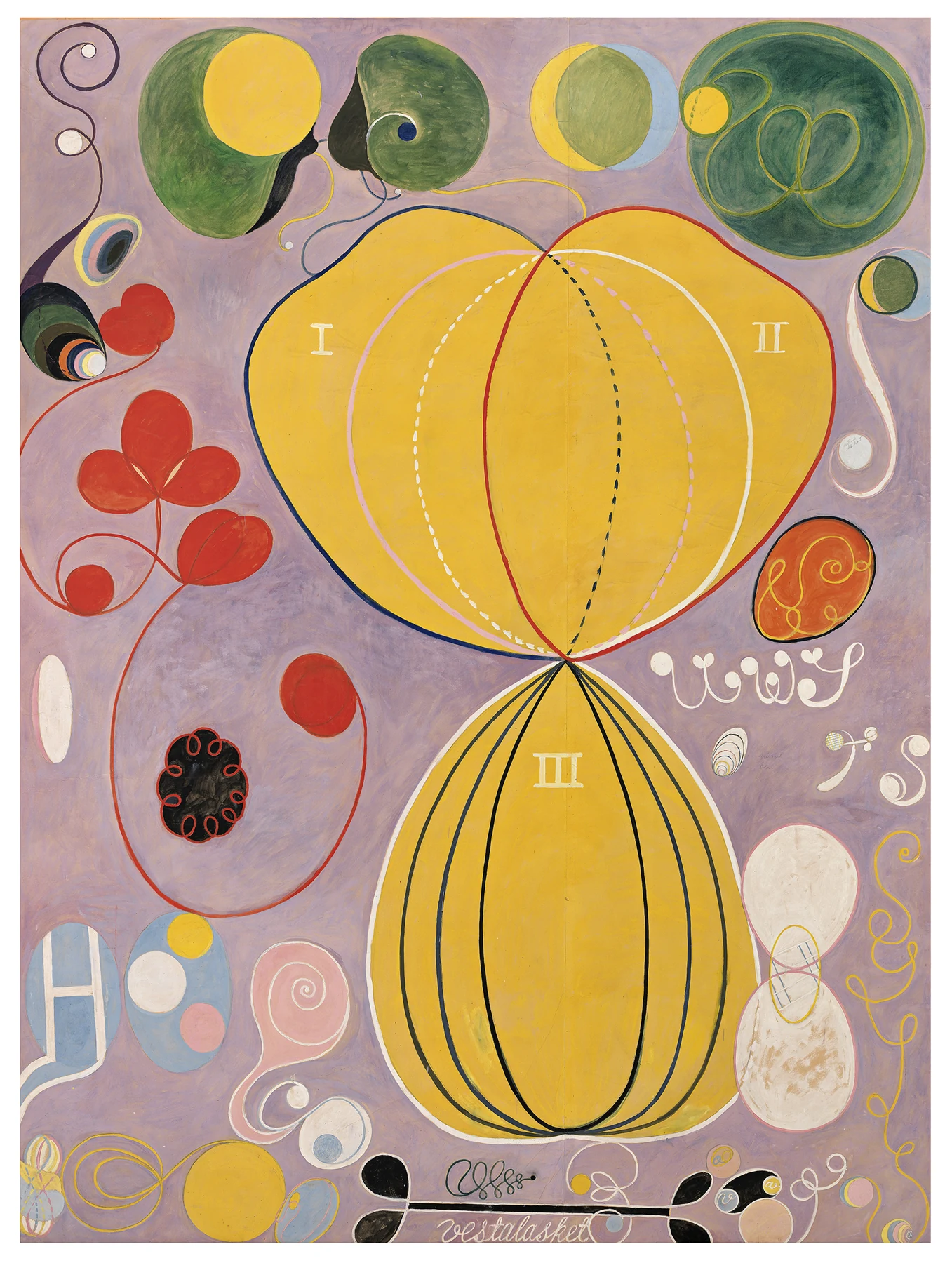
The ten-part group addresses the stages of human life at an unusually large scale: the Kunstmuseum describes works about 3.2 metres high. No. 7 belongs to adulthood. Our reading is to compare large floating forms with the smaller handwritten marks, and then imagine the change of bodily relation that the actual size produces. A screen can convey the arrangement but collapses that contrast of scale. The exact object identity matters more than the common online shorthand of a decorative pink abstraction. Kunstmuseum Den Haag: Forms of Life Wikimedia Commons

Evolution, No. 13, 1908
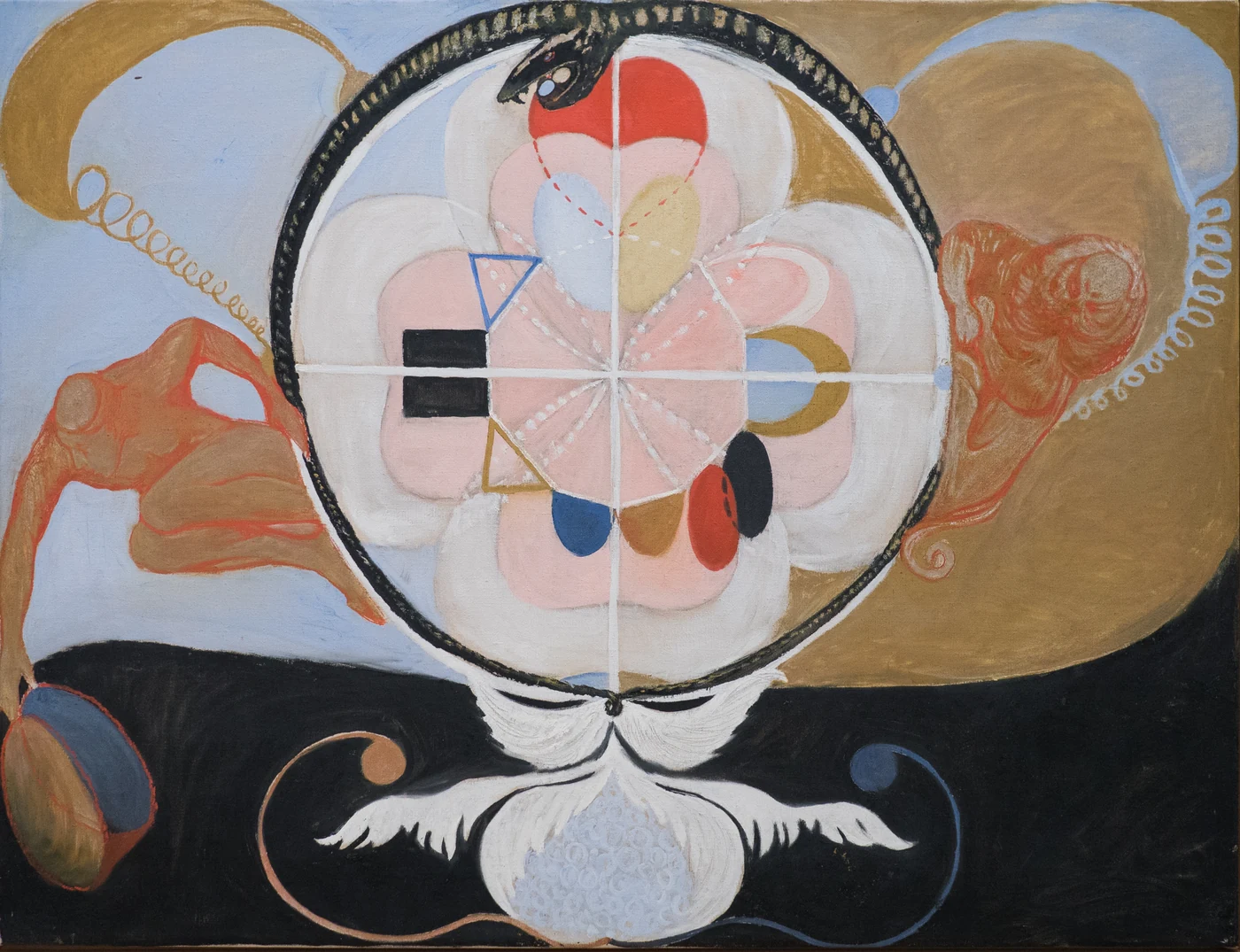
Moderna Museet connects the Evolution series with development and the emergence of matter from spirit. Our looking question is how a single picture can suggest a process rather than a static classification. Compare symmetry with the small differences that interrupt it. If a catalogue explanation offers an answer, return to the image and ask which visible relationships make the interpretation persuasive. This keeps the work's esoteric programme and its visual construction in conversation. Moderna Museet: topics and central works Wikimedia Commons

The Swan, No. 1, 1915
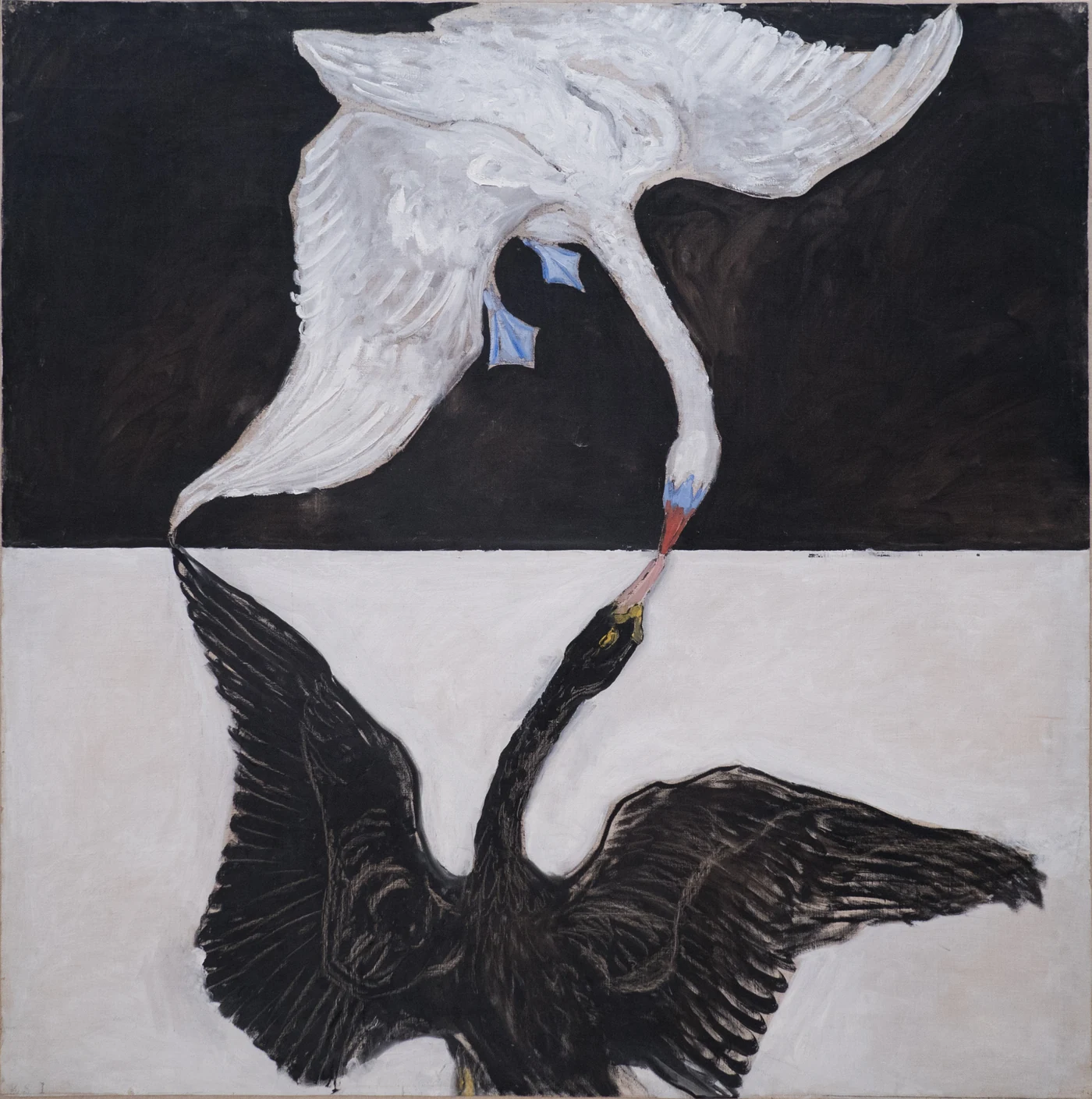
The paired swans make opposition and an attempted meeting unusually explicit. The series as a whole moves through different degrees of abstraction. Our reading is to follow where the animals remain recognisable and where their contrasting fields begin to carry the relation independently. The image is more useful within that sequence than as an illustration of a timeless rule that black and white always mean the same things. Moderna Museet: topics and central works Wikimedia Commons

The Swan, No. 17, 1915
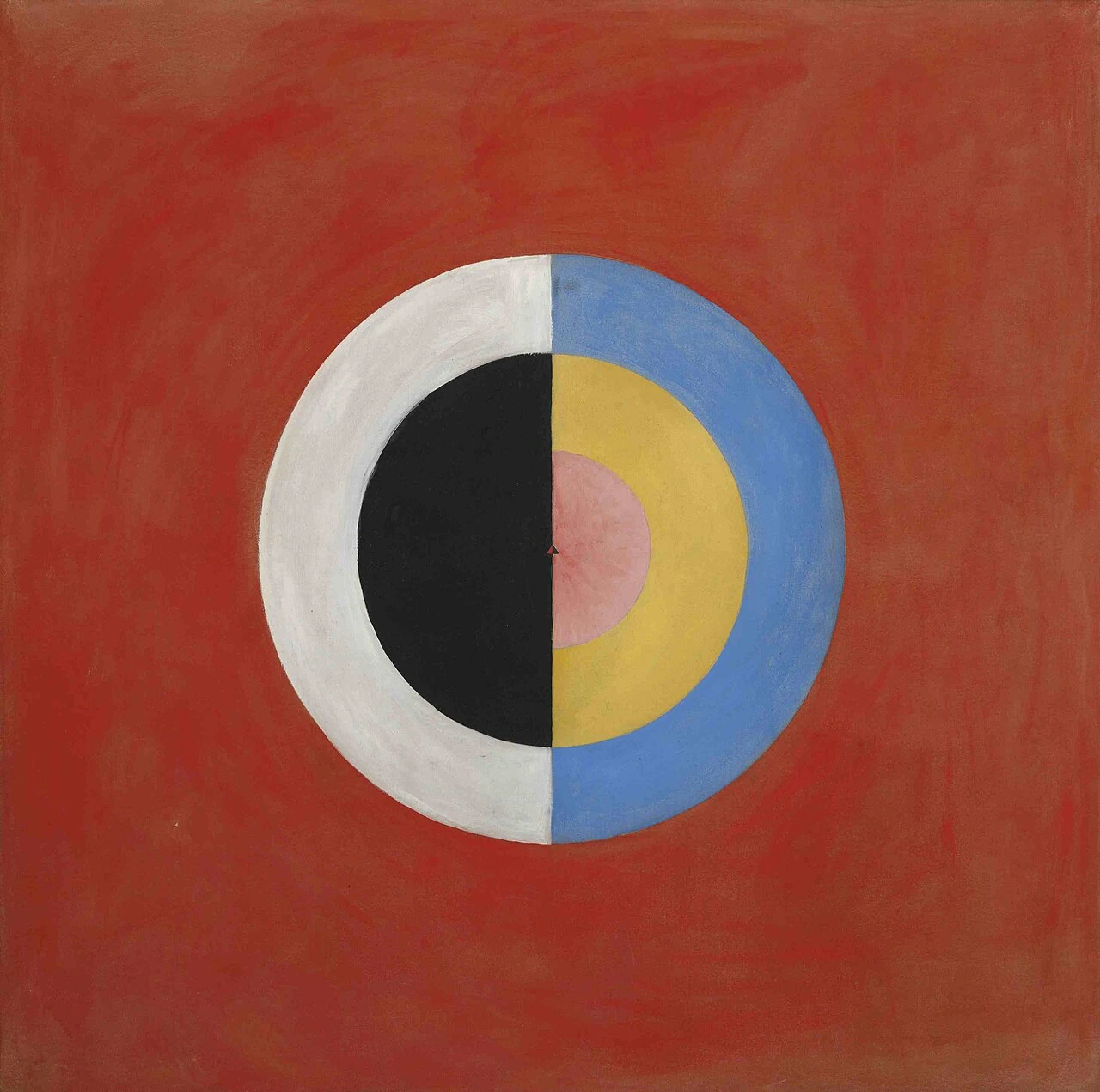
Compare the circle and divisions here with the birds in No. 1. Our exercise is to describe what has become geometric and what kind of opposition remains. An image can become less recognisable while retaining a narrative task within a series. That is one reason the abstract-art label can be both illuminating and incomplete: it describes the appearance without necessarily describing the function af Klint gave it. Moderna Museet: symbols Wikimedia Commons

The Dove, No. 1, 1915
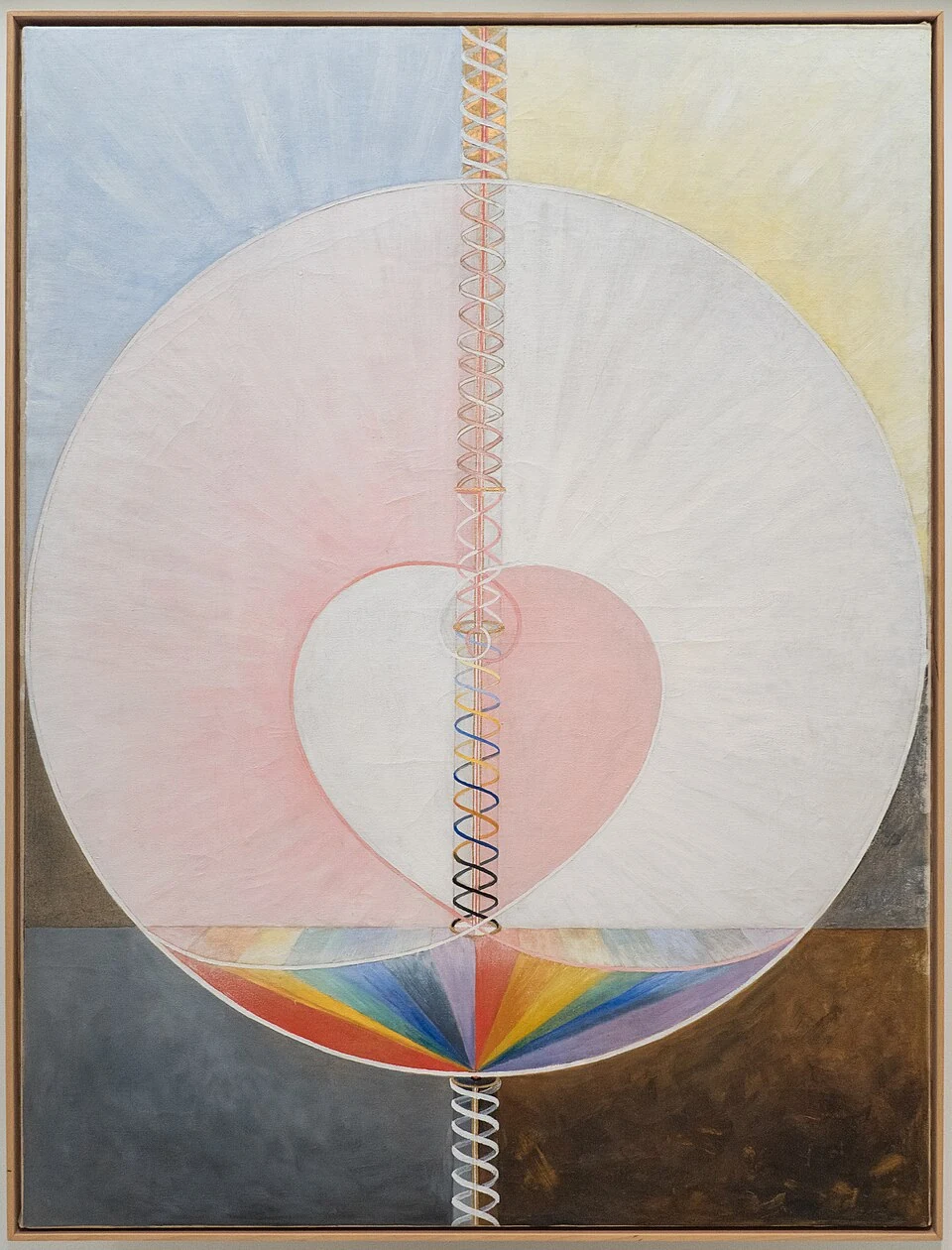
Moderna Museet's symbol guide connects the dove with Christian love and the Holy Spirit, while warning that the surrounding context matters. Our suggestion is to compare the title's named creature with what is actually recognisable on the surface. Does the composition require a pictured bird to carry the association? The question helps distinguish a symbol's cultural history from a literal inventory of depicted objects. Moderna Museet: symbols Wikimedia Commons

Altarpiece, No. 1, 1915
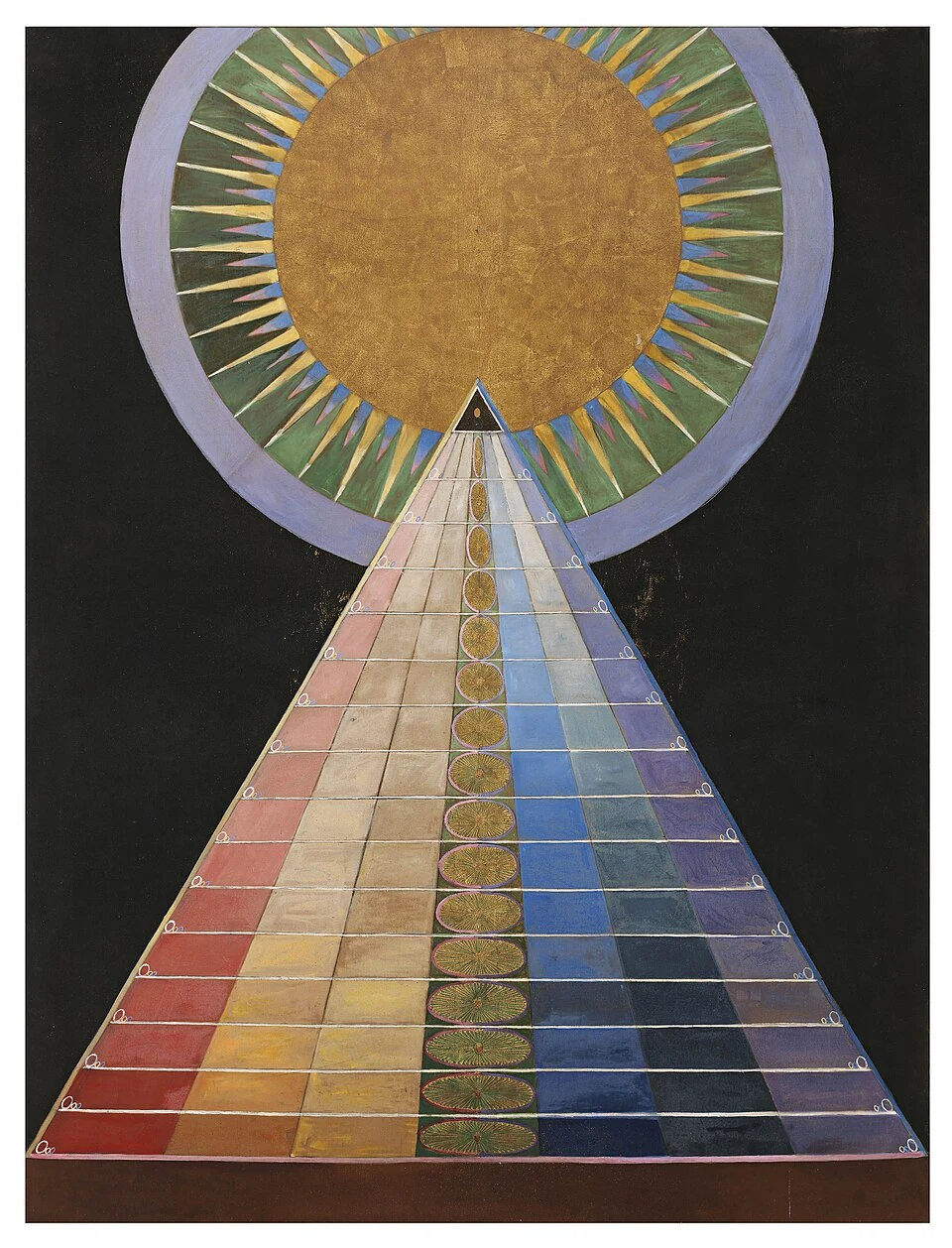
The Altarpieces close the Temple cycle. Moderna Museet reads their triangles and circles through spiritual descent and ascent; its 2013 exhibition dates No. 1 to 1915. That date takes precedence here over the inconsistent filename attached to the Commons reproduction. Our looking exercise is to trace the upward movement without deciding in advance that it proves spiritual progress. The force of the arrangement can be assessed while its historical meaning remains clearly attributed. Moderna Museet: topics and central works Moderna Museet: A Pioneer of Abstraction
What delayed recognition changes
Af Klint changes the archive from which the history of abstraction is written. Her early non-figurative paintings and notebooks expand the range of people, practices and purposes that belong in that account. Our inference is that adding her to a familiar list is only a beginning. Group practice, esoteric study, women's professional networks and the delayed circulation of work also change the questions historians ask. Chronological priority alone does not explain who could exhibit, who was seen and whose experiments entered an influential public debate. Hilma af Klint Foundation: biography and chronology Wikipedia: Hilma af Klint
The 20-year restriction also needs precision. The Foundation's chronology links a 1932 X marking to notebooks, including the Blue Books, and documents both earlier and later efforts to share work within spiritual circles. The familiar story of a completely secret archive captures the delay in broad recognition while losing those qualifications. Our recommendation is to distinguish a specific instruction, the artist's intended audience and the much later museum breakthrough. Hilma af Klint Foundation: biography and chronology
For viewers, the Foundation's FAQ describes an ongoing lending programme and a collaboration ensuring a continuing presence at Moderna Museet. It does not run its own museum. For someone assessing an alleged work, it also states that it does not authenticate or value objects and recommends contacting an established auction house. Our collecting advice is to request provenance, exact object details and independent specialist examination rather than treating the Foundation's name as an automatic authentication service. Hilma af Klint Foundation: FAQ
Our final reading is to keep admiration compatible with judgement. The exceptional story, early dates and delayed recognition deserve attention, but no biography can settle whether an individual painting sustains looking. Compare works within a series, notice when an explanation adds something and when it merely repeats a title, and allow some pictures to persuade you more than others. That is a fuller response to a major artist than either unquestioning celebration or dismissal of beliefs you do not share.
Questions people ask about Hilma af Klint
What is Hilma af Klint famous for?
Af Klint is famous for early non-figurative paintings beginning in 1906, especially the 193-work Paintings for the Temple cycle. Her spirals, circles, organic forms and geometric sequences grew from spiritual investigations. Major museum recognition came decades after her death. Hilma af Klint Foundation: biography and chronology Moderna Museet: topics and central works
Was Hilma af Klint the first abstract artist?
Her non-figurative work from 1906 predates many familiar milestones in modern abstraction. Calling any one artist the first nevertheless depends on what counts as abstraction, exhibition and influence. She is an essential early protagonist, and the richer question is how her work changes the history rather than who wins a single race. Moderna Museet: A Pioneer of Abstraction Wikipedia: Hilma af Klint
What do the colours and symbols mean?
Her vocabulary includes spirals associated with evolution, blue and yellow associated with feminine and masculine principles, and W and U associated with matter and spirit. Moderna Museet warns against definite, context-free translations. Read the symbol within its painting, series and documented spiritual programme. Moderna Museet: symbols
Who were The Five?
The Five were Hilma af Klint, Anna Cassel, Cornelia Cederberg, Sigrid Hedman and Mathilda Nilsson. Their spiritual meetings included automatic writing and drawing. Their collaborative practice is an important context for the later work, while the attribution of individual objects requires specific evidence. Hilma af Klint Foundation: biography and chronology
Did she really keep all her abstract art secret?
No. The Foundation records knowledge and exhibitions within spiritually interested circles, including theosophical and anthroposophical settings. Her instructions delayed later access to important material, and broad museum recognition came much later. Restricted circulation is more accurate than a claim that nobody saw any of it. Hilma af Klint Foundation: biography and chronology
What are The Ten Largest?
They are ten monumental paintings from 1907 within Paintings for the Temple, addressing childhood, youth, adulthood and old age. The works are about 3.2 metres high. Their scale and sequencing are part of the experience, which an isolated small reproduction cannot fully convey. Kunstmuseum Den Haag: Forms of Life Moderna Museet: topics and central works
Can I buy an original, and what is the auction record?
Originals occasionally reach the market, but distinguish conventional paintings, rare abstractions and later reproductions. The reported record work The Power of the Spleen sold on 25 November 2019 with a SEK1.6 million hammer price and a house-reported total of SEK1.96 million. Bukowskis's SEK6 million to SEK8 million estimate for Ser III No. 5 on 19 November 2026 is a future estimate as of 26 October, not a sale result. Stockholms Auktionsverk: Mjältens kraft, 25 November 2019 Stockholms Auktionsverk: results report, 26 November 2019 Anna Brady, The Art Newspaper: market report, 20 October 2026 Bukowskis: Ser III No. 5 announcement, 20 October 2026
Where can I see her paintings, and does the Foundation authenticate them?
The Foundation describes a continuing display relationship with Moderna Museet and lends to exhibitions internationally; check its exhibition listings for current locations. It does not run its own museum and states that it does not authenticate or value works. For an alleged original, its FAQ recommends an established auction house. Hilma af Klint Foundation: FAQ
Sources and image credits
Sources opened and checked on 26 October 2026. Our looking notes and suggested exercises are interpretations. The benchmark combined Wikipedia: Hilma af Klint, Hilma af Klint Foundation: biography and chronology, Moderna Museet: A Pioneer of Abstraction, Kunstmuseum Den Haag: Forms of Life. Collection records govern titles, dates and ownership; auction results distinguish realised prices from estimates. Each image caption links to its individual rights statement.
- Hilma af Klint Foundation: biography and chronology
- Moderna Museet: symbols
- Moderna Museet: topics and central works
- Moderna Museet: A Pioneer of Abstraction
- Kunstmuseum Den Haag: Forms of Life
- Wikipedia: Hilma af Klint
- Laura Cumming, The Guardian, 23 April 2023
- David Zwirner: Tree of Knowledge
- Stockholms Auktionsverk: Mjältens kraft, 25 November 2019
- Stockholms Auktionsverk: results report, 26 November 2019
- Anna Brady, The Art Newspaper: market report, 20 October 2026
- Bukowskis: Ser III No. 5 announcement, 20 October 2026
- Bukowskis: Still life, 12 December 2024
- Wikimedia Commons
- Wikimedia Commons
- Wikimedia Commons
- Wikimedia Commons
- Wikimedia Commons
- Wikimedia Commons
- Hilma af Klint Foundation: FAQ