Artists / No. 017
Who was Kazimir Malevich, and what is his art about?
Kazimir Malevich (1879 to 1935) was a painter and theorist, born near Kyiv to Polish parents, who founded Suprematism: in December 1915, in Petrograd, he hung a black square on white high in a corner, where a Russian home keeps its icon. His art is about what remains when painting stops depicting things: pure feeling, given the plainest form, colour and shape floating in white space. He called the square “the zero of forms”. That absence is not a loss. The square is a threshold, the moment a feeling older than any object becomes visible. [3] [1] [10]
This page follows the man and his work: the road to the square, the faceless peasants, his arrest and funeral, Amsterdam’s collection, his nationality, prices, and named critics from Petrograd to Buenos Aires and Tokyo. For the movement and the artists around it, read Suprematism. Every fact carries a source; his work is in the public domain, and the paintings are shown.
Who was Kazimir Malevich?
Kazimir Malevich was born on 23 February 1879 (11 February in the old calendar) near Kiev, now Kyiv, the first of fourteen children of Severin and Ludwika Malevich, Polish Catholics whose families had fled after the failed uprising of 1863; nine of the children reached adulthood. His father managed sugar refineries and the family moved with the work: to Parkhomovka near Kharkiv, where the boy taught himself to paint in a simple peasant manner, then near Konotop, and in 1896 to Kursk. At home they spoke Polish; around him he heard Ukrainian and Russian. His devotion to painting, he said, made him the “black sheep” of the family. [1]
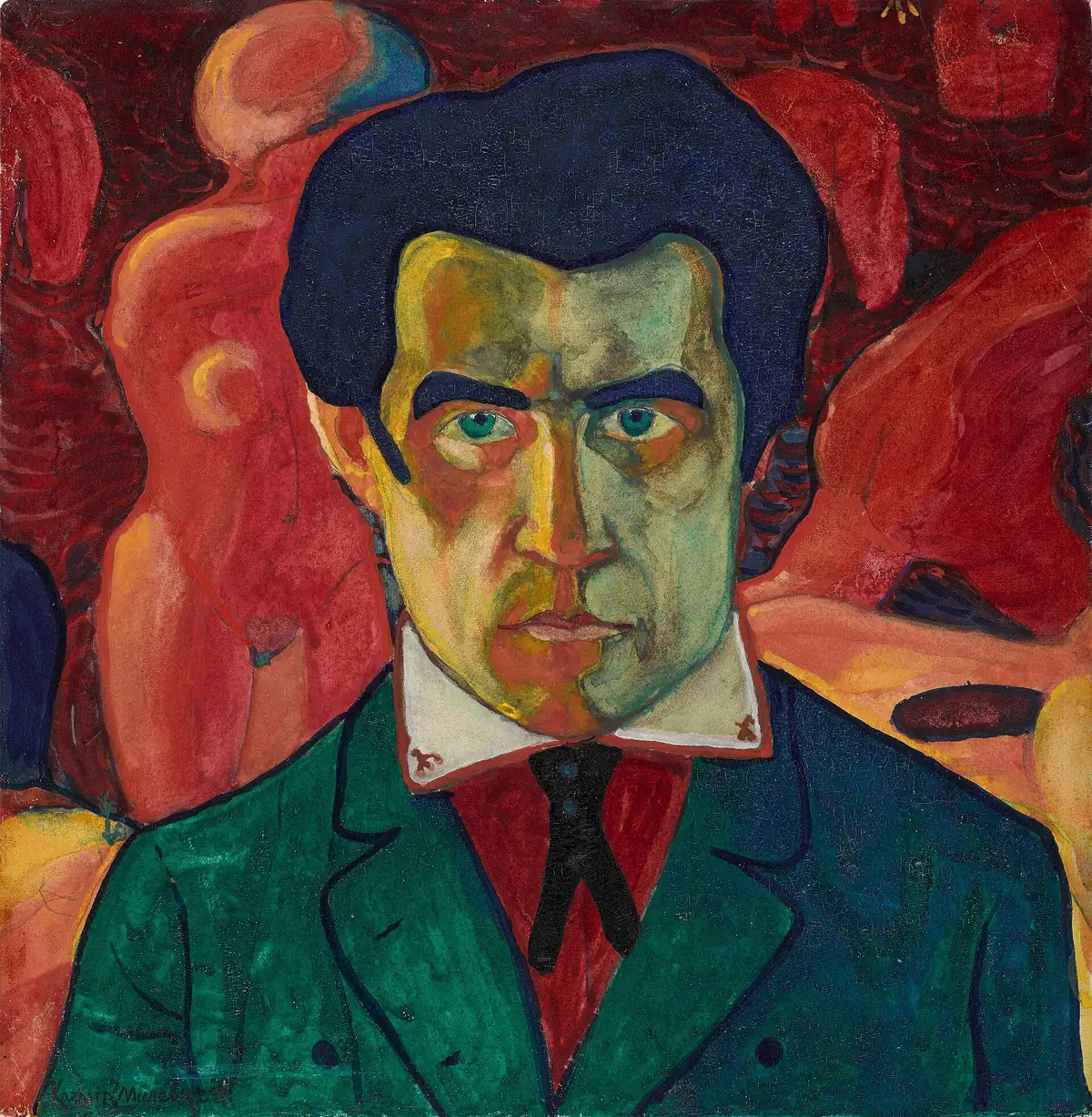
He came to Moscow in 1904 and never got into its art school, despite several attempts; he studied instead in Fedor Rerberg’s studio. What formed him was looking. In the private collections of Sergei Shchukin and Ivan Morozov he saw Cézanne, Gauguin, Matisse and Picasso; from 1907 he painted Symbolist visions, from 1908 he studied icons and folk art, and with Natalia Goncharova and Mikhail Larionov he showed at the Knave of Diamonds in 1910 and, with his peasant pictures, at the Donkey’s Tail in 1912. The Stedelijk Museum lists the range he absorbed: Impressionism, Symbolism, Fauvism, Cubism, Russian icon painting and folk art. [1] [9] [13]
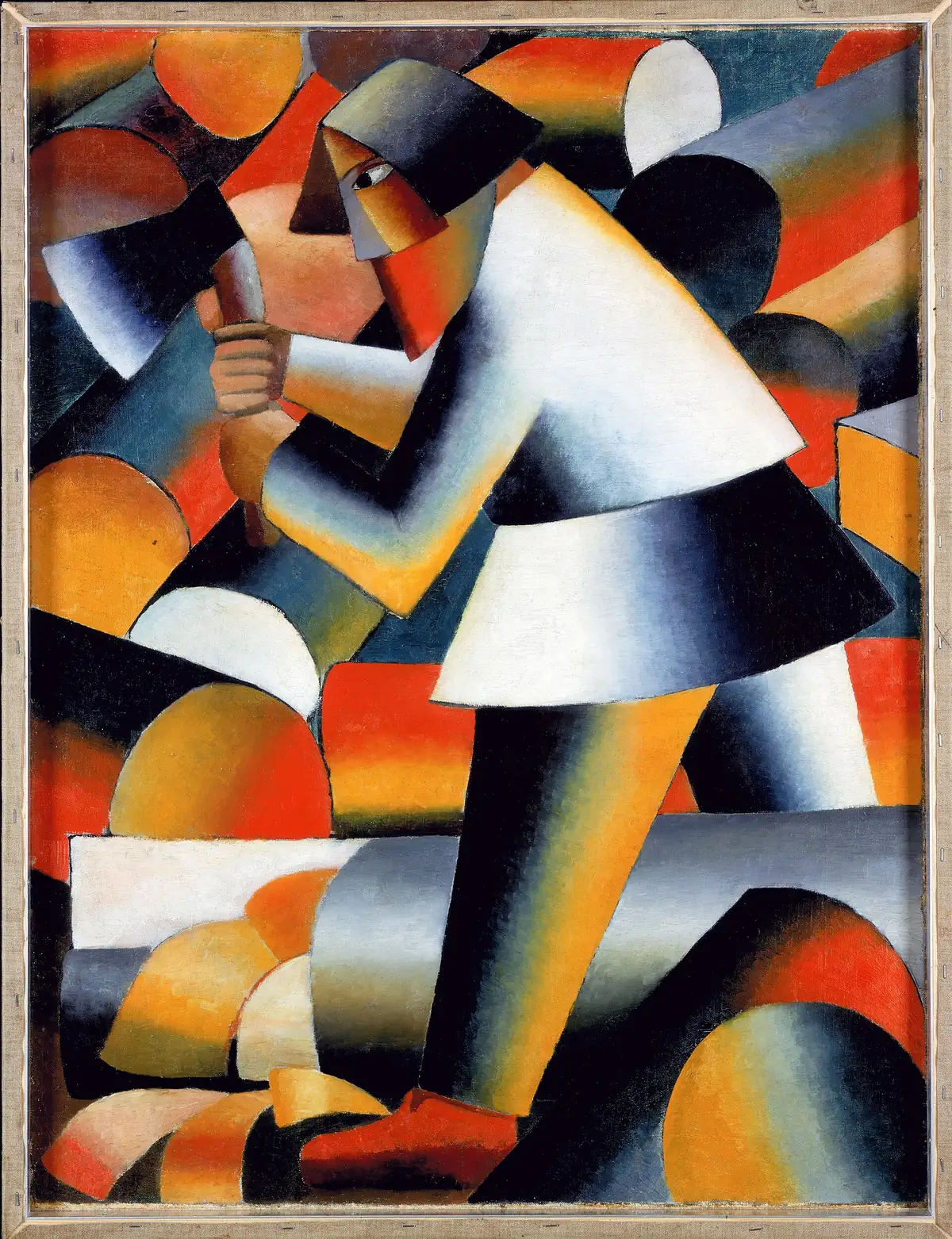
By 1912 the peasants had turned into cylinders and cones of polished metal; The Woodcutter, now in Amsterdam, belongs to that moment, which he called Cubo-Futurist. In 1913 he designed the sets and costumes for the Futurist opera Victory over the Sun, whose heroes capture the sun and abolish time, and around then he wrote to its composer, Mikhail Matyushin: “We have come to reject reason, but we have rejected reason because a different kind of reason has arisen within us, one which might be called transrational [zaum] if compared with the one which we have rejected [...]”. He was looking for a logic beyond the logic of things. [1] [2]
The step from there to the square ran through the Alogisms, works composed, in the Guggenheim’s words, of “signs, symbols, and word fragments” that “form a bridge between his prior Cubist phase and the breakthrough to non-objective art”. One way to read that bridge: once the things in a picture no longer had to make sense together, they no longer had to be there at all. [8]
What does Black Square mean?
Black Square means a beginning, not an end. Malevich gave it names that all point forward: “the zero of forms” («нуль форм»), “a living royal infant”, “the face of the new art”, “the first step of pure creation in art”, as the State Tretyakov Gallery, which owns the 1915 canvas, records them. It hung at the Last Futurist Exhibition of Paintings 0,10, which opened in Petrograd on 19 December 1915 with fourteen artists; Malevich showed thirty-nine works and placed the square in the “red corner”, the corner of the icon. In the catalogue it was called Quadrilateral, and it is one: its angles are not exact right angles, which the Tretyakov reads not as carelessness but as a principle, a form meant to move. [3]
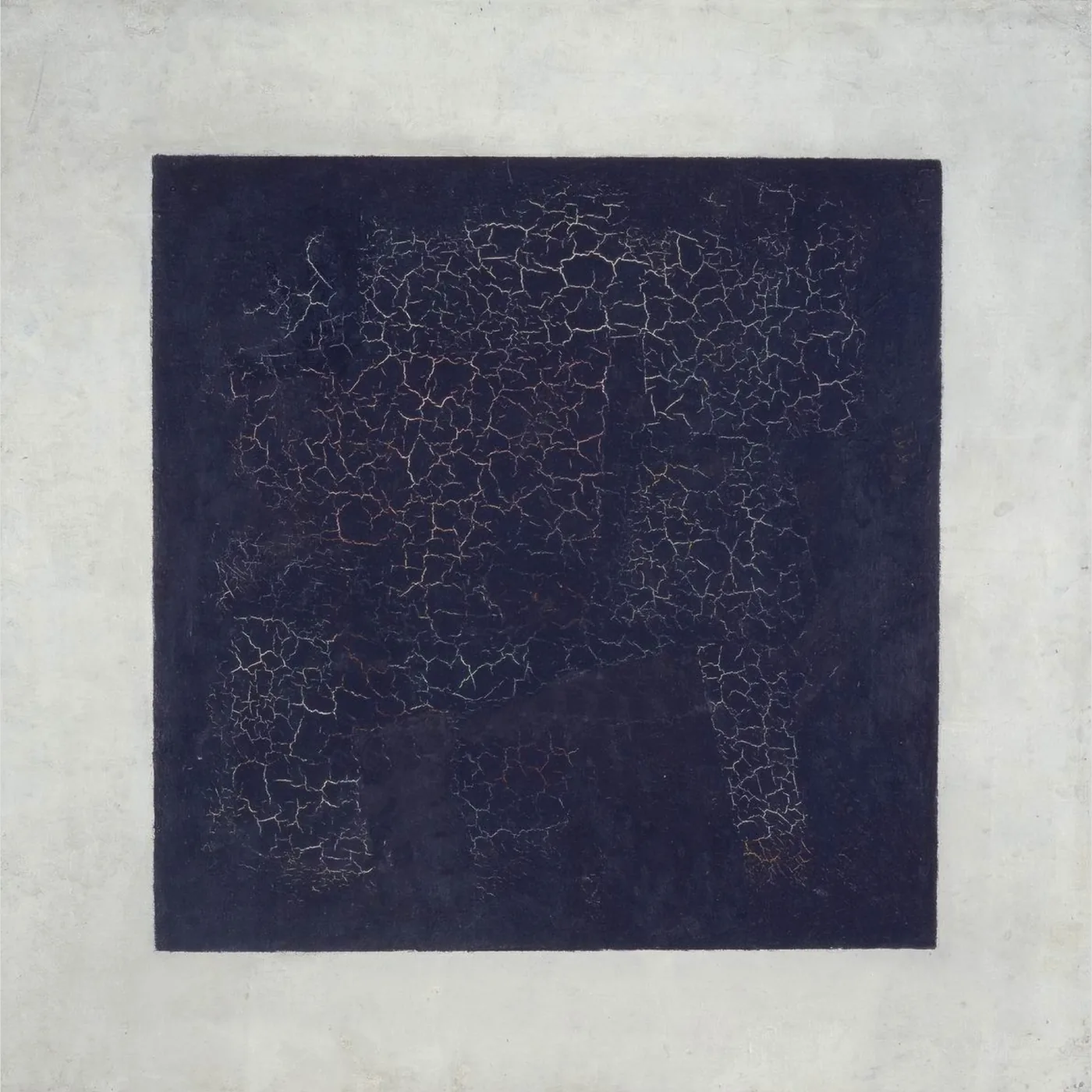
The colours carry the meaning. In the Tretyakov’s summary, white was for Malevich a metaphor of boundless space, the colour that holds all colours; black was economy, a “not-colour” that absorbs them. “The most important thing in Suprematism”, he wrote, is “two foundations, the energy of black and white.” Earlier in 1915, when Matyushin was planning a new staging of the 1913 opera, Malevich wrote him pleading letters to keep the square from his designs for it: the square “will have great significance in painting” and is the “embryo of all possibilities”. Harvard’s Russia in Global Perspective project adds the image that settled it: his previous canvases had been only a “partial eclipse” of the world of objects; a black square would be the total one. [3] [2] [19]
Read that way, the square does not abolish the world. It clears the room so that something which was already there, before any object, can appear. His pupil Anna Leporskaya remembered that he “neither knew nor understood what the black square contained”, and that he thought it so important that for a whole week he could not eat, drink or sleep. [1]
The square was one of three. Black Circle and Black Cross were made at the same time and shown at the same exhibition, and the Russian Wikipedia calls the three «три основных элемента супрематической системы», the three basic elements of the Suprematist system, from which the later forms grew. The cross is a Greek cross with arms of equal length, one of the most common forms of the Christian cross, in use since the fourth century, filling the canvas against a white ground. The circle echoes a line from the Suprematist manifestos in which Malevich says he “escaped from the circle of objects, moving from the horizon-ring to the circle of spirit”. How charged the cross remained shows at his funeral: his students painted a square and a circle on the coffin but no cross, «потому что это звучало бы на похоронах слишком определённо, как религиозный символ», because at a funeral it would have sounded too definite, like a religious symbol. [18] [39] [1]
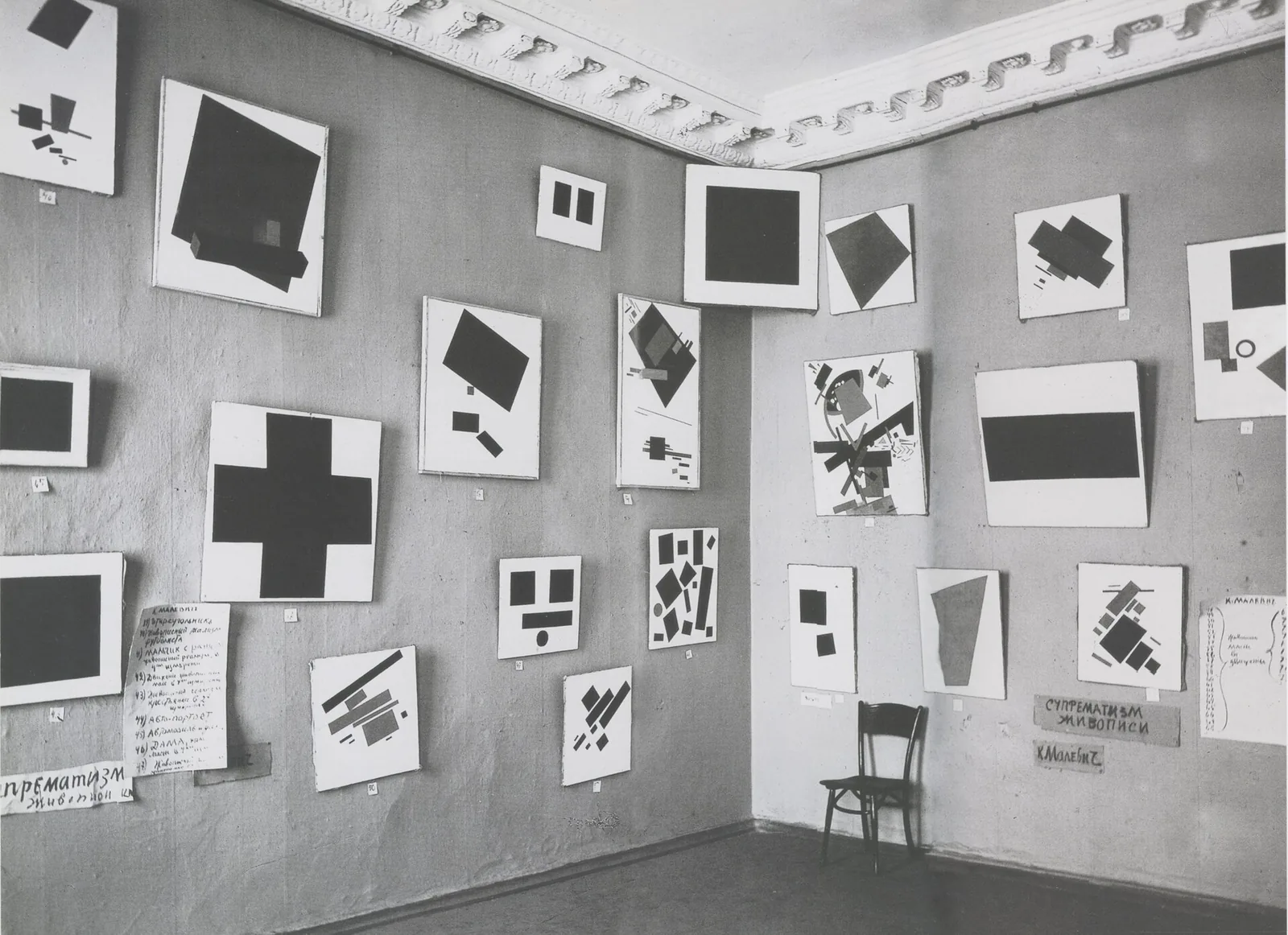
The painting keeps its history under the black. In 2015 a technical study at the Tretyakov found two earlier multi-figure geometric compositions beneath it; Wikipedia records that the first is Cubo-Futurist, the second what the researcher Yekaterina Voronina called proto-Suprematist, and that a handwritten phrase recalls Alphonse Allais’s joke picture of 1897, a black rectangle titled as a fight in a cellar at night. Malevich made three more Black Squares, for the Venice Biennale of 1924, for his Tretyakov exhibition of 1929 and in the early 1930s, each different in size and proportion, and he dated the original to 1913, the year of the opera. [3] [2] [19]
Why is Black Square considered art?
Black Square is considered art because it changed what a painting could be, and nearly everything after it has had to answer it. Tate calls it “the Hour Zero of modern art for many artists” and sets it “on a par with Duchamp’s ‘readymade’ as a game-changing moment in twentieth century art”. The philosopher Boris Groys, quoted by the Argentine weekly Perfil, argued that although it was no active revolutionary gesture, it was revolutionary in a deeper sense, as “el anuncio de la muerte de toda nostalgia cultural”, the announcement of the death of all cultural nostalgia. [4] [5] [25]
It is also, plainly, a painting. Wikipedia describes broad strokes of thick black oil on linen, a border worked in several whites and greys, and a surface now crackled after decades of neglect in storage. The objection that anyone could have made it is old; the Russian Wikipedia quotes the complaint that even people who know the history of the twentieth century still allow themselves to think its author could have been anyone, “хоть дитя несмышлёное”, even a witless child. The answer is that no one did, until he did, and that he put it where the sacred image belongs. [2] [18]
What is White on White about?
Suprematist Composition: White on White (1918) is about infinity made of paint: a white square, tilted and off-centre, on a white ground of a slightly warmer tone, with the brushwork left visible. Wikipedia’s account of the painting, which belongs to the Museum of Modern Art, says Malevich meant it to evoke floating, with white standing for infinity and the tilt for movement. It was the far end of the road that began with the black square: the Thyssen dates the white series to 1917 and 1918, and the Guggenheim describes the work of those years as “ethereal”, seeming “to dissolve into imaginary space”. [6] [10] [8]
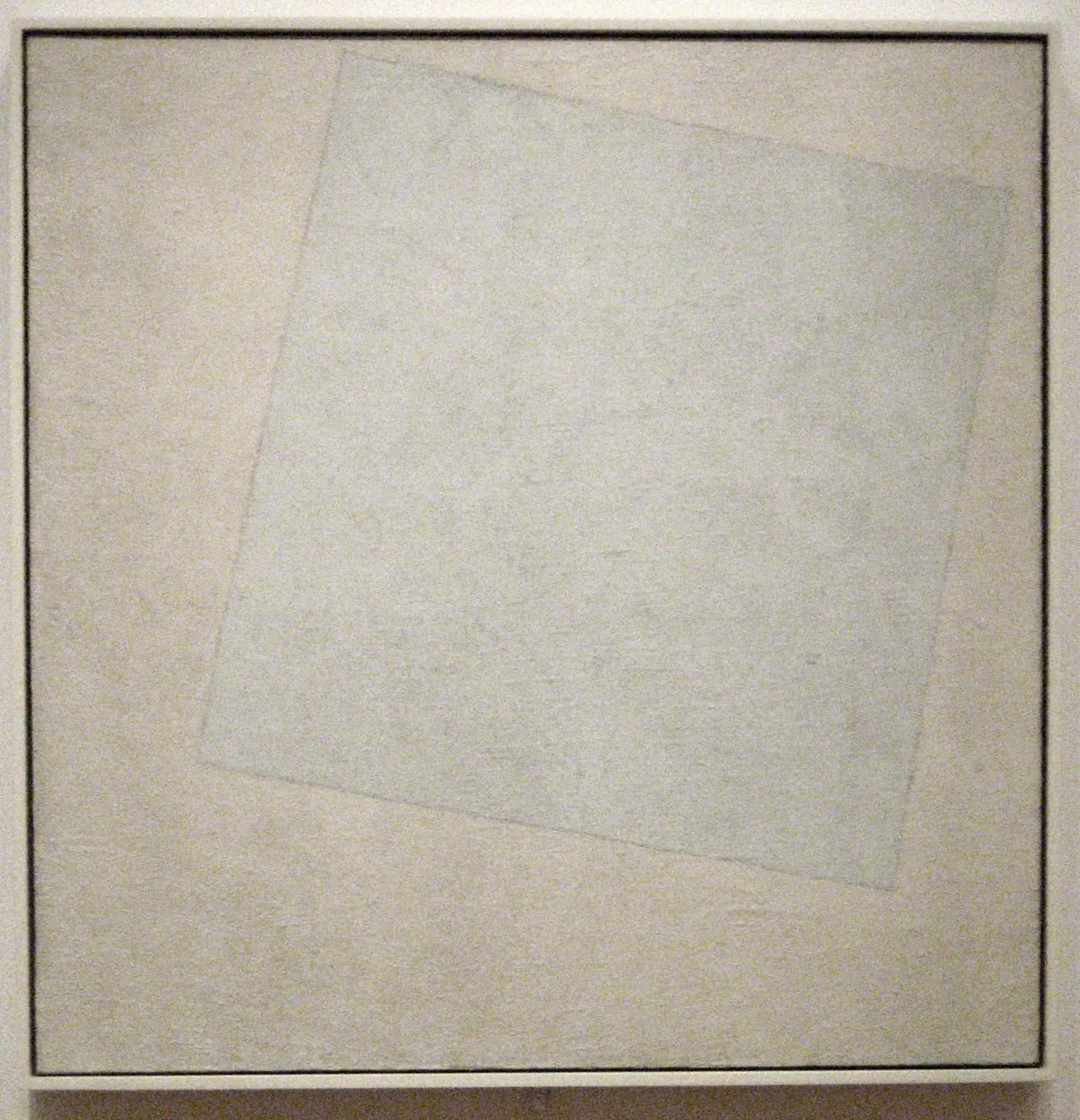
What keeps it from being a blank is that it stays material. Two whites, a hand-drawn edge and the grain of the brush are the most physical things a painter has, and here they carry the least physical thing he could imagine. Suprematism was a view of the world as much as a style: Wikipedia’s article on the movement links it with the Russian esotericist P. D. Ouspensky, who wrote of “a fourth dimension or a Fourth Way beyond the three to which our ordinary senses have access”, and Malevich was fascinated by aviation and photographs taken from the air. Matter, in this reading, is not what the spirit must escape. It is the field in which the subtle becomes visible, one stroke at a time. [7] [1]
His rivals were less moved. A Constructivist critic called it the only good canvas in a show by Malevich’s group: “an absolutely pure, white canvas with a very good prime coating. Something could be done on it.” The painting went to Berlin with Malevich in 1927 and stayed behind, was stored in Hanover through the Nazi years, was shown in New York in 1935 and entered MoMA’s collection in 1963. [6]
What did Malevich do after the square?
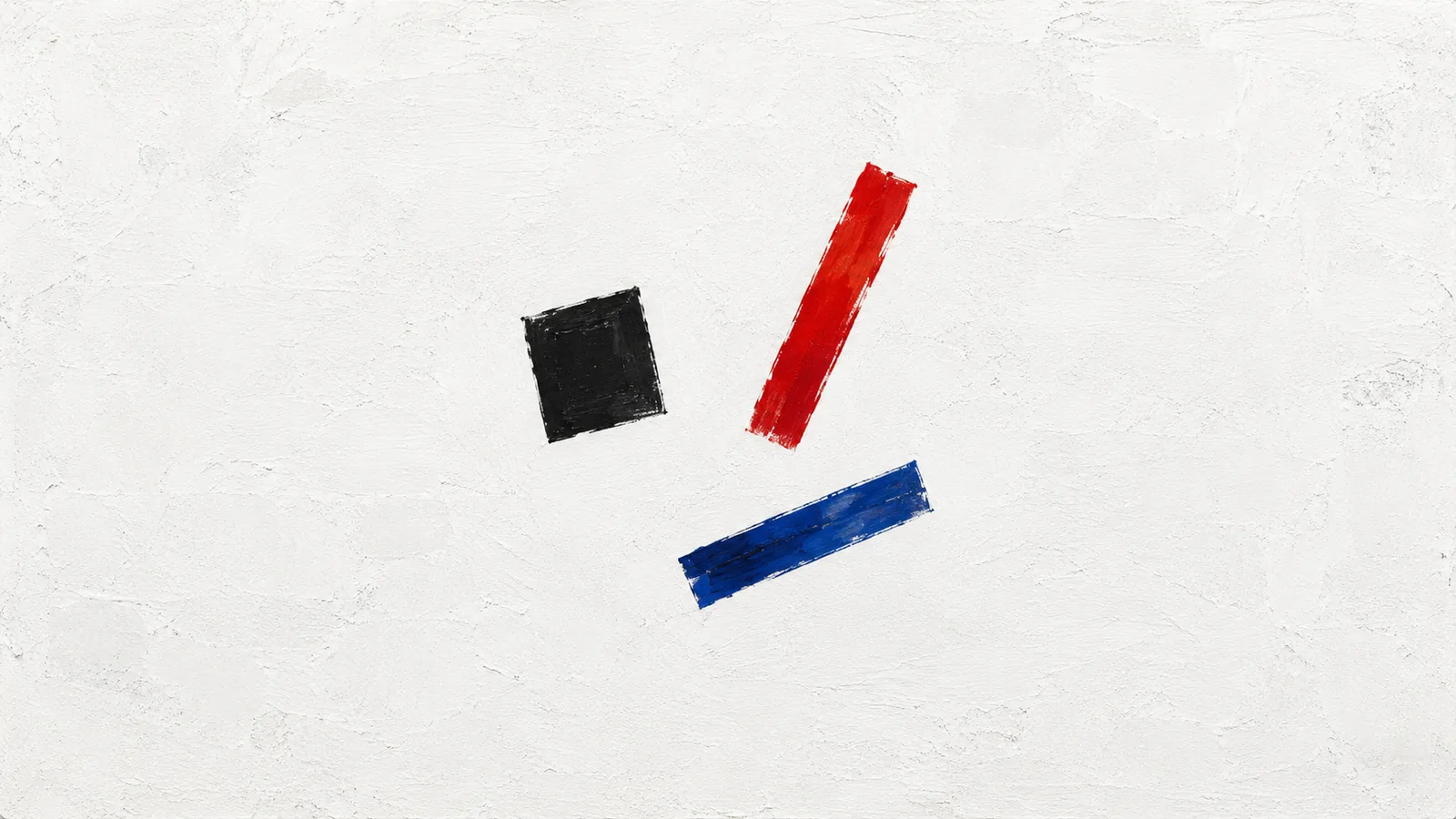
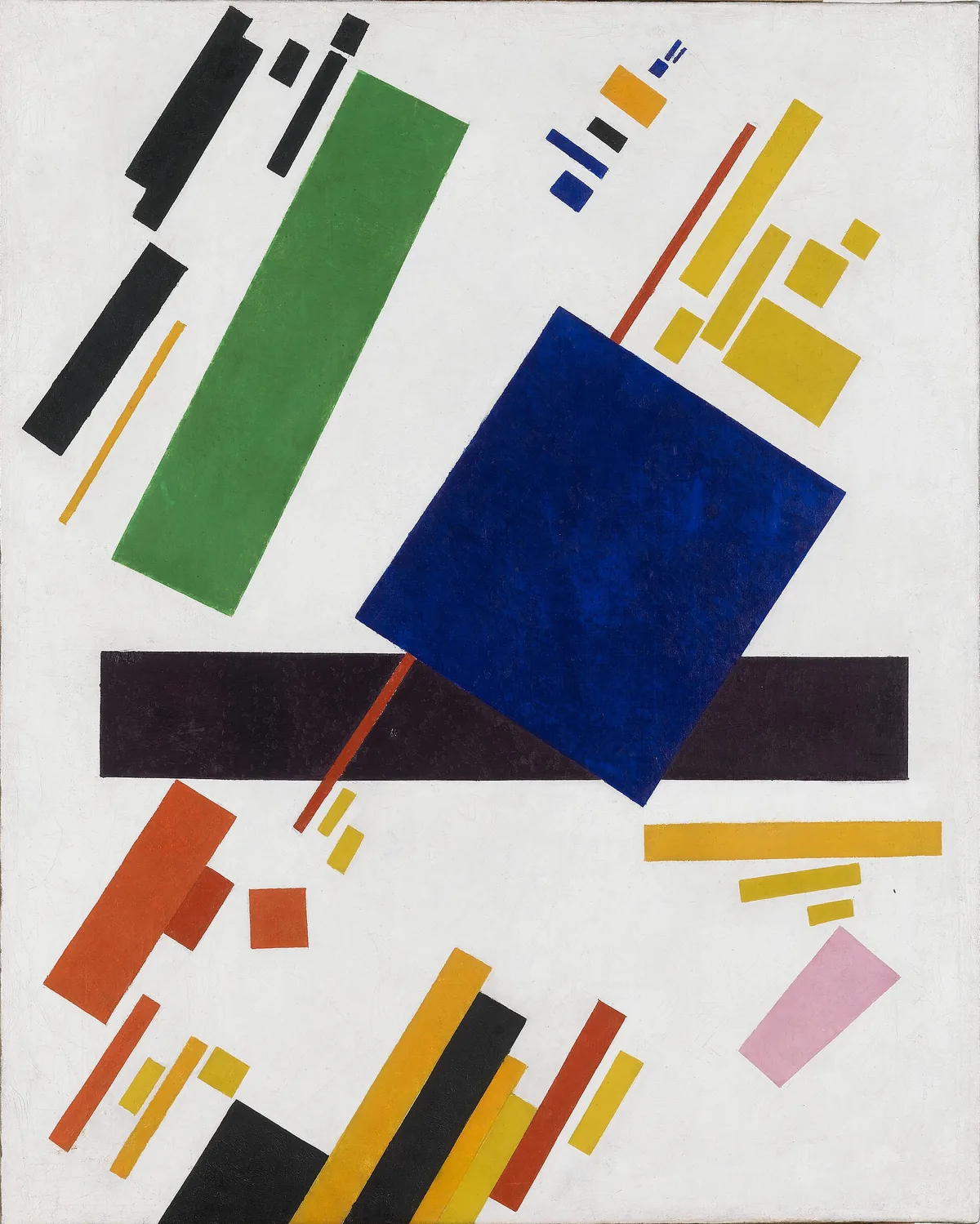
After the square, Malevich made Suprematism move, then taught it, then built it. By 1916 the forms had begun to fly, bars and planes crossing a white field at angles, which the Guggenheim calls a shift “from an aesthetic of static composition into a dynamic realm”. The State Russian Museum describes one such canvas as made of the “letters” of “the universal language invented by Kazimir Malevich”, a picture with no top and no bottom. [8] [11]
The Revolution gave him posts and pupils. From 1919 he taught at the art school in Vitebsk, run by Marc Chagall, and soon directed it; there he and his students founded UNOVIS, the Affirmers of the New Art, who wore a black square sewn on the sleeve or lapel. From 1923 he directed the Institute of Artistic Culture in Petrograd, where between 1924 and 1926 he worked mainly on Architektons, white plaster models of a Suprematist architecture, until a party newspaper called the institute “a government-supported monastery” and it was closed. [10] [3] [9] [1]
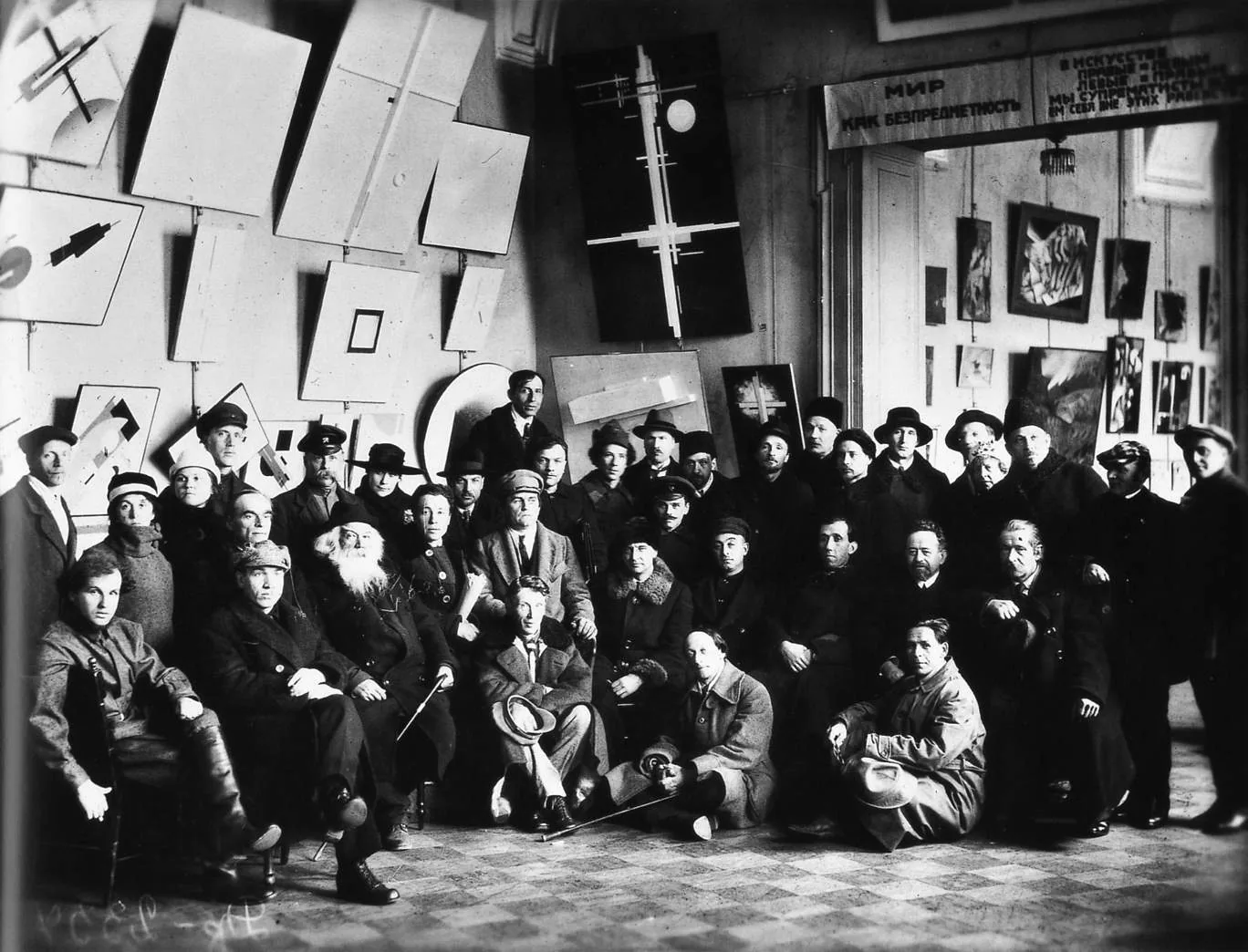
In 1927 he made the only journey of his life outside his country: to Warsaw, where former students received him, and to Germany, where he visited the Bauhaus, met Walter Gropius and László Moholy-Nagy, and showed more than seventy works at the Great Berlin Art Exhibition. Max Kozloff notes in Artforum that on this trip he published his most influential tract, The Non-Objective World, as a Bauhaus book; the school is on this site at Bauhaus. [1] [9] [20]
Why did Malevich return to painting peasants?
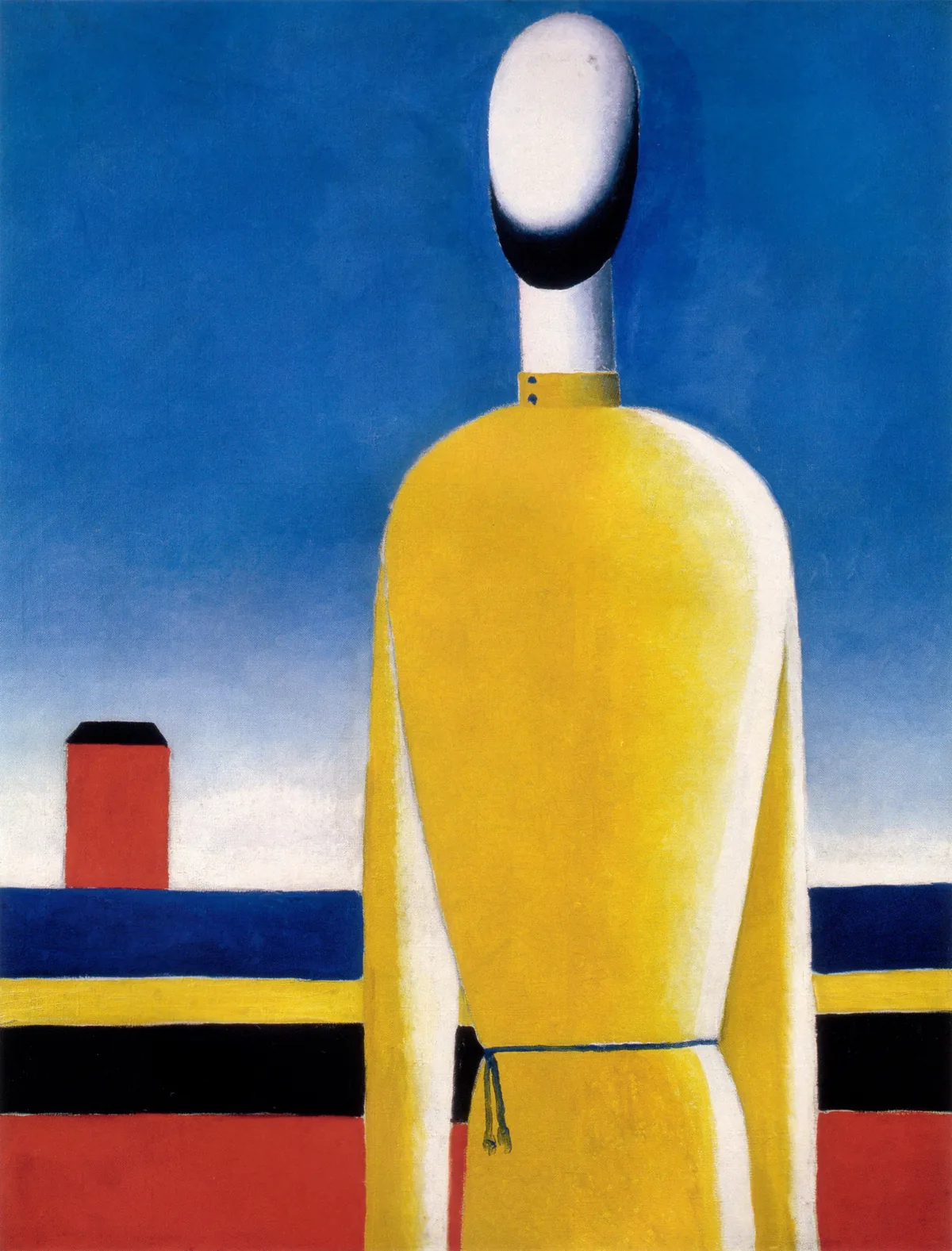
Malevich returned to the peasant in the late 1920s for more than one reason. The political one is real: Stalin’s cultural policy closed the space for abstraction, and the Thyssen notes that he is believed to have dated some of his abstract works of these years to earlier years, to avoid trouble. The canvases themselves resist that reading: in Head of a Peasant the face is split into a red and a white half, in Complex Presentiment the figure has no face at all and stands beside a red house without windows, and the late figures stand in striped fields under empty skies. Tate’s curator Achim Borchardt-Hume, presenting the 2014 retrospective, found them very hard to see as a celebration of the peasant under the new regime: “It’s not simply, it’s not repentant. He signs his latest work; his latest figurative works was the Black Square. It’s as though he wants to say, now I’m painting this but I was the inventor of the Black Square and I will not repent for this.” [1] [10] [4]
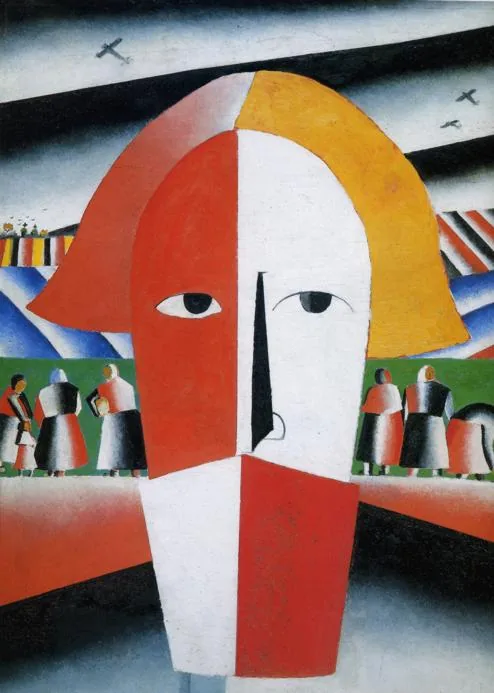
The Guggenheim reads the late figures as Suprematism “folded” into the figure, and says the studies for them “definitively link them to the abstract system of the preceding 15 years”. Seen that way, the return is not a surrender but the same intention running on in another form, as a river keeps its water when it changes its bed. The Japanese Wikipedia goes further: even the works that look figurative are in substance non-objective paintings, because their subject is missing. [8] [21]
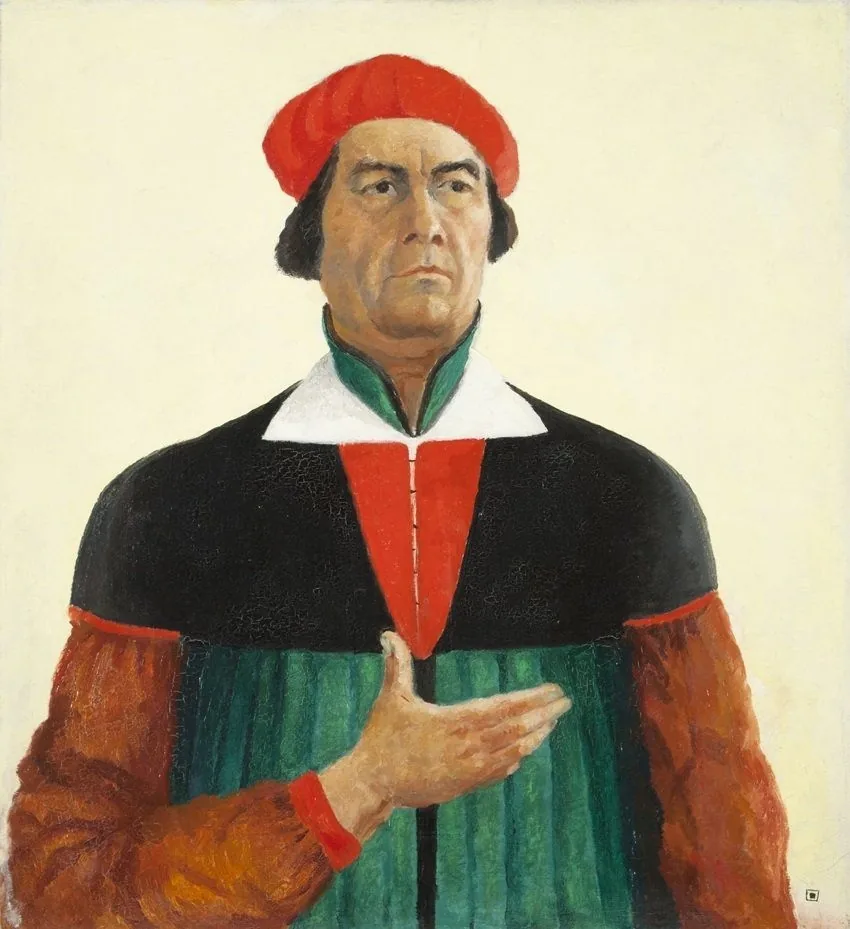
In his last years he painted himself and those close to him in a manner the Guggenheim calls “steeped in Renaissance portraiture”. In the self-portrait of 1933 he wears a red beret and a costume of black, green and red, holds his open hand at his chest, and in the lower right corner, where a signature would go, paints a small black square. [8] [3]
What happened to Malevich under Stalin?
Under Stalin, Malevich lost his posts, many manuscripts and for a time his freedom, and after his death his work went into storage for half a century. In autumn 1930 he was arrested by the OGPU in Leningrad, accused of spying for Poland and threatened with execution; he was released in early December. In 1933 he was diagnosed with cancer and was not allowed to go abroad for treatment. He died in Leningrad on 15 May 1935. [1] [9]
His funeral was a last Suprematist work, made by his students. The Tretyakov describes it: Black Square hung on the wall at the head of the coffin; a black square was painted on the lid at the head; another was fixed to the radiator of the hearse; the railway carriage that carried the coffin from Leningrad to Moscow bore a black square on white with the words “K.S. Malevich”. Near death he had asked his friend Ivan Klyun to tell the director of the Tretyakov that the best work in the whole gallery was his Black Square. His ashes were buried under an oak near his dacha at Nemchinovka, as he had wished, beneath a white cube with a black square designed by his pupil Nikolai Suetin. The cube was destroyed in the Second World War; in 2013 an apartment block was built on the site. [3] [1]
Tate puts the afterlife in one line: the painting “was revealed to the world after months of secrecy and was hidden again for almost half a century after its creator’s death”. It was not exhibited again until the 1980s. [5] [2]
Why does Amsterdam hold so much Malevich?
Amsterdam holds the largest Malevich collection outside Russia because of what he left behind in Berlin in 1927. When he was called back to the Soviet Union, paintings, drawings, teaching charts and manuscripts stayed in Germany; the architect Hugo Häring later sold them, and in 1958 the Stedelijk’s director Willem Sandberg acquired them. In 1970 the museum had the Danish art historian Troels Andersen reconstruct the Berlin show, which put it at the front of Western research on Malevich. The Stedelijk had already been the first museum to present Suprematism outside Russia, at the First Russian Art Exhibition of 1923. [12] [13] [15]
The second layer came with Nikolai Khardzhiev, the first historian of the Russian avant-garde, who knew Malevich and kept what others were told to forget. In 1993 he and his wife Lidia Chaga emigrated to the Netherlands with his collection, which includes 175 works by Malevich, most of them small drawings; it has been on long-term loan to the Stedelijk since 2001. In 1997 the museum showed 79 of the drawings, none seen in public before, and its director Rudi Fuchs presented Malevich “as a passionate mystic visionary”. [12] [14]
The heirs contested the 1958 purchase after the Iron Curtain fell, arguing that Häring had no right to sell. In 2008 the City of Amsterdam settled: five paintings went to the family, and the rest stays with the city on long-term loan to the Stedelijk. The Mayor, Job Cohen, promised the works “a place of honour” in the reopened museum. [15] [17]
Was Malevich Russian, Ukrainian or Polish?
Malevich was each of the three by one measure or another, and the sources differ on which to lead with. He was born near Kyiv when it belonged to the Russian Empire, to ethnic Polish parents, and made his name in Moscow and Petrograd. He signed in Polish as Kazimierz Malewicz and gave Polish as his nationality on a visa application in 1926; according to the Russian scholars Tatiana Mikhienko and Irina Vakar, the police file from his arrest in 1930 records him declaring himself Ukrainian. [1]
Since 2022 museums have shifted. The Art Newspaper reported on 1 March 2023 that the Stedelijk now communicates: “born in Ukraine to parents of Polish origin”. The Japanese Wikipedia calls him “ウクライナ・ソ連の芸術家”, a Ukrainian and Soviet artist; the Chinese Wikipedia, a leading figure of both the Russian and the Ukrainian avant-garde. English Wikipedia still opens with “Russian avant-garde artist” and records that historians, including those of Ukrainian origin, regard the question as unresolved. This page uses the place names of each period and leaves the label to the reader. [17] [21] [23] [1]
How does the world see Malevich?
The world sees Malevich as the painter who started abstraction from zero, though the recognition took decades. In 1916 the leading critic in Petrograd mocked the square; in the 1930s his own country hid it; in 2014 Tate called it the Hour Zero of modern art. One way to read that long distance is that the square was waiting for a public that did not yet exist. The Chinese Wikipedia ranks him with Wassily Kandinsky and Piet Mondriaan as one of the three founders of early abstraction, and English Wikipedia traces his line to Ad Reinhardt and the Minimalists; see Minimalism. [18] [4] [23] [1]
Russia
The first professional review understood the gesture at once, and rejected it. Alexandre Benois, founder of the World of Art group, wrote in the newspaper Rech on 9 January 1916: “Несомненно, это и есть та икона, которую господа футуристы предлагают взамен мадонн и бесстыжих венер”, without doubt this is the very icon which the Futurist gentlemen offer in place of madonnas and shameless Venuses. The Tretyakov today calls the square the declaration of a new direction and tells the story of the funeral as proof of its place in his life. Harvard’s Russia in Global Perspective project reads the work as Russian in its rejection of rationalism, its “embrace of the heavens” and its bombast. [18] [3] [19]
Western Europe and the United States
The West received him late, through New York and Amsterdam. Alfred Barr showed him at MoMA in Cubism and Abstract Art in 1936; the Guggenheim gave him his first US retrospective in 1973, the Stedelijk a retrospective in 1989, and Tate, the Stedelijk and the Bundeskunsthalle a joint survey in 2013 and 2014, the first ever in the UK. The Guggenheim’s exhibition of 2003 defined his aim as “an artistic utopia that would evoke higher states of spiritual consciousness and become the secular equivalent of religious painting”. [1] [5] [13] [8]
The sharpest dissent came from the critic Max Kozloff in Artforum in January 1974: “It is characteristic of liberal art history that it sees the Suprematist road sign as a ‘search for rest that is Godhead’ (Simon Pugh), and not at all as a pointer to an ominous destination.” His reasoning was political. Malevich, he argued, was “eminently anticommunist in his preachments against reason” and in his denial that rational political action was worth anything, yet in line with a Marxist eschatology when he predicted “the withering away of a materialist world of bounded conditions”. “Both these contrasting aspects of the artist want to be recognized.” Kozloff granted that Malevich had already tried the tactics of the abstract painting of his own day, “centered imagery, diminished color field” (our example: the colour fields of Mark Rothko), but found something “far more prickly” in accepting him as a spiritual ancestor. [20]
Japan
The Japanese Wikipedia sees the late return to figuration not as defeat but as the only road left once he had reached “白紙という究極の抽象”, the ultimate abstraction of the blank sheet. In 2024 the critic Sawayama Ryo, interviewed by Kageyama Koichi for artscape, connected Black Square with Russian Cosmism and with Malevich’s interest in aircraft and weightlessness: “《黒の正方形》を見るということは、無重力に向けて感覚が解放されて、逆さまから絵を見ている感じになる”, to look at Black Square is to have your senses released towards weightlessness, as if seeing the picture upside down. For Malevich, he added, the political revolution, the artistic revolution and the revolution of the planets were connected. [21] [22]
China
The Chinese Wikipedia names him with Kandinsky and Mondrian as the three representative figures of early abstract art and tells the story of the fourth Black Square, which surfaced in Samara in 1993 and was bought for the Hermitage in 2002 for one million dollars, paid for by Vladimir Potanin. In 2023 a journal of East China Normal University in Shanghai published a study under the English title “From Black Square to White Square: The Evolutionary Thought of Kazimir Malevich’s Suprematism and the End of Art”. [23] [24]
Latin America
In 2016 the Fundación Proa in Buenos Aires showed a retrospective lent by the State Russian Museum, the first major Malevich retrospective in Latin America; the weekly Perfil called it “la muestra de la década”, the exhibition of the decade, and quoted Boris Groys. Arte al Día noted that Malevich had already entered Argentine art through Martín Legón, who restaged the square as a pond of Chinese ink for the MACRo museum in Rosario, and that local translations of Groys are “a key point of reference for Argentine critics”. [25] [26] [38]
The Arab world
The Arabic Wikipedia calls him “فنان روسي”, a Russian artist, “مؤسس حركة السوبرماتزم”, the founder of the Suprematist movement, and one of the leading names of geometric abstraction, and singles out Black Square as the point where he reached the furthest stage of abstraction. We found no Arabic museum or critic’s text on him to quote; that gap is part of the picture. [27]
How much is a Malevich worth?
A major Malevich painting is worth tens of millions of dollars, and very few ever come to market. The benchmark is a single canvas: a Suprematist Composition of 1916, from the five paintings Amsterdam returned to the heirs in 2008, which sold at Sotheby’s New York that November for $60,002,500, then a record for any Russian work of art at auction, and sold again at Christie’s New York in May 2018 for over $85 million with fees. The fourth Black Square changed hands in 2002 for one million dollars, on its way to the Hermitage. [16] [1] [23]
The record canvas shows why provenance decides the price: it belonged to the group Malevich left in Berlin in 1927, which the architect Hugo Häring sold and the Stedelijk bought in 1958, and it could only reach the market after Amsterdam settled the heirs’ claim in 2008. Wikipedia notes one practical test of authenticity: his habit of laying red over black, so that the red reads with a touch of darkness, a layering that fakes tend to lack. [15] [1]
How do you look at a Malevich?
Look at a Malevich first as an object, then as a field, then as a place. The steps below are our exercise, built on what the museums describe.
- Find the hand. In Black Square the corners are not true right angles and the black lies in broad strokes over earlier paint; in White on White the edge of the inner square wavers. [3] [6]
- Lose the top. The Russian Museum points out that a Suprematist canvas has no top or bottom. Tilt your head; the shapes keep their relations. [11]
- Look up. At 0,10 the square hung high across a corner, looking down on the room. Imagine it there, where the icon was. [4]
- Let the white work. White is not background but space without end; give it as long as the black.
- In the late figures, look for the missing face, then for the small black square in the corner. [4]
Questions and answers
What is Suprematism, in one sentence?
Suprematism is Malevich’s art of basic geometric forms in pure colour on white, launched in 1915 to express pure feeling rather than depict objects; the full story is at Suprematism. [10] [2]
Where can you see Malevich’s work?
The 1915 Black Square is in the State Tretyakov Gallery in Moscow, late figures such as Head of a Peasant in the State Russian Museum in St Petersburg, White on White at the Museum of Modern Art in New York, and the largest collection outside Russia at the Stedelijk Museum Amsterdam. [3] [6] [13]
How many Black Squares are there?
There are four painted Black Squares, from 1915, 1923 or 1924, 1929 and the early 1930s, all in Russia, each different in size and proportion. [3] [2]
What did Malevich write?
His key texts are From Cubism and Futurism to Suprematism, written for 0,10 in 1915, and The Non-Objective World, published as a Bauhaus book in 1927 and in English in 1959. [1] [20]
Timeline
- 1879 Born 23 February near Kyiv, eldest of fourteen children of Polish parents. [1]
- 1896 The family settles in Kursk; he works as a railway draughtsman. [1]
- 1904 to 1910 Moscow: Rerberg’s studio, the Shchukin and Morozov collections. [1]
- 1910 to 1912 Knave of Diamonds and Donkey’s Tail; peasant pictures; The Woodcutter. [9]
- 1913 Victory over the Sun: black squares on the curtain and costumes. [2]
- 1915 Black Square at 0,10, Petrograd, opening 19 December. [3]
- 1916 Benois reviews the square in Rech; dynamic Suprematism. [18] [8]
- 1918 White on White. [6]
- 1919 to 1922 Vitebsk; UNOVIS. [10]
- 1923 to 1926 Director of the Institute of Artistic Culture, Petrograd; Architektons. [9]
- 1927 Warsaw, the Bauhaus, Berlin; the paintings stay behind. [1]
- 1928 to 1930 Teaches in Kyiv; the faceless peasants. [1]
- 1929 Solo exhibition at the Tretyakov Gallery. [9]
- 1930 Arrested by the OGPU; released in December. [1]
- 1933 Self-portrait signed with the square; diagnosed with cancer. [1]
- 1935 Dies in Leningrad on 15 May; buried at Nemchinovka under a white cube with a black square, the same intention to the end. [1] [3]
- 1958 The Stedelijk acquires the Berlin group. [12]
- 1993 to 1997 Khardzhiev brings his collection to Amsterdam; the drawings are first shown. [14]
- 2008 Amsterdam settlement; record sale at Sotheby’s. [15] [16]
- 2014 Tate Modern retrospective, the first in the UK. [5]
- 2015 Tretyakov research finds two compositions under Black Square. [3]
- 2016 First retrospective in Latin America, Fundación Proa. [25]
- 2023 The Stedelijk describes him as born in Ukraine to parents of Polish origin. [17]
Sources
Every source below was opened on 1 November 2026. Quotations are verbatim from the page cited; translations from Russian, Japanese, Chinese, Spanish and Arabic are ours and follow the original.
- Wikipedia, Kazimir Malevich. Birth and family, Moscow years, the letter of 1913, 0,10, Leporskaya, Vitebsk, the 1926 closure, Warsaw and Berlin 1927, arrest 1930, death and burial, nationality, auction results.
- Wikipedia, Black Square (painting). Letters to Matyushin, composition, versions, the 2015 X-rays, censorship and condition.
- State Tretyakov Gallery, Черный супрематический квадрат (Black Suprematic Square), 1915, inv. 11925. The names Malevich gave the square, black and white, the title Quadrilateral, the 2015 research, later versions, UNOVIS, Klyun’s memory, the funeral; Russian original.
- Tate, Kazimir Malevich: Black Square, 17 July 2014. Film transcript with the curator Achim Borchardt-Hume: Hour Zero, the icon corner, the late work.
- Tate Modern, Malevich, exhibition 16 July to 26 October 2014. First UK retrospective; the comparison with Duchamp; hidden for half a century.
- Wikipedia, Suprematist Composition: White on White. Description, intended meaning, provenance, the Constructivist remark.
- Wikipedia, Suprematism. Ouspensky and the fourth dimension.
- Solomon R. Guggenheim Museum, Kazimir Malevich: Suprematism, 2003, curated by Matthew Drutt. Aims, dynamic Suprematism, the white works, the late figures.
- Peggy Guggenheim Collection, Kazimir Malevich. Biography: Jack of Diamonds, Donkey’s Tail, Vitebsk, Institute of Artistic Culture, Berlin, the 1929 Tretyakov show, arrest.
- Museo Nacional Thyssen-Bornemisza, Kazimir Malevich. The supremacy of pure feeling, the White on White series, Vitebsk and UNOVIS, the backdating of late works.
- State Russian Museum, virtual gallery, entry on a Suprematist painting by Malevich. The “letters” of a universal language; no top or bottom.
- Stedelijk Museum Amsterdam, Russian art at the Stedelijk Museum. The 1923 exhibition, Sandberg’s acquisition of 1958, Andersen, the 1989 retrospective, Khardzhiev.
- Stedelijk Museum Amsterdam, Kazimir Malevich and the Russian Avant-Garde, 2013. Largest collection outside Russia; influences; first museum to show Suprematism outside Russia.
- Stedelijk Museum Amsterdam, Kazimir Malevich: the Khardzhiev-Chaga collection, 1997. 79 works on paper; Rudi Fuchs on the mystic visionary.
- Stedelijk Museum Amsterdam, The City of Amsterdam and the Heirs of Kazimir Malevich reach an amicable settlement. Five paintings to the heirs; Häring; Job Cohen’s statement.
- TheArtWolf, Auction records for Malevich, Munch, Degas at Sotheby’s, November 2008. Suprematist Composition, 1916, $60,002,500, with Sotheby’s statement.
- Gareth Harris, Russian or Ukrainian? Museums update Kazimir Malevich’s nationality, The Art Newspaper, 1 March 2023. With the linked item of 31 May 2008 on the five works returned.
- Wikipedia (Russian), Чёрный квадрат. Alexandre Benois in Rech, 9 January 1916; Russian original.
- Harvard University, Russia in Global Perspective, Black Square. Partial and total eclipse, the redating, the reading as Russian.
- Max Kozloff, Malevich as a Counterrevolutionary (East and West), Artforum, January 1974.
- Wikipedia (Japanese), カジミール・マレーヴィチ. Ukrainian and Soviet artist; the reading of the late figures; Japanese original.
- Kageyama Koichi, カジミール・マレーヴィチ《黒の正方形》, with Sawayama Ryo, artscape, 24 September 2024; Japanese original.
- Wikipedia (Chinese), 卡济米尔·马列维奇. The three founders of abstraction; the fourth Black Square; the 2008 sale; Chinese original.
- From Black Square to White Square: The Evolutionary Thought of Kazimir Malevich’s Suprematism and the End of Art, journal of East China Normal University, 2023, vol. 43, no. 4, p. 105. Article page.
- Perfil, Kazimir Malevich en Proa: la muestra de la década, 26 September 2016. The Proa retrospective; Boris Groys; Spanish original.
- Arte al Día, Kazimir Malevich: Retrospective, Fundación Proa, Buenos Aires. Martín Legón; Groys in Argentina.
- Wikipedia (Arabic), كازيمير ماليفيتش. Opening definition; Arabic original.
- Kazimir Malevich, Black Suprematic Square, 1915, State Tretyakov Gallery. Public domain.
- Kazimir Malevich, Suprematist Composition: White on White, 1918, Museum of Modern Art. Public domain.
- Kazimir Malevich, Suprematist Composition, 1916. Public domain.
- Kazimir Malevich, The Woodcutter, 1912, Stedelijk Museum Amsterdam. Public domain.
- Kazimir Malevich, Self-Portrait, 1908 or 1910 to 1911. Public domain.
- Photographer unknown, the 0,10 exhibition, Petrograd, 1915. Public domain.
- Photographer unknown, Malevich at the Exhibition of Petrograd Artists of All Directions, May 1923. Public domain.
- Kazimir Malevich, Complex Presentiment (Half-Figure in a Yellow Shirt), about 1931 to 1932. Public domain.
- Kazimir Malevich, Self-Portrait, 1933. Public domain.
- Kazimir Malevich, Head of a Peasant, between 1928 and 1930, State Russian Museum. Public domain.
- Fundación Proa, Kazimir Malevich: works in the exhibition, Buenos Aires, 2016. Titles and dates of the works lent by the State Russian Museum.
- Wikipedia, Black Cross (painting). The Greek cross; the triptych with Black Square and Black Circle.


