Movements / No. 007
Der Blaue Reiter
Der Blaue Reiter, or The Blue Rider, was the international circle centred on Munich that organised exhibitions and a 1912 almanac to explore expressive colour, spiritual experience and new relationships between the arts. Lenbachhaus; Wikipedia, Der Blaue Reiter
Active principally from 1911 to 1914, the circle brought together different visual languages rather than enforcing one style. Kandinsky's abstractions, Marc's animals, Münter's portraits and Werefkin's dramatic scenes belong to the same story. This guide explains that diversity, the works and collections, and the different ways museums, critics and the market now value it. Tate, Expressionists
How do you recognise Blue Rider art?
Strong colour that departs from ordinary appearances is a useful first clue: a blue horse, a yellow cow, a face constructed through chromatic contrast. Yet the circle also included graphic work, photography, performance and music. The more reliable common ground is an attempt to make art express inward experience, rather than requiring every picture to resemble the same painter. Tate, Expressionists; Lenbachhaus
The Lenbachhaus identifies folk art, children's drawings, Japanese prints, Bavarian reverse-glass painting and international avant-garde work among the circle's resources. These sources help explain its flattened spaces and direct outlines. Our reading is that the crucial change is permission to translate a subject into a new visual language: natural appearance becomes a starting point, not an obligation governing every colour or contour. Lenbachhaus, A New Language
A short timeline from Munich to dispersal
- 1908–1909: painting and discussion in Murnau help develop the relationships from which the Munich New Artists' Association emerges. This is the immediate setting before the Blue Rider project. Wikipedia, Der Blaue Reiter
- 1911: Kandinsky and Franz Marc plan an almanac. A conflict over Kandinsky's Composition V accompanies the break from the existing association. Their first editorial exhibition opens at Munich's Thannhauser gallery on 18 December. Wikipedia, Der Blaue Reiter
- 1912: a second exhibition at Hans Goltz concentrates on graphic work. Piper publishes the almanac edited by Kandinsky and Marc, bringing modern paintings into dialogue with music and other cultural forms. Wikipedia, Der Blaue Reiter
- 1914–1916: war disperses the circle. Kandinsky returns to Russia; August Macke dies in 1914 and Marc in 1916. MoMA, German Expressionism; Wikipedia, Der Blaue Reiter
- 1957: Gabriele Münter gives more than a thousand works to the Lenbachhaus, establishing the foundation of its exceptional collection. Lenbachhaus, collection history
- 2024–2026: Tate's Expressionists and the Lenbachhaus presentation A New Language revisit the circle through friendships, women artists and different media. These are historical exhibition references, not current ticket offers. Tate; Lenbachhaus
What did the circle believe?
A shared project without a compulsory style
The phrase “group” can suggest a membership organisation with a manifesto and a single method. The Blue Rider was more accurately a network organised through exhibitions, publishing and personal exchanges. Its first exhibition included Henri Rousseau, Robert Delaunay, Elisabeth Epstein and the composer Arnold Schoenberg alongside the figures now most readily associated with the name. The range was part of the argument, rather than an inconsistency to be tidied away. Wikipedia, Der Blaue Reiter
The name should also be handled carefully. Kandinsky later connected it with Marc's love of horses, his own interest in riders and their shared enthusiasm for blue. A 1903 painting also bears the title, but the historical account questions whether that title directly supplied the group's name. The almanac's horseman is a public emblem; a neat origin anecdote is less secure evidence for the whole project. Wikipedia, Der Blaue Reiter
Spirituality, animals and abstraction
For Marc, animals offered a way beyond what he saw as human corruption and materialism. His colour and increasingly fractured planes attempted to communicate a world of spiritual connections. Christie's describes the transition around 1913 through his engagement with Robert Delaunay and Futurism. This is a specific development in Marc's work, rather than a rule requiring every Blue Rider artist to paint animals or to abandon recognisable subjects. Christie's, Franz Marc and The Foxes
Kandinsky connected visual expression with music and pursued paintings in which colour and line could work beyond straightforward depiction. The group context nevertheless matters: Münter's photographs and portraits, Werefkin's social and theatrical scenes, and Sacharoff's performances expanded what counted as modern expression. Tate's 2024 presentation makes this plurality central, placing the women within the movement's creative activity rather than treating them only as companions or custodians. Tate, Expressionists; Tate, exhibition guide
The almanac as an argument in images
The two initial exhibitions did different jobs. The first brought together 43 works by 14 artists, making visible the variety announced by the editorial project. From January 1912 to July 1914 it travelled through cities including Cologne, Berlin, Budapest, Oslo and Helsinki. The second Munich exhibition, held at Hans Goltz from February to April 1912, concentrated on black-and-white work. That change of emphasis matters: colour was central to the circle's reputation, but the exhibition programme also argued through drawing and print. Its public audience was international before the war brought the network to an end. Wikipedia, Der Blaue Reiter
Published in May 1912, the almanac joined essays, musical material and reproductions drawn from markedly different contexts. Children's pictures, Bavarian glass paintings, medieval images and non-European objects appeared alongside modern art. The juxtaposition challenged the idea that academic European painting possessed an exclusive right to artistic seriousness. A second volume was planned but never realised; a second edition of the first volume appeared in 1914. Wikipedia, Der Blaue Reiter; LACMA, 1914 almanac
That openness has limits. The Lenbachhaus now explicitly introduces questions of exoticism and colonialism into its interpretation. A European artist's admiration for an object does not erase the unequal circumstances in which objects were collected, classified or presented. Our interpretation is that a serious account should preserve both facts: the almanac contested hierarchies within art, while its editors remained participants in the colonial world of their time. Lenbachhaus, A New Language
Why the war matters
The outbreak of war made this international network difficult to sustain and ultimately impossible in its existing form. Nationality affected where artists could live, and the deaths of Macke and Marc removed two central participants. Marc's early hopes that catastrophe might bring renewal were followed by horror at the actual conflict. His wartime letters, discussed by Christie's, complicate any romantic reading of the movement's apocalyptic imagery as a simple prediction or endorsement of war. MoMA; Christie's, Franz Marc
Eight works and documents that explain the range
The reproductions below concentrate on Marc and Kandinsky because cleared images are available. This is not a ranking of the circle's contributors. Münter, Epstein, Maria Franck-Marc, Werefkin and Macke remain essential to the historical account and to a visit to its collections. Collection ownership is identified separately from present display. Lenbachhaus
Franz Marc, Blue Horse I, 1911
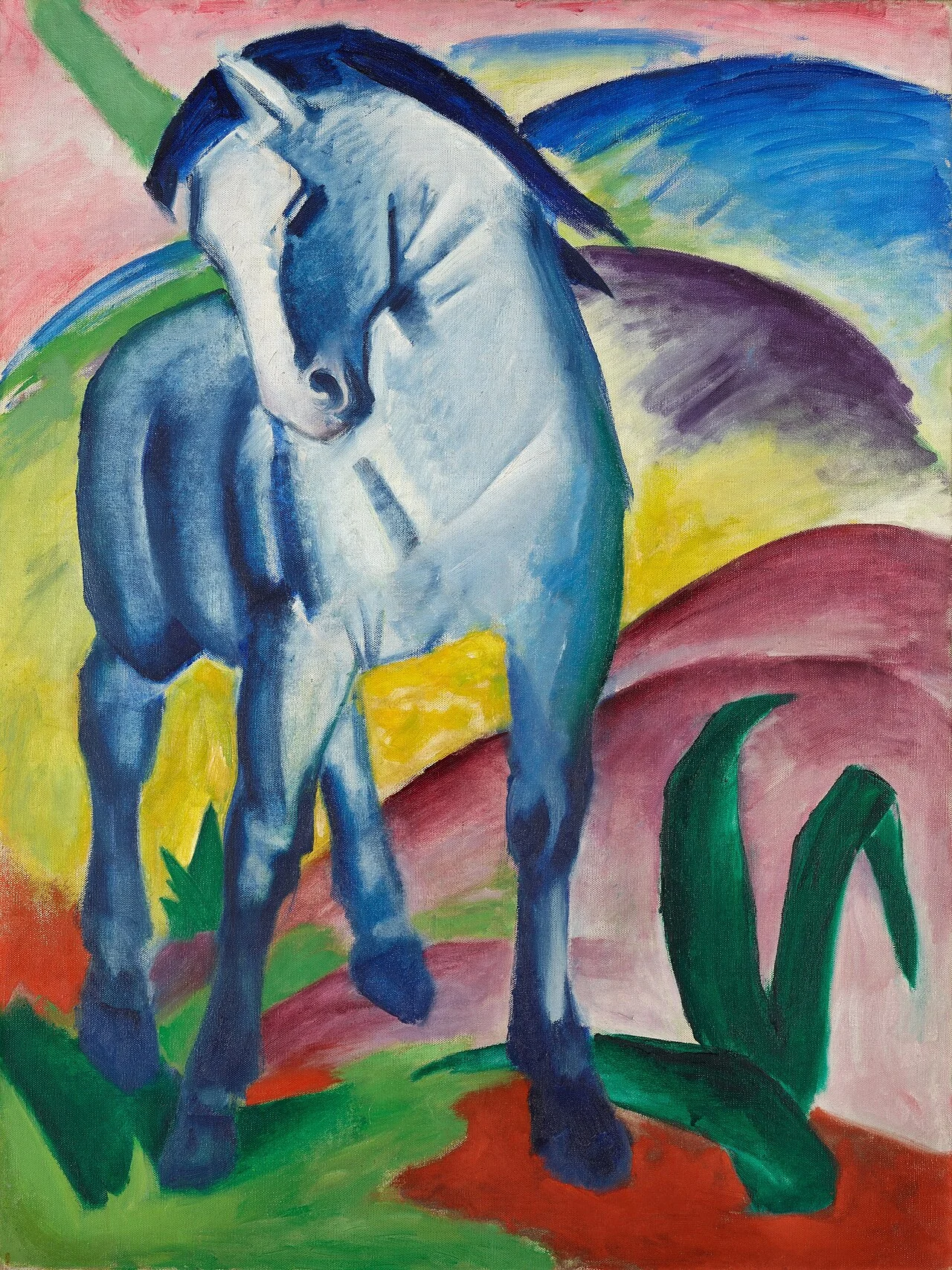
At the Lenbachhaus in Munich, this horse is one of the circle's most recognisable images. Its blue body and rounded landscape make naturalistic colour subordinate to pictorial relationships. Our reading is that the animal appears both substantial and inwardly concentrated: the bent head makes the surrounding colour feel like part of a state of being, rather than scenery placed behind a specimen. Wikimedia Commons, Blue Horse I

Franz Marc, Yellow Cow, 1911
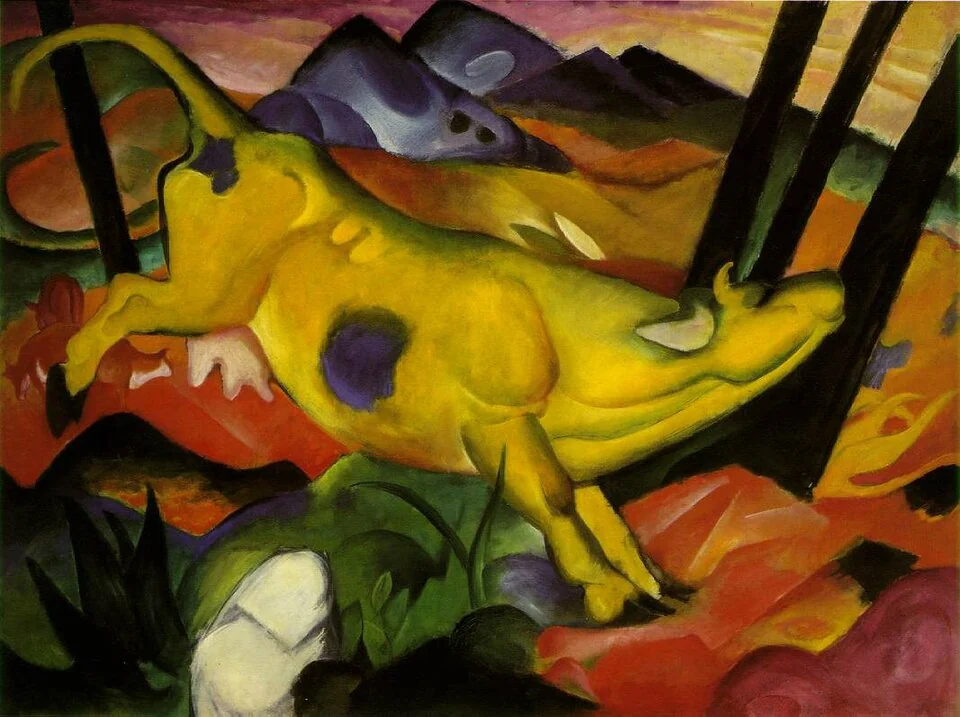
The Guggenheim in New York owns this exuberant animal painting. Marc had co-founded the Blue Rider project that year; the cow belongs to the core period, not to a later imitation of its imagery. Our formal reading highlights the arching body and strongly contrasted ground: the picture makes colour an event extending across animal and landscape, rather than an inventory of local hues. Christie's, Yellow Cow context; Wikimedia Commons, Yellow Cow

Franz Marc, Dog Lying in the Snow, 1911
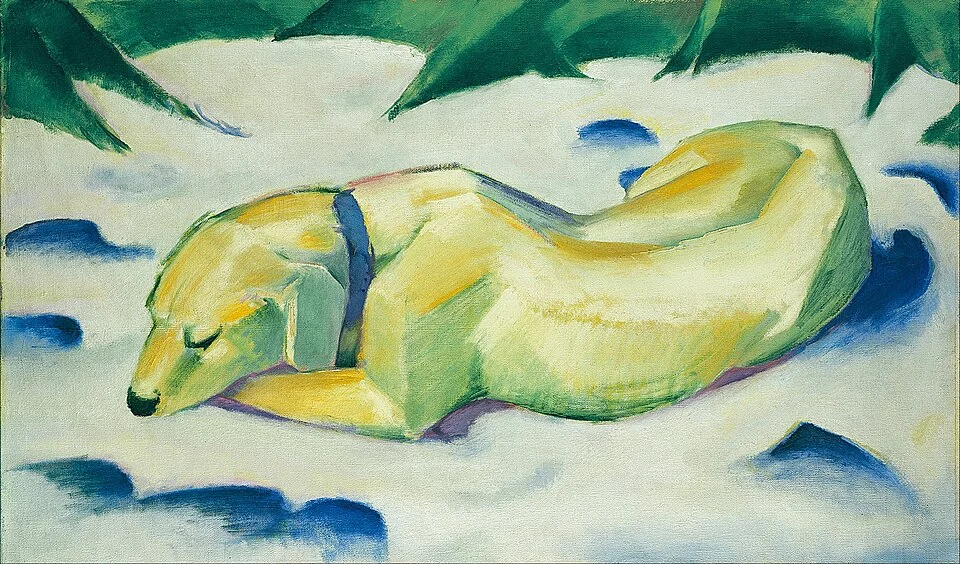
The Städel Museum in Frankfurt holds this quieter example. The light dog and snow produce a very different register from the bright cow, showing why “intense expression” need not mean maximum saturation everywhere. Our reading is that the animal's low, extended body and enclosing ground concentrate attention through a restricted contrast. The subject remains identifiable, even while painting reorganises its appearance. Wikimedia Commons, Städel collection details

Franz Marc, Tiger, 1912
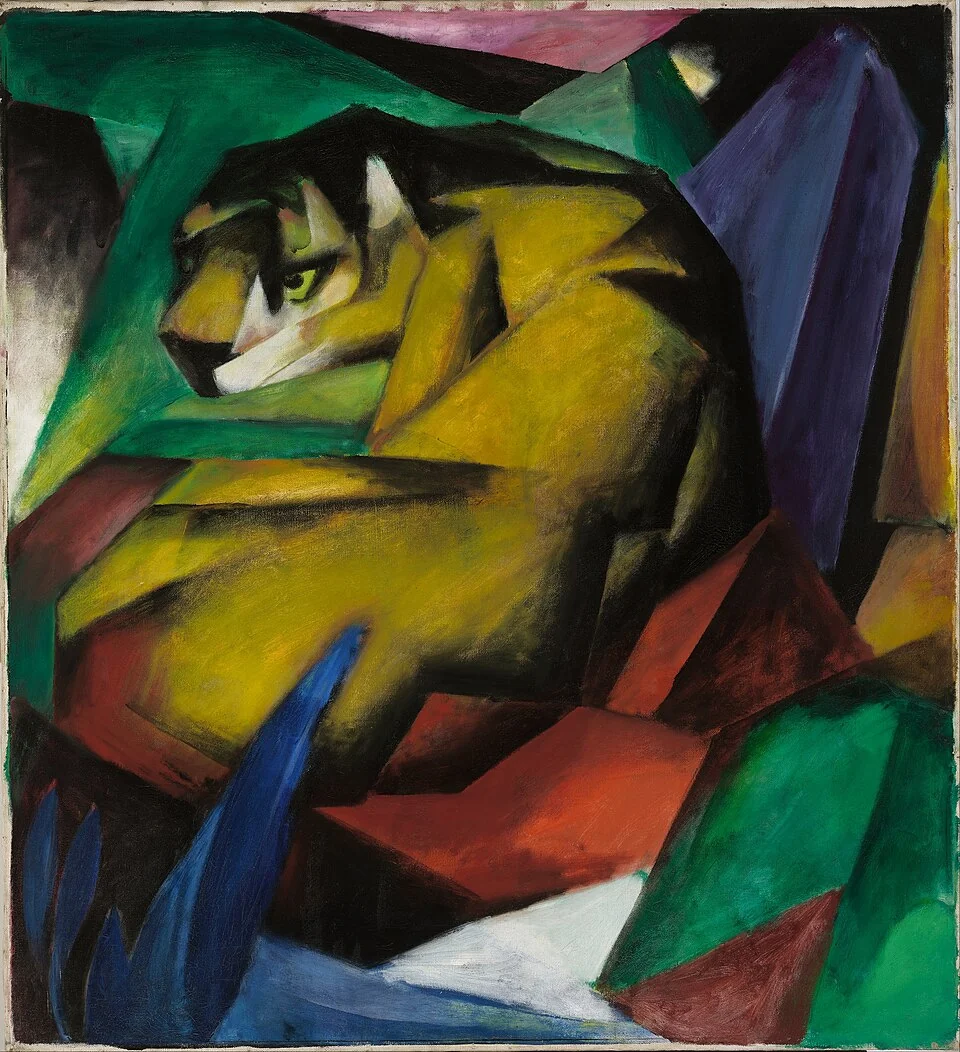
Owned by the Lenbachhaus, Tiger gives the animal a compressed, angular body closely integrated with surrounding forms. Tate selected it as a principal image for its Expressionists exhibition. Our reading is that the crouching pose and crystalline setting make strength feel contained rather than released. It also reveals a route towards abstraction that retains the animal instead of removing the subject altogether. Tate, Expressionists; Wikimedia Commons, Tiger

Franz Marc, The Foxes, 1913
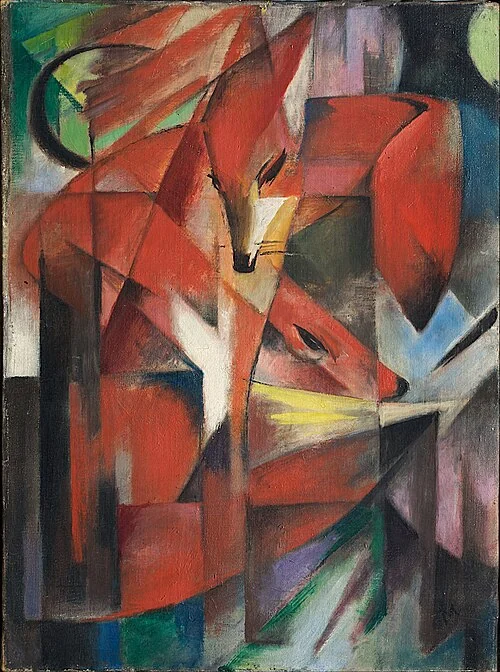
This painting passed through Düsseldorf's museum collection before restitution to the heirs of Kurt and Else Grawi and its 2022 sale. It is therefore not a work a visitor should assume remains at the Kunstpalast. Christie's specialist Keith Gill interprets its intersecting planes as directing the viewer back towards the centre. That spatial argument links the recognisable animals to Marc's evolving geometric language. Christie's, provenance and interpretation
Franz Marc, Fate of the Animals, 1913
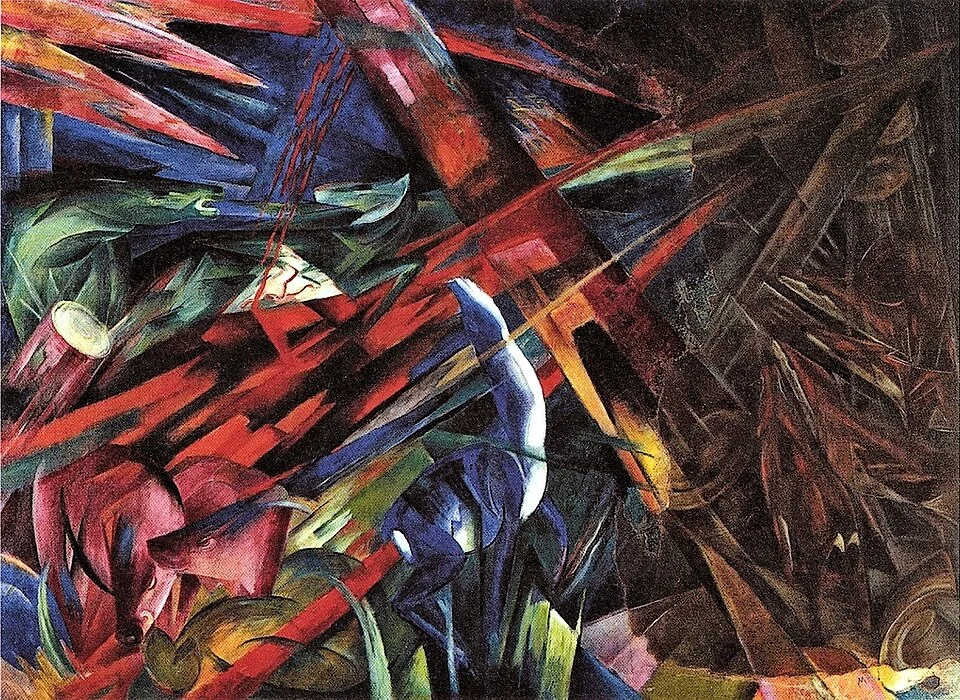
The Kunstmuseum Basel owns this violent forest scene. Its broken planes contrast with the unity often sought in the animal pictures. Our reading is that diagonals now threaten the creatures rather than merely binding them to their surroundings. Describing it as an image made before the war is a verifiable chronology; calling it a literal prophecy would be a much larger interpretive claim. Wikimedia Commons, Basel collection details

Kandinsky, Impression III (Concert), 1911
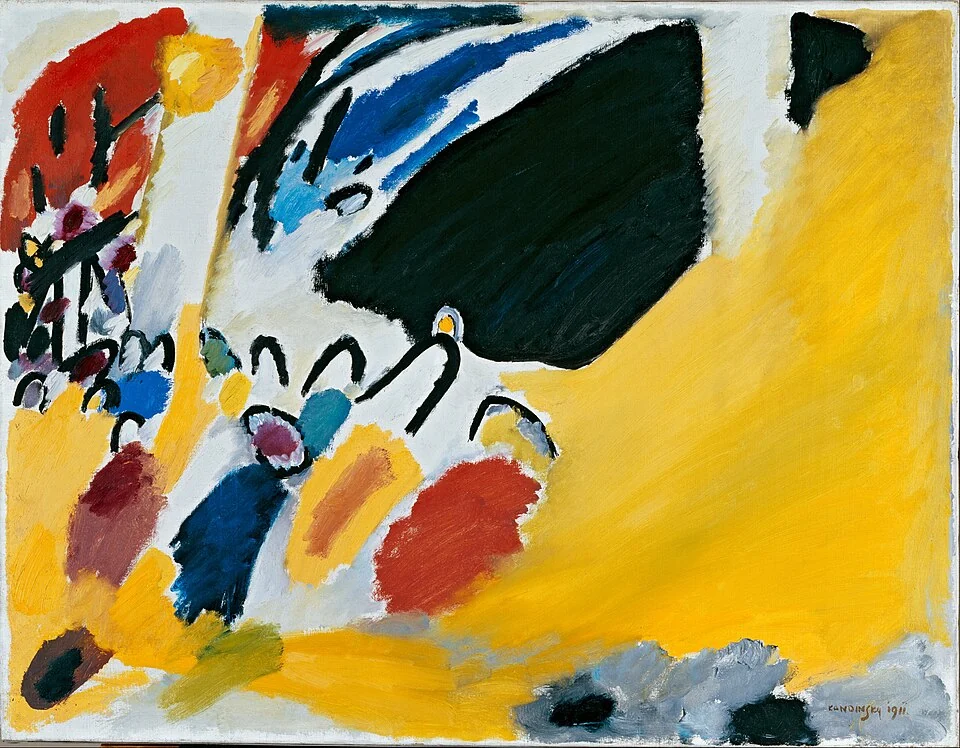
This Lenbachhaus painting provides the musical counterpart to Marc's animals. Tate's exhibition guide situates Kandinsky's engagement with Schoenberg within the circle's exchanges. Our reading distinguishes a large dark piano-like form from the expansive yellow surrounding it: a concert experience is translated into a relation of forces, rather than reproduced as an illustrative scene of musicians on a stage. Tate, exhibition guide; Wikimedia Commons, Impression III

Kandinsky, almanac cover, 1912
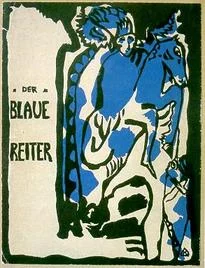
The rider on the publication's cover compresses the project into a portable emblem. The modest reproduction shown here documents the design, rather than pretending to replace an examination of a physical book. LACMA's record of the 1914 edition identifies printed material and a woodcut electrotype, reminding us that edition and printing process matter when looking at or collecting this object. Wikimedia Commons, almanac cover; LACMA

What do museums, critics and dealers say?
Germany's Lenbachhaus interprets the circle as an exchange among many personalities, supported by the extraordinary material preserved and donated by Münter. Its collection history credits her 1957 gift with turning the municipal gallery into a museum of international standing. That institutional history is also an account of agency: preservation, collecting and donation shaped what later viewers could know. Lenbachhaus, collection history
In Britain, Tate's 2024 presentation foregrounded friendships, gender and media beyond painting. The exhibition page reproduces the Guardian's description, “A network of artists whose loves and friendships crossed borders and genders”. This is a review excerpt selected by the museum, not a quotation checked against the complete newspaper review. It captures a shift away from narrating the movement exclusively through two famous male painters. Tate, quoted reception of Expressionists
In the United States, MoMA's German Expressionism account pays particular attention to prints and the connection between simplified graphic form and abstraction. London dealer Richard Nagy explicitly places Der Blaue Reiter beside Die Brücke and New Objectivity among the gallery's specialisms. The museum isolates a medium and historical problem; the dealer locates the circle within a continuing field of collecting. Those are distinct kinds of recognition. MoMA; Richard Nagy
Two dated results show the high end of that market. Christie's London sold The Foxes for £42,654,500 on 1 March 2022, a Marc record at the sale. Sotheby's London sold Kandinsky's Murnau with Church II for £37,196,800 on 1 March 2023, setting his auction record then. Both works had restitution histories. Kandinsky's canvas dates from 1910, before the circle's formal exhibition activity, so the result is relevant context rather than a price for a strictly defined Blue Rider-period painting. Christie's; Sotheby's
How does it differ from Expressionism and the Bauhaus?
Expressionism is the wider historical category. The Blue Rider is a particular Munich-centred project within it; Die Brücke was a separate association formed in Dresden. The Lenbachhaus contrasts the latter's emphasis on figuration with the Blue Rider circle's varied routes towards luminous colour and partial abstraction. This distinction is useful without becoming absolute: neither circle should be reduced to a single subject or technique. Lenbachhaus
The Bauhaus belongs to a later institutional history. Kandinsky and Klee became teachers there, but a painting made during their teaching years is not automatically a Blue Rider work. The original project ended with wartime dispersal; its ideas continued through individual careers, collections, books and new educational contexts. Our interpretation is that its most productive legacy is the possibility of collaboration without pictorial uniformity. Wikipedia, Der Blaue Reiter; Wikipedia, Bauhaus
Artists
Our Wassily Kandinsky page follows his whole career beyond this circle. Marc, Münter, Macke, Werefkin, Jawlensky, Maria Franck-Marc and Elisabeth Epstein supply essential complementary perspectives. Their differences help explain why the network cannot be understood through one artist's eventual move into abstraction. Lenbachhaus, participating artists
Questions people ask about Der Blaue Reiter
What was Der Blaue Reiter in simple words?
It was an international circle of artists centred on Munich that used exhibitions and a book to explore expressive colour and inward experience. Its participants worked in different styles and media. The name translates as The Blue Rider. Wikipedia, Der Blaue Reiter
When and where was it active?
Its main collective activity ran from 1911 to 1914 around Munich and nearby Murnau. Exhibitions travelled more widely. The First World War dispersed the international network. Wikipedia, Der Blaue Reiter
Who were the key artists?
Kandinsky and Franz Marc edited the almanac. Gabriele Münter, August Macke, Marianne Werefkin, Alexej Jawlensky, Maria Franck-Marc and Elisabeth Epstein were important within the wider circle. Their work included painting, photography and other forms of expression. Lenbachhaus
How can I recognise its art?
Look for expressive rather than naturalistic colour, simplified forms and an interest in inward or spiritual experience. Animal subjects and emerging abstraction are prominent, but neither is compulsory. The circle never imposed one uniform appearance. Tate, Expressionists
Was it the same as German Expressionism?
German Expressionism is the broader category. Der Blaue Reiter was a particular Munich-centred circle within it, while Die Brücke was a separate association. The Blue Rider was especially open to different artistic languages and routes towards abstraction. Lenbachhaus
What was the Blue Rider almanac?
It was the book edited by Kandinsky and Marc and published by Piper in 1912. It brought essays, music and reproductions of modern, folk, children's and non-European art into dialogue. A second edition appeared in 1914, but the planned second volume was not published. Wikipedia, Der Blaue Reiter
Which works can I see in museums?
The Lenbachhaus owns Blue Horse I, Tiger and Impression III; the Guggenheim owns Yellow Cow; the Städel owns Dog Lying in the Snow; Kunstmuseum Basel owns Fate of the Animals. Check current displays and loans before visiting. The Foxes was restituted and sold, so it should not be assumed to remain in Düsseldorf. Works and collection sources
What are the auction records and collecting considerations?
The Foxes sold at Christie's London for £42,654,500 on 1 March 2022, a Marc record then. Kandinsky's earlier Murnau with Church II sold at Sotheby's London for £37,196,800 on 1 March 2023. These exceptional paintings are not price guides for prints or almanacs, whose edition and physical identity require separate attention. Christie's; Sotheby's
Sources and image credits
Sources opened and compared on 26 October 2026. Core comparisons: Wikipedia, Der Blaue Reiter; Lenbachhaus; Tate, Expressionists; MoMA, German Expressionism. The account adds object-specific documentation, international reception and dated market evidence. Passages identified as our readings are interpretations.
Each figure links to the Commons file page whose public-domain statement was checked. Reproductions are shown at reduced size. Low-resolution documentary images retain their native display width.
- Lenbachhaus
- Wikipedia, Der Blaue Reiter
- Tate, Expressionists
- MoMA, German Expressionism
- Lenbachhaus, collection history
- Christie's, Franz Marc and The Foxes
- Tate, exhibition guide
- LACMA, 1914 almanac
- Wikimedia Commons, public domain
- Wikimedia Commons, public domain
- Wikimedia Commons, public domain
- Wikimedia Commons, public domain
- Wikimedia Commons, public domain
- Wikimedia Commons, public domain
- Wikimedia Commons, public domain
- Wikimedia Commons, public domain
- Richard Nagy
- Sotheby's
- Wikipedia, Bauhaus
