Movements / No. 009
Bauhaus
The Bauhaus was the German school of art, craft, design and architecture active from 1919 to 1933 that taught students to connect artistic experiment with the materials, technologies and needs of modern life. Wikipedia, Bauhaus
Founded by Walter Gropius in Weimar, it later moved to Dessau and Berlin under changing political pressure. Its name now suggests a style, but the historical institution contained competing programmes, practical workshops and artists whose paintings looked very different from its furniture. This guide connects those parts and distinguishes school-era objects from later editions and later careers. Bauhaus Kooperation; Wikipedia, Bauhaus
How do you recognise Bauhaus work?
Common clues include clear geometry, reduced ornament, experimental materials, legible typography and a visible relationship between construction and function. Yet no single checklist identifies every Bauhaus object. An early wooden chair, a woven textile, a photogram, a theatrical costume and a Kandinsky painting can all belong to its history. Their connection may be a workshop or teaching relationship, not an identical palette of red, yellow and blue. Wikipedia, Bauhaus
Our most useful distinction is between a method and a surface appearance. A method asks what a material permits, what the object must do and how its parts relate. A surface appearance copies circles, a sans-serif label or tubular steel. The school repeatedly changed its answer to the first set of questions, which is why “Bauhaus style” is too narrow a description of fourteen years of teaching. Wikipedia, Bauhaus; Bauhaus Kooperation
A short timeline: three cities and three directors
- 1919: Gropius establishes the school in Weimar. Its founding programme seeks a unity of arts through building and craft, drawing on earlier educational reform. Bauhaus Kooperation; Wikipedia, Bauhaus
- 1921–1922: Paul Klee and then Wassily Kandinsky join the faculty, extending its range of pictorial theory and teaching. Wikipedia, Bauhaus
- 1923: an exhibition presents the school's work publicly, including the experimental Haus am Horn. The orientation towards industry becomes more explicit as Johannes Itten leaves and László Moholy-Nagy takes a central teaching role. Wikipedia, Bauhaus
- 1925–1926: the move to Dessau leads to Gropius's purpose-designed school building and a new institutional setting for the workshops. Wikipedia, Bauhaus
- 1928–1930: Hannes Meyer succeeds Gropius and emphasises collective needs, research and affordable production. Mies van der Rohe becomes director in 1930, increasing the emphasis on architecture. Wikipedia, Bauhaus
- 1932–1933: the school moves to Berlin after closure in Dessau. Under Nazi repression, its teachers resolve to dissolve it in July 1933. German Federal Archives
- After 1933: emigration and teaching carry different Bauhaus practices abroad, including the Alberses at Black Mountain College and Moholy-Nagy's New Bauhaus in Chicago. Wikipedia, Bauhaus
Dates deserve checking even in strong introductions. The Met essay gives 1930 for the Berlin relocation, whereas the German Federal Archives and the institutional chronology place Berlin in 1932–1933. This page follows the latter chronology. A source can be valuable for its analysis of workshops while still containing a factual slip that should not be repeated. The Metropolitan Museum of Art; German Federal Archives; Bauhaus Kooperation
What did students learn?
Start with materials and perception
The preliminary course, or Vorkurs, prepared students for specialised workshops through investigations of materials and visual relationships. Itten's early approach was different from the later teaching of Moholy-Nagy and Josef Albers. Exercises in colour, construction and material behaviour made education an active inquiry rather than simply training students to reproduce a master's finished style. The school combined theoretical instruction with technical practice. Wikipedia, Bauhaus
The faculty's diversity was part of this system. Klee's pictorial theory, Kandinsky's analysis of colour and form, and Moholy-Nagy's investigations of photography and technology did not collapse into a single shared painting manner. Students encountered ways of thinking that could inform a textile, a print or a spatial design. Our interpretation is that the common educational framework created productive friction rather than requiring uniform visual results. Wikipedia, Bauhaus
From craft to industrial prototypes
The 1919 ideal of a renewed craft community did not remain the school's only programme. In the 1920s the workshops increasingly investigated prototypes and cooperation with industry. Breuer's tubular furniture is an especially clear example: a conventional upholstered mass becomes a framework of supports and suspended surfaces. This transition involved finance and production as well as taste; it was not merely a decision to replace ornate shapes with cleaner ones. Wikipedia, Bauhaus; Centre Pompidou, Breuer
Marianne Brandt's tea infuser exposes an important qualification. Its carefully organised geometry and functional details embody the school's design ambition, but the celebrated vessel was not mass-produced. By contrast, the weaving workshop developed commercially successful textiles. The ambition to design for modern production therefore should not be confused with a claim that every surviving Bauhaus object was cheap, machine-made or manufactured in large numbers. The Metropolitan Museum of Art
Women and the boundaries of opportunity
Women participated in the school, but access to workshops was unequal. Many were channelled towards weaving rather than encouraged equally in all areas. Gunta Stölzl's leadership and Anni Albers's work made textiles central achievements, not a secondary decorative footnote. Brandt's role in metalworking is another reason to investigate actual workshop histories instead of assuming the school's modern image guaranteed an uncomplicated equality of opportunity. Wikipedia, Bauhaus
The 2025 Affinities exhibition at David Zwirner traced the dialogue between Klee and Anni and Josef Albers through their Bauhaus years and later work. It placed textiles, glass and painting in conversation. That approach corrects a medium hierarchy: an experiment with warp and weft can carry an investigation of structure and colour as serious as one conducted on canvas. This is our implication from the exhibition's comparison, not a claim that their works were interchangeable. David Zwirner, Affinities
Architecture, theatre and communication
Architecture was a central aspiration from the outset, but a dedicated architecture department arrived only in 1927. This explains the apparent contradiction between a school named around building and the prominence of painting and craft in its early curriculum. Under Meyer, planning addressed social needs; under Mies, architectural education took a different direction. The three directorships are substantive differences, not merely changes of administrator. Wikipedia, Bauhaus
Oskar Schlemmer's stage work examined the body within constructed space, extending the school's investigations beyond static objects. Typography and photography developed their own roles in advertising and communication. The poster, book and exhibition were means by which the institution represented itself publicly. What later looks like a consistent graphic identity was produced within a school that also contained changing beliefs about art, industry and society. Wikipedia, Bauhaus
Key objects, buildings and paintings
The essential design objects include the Haus am Horn in Weimar, Gropius's Dessau school, Breuer's B3 chair and Brandt's tea infuser. The cleared images here show a poster and paintings by teachers, not the entire range of the workshops. Signs in Yellow is explicitly a later legacy example. No copyrighted chair, textile or building reproduction has been substituted simply to make a more comprehensive-looking picture selection. Wikipedia, Bauhaus
Joost Schmidt, Bauhaus exhibition poster, 1923
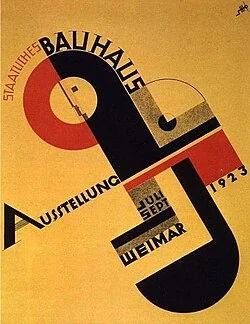
The poster brings text, a geometric profile and directional structure into one composition for the Weimar exhibition. This modest-resolution reproduction documents a specific graphic object. Our reading is that the design communicates both a public event and an experimental institutional identity: a face can become an arrangement of shapes without losing its role as a point of recognition. Wikimedia Commons, Joost Schmidt poster

Paul Klee, Red Balloon, 1922
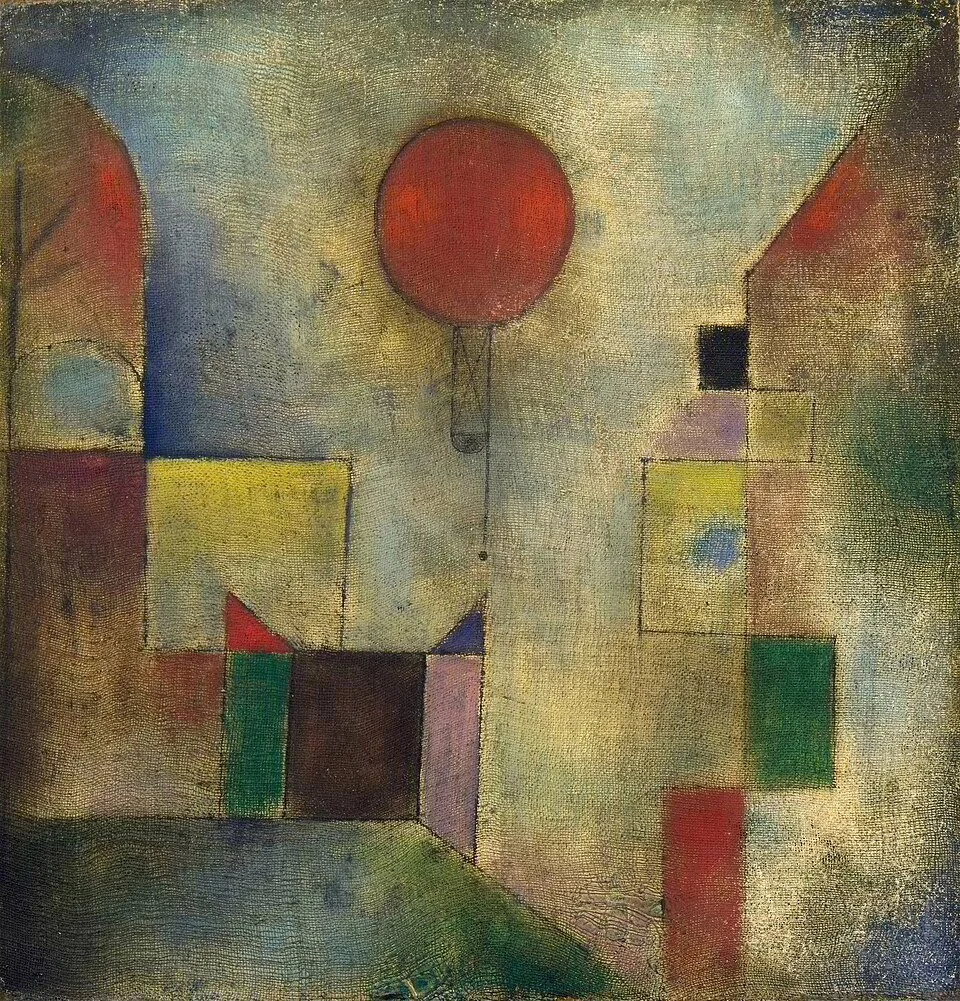
The Guggenheim painting dates from Klee's teaching years. A red circular form hovers over an arrangement suggesting buildings without giving up the independence of coloured planes. Our reading is that representation and abstraction remain in dialogue: the title helps summon a city and a balloon, while the arrangement can still be understood through relationships of colour, scale and position. Wikimedia Commons, Red Balloon

Paul Klee, Night Feast, 1921
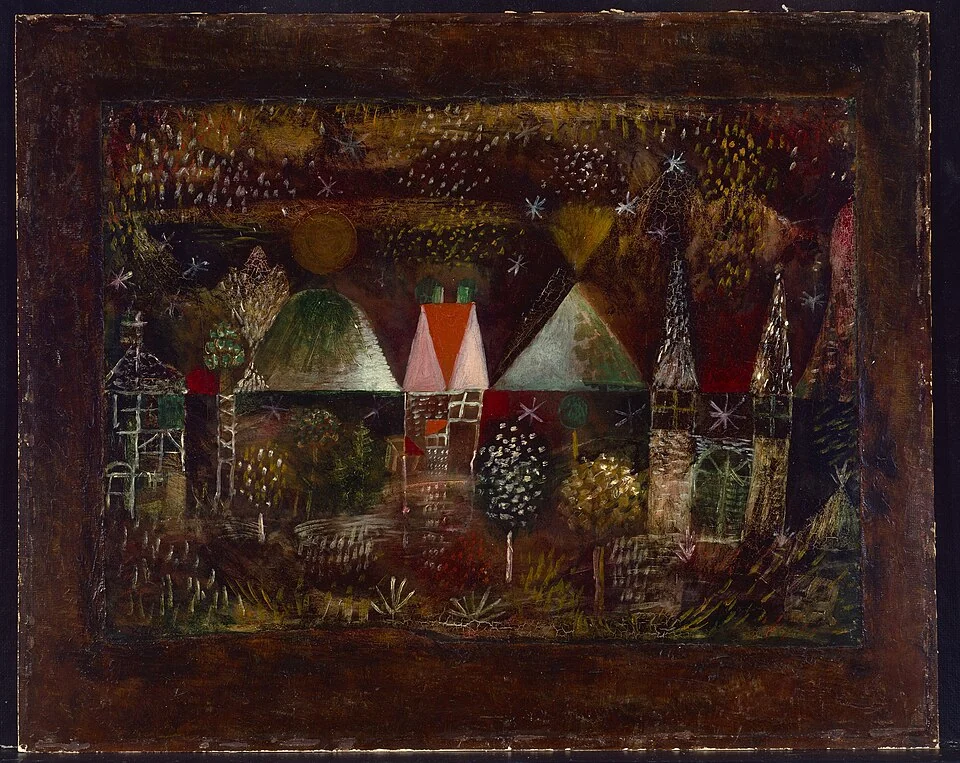
This Guggenheim work is oil on paper mounted on painted cardboard and board, an object with a layered construction rather than simply a conventional stretched canvas. It belongs to the year Klee joined the school. Our reading highlights the concentration of marks and tonal intervals; its particular handling shows how far the paintings of Bauhaus teachers could range beyond the familiar primary-colour diagram. Wikimedia Commons, Night Feast

Paul Klee, Red and Green Architecture, 1922
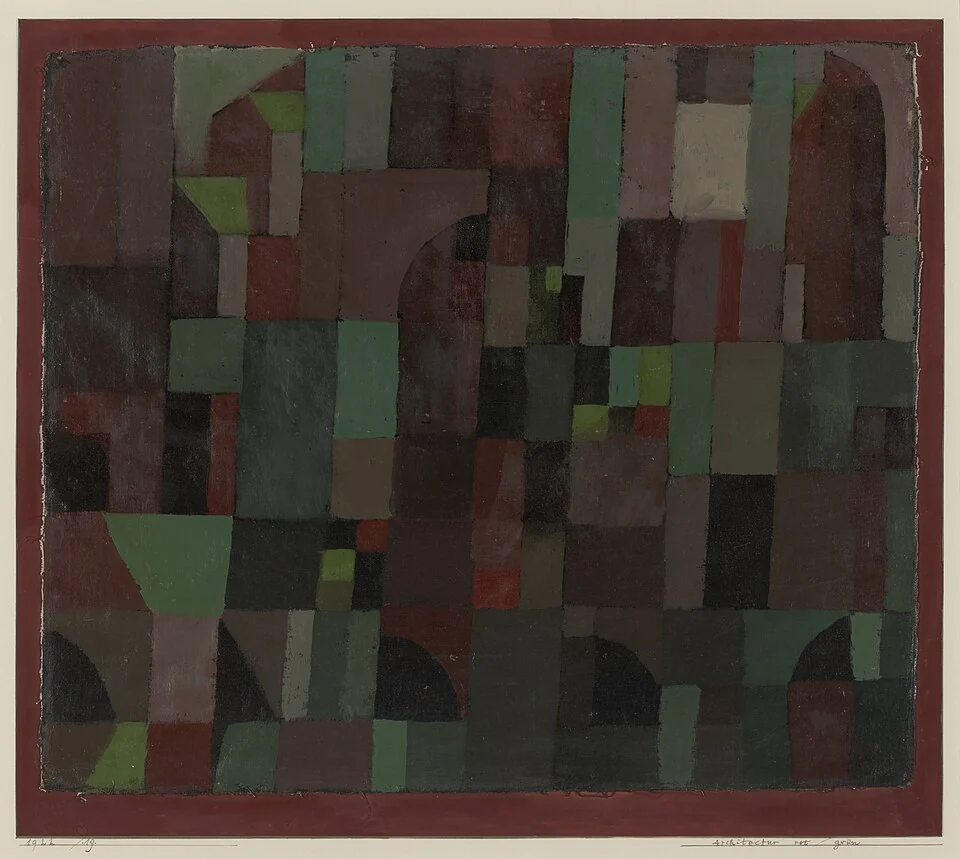
Yale University Art Gallery owns this painting, also described through its yellow-violet gradation. The architectural title does not make it a plan for a building. Our reading is that the image explores how colour can make a constructed field feel inhabited or spatial. That distinction keeps a painter's investigation of architecture separate from the professional design of an actual structure. Wikimedia Commons, Yale collection details

Kandinsky, Composition VIII, 1923
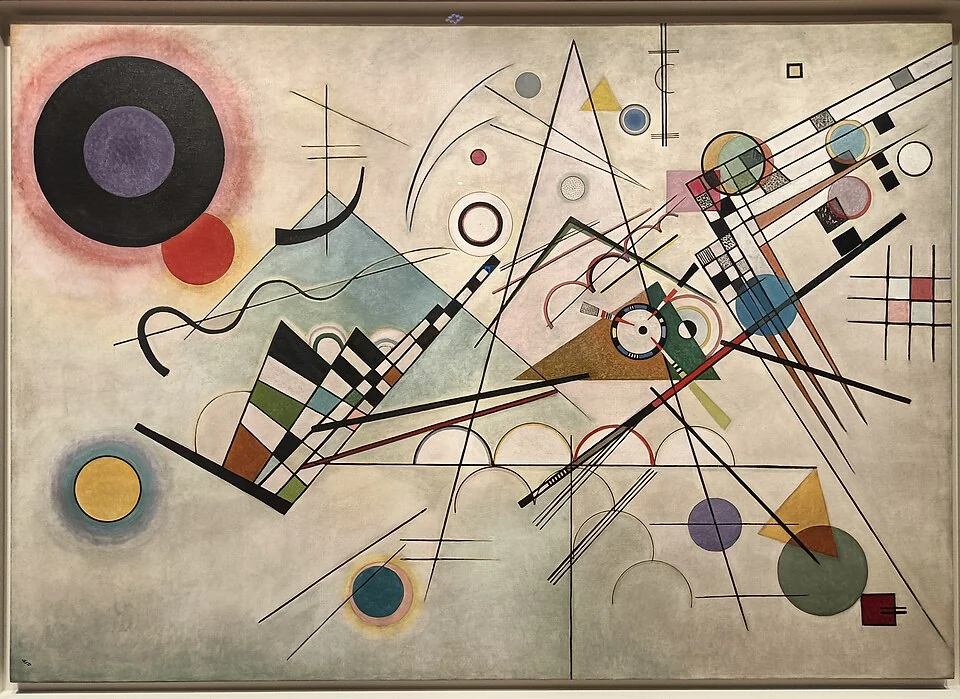
The Guggenheim owns this painting from Kandinsky's early Bauhaus period. Circles, diagonals and smaller geometric forms are more sharply differentiated than the interwoven colour of many pre-war works. Our interpretation is that the painting makes relationships appear analysable without turning them into a rigid formula. Teaching and painting can share questions about form while remaining different activities with different outcomes. Wikimedia Commons, Composition VIII

Kandinsky, On White II, 1923
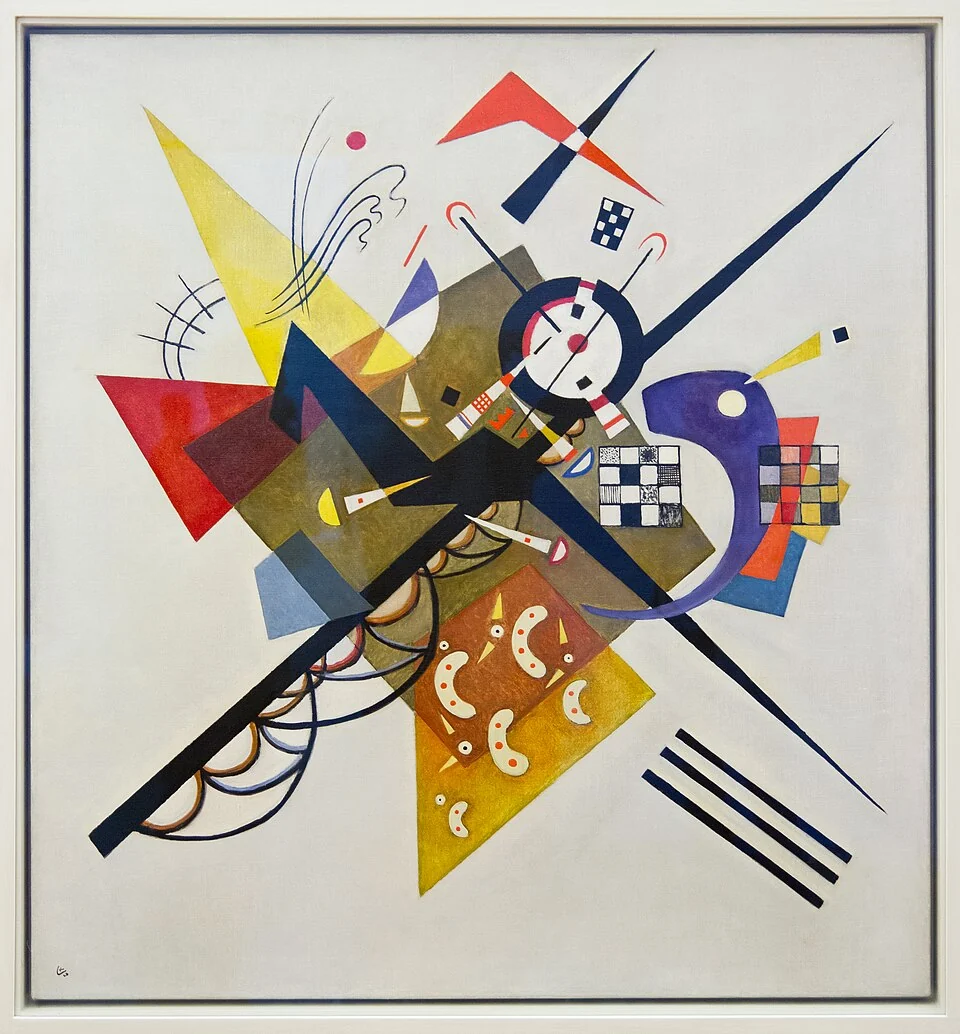
Held by the Musée national d'art moderne, Centre Pompidou, this canvas places forceful crossing forms against an open field. Our reading focuses on the interval between the dark directional structure and its surrounding space. It shows why the school's association with geometry should not be mistaken for the absence of conflict or intensity in the art made by its teachers. Wikimedia Commons, On White II

Kandinsky, Yellow-Red-Blue, 1925

Also in the Pompidou collection, this work opposes a luminous, more angular area to darker circular and curved forms. Our reading treats the title's three colours as participants in a spatial argument rather than a universal dictionary of emotional meanings. The painting belongs to the school's history, but no evidence here makes it an official model that every workshop was expected to reproduce. Wikimedia Commons, Yellow-Red-Blue

Paul Klee, Signs in Yellow, 1937
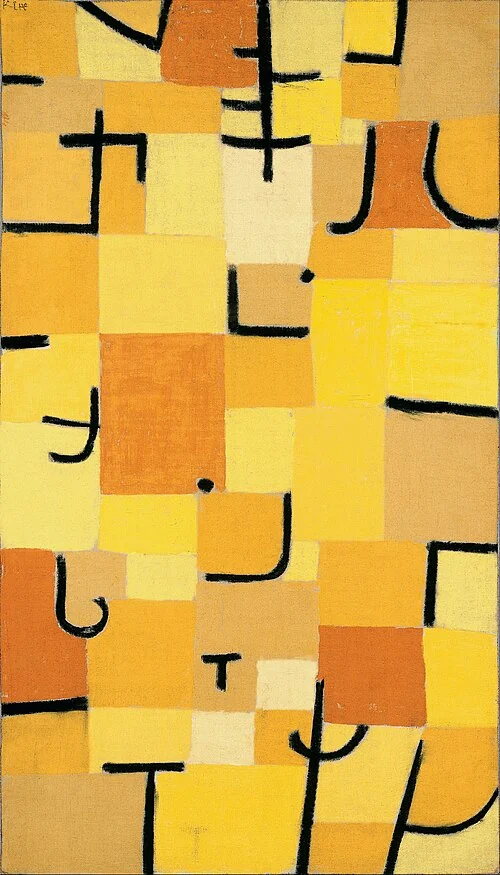
This Fondation Beyeler work was made four years after the school closed. It is included as an afterlife, not misdated into the Bauhaus curriculum. Its sign-like forms extend Klee's continuing investigation of pictorial language. Our comparison with the 1922 paintings shows an individual career developing beyond its institutional episode, which is also how later Albers and Breuer work should be approached. Wikimedia Commons, Fondation Beyeler collection details

Breuer's B3 chair and Brandt's tea infuser
Breuer designed the B3 in 1925; the name “Wassily” came later. The Pompidou explains that the chair was not originally designed for Kandinsky, although he admired it and received an example. Brandt's 1924 tea infuser combines metal and an insulating handle in an unusually concentrated form. These works are discussed without reproductions here; their museum and manufacturer records are the appropriate next step for examining construction and versions. Centre Pompidou; The Metropolitan Museum of Art
What do institutions, galleries and the market say?
Germany's Federal Archives makes the politics concrete through letters, budget negotiations and attacks on the school. Its documents show that the pressure was institutional and financial long before the final dissolution. This reception history matters because a convenient story about inevitable stylistic progress can obscure how fragile the school was, and how much administrative defence its experiment required. German Federal Archives, rise and decline
In France, the Pompidou calls the B3 a “cornerstone of modern design”, while correcting the popular story about its name. In the commercial sphere, Knoll's anniversary presentation stresses the continuing lightness and adaptability of Breuer's tubular furniture. The latter is a manufacturer's interpretation of a design it sells; it is useful evidence for commercial afterlife, not independent proof that every historical promise of affordability was fulfilled. Centre Pompidou; Knoll
New York gallery David Zwirner's Affinities exhibition, curated by Nicholas Fox Weber in 2025, described Klee and the Alberses as sharing goals without imitating one another. It is a useful dealer-gallery contribution because it puts individual differences inside the network. Paintings, glass and weaving appear as sustained investigations rather than as illustrations of a pre-existing logo or fashionable interior scheme. David Zwirner, Affinities
A dated design-market benchmark comes from Lempertz in Cologne. On 15 May 2024, its sale of a 1924 Brandt MT49/ME8 tea infuser realised €340,000 including taxes and fees; the buyer was Hamburg's Museum für Kunst und Gewerbe. Lempertz described it as a record price and noted that research established it as the eighth known example. This result belongs to a rare period object with family provenance, not to any later teapot using a hemispherical body. Lempertz, 15 May 2024 results
Our collecting recommendation is to ask which category an object occupies: a school-era original, a later production by a documented manufacturer, or an unconnected object advertised by style. Phillips's Breuer archive lists materially different furniture at very different result levels, reinforcing why the famous tea infuser is not a general “Bauhaus price”. Condition, alterations, production history and provenance require object-specific checking. Phillips, Marcel Breuer archive; Lempertz
What continued after 1933?
The international legacy travelled through people and institutions. Gropius and Breuer taught at Harvard; Mies worked and taught in Chicago; Moholy-Nagy founded the New Bauhaus there in 1937; Josef and Anni Albers took their practices to Black Mountain College. Their later careers transformed what they carried with them. The word “influence” should therefore name a route of transmission instead of assuming that every modern building or foundation course has the same origin. Wikipedia, Bauhaus
De Stijl and Constructivism were neighbouring sources and interlocutors, not alternative names for the school. Van Doesburg promoted his ideas in Weimar without becoming a regular Bauhaus master. The early Expressionist ambitions, later industrial prototypes and competing directorial programmes make the institution a place of argument. Our judgement is that the legacy worth retaining is its demand to connect artistic choices to material, social and perceptual consequences. Wikipedia, Bauhaus
Artists
Our Wassily Kandinsky guide follows one Bauhaus teacher across his wider career. Klee, Moholy-Nagy, Schlemmer, Stölzl, Brandt and the Alberses are equally necessary to understand the school's range. Architects and designers including Gropius, Meyer, Mies and Breuer make a painting-only account insufficient. Wikipedia, Bauhaus
Questions people ask about the Bauhaus
What was the Bauhaus in simple words?
It was a school that connected art, craft, design and architecture with modern materials and life. It existed in Germany from 1919 to 1933. The name now describes a wider legacy, but the historical school was not one fixed visual style. Wikipedia, Bauhaus
When and where did it operate?
The school began in Weimar in 1919, moved to Dessau in 1925 and then to Berlin in 1932. It dissolved in 1933 under Nazi pressure. These relocations reflected political and financial conditions as well as educational ambitions. German Federal Archives; Wikipedia, Bauhaus
Who were the main figures?
Its directors were Walter Gropius, Hannes Meyer and Ludwig Mies van der Rohe. Teachers and designers included Klee, Kandinsky, Moholy-Nagy, Breuer, Schlemmer, Stölzl, Brandt, and Josef and Anni Albers. Different workshops and periods gave them different roles. Wikipedia, Bauhaus
What are the main Bauhaus characteristics?
Geometry, material experiment, reduced ornament and relationships between form, construction and use are recurring characteristics. They do not cover every painting, textile or stage work made at the school. A workshop and date are stronger historical evidence than visual resemblance alone. Wikipedia, Bauhaus
Was Bauhaus the same as De Stijl?
No. De Stijl was a journal-centred artistic network, while the Bauhaus was an educational institution. They exchanged ideas, especially through Van Doesburg in Weimar. The school also contained approaches that did not follow De Stijl's particular geometric rules. Wikipedia, Bauhaus
Which objects and places should I start with?
Start with the Haus am Horn in Weimar, the Bauhaus building in Dessau, Breuer's B3 chair and Brandt's tea infuser. Paintings by Klee and Kandinsky add another part of the history. Check access and current display with the relevant institution. Wikipedia, Bauhaus; The Metropolitan Museum of Art
Why did the Bauhaus close?
Political hostility, funding pressure and Nazi repression undermined its operation. After the Dessau closure and a final period as a private school in Berlin, the teachers resolved to dissolve it in July 1933. Its ideas continued through emigrating staff and students. German Federal Archives
What do Bauhaus originals cost today?
There is no single Bauhaus price. Lempertz reported €340,000 including taxes and fees for a 1924 Brandt tea infuser on 15 May 2024, describing it as a record. A rare school-era object and a later furniture edition require different comparisons. Lempertz
Sources and image credits
Sources opened and compared on 26 October 2026. Core comparisons: Wikipedia, Bauhaus; The Metropolitan Museum of Art; Bauhaus Kooperation; German Federal Archives. The account adds object-specific documentation, international reception and dated market evidence. Passages identified as our readings are interpretations.
Each figure links to the Commons file page whose public-domain statement was checked. Reproductions are shown at reduced size. Low-resolution documentary images retain their native display width.
- Wikipedia, Bauhaus
- Bauhaus Kooperation
- German Federal Archives
- The Metropolitan Museum of Art
- Centre Pompidou, Breuer
- David Zwirner, Affinities
- Wikimedia Commons, public domain
- Wikimedia Commons, public domain
- Wikimedia Commons, public domain
- Wikimedia Commons, public domain
- Wikimedia Commons, public domain
- Wikimedia Commons, public domain
- Wikimedia Commons, public domain
- Wikimedia Commons, public domain
- Knoll
- Lempertz, 15 May 2024 results
- Phillips, Marcel Breuer archive