
Artists / No. 001
Wassily Kandinsky
Read a Kandinsky painting the way you listen to music: follow colour, line and form as forces in their own right, because Wassily Kandinsky (1866 to 1944), the Russian-born painter and theorist, helped make them independent subjects of modern painting. MoMA
Start with what the painting does to your attention. Does it pull, scatter, settle, interrupt? This guide moves between the pictures, Kandinsky's arguments and the people who interpret them. You can follow the whole route or go straight to a work or question.
How do you look at a Kandinsky?
Try three passes. These are our looking exercises, not a claim that every viewer feels the same thing. First, spend twenty seconds without hunting for an object. Name the strongest contrast you can see: a dark mass against light, a thin line against a broad patch, or a crowded area beside an empty one.
On the second pass, follow one line until another form interrupts it. Notice where your eye accelerates and where it rests. On the third, allow associations back in: a hill, a rider, a musical instrument, a map. Keep the difference between seeing a shape and identifying its subject. An association can be productive without becoming the painting's hidden answer.
This approach has a museum precedent. The Guggenheim Bilbao's teaching guide asks viewers to imagine sounds, describe personal colour associations and consider whether forms are invented or drawn from the visible world. It invites reasons for a response rather than supplying a single correct emotion.
Keep one question in reserve: what would change if this mark disappeared? Try covering a corner of a reproduction with your hand. If the rhythm changes, you have found a relationship worth describing. You do not need to agree with Kandinsky's spiritual beliefs to test the organisation of a painting.
A life in six moments
- 1866: Born in Moscow on 16 December. He later studied law and economics before turning to art. Biography
- 1896: Moves to Munich at thirty to study art. This is a career change, not the beginning of a childhood art-school trajectory. MoMA biography
- 1911 and 1912: Kandinsky and Franz Marc develop the Blue Rider exhibition and publishing project. Their almanac appears in 1912. Lenbachhaus
- 1914 to 1921: War forces his departure from Germany. In Russia he participates in the reorganisation of artistic culture, then returns to Germany in 1921. MoMA biography
- 1922 to 1933: Teaches at the Bauhaus, including colour and form. The school closes under Nazi pressure in 1933. Bauhaus Kooperation; MoMA
- 1933 to 1944: Lives in France. He becomes a French citizen in 1939 and dies in Neuilly-sur-Seine on 13 December 1944. Biography
What were Kandinsky's key ideas?
Concerning the Spiritual in Art
Kandinsky argues that painting can address an inner life through the relationships of its elements. In Concerning the Spiritual in Art, the artist's choices should arise from expressive need, rather than a demand to imitate appearances or follow fashionable conventions. His spiritual language makes artistic form a serious matter, not merely an arrangement that looks attractive.
MoMA catalogues the German book as 1911; the Guggenheim's account uses 1912.
Inner necessity
Inner necessity, or innere Notwendigkeit, is the pressure to find a form adequate to an inward expression. Kandinsky connects it to the artist's personality, the character of an age and something enduring in art. It asks why a particular choice is necessary. It does not remove the need for judgement or work. Kandinsky's text, chapter VI
Music and synesthesia
Music offered a model of expression without depicting a recognisable thing. Kandinsky's titles Impression, Improvisation and Composition distinguish an external impression, an inward spontaneous response and a more deliberately developed construction. The words do not mean that every painting transcribes a particular score. Jason Edward Kaufman, reporting MoMA's Compositions exhibition
Synesthesia is the association of experiences across sensory domains. Google's Play a Kandinsky presents his colour and sound associations through a contemporary musical interpretation made with Centre Pompidou. Treat it as a reconstruction inspired by his writings. It cannot let us verify exactly what he privately heard or experienced.
Colour and form: a theory to test
The famous pairings are a yellow triangle, a red square and a blue circle. They give colour an active relationship to shape. However, Makin and Wuerger's 2013 experimental study found no convincing support for the proposed pairings in an implicit association test. Its result concerns those associations in that experiment, not whether a Kandinsky painting can move you.
Use the theory as a question at the painting: does the yellow seem sharper here, and what else makes it sharp? An adjacent black line, the size of a patch or the angle of a neighbouring form may matter as much to your reading. Keep your description local to the image instead of turning a colour into a universal emotional instruction.
Point and Line to Plane
Published in 1926, Point and Line to Plane examines elementary pictorial relationships. A point concentrates; a line is the trace of a moving point; the plane receives their activity. Kandinsky connects this vocabulary to rhythm, dance and music. This is analysis of forces and tensions rather than a recipe for filling a canvas with geometry. Book excerpts and publication details
Der Blaue Reiter and the Bauhaus
The Blue Rider was an exhibition and editorial circle, not a rule that everyone had to paint alike. Its almanac placed contemporary art in dialogue with folk art, children's drawings and work from different cultures. Kandinsky, Marc and Münter's break with the New Artists' Association in December 1911 led quickly to a counter-exhibition. Lenbachhaus's account
At the Bauhaus, Kandinsky turned colour and form into teachable investigations. He led the wall-painting workshop in Weimar and taught form alongside an extensive colour theory. His teaching continued through the school's later locations until 1933. Read the geometric pictures with that educational project in mind, while remembering that a painting can do more than illustrate a lesson. Bauhaus Kooperation
How do people actually read the work?
The critic's route is comparison. In his 1995 review, Jason Edward Kaufman describes the abrupt difference between the saturated, gestural Composition VII and the diagrammatic VIII. His account of the exhibition emphasises how the studies reveal a deliberate creative process. Put the two images beside one another in your memory: Kandinsky's abstraction does not have one fixed appearance. The Art Newspaper
The museum's route adds evidence. The Tretyakov Gallery connects Composition VII to more than thirty preparatory works and earlier apocalyptic motifs, while cautioning that the studies do not form a simple step-by-step sequence. Such research can recover a painting's development without turning it into a puzzle with a single solution. Tretyakov Gallery on Google Arts & Culture
The everyday viewer's route can begin with recognition. The Art Gallery of New South Wales asks learners to look for a mountain, sun, clouds or rainbow in Composition VIII; its resource also links recordings of school pupils responding to works. Those are invitations and particular responses, not a survey of what everyone sees. They give permission to begin with an association and then examine it. Learning resource, pages 28 and 29
Our practical rule: separate observation, association and historical evidence. “There is a black diagonal” is observation. “It feels like a collision” is interpretation. “The artist prepared this composition through studies” requires a source. A strong reading can hold all three without confusing them.
Nine works that open up the whole journey
The looking notes below are our interpretations of the reproductions. Titles, dates and collections follow the linked records. “Collection” identifies the owner, not a promise that a work is currently on the wall.
1. Blue Mountain, 1908 to 1909
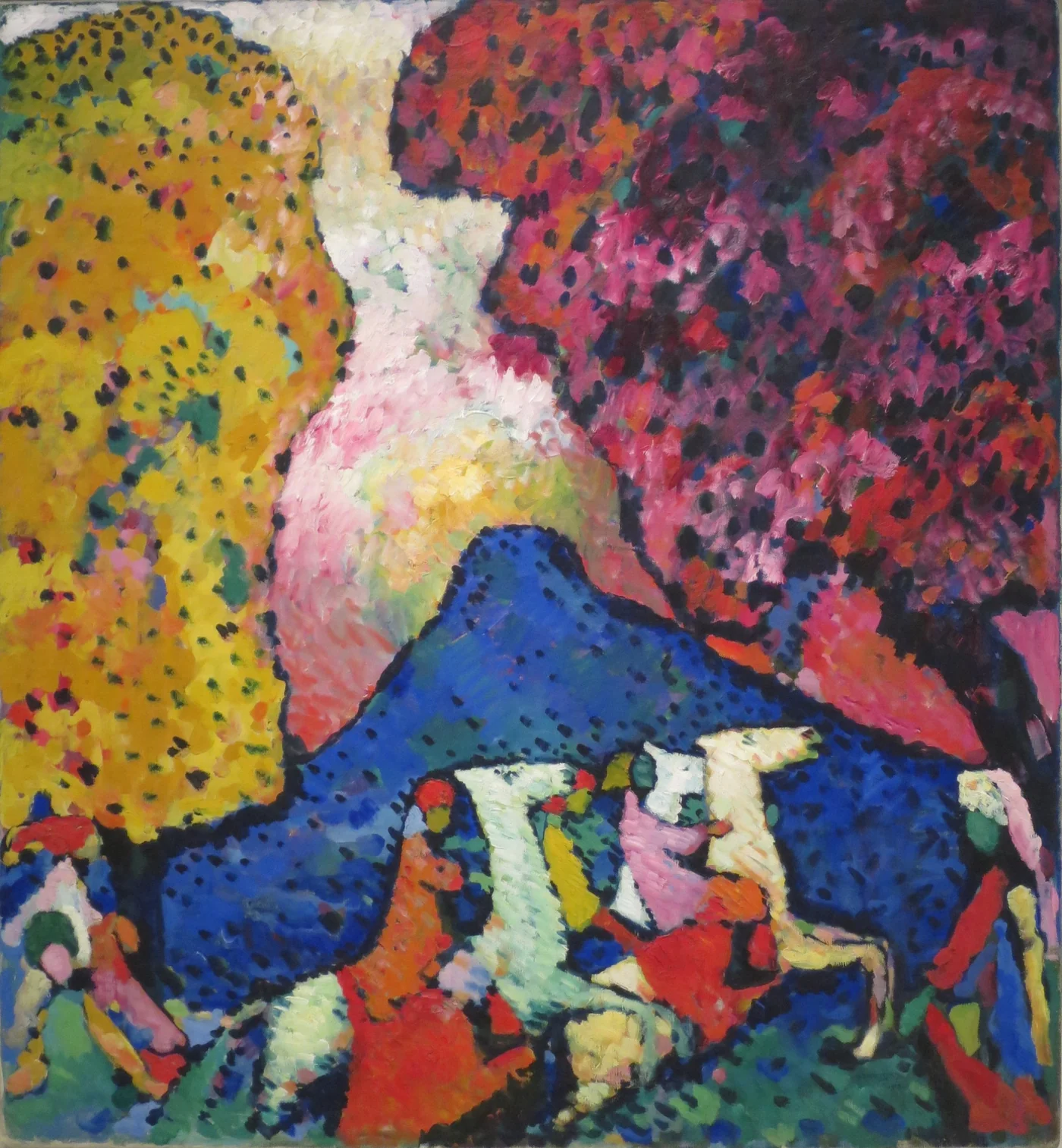
A good starting place because a landscape and riders remain legible. Follow the bright horses across the lower part, then look at how the coloured trees frame the mountain. The picture can be read as a landscape and as an arrangement of upright masses. Ask which holds your attention longer. The Guggenheim's catalogue dates the work to 1908 to 1909. Around the Circle checklist
2. Impression III (Concert), 1911
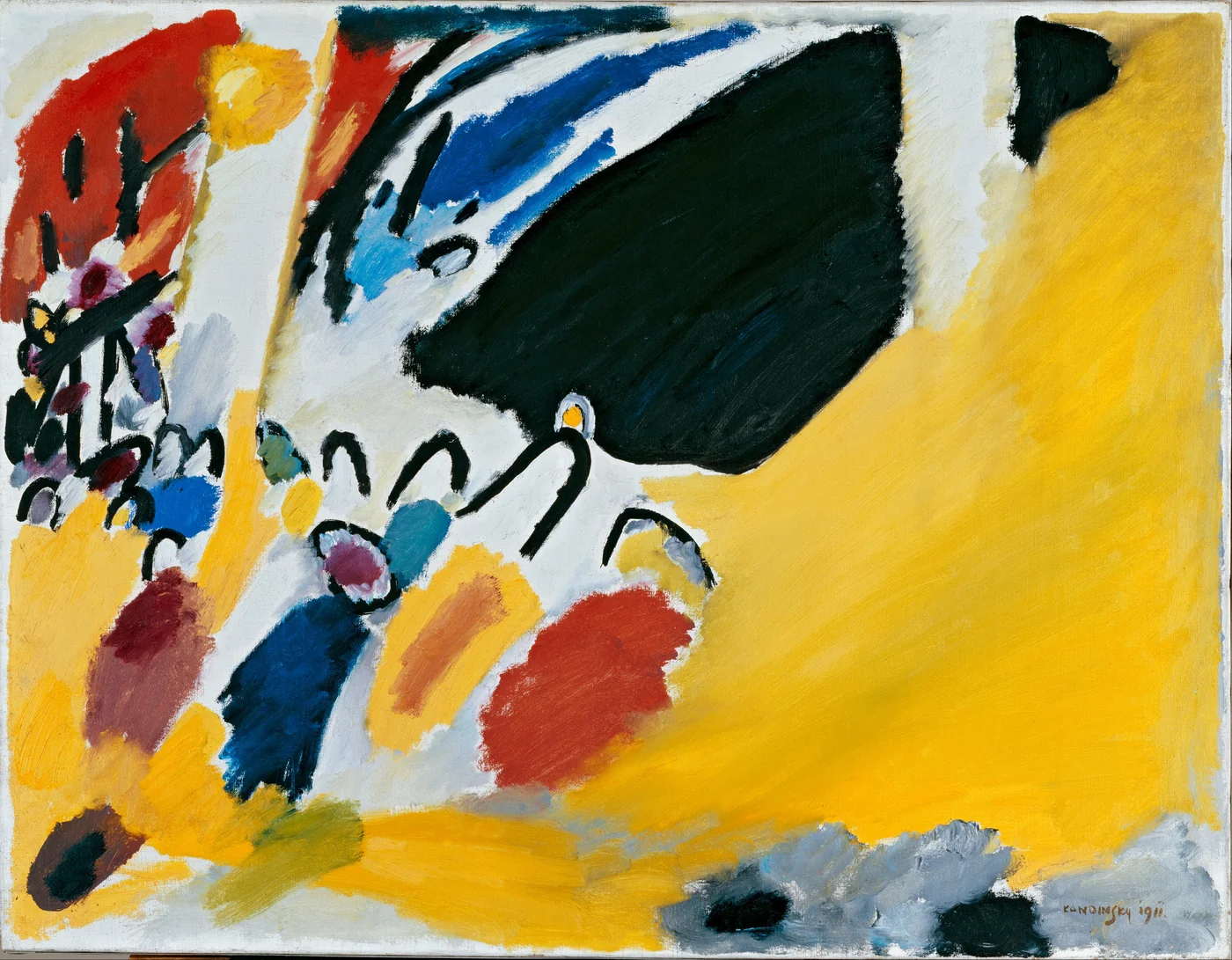
The Lenbachhaus relates this painting to a Munich concert of Schoenberg's music in January 1911. It identifies a grand piano and listeners within the yellow and black structure. Look first at the black weight, then at the yellow spreading around it. The concert subject remains available, but the contrast carries the impact before you have named the instrument. Lenbachhaus collection record
3. Colour Study: Squares with Concentric Circles, 1913
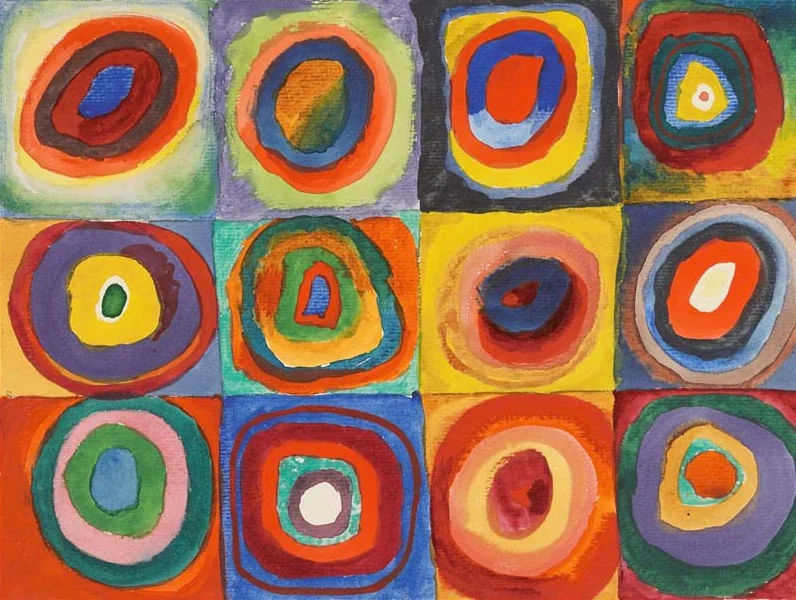
The record describes watercolour, gouache and crayon on paper, not a monumental oil painting. Try covering all but two squares. Which ring seems to advance, and which seems to sink? Then uncover the sheet and notice how a repeated structure allows many different local relationships. The uneven edges matter to the experience as much as the recognisable circle motif. Work and medium record

4. Composition VII, 1913
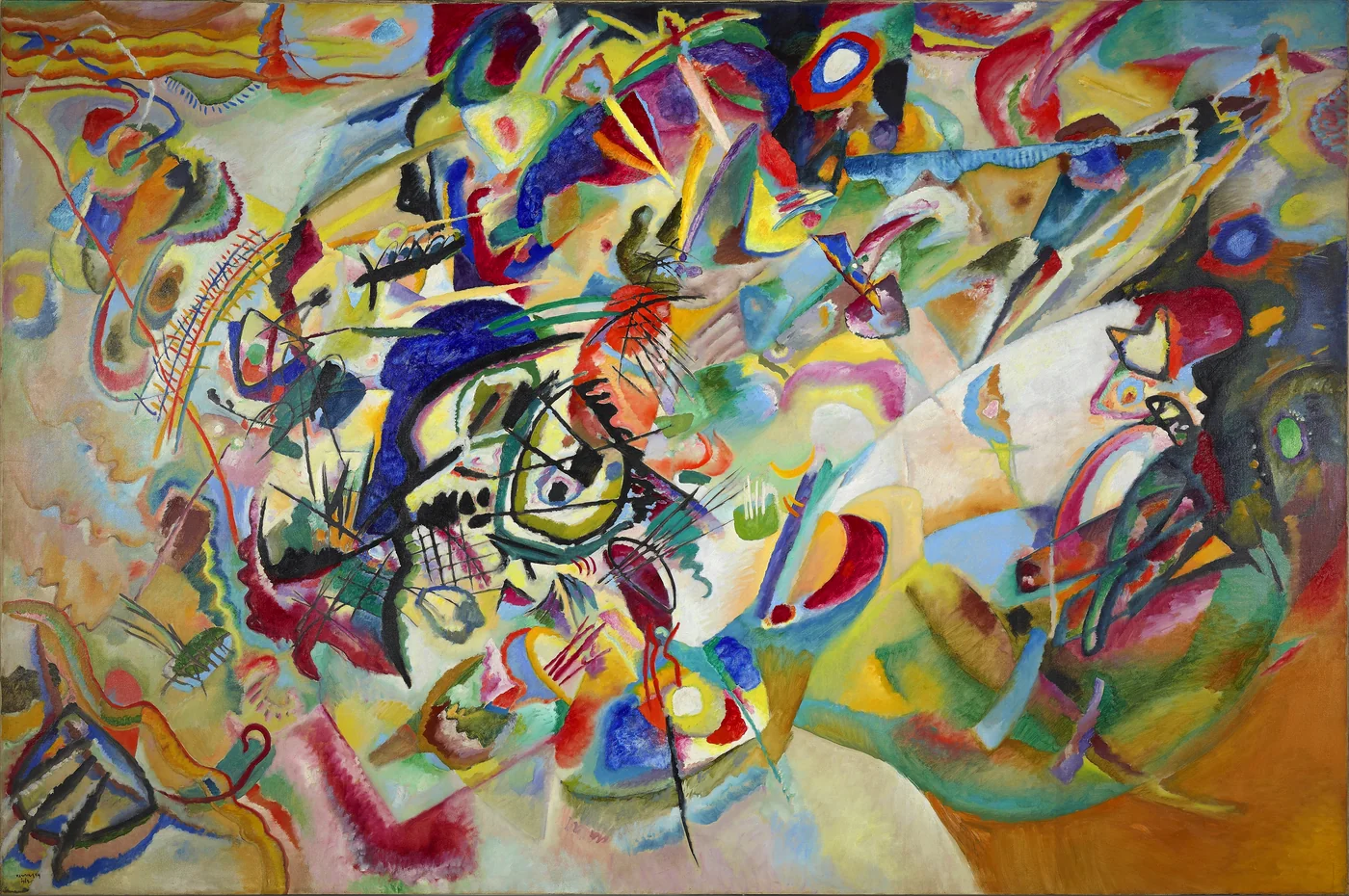
Begin near the pale central opening and follow the surrounding curves. Then seek a counter-movement that prevents the whole image from simply spinning. The Tretyakov's reading links its motifs to earlier works involving resurrection and judgement, rather than assigning each colour a separate symbol. Its preparatory studies are evidence of sustained construction behind the apparent rush. Tretyakov Gallery
5. Composition VIII, 1923
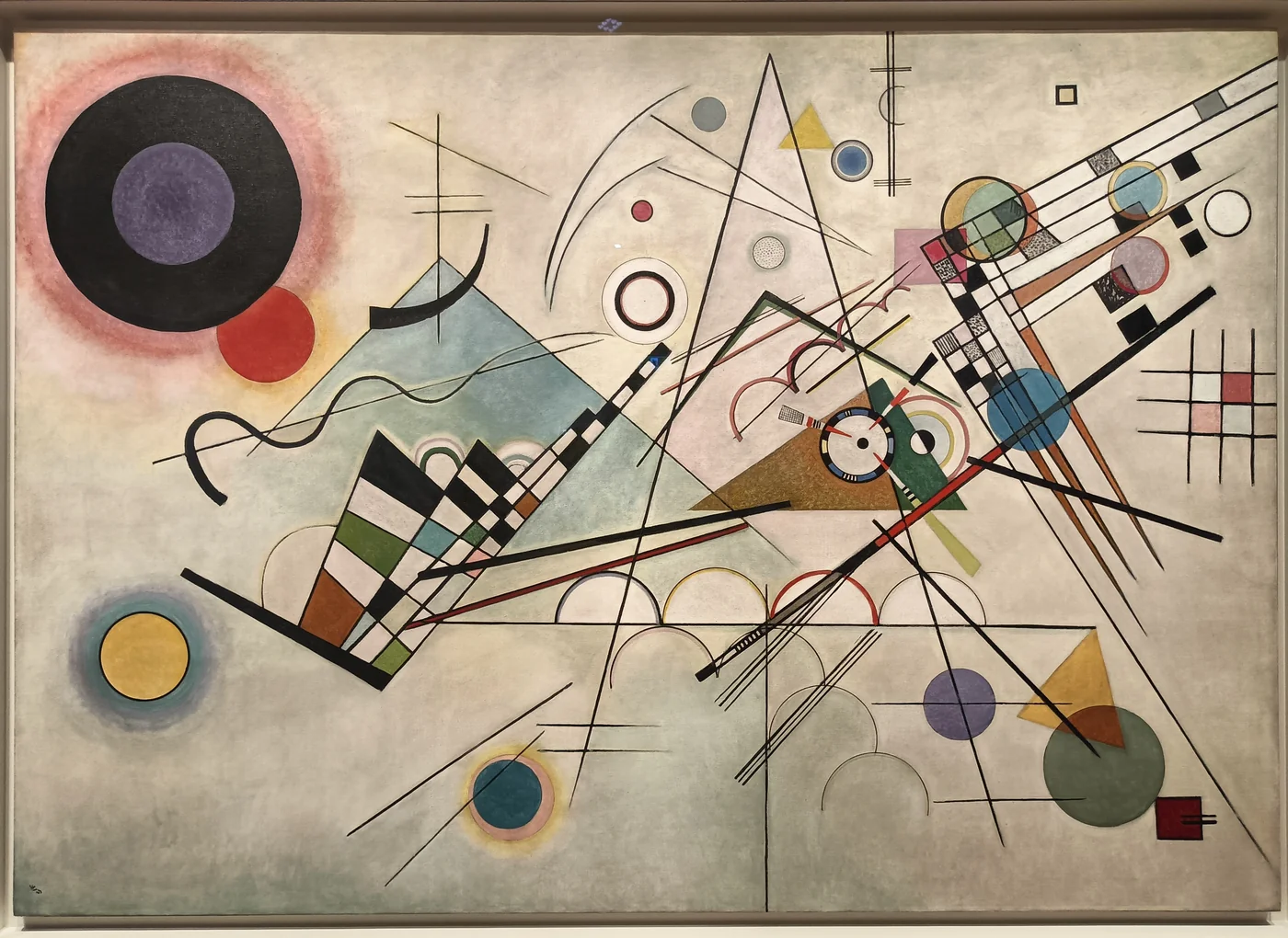
Compare its separate, sharp elements with the overlapping currents in VII. Let the large upper-left circle act as an anchor, then follow the fine diagonals across the open ground. Does their apparent precision make the image calm, or does it intensify the tension? The Guggenheim identifies its interacting circles, triangles and lines as central to this painting's construction. Guggenheim teaching guide
6. On White II, 1923
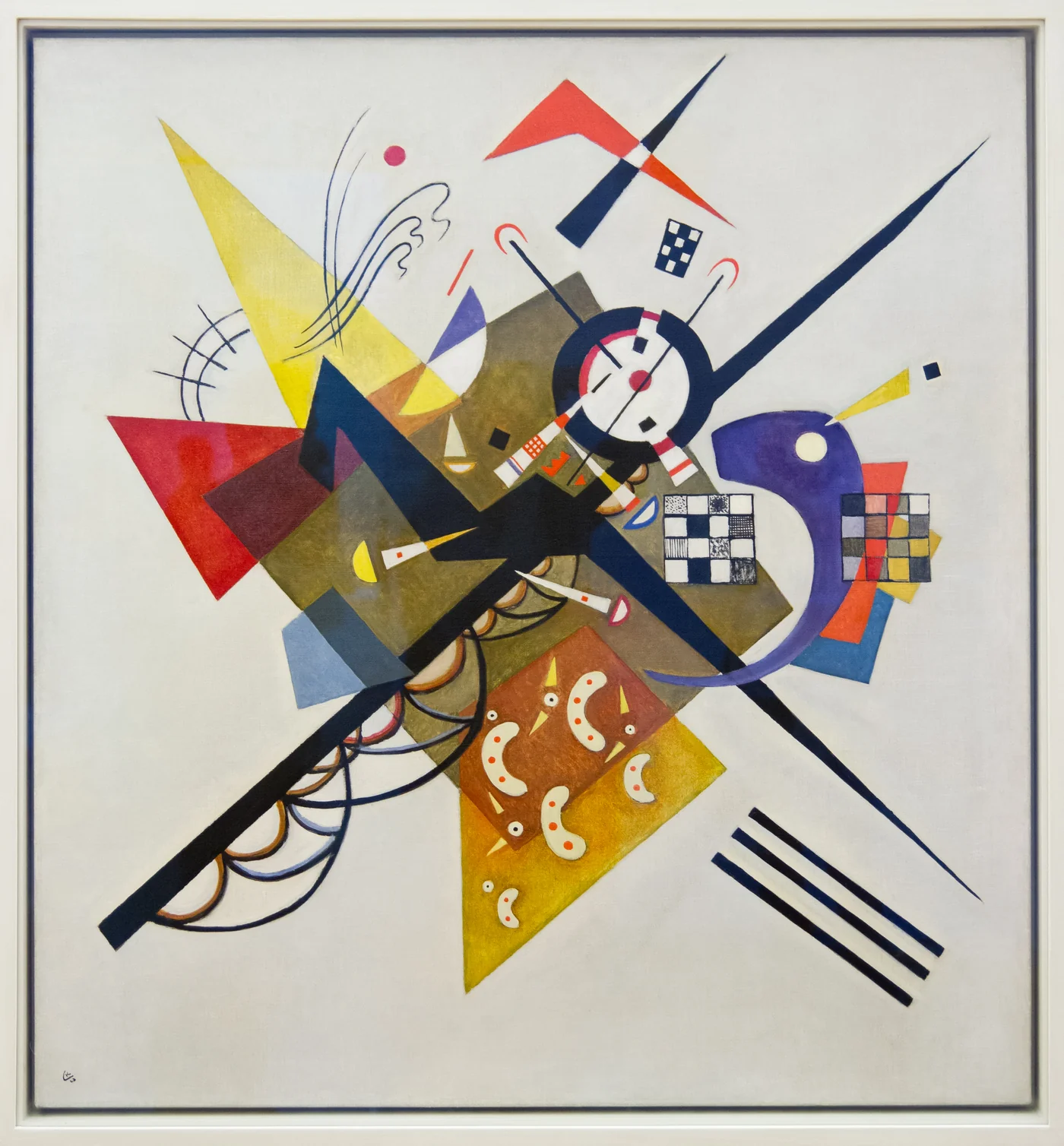
Look at how much of the surface stays open. Trace each long black diagonal through the busy centre and out towards an edge. The surrounding white can feel like an active interval, giving the crossing forms room to exert force. Test that reading by covering the margins. Avoid assigning a fixed moral meaning to black or white solely from their presence. Title, date and collection record

7. Yellow-Red-Blue, 1925
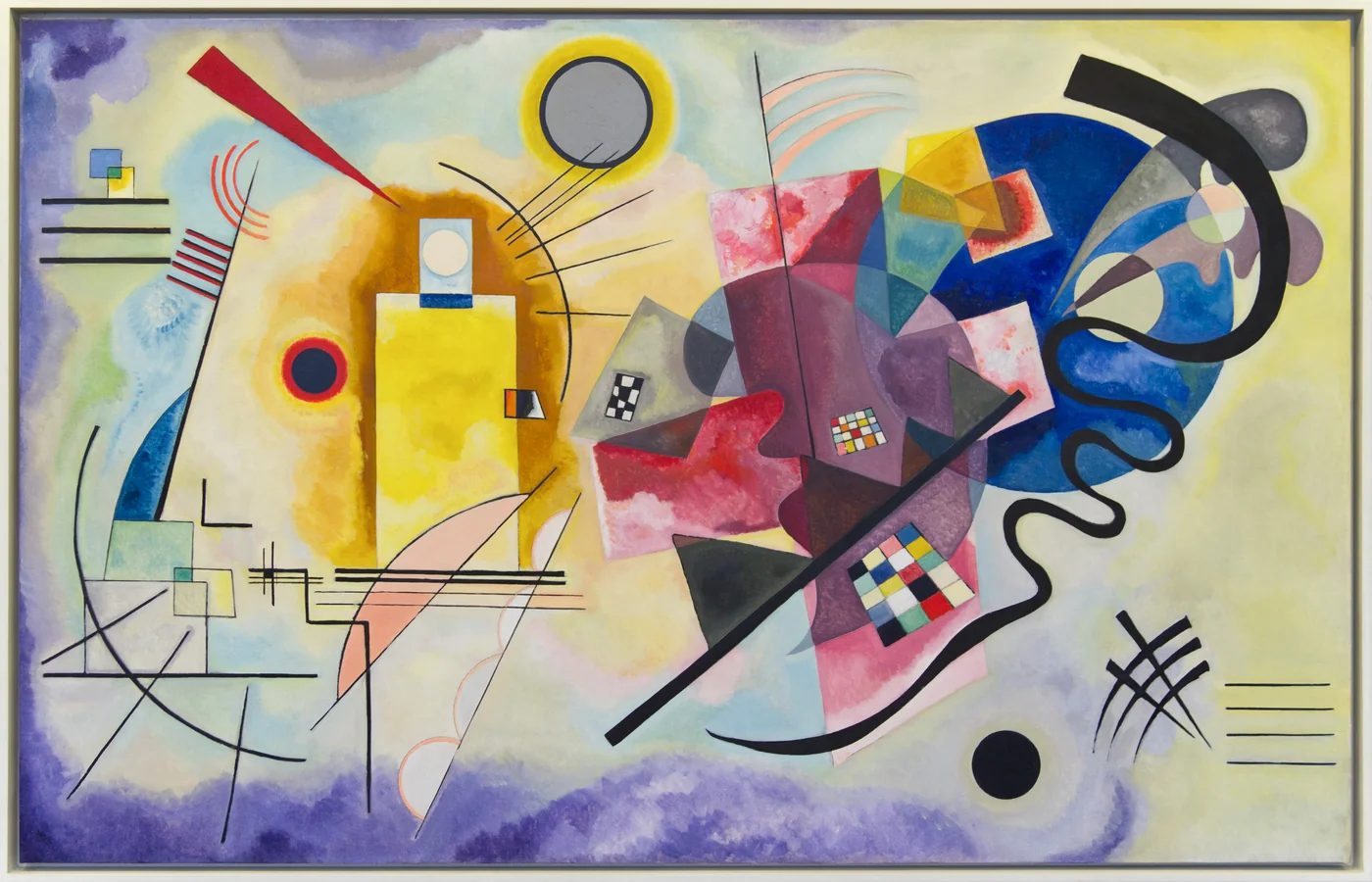
The Pompidou reads an equilibrium of opposing elements: luminous geometry on the left, darker and more complex forms on the right, with primary colours organising the passage across. Try that route, then follow the black curve instead. The second journey may connect areas that the first separated. This is a useful painting for testing a theory against an actual arrangement. Centre Pompidou
8. Several Circles, 1926
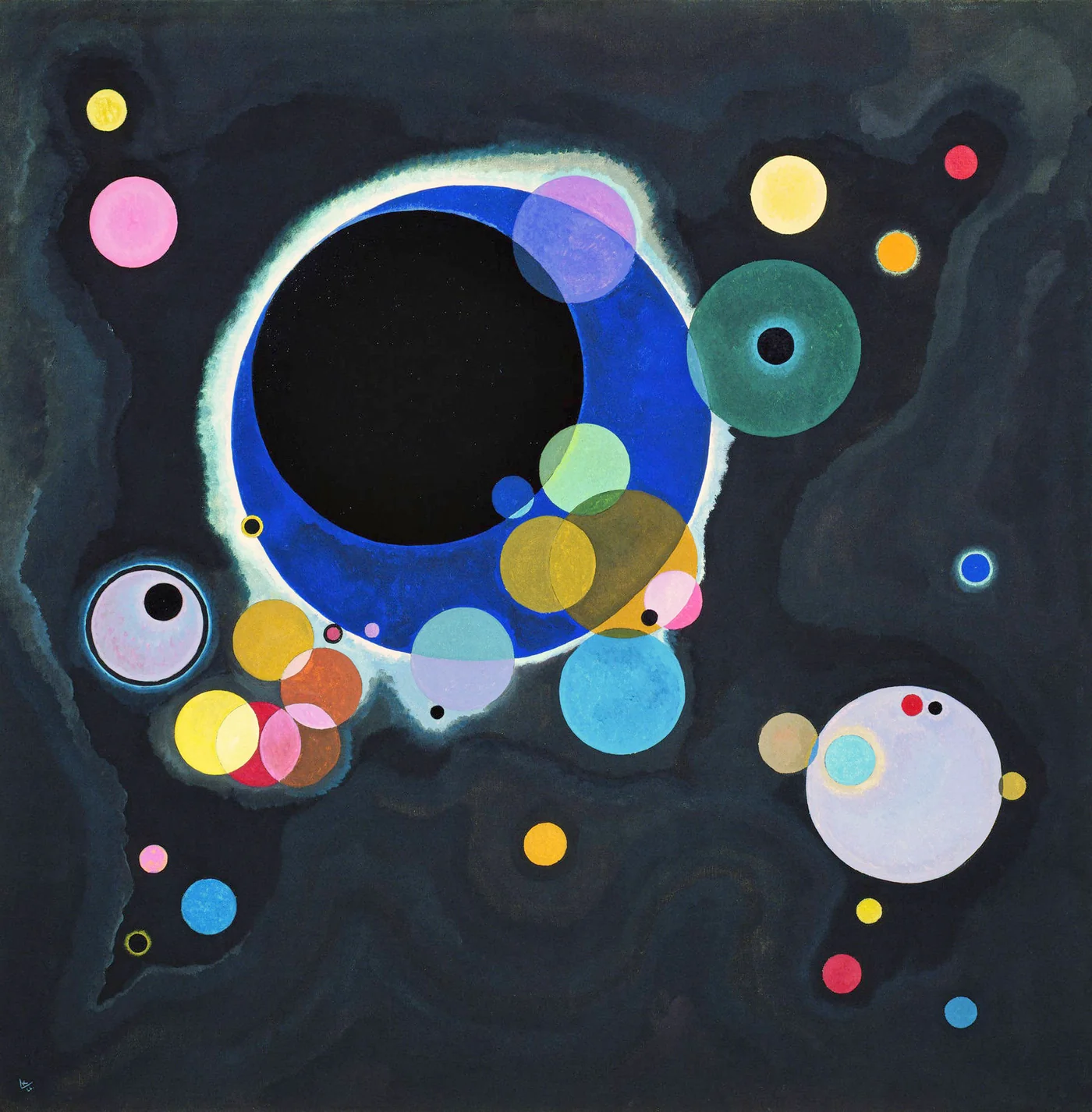
The Guggenheim describes layered transparency, varied surfaces and an atmosphere suggesting cosmic space. Look at an overlap, then at an isolated circle. Compare their apparent depths. A planetary association is available, but you can also read the picture as an experiment in adjacency: the same simple shape becomes different through size, position, colour and contact. Guggenheim exhibition text
9. Composition X, 1939
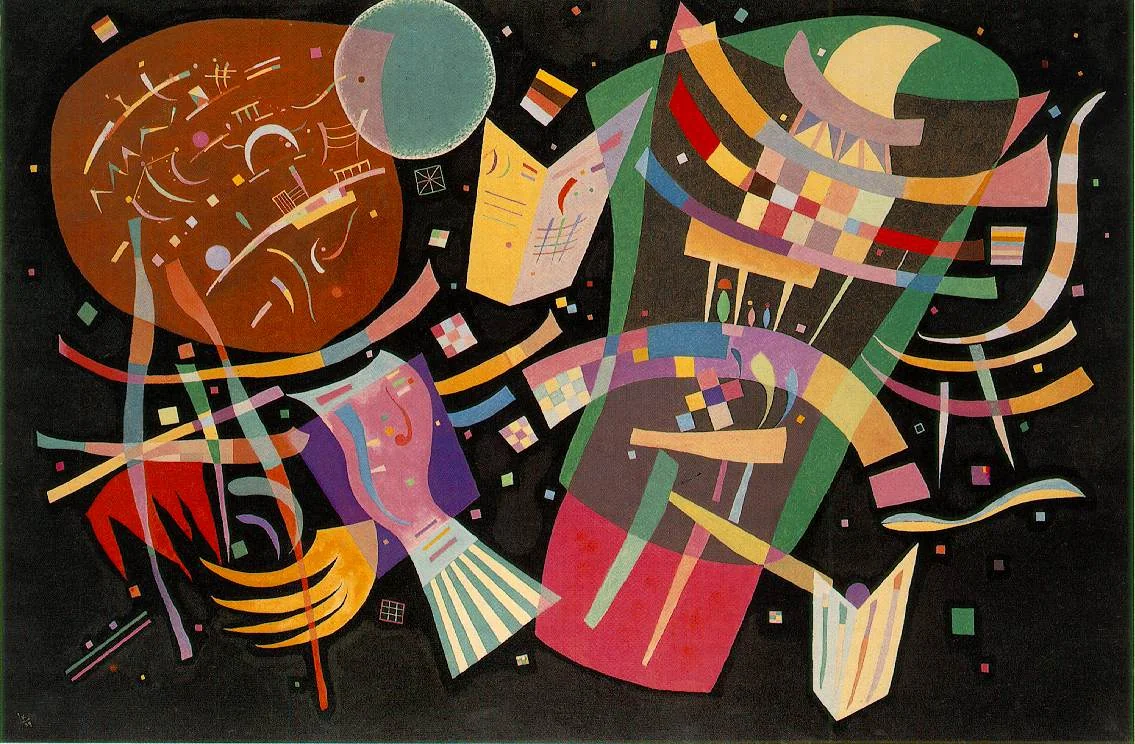
This late oil painting measures 130 by 195 cm in the owning museum's record. Compare its floating, irregular forms with the instruments of geometry in VIII. Let your eye travel between the large patterned bodies and the smaller marks. The dark ground leaves the forms suspended, so try reading the intervals between them as carefully as the forms themselves. Kunstsammlung Nordrhein-Westfalen
What connects Kandinsky to abstract expressionism and AI?
The historical bridge is not a claim that Pollock, Rothko and de Kooning all painted alike or simply followed Kandinsky. MoMA's catalogue Jackson Pollock: Drawing into Painting identifies Kandinsky's influence in opened space, scattered linear elements and bright colour. That is a specific formal connection, rather than a complete explanation of Pollock's development.
The Met distinguishes energetic gesture, including Pollock and de Kooning, from the large colour fields associated with Rothko and others. De Kooning moves between abstraction and figuration; Rothko seeks an enveloping, sometimes quasi-religious encounter through colour. These are different ways of asking how a painting can communicate beyond straightforward depiction. Stella Paul, The Metropolitan Museum of Art
Our comparison is this: Kandinsky makes the relationship between form and inward experience explicit; Pollock foregrounds an unfolding trace; Rothko concentrates the encounter into colour; de Kooning keeps bodily recognition under pressure. These are viewing connections, not evidence that Kandinsky directly caused every later choice.
There is also a concrete digital afterlife. Play a Kandinsky combines the work of sound artists Antoine Bertin and NSDOS with Google's Magenta machine-learning model to interpret Yellow-Red-Blue musically. Its authors describe sounds inspired by Kandinsky's writings. This is a new interpretation, not recovered audio from the painter's mind.
For AI-generated abstraction today, our proposal is to separate resemblance from intention. A prompt can ask for circles, diagonals, a pale ground and competing rhythms. Judging the result still means deciding what belongs, what distracts and what the work is trying to sustain. Use Kandinsky's question of necessity as an editing test: if an element has no job, remove it. A recognisable surface style is only the beginning of that judgement.
Questions people ask about Kandinsky
Why is Kandinsky important?
Kandinsky helped establish abstraction as both a practice and a subject of theory and teaching. His paintings and writings made relationships of colour and form central to expression, while his Bauhaus teaching gave those investigations an educational setting. His importance includes the argument around the work as well as the pictures. MoMA biography
Did Kandinsky invent abstract art?
Kandinsky is best described as a pioneer of modern abstraction, rather than its sole inventor. MoMA's Compositions exhibition places his work within the history of the move from figuration to abstraction. A claim that one person invented all abstract art would be much broader than that evidence. MoMA: Kandinsky, Compositions
What did Kandinsky mean by inner necessity?
Inner necessity is the inward demand for expression that should guide an artist's choice of form. Kandinsky connects personality, the artist's time and an enduring artistic purpose. It asks whether a choice serves expression, rather than whether it obeys an accepted convention. Concerning the Spiritual in Art, chapter VI
What do Kandinsky's colours and shapes mean?
His well-known pairings associate yellow with a triangle, red with a square and blue with a circle. They belong to his artistic theory, not a universally established code for human vision. A 2013 implicit association study did not support those combinations, so read each painting's relationships before applying a colour dictionary. Makin and Wuerger
Did Kandinsky hear colours?
Kandinsky's writings connect colour, form and sound, and contemporary projects describe these connections through synesthesia. That does not give us direct access to the quality of his private sensations. Google's Play a Kandinsky explicitly offers sounds inspired by the writings, which is how its reconstruction should be understood. Project explanation
How to paint like Kandinsky?
Try this exercise: choose a tension, such as agitation against calm, and limit yourself to three colours, two kinds of line and one repeated shape. Make three arrangements, changing the spacing before adding more marks. Compare them and remove any element that contributes nothing; this is our exercise inspired by his analytical approach, not a historical recipe. Point and Line to Plane
What is a useful Kandinsky style prompt for AI images?
Use a visual instruction rather than only an artist's name. Our example: “An abstract composition on a pale ground, a large off-centre blue circle, fine black diagonals, a few red and yellow shapes, irregular spacing, tension between quiet intervals and dense intersections, visible painted edges.” Generate variations, then judge the arrangement yourself; this proposed prompt is a starting exercise, not a claim of historical authenticity.
What is the difference between Composition VII and VIII?
Composition VII dates to 1913 and VIII to 1923. The earlier painting interweaves sweeping, overlapping colour; the later one separates circles, triangles and lines more sharply. Kaufman's exhibition review makes that change a central comparison, so use the pair to see the range within Kandinsky's abstraction. The Art Newspaper
Where can I see Kandinsky's paintings?
The works on this page belong to the Guggenheim in New York, the Lenbachhaus in Munich, the Tretyakov Gallery in Moscow, Centre Pompidou in Paris and Kunstsammlung Nordrhein-Westfalen in Düsseldorf. MoMA also has a Kandinsky collection. Check each museum's current display and loan information before travelling, since ownership does not guarantee that a particular painting is on view. MoMA; individual collection records above
Sources and image credits
Read for this page on 25 October 2026. The looking exercises and comparisons marked as ours are interpretations. Museum collection records supply work details; each painting caption links to its Commons file and rights statement; the header image is our own.
- Wassily Kandinsky, Concerning the Spiritual in Art, Michael Sadleir translation, Project Gutenberg.
- Point and Line to Plane, publication information and translated excerpts, Bauhaus Bookshelf.
- MoMA, German Expressionism: Kandinsky biography; artist and collection index.
- MoMA, Kandinsky: Compositions, 1995 exhibition.
- Guggenheim Bilbao, Composition 8 teaching guide, adapted from Nancy Spector.
- Guggenheim, Around the Circle, 2021 exhibition texts and checklist.
- Lenbachhaus, The Blue Rider; Impression III collection record.
- Bauhaus Kooperation, Kandinsky's teaching.
- State Tretyakov Gallery, Composition VII, Google Arts & Culture.
- Centre Pompidou, Yellow-Red-Blue; Kunstsammlung Nordrhein-Westfalen, Composition X.
- Jason Edward Kaufman, review of Kandinsky's Compositions, The Art Newspaper, 1 February 1995.
- Art Gallery of New South Wales, Kandinsky learning resource, 2023.
- Alexis D. J. Makin and Sophie M. Wuerger, The IAT shows no evidence for Kandinsky's color-shape associations, 2013.
- MoMA, Jackson Pollock: Drawing into Painting; Stella Paul, Abstract Expressionism, The Met, 2004.
- Google Arts & Culture and Centre Pompidou, Play a Kandinsky.
- Wikipedia, Wassily Kandinsky, biographical cross-check.