Thinkers / No. 009
Arthur Schopenhauer
Arthur Schopenhauer, the German philosopher who lived from 1788 to 1860, argues that art temporarily frees us from desire by turning attention from personal interests towards the forms of things in disinterested contemplation. The World as Will and Idea, Book III; Biography
That release belongs to a larger, pessimistic account of existence as restless striving. His reading of the Upanishads helped him describe the limits of individuality and the basis of compassion, but his philosophy is a European reconstruction, not a transparent summary of Indian thought. Here the texts, artistic consequences and critical reception are kept in view together. Stanford Encyclopedia of Philosophy
Look at something you do not need to acquire
Our exercise: spend a minute looking at a sculpture without evaluating its price, usefulness or place in a collection. Describe its weight, surface and relation to light. Then notice when attention shifts towards ownership, status or personal memory. The point is to recognise a change in the activity of looking, not to certify that you have become free of the will.
Schopenhauer's contrast is between knowing an object through its practical relations and attending to what it is. In ordinary cognition, we locate things in space, time and causal chains because they matter to our purposes. Aesthetic contemplation suspends that service to desire. In his vocabulary, the individual knower becomes a pure subject of knowledge and the object is apprehended as an Idea. The World as Will and Idea, sections 33 and 34
A short life and publication timeline
- 1788: Born on 22 February in Danzig, now Gdańsk. He later studies in Göttingen and Berlin. Biography
- 1813: Receives his doctorate from Jena for On the Fourfold Root of the Principle of Sufficient Reason. SEP, life and works
- 1813 to 1814: Encounters Indian thought through Friedrich Majer and the Latin Oupnek'hat. SEP
- 1818 and 1819: His principal book is published late in 1818 with an 1819 title-page date. SEP, aesthetics
- 1844: A second edition adds a substantial second volume of explanatory essays. SEP
- 1851 to 1853: Parerga and Paralipomena and John Oxenford's review contribute to late recognition. Reception history
- 1860: Dies in Frankfurt on 21 September. Biography
Representation, will and the limits of satisfaction
Why the world is representation
Schopenhauer begins from the world as known by a subject. Objects appear through space, time and causality; ordinary knowledge establishes relations among them. Representation does not mean that each person can invent whatever world they wish. It means that the world of objects, as experienced, is structured through the conditions of cognition. He develops this account through his engagement with Kant and the principle of sufficient reason. The World as Will and Idea, Book I
The body supplies a second route. I know an action outwardly as a bodily event, but also inwardly as willing. Schopenhauer treats these as two aspects of one occurrence, rather than an invisible decision pushing a separate machine. From this privileged case he extends will as an interpretation of the inner nature of the world. That extension is the decisive metaphysical move, and a place where a reader can question the argument. Book II, section 18
Will is not a cosmic person's intention
The will is blind striving, not rational providence or an individual faculty of making plans. It appears in natural forces, living growth and human desire at different grades of objectification. Particular organisms compete and suffer, but the will as such is not one more organism among them. Schopenhauer's account therefore joins a metaphysics of underlying unity to a harsh description of conflict in the phenomenal world. Book II, sections 21 to 29
Satisfaction relieves a lack but does not finish desire. New needs emerge, while the absence of pressing aims can produce boredom. This cycle explains his pessimism more precisely than a claim that people are sad all the time. The problem is the structure of striving itself: its success gives no final condition in which willing is permanently fulfilled. A pleasant event can be real while leaving that diagnosis untouched. Book IV, sections 56 to 58
What he found in the Upanishads
His important early source was Anquetil-Duperron's Latin Oupnek'hat, published in 1801 and 1802 from a Persian rendering associated with Dārā Shikōh's project. Schopenhauer did not begin with direct access to the Sanskrit originals. Persian and Latin mediation mattered, as did the Kantian categories through which he read the material. The historical question is consequently how he appropriated it, not whether his will is simply another name for Brahman. SEP, Indian sources; Upanishadic reception
In his principal book's preface, he presents knowledge of the Upanishads as excellent preparation for his argument. In Book III, he invokes tat tvam asi, “that art thou,” while discussing recognition of the same essence in other beings. The phrase becomes a bridge between aesthetic contemplation, metaphysical unity and ethics in his own system. Its function there must be distinguished from the specific teaching dialogue of the Chāndogya Upanishad. Preface and section 44; Advaita and Upanishadic interpretation
Compassion is more than a useful bargain
On the Basis of Morality distinguishes egoism, malice and compassion as fundamental motives. A genuinely moral act must take another's well-being as its end, rather than treat it as a means to the agent's reward. Compassion weakens the separation through which another being's suffering seems wholly external to oneself. His metaphysical explanation connects that experience to the underlying identity concealed by individuation. The Basis of Morality, Parts III and IV
The text explicitly invokes tat tvam asi as a formula for this higher understanding. It does not ask that every helpful action begin with a theoretical proof. Compassion is the operative motive; metaphysics tries to explain its possibility. This order matters when assessing the theory: rejecting his account of ultimate identity does not require denying that people can respond directly to someone else's pain. The Basis of Morality, metaphysical explanation
How art interrupts willing
The beautiful and the sublime
In beautiful contemplation, the object makes disinterested attention comparatively easy. In the sublime, something potentially hostile to the individual will is contemplated without surrendering to fear or practical anxiety. A vast landscape or powerful natural force can expose our bodily smallness while attention reaches beyond immediate self-preservation. Schopenhauer treats these as related modes of aesthetic knowledge, not merely two intensities of visual pleasure. Book III, section 39
The relief is temporary. An aesthetic interval does not permanently abolish the desiring individual, and it differs from compassion or ascetic denial of the will. Calling art a moment of release is therefore more exact than claiming that a beautiful picture cures existence. His account makes the pause valuable while acknowledging that practical life and its demands return. Book III, section 38; Book IV, section 68
Why sculpture belongs to a hierarchy
He ranks arts according to the grades of the will they disclose. Architecture makes gravity, rigidity and resistance perceptible; landscape gardening displays plant life; animal and human representation disclose more complex forms. Sculpture and painting of the human figure can reveal humanity and individual character. The hierarchy is his philosophical construction, not an established ranking of cultural worth. Book III, sections 43 to 48
Our application to a contemplative sculpture: let the viewer discover relationships before supplying an explanatory story. Weight resting on a narrow support, a restrained change of surface or the balance of a torso can sustain attention to form. A work does not need to depict a saint or carry an instruction to be contemplative. That is our proposed application; Schopenhauer's own detailed examples mostly belong to the arts available to his period.
Why music is exceptional
For the other arts, the Idea mediates between the individual work and will. Music has a different position: Schopenhauer argues that it expresses will directly, rather than copying Ideas or visible appearances. Melody's departure, tension and return can express the structure of striving without telling one person's story. This gives instrumental music remarkable philosophical importance in his system. Book III, section 52
He also admits a limit to proof. The relation he posits between music and the inner essence of reality cannot be demonstrated in the ordinary way, because that essence is not itself an object of representation. The listener is asked to test the explanation against musical experience and the wider system. Its influence on composers should not be mistaken for independent verification of its metaphysics. Section 52; SEP, music
What writers, composers and critics say
Richard Wagner's engagement was transformative but selective. Kevin C. Karnes traces how the composer used both operas and prose to extend and correct what he saw as shortcomings in Schopenhauer. Tristan und Isolde explores erotic love as a possible route through suffering, while Parsifal develops compassion. These are artistic revisions, not musical demonstrations of a philosopher's propositions. Karnes, Schopenhauer's Influence on Wagner
Friedrich Nietzsche first treated Schopenhauer as an exemplary educator, then challenged the interpretation of art as the quieting or denial of life. The early admiration and later opposition belong to different stages of Nietzsche's work. The SEP aesthetics entry quotes Nietzsche's description of Schopenhauer's later nineteenth-century “ascendency in Europe.” The words belong to Nietzsche, not to the encyclopedia's author. SEP, reception and Nietzsche
International literary reception includes Tolstoy in Russia, Proust in France, Thomas Hardy in Britain and Borges in Argentina. The same aesthetics entry also identifies composers Brahms, Mahler and Schönberg, and philosopher Susanne Langer, among the recipients of his thought. These connections establish a broad afterlife, but do not make their artistic aims uniform: a philosophy can supply an opponent, a technique of description or a problem as well as a conviction. SEP, influence and musical symbolism
Tolstoy's letter to Afanasy Fet of 30 August 1869 describes “Constant raptures over Schopenhauer.” The quotation is Tolstoy's response, not Schopenhauer's self-assessment. Scientific readers also included Einstein, who described his thoughts as a “continual consolation.” These testimonies document attraction across disciplines; they do not make a literary response or a physicist's admiration scientific evidence for the metaphysics of will. Reception, with the letter and Einstein references
One concise first-person judgement is Schopenhauer's claim, in the preface, that the Upanishads opened an exceptional resource for his century. That enthusiasm contrasts with the need to study his sources critically. His privileged access was to translations shaped by their own intellectual environments; his account of will and pessimism is not something every Upanishadic interpreter would recognise as the teaching of those texts. First-edition preface; SEP, sources and comparisons
His universal language of compassion must also be read beside the misogyny and prejudices in other writings. The contrast is substantive: a general claim about shared essence does not guarantee an equal assessment of actual people. A biography that records only the benevolent ideal would misrepresent the author, while a criticism should distinguish those prejudices from the argument that another's suffering can motivate action directly. Views on women and social prejudices; Compassion argument
Key works and five representations
The World as Will and Representation is also called The World as Will and Idea in the older Haldane and Kemp translation linked here. “Idea” in that title translates Vorstellung; the same English word can also appear for the Platonic Ideas discussed in Book III. A reader needs to distinguish the world as representation from the Ideas that aesthetic cognition is supposed to apprehend. Haldane and Kemp edition
For ethics, On the Basis of Morality gives the focused account of compassion. On the Freedom of the Will addresses freedom and character; the Fourfold Root explains the types of explanatory ground. The short essays in Parerga and Paralipomena are another entrance, but their accessibility should not hide the architecture of the larger system. IEP, works
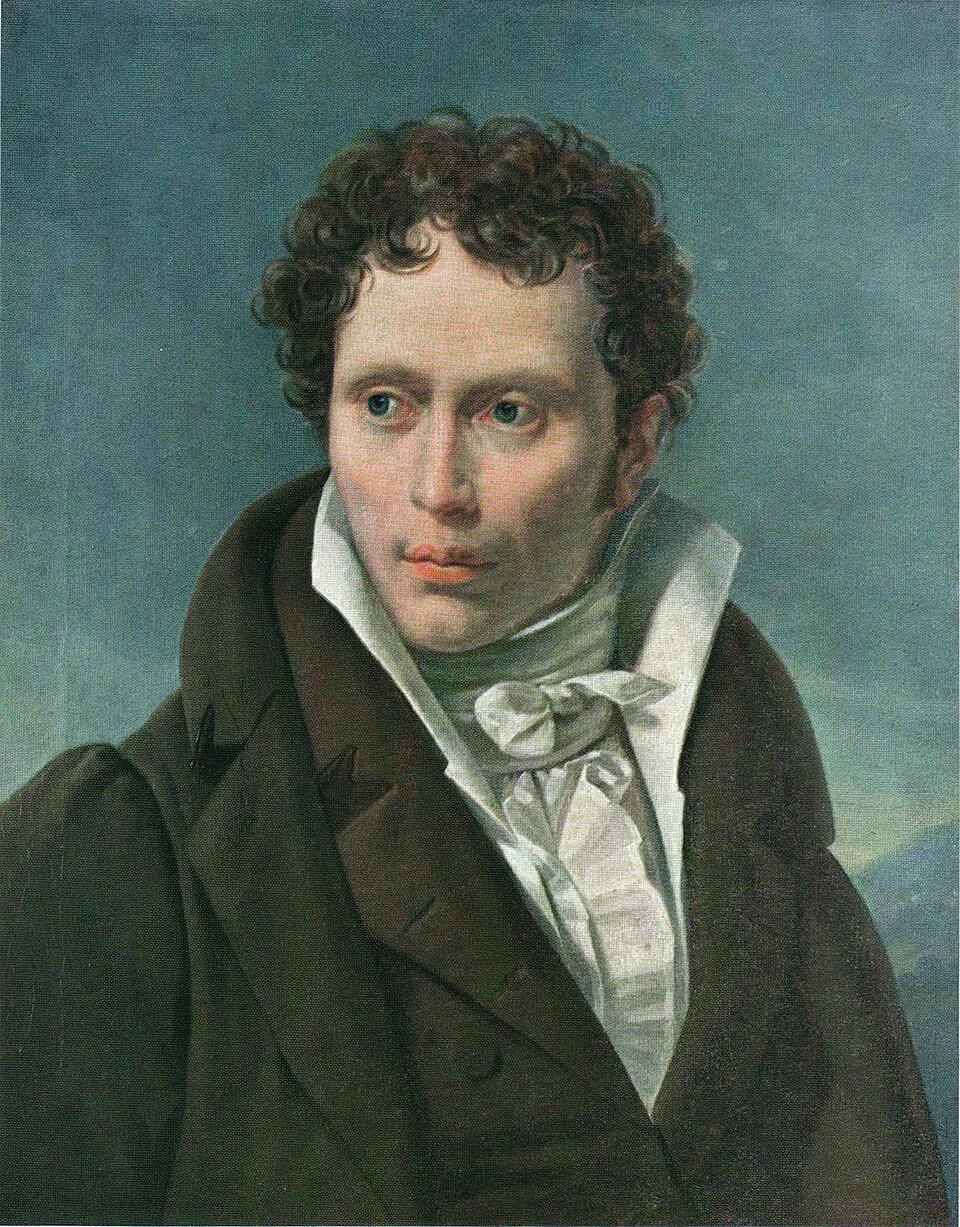
Ludwig Sigismund Ruhl, about 1815
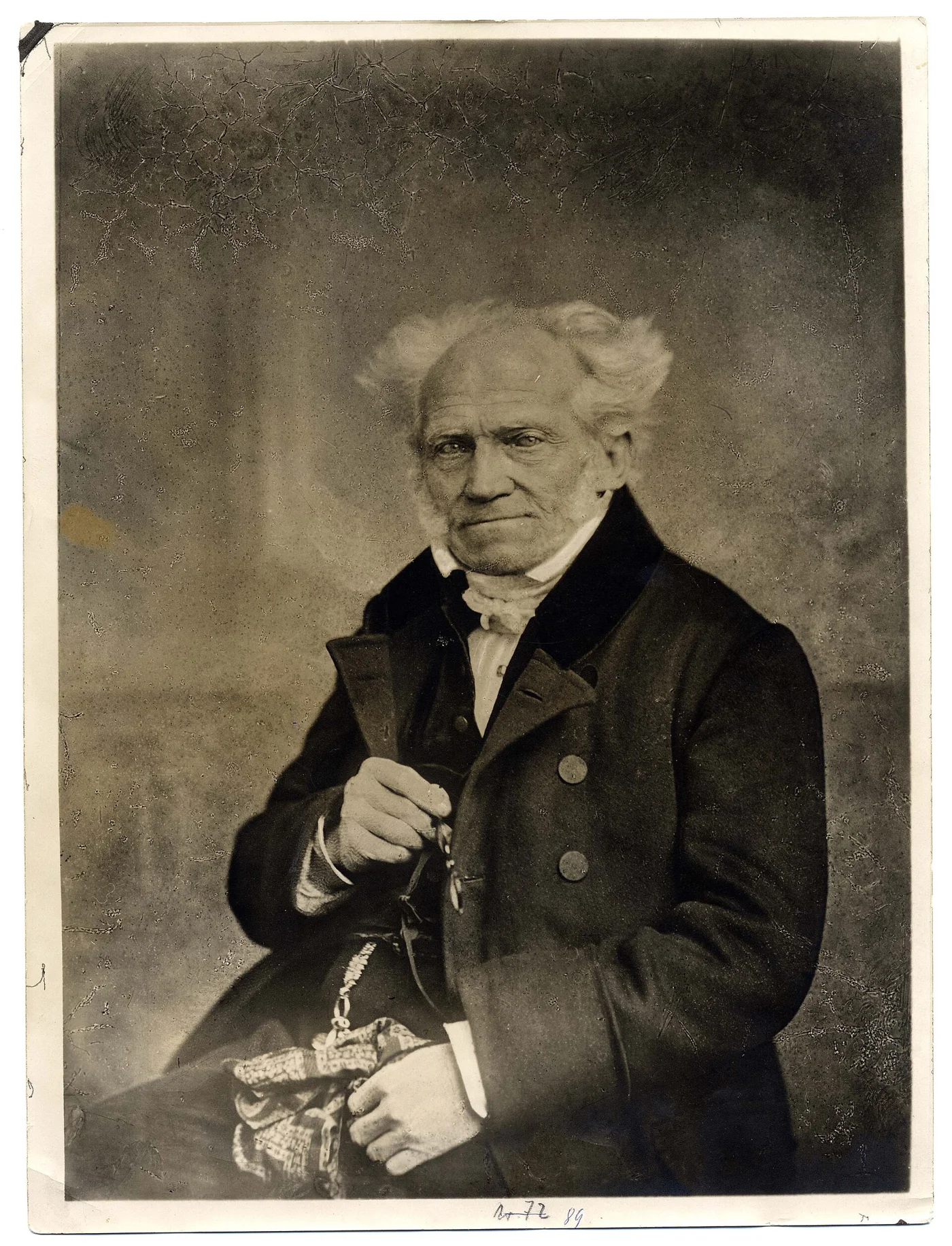
Johann Schäfer, March 1859
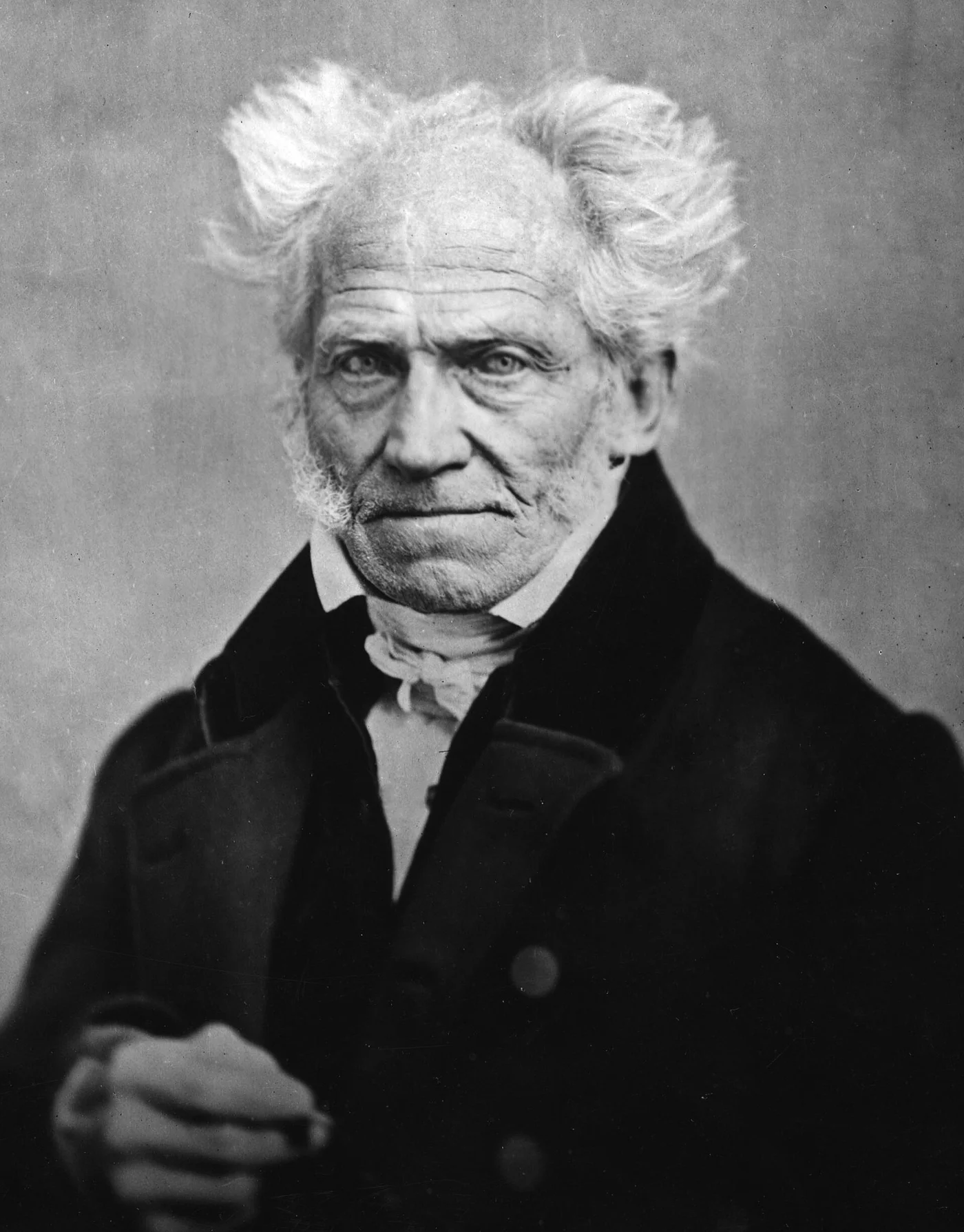
Johann Schäfer, second portrait, March 1859
Jules Lunteschütz, 1855
Félix Vallotton, 1896

What remains arguable today
His account of aesthetic release raises two separable questions. Can attention temporarily loosen its service to desire? And does that experience reveal a metaphysical Idea or the will itself? A reader might accept the first description without accepting the second explanation. Contemporary discussion of his aesthetics explicitly examines how insights about attention might be assessed independently of the full metaphysical system. SEP, scope and contemporary assessment
Compassion raises a parallel problem. Schopenhauer presents it as both an observable motive and a disclosure of shared essence. Moving from the experience of being touched by another's pain to a doctrine of one will requires an argument. His work remains valuable as a place to inspect that transition, rather than as an authority that automatically settles what a moving artwork or a generous action means. The Basis of Morality, Part IV
Questions people ask about Schopenhauer
How did the Upanishads influence Arthur Schopenhauer?
They gave him an admired account of ultimate unity and the limits of ordinary individuality. His main early access was the Latin Oupnek'hat, mediated through Persian, rather than the Sanskrit originals. He interpreted that material through his own Kantian and Platonic commitments, so his philosophy should be read as an appropriation rather than a direct exposition of the Upanishads. SEP, Indian sources
What did Tat Tvam Asi mean to Schopenhauer?
He used “that art thou” to express the identity beneath apparently separate beings. In his ethics, recognition of that identity helps explain why another's suffering can matter directly to us. His use makes the phrase serve a theory of will and compassion; it should not be treated as an exhaustive interpretation of its original Upanishadic context. The Basis of Morality, metaphysical explanation
Why does Schopenhauer connect compassion with unity?
Compassion weakens the boundary that makes another being's pain seem wholly unrelated to oneself. Schopenhauer explains this as an intuitive recognition of a common underlying essence, hidden by space, time and individuation. Compassion is the moral motive; his metaphysics provides a further explanation of why that motive can overcome egoism. The Basis of Morality, Parts III and IV
How does art free us from desire according to Schopenhauer?
Art can shift attention from what an object offers our private interests to disinterested contemplation of its Idea. For that interval, knowing ceases to serve willing and its restless demands. The release is temporary and differs from his accounts of compassion and ascetic denial. Music has an exceptional status because he takes it to express will directly. Book III, sections 34, 38 and 52
What makes a sculpture contemplative from Schopenhauer's perspective?
It would help attention rest on form rather than on acquisition, utility or private advantage. Our application is to examine balance, surface and the relations of weight and support before supplying a narrative. This is a present-day exercise inspired by his distinction between aesthetic and practical attention, not his prescription for a particular sculptural style. Book III, sections 33 to 38
Who was Schopenhauer, and when did he live?
Arthur Schopenhauer was a German philosopher born in Danzig on 22 February 1788 and deceased in Frankfurt on 21 September 1860. His principal work appeared in late 1818 with an 1819 title-page date, and his wider recognition came much later. His philosophy joins an account of representation to a metaphysics of will, ethics and aesthetics. Biography; Publication history
Which Schopenhauer book and translation should I read first?
For art, our suggested entrance is Book III of The World as Will and Representation, while checking its references to the preceding books. The public-domain Haldane and Kemp edition calls the work The World as Will and Idea. E. F. J. Payne and the Cambridge translators Judith Norman, Alistair Welchman and Christopher Janaway provide other English editions. For compassion, choose On the Basis of Morality. Editions and translations
Who was influenced by Schopenhauer's philosophy of art?
Wagner, Brahms, Mahler and Schönberg engaged with a philosophy that gave music exceptional significance. Literary reception includes Tolstoy, Proust, Hardy and Borges; Nietzsche moved from admiration towards strong criticism. Their responses are evidence of influence, not proof that each accepted Schopenhauer's pessimism or his metaphysical explanation of artistic experience. SEP, reception; Karnes on Wagner
Sources and image credits
Sources consulted on 26 October 2026. Each factual passage links to its evidence; looking exercises are marked as our interpretations. The captions link to the Commons file records and identify creators and rights. Images are local WebP conversions. Image provenance rechecked on 27 October 2026.
- The World as Will and Idea, sections 33 and 34
- Reception, with the letter and Einstein references
- Stanford Encyclopedia of Philosophy
- SEP, scope and contemporary assessment
- Advaita and Upanishadic interpretation
- The Basis of Morality, metaphysical explanation
- Karnes, Schopenhauer's Influence on Wagner
- IEP, works