Movements / No. 008
Suprematism
Suprematism is the movement developed by Kazimir Malevich that uses basic geometric forms and colour to make non-objective paintings, seeking expression through feeling rather than the depiction of recognisable things. Tate
Its public breakthrough came at the 0.10 exhibition in Petrograd in 1915. A square, circle or rectangle could now be the main event of a picture, rather than an ingredient in a landscape or portrait. This guide explains the works, the difference from Constructivism, its contested historical setting and what museum and market language can actually establish. Wikipedia, Suprematism
How do you recognise Suprematism?
Typical paintings place geometric forms against an open, often white field. Some use a single concentrated shape; others assemble bars, rectangles and circles in arrangements that suggest floating or rotation. Their space is not an ordinary room with a horizon and a measurable floor. The shapes organise a pictorial event without having to stand for objects in front of the painter. Tate
Do not equate geometry with a perfectly mechanical surface. MoMA's account of White on White stresses visible brushwork, different whites and the imprecision of the inner square. Our reading is that this material evidence keeps the painting in tension with its apparent simplicity: what looks like an easily repeatable diagram at small scale becomes a particular arrangement of painted edges and surfaces in person. MoMA, White on White
“Non-objective” is a useful distinction from abstraction that still transforms a recognisable subject. Malevich moved through Cubo-Futurist work before developing this position. That history explains why early Suprematist titles sometimes retain references to figures or dimensions, even when the visible forms no longer illustrate a person carrying a bag or a peasant woman. A title records an argument; it need not be a literal description. Wikipedia, Suprematism; MoMA, Suprematism
When and where did Suprematism develop?
- 1913: Malevich works on the Futurist opera Victory over the Sun, later important to his account of the square's origins. This is an antecedent, not the date of every surviving Black Square canvas. Wikipedia, Suprematism
- 1915: the 0.10 exhibition publicly presents his geometric paintings in Petrograd, the city now called St Petersburg. Black Square occupies a high corner associated with domestic religious icons. Tate; Wikipedia, Suprematism
- 1916–1918: coloured compositions develop increasingly complex relations; White on White, dated 1918, takes the experiment towards a near-monochrome surface. Christie's, 1916 composition; MoMA
- 1919 onwards: El Lissitzky's engagement with Malevich connects the ideas with Proun works, architecture and international exchanges. The Vitebsk teaching environment becomes an important collective setting. Wikipedia, Suprematism
- 1927: The Non-Objective World appears as a Bauhaus book, giving Malevich's ideas a new German-language publishing context. Wikipedia, Suprematism
- 1930s: the political space for the avant-garde contracts; Malevich returns to figurative painting before his death in 1935. Later figures cannot be understood simply as evidence that the geometric works never mattered to him. Tate
Introductory accounts use different starting dates because they refer to different events: the 1913 theatrical experiment, the emergence of the ideas, or the 1915 exhibition. Tate also uses St Petersburg for the exhibition's location. Keeping the event and the city's contemporary name together prevents a false choice between competing summaries. Tate; Wikipedia, Suprematism
What did “supremacy” mean?
Feeling instead of representation
The term refers to the priority Malevich assigned to artistic feeling, not to the political doctrine of racial supremacy. He wanted painting released from its obligation to describe things, illustrate history or serve an external subject. A shape could act through scale, colour and position. This does not make Suprematism an absence of meaning; it moves the proposed basis of meaning away from recognisable narrative. Wikipedia, Suprematism; Tate
White is often an active spatial proposition in this account. MoMA connects White on White with limitless space, floating and Malevich's interest in aviation. The off-centre square does not rest on a painted floor. Our interpretation is that the field suspends the usual question of where an object is located, making the relationship between form and surrounding space the thing to experience. MoMA, White on White
The square and the icon corner
The placement of Black Square at 0.10 mattered as much as the motif. Hanging high across a corner echoed the position occupied by a principal icon in Russian Orthodox homes. That display asserted a radical new artistic authority within a recognisable cultural setting. It does not require us to decide that the work is either a conventional religious image or a purely secular technical diagram. Wikipedia, Suprematism; Wikimedia Commons, 0.10 installation photograph

Malevich's theatrical work in 1913 supplied part of his retrospective origin story. The surviving 1915 Black Square and later versions belong to a sequence of objects, not one timeless symbol without dates. The distinctions matter for scholarship, museum labels and collecting: a repeated motif can preserve an idea while a later execution has a different exhibition history and physical identity. Wikipedia, Suprematism; Wikimedia Commons, later Black Circle

A collective field beyond Malevich
The Supremus circle involved figures including Olga Rozanova, Ivan Kliun, Ivan Puni, Liubov Popova, Nadezhda Udaltsova and Aleksandra Ekster. A planned journal gathered painting, literature, music and decorative-art discussions but did not reach publication. Treating Suprematism as a single man's finished invention obscures these exchanges and the different directions participants subsequently took. Wikipedia, Suprematism
Architecture and applied objects also entered its field. Nikolai Suetin and Ilya Chashnik worked with Suprematist motifs on porcelain; Lazar Khidekel explored architectural possibilities; El Lissitzky's Proun works connected painting and spatial construction. These developments complicate an absolute separation between autonomous painting and practical design, even though Malevich's theory placed feeling above utilitarian service. Wikipedia, Suprematism
Suprematism and Constructivism are different arguments
Both movements use abstraction, and artists moved between their networks, but their purposes diverged. Constructivism's productive and utilitarian orientation reconceived the artist as an organiser of material life. Malevich's position defended non-objective art from having to justify itself by the usefulness of a manufactured object. Shared diagonals therefore do not establish shared beliefs about what art should do. Wikipedia, Suprematism
El Lissitzky makes the boundary particularly interesting. His engagement with Malevich helped carry the ideas westwards, but the Proun works also developed problems beyond Malevich's original painted vocabulary. Our reading is that influence becomes clearest when we identify both a debt and a change of purpose. Calling every geometric experiment “Suprematist” removes the very differences that made these exchanges historically consequential. Wikipedia, Suprematism
Which works should you know?
The selection separates the first public presentation, key painted motifs and later versions. Details come from the linked object documentation; current display must be checked separately. In particular, the 1924 circle and cross below should not be labelled surviving canvases from the 1915 exhibition simply because their motifs originated around that earlier moment. Wikimedia Commons, Black Circle documentation; Wikimedia Commons, Black Cross documentation

Black Square, 1915
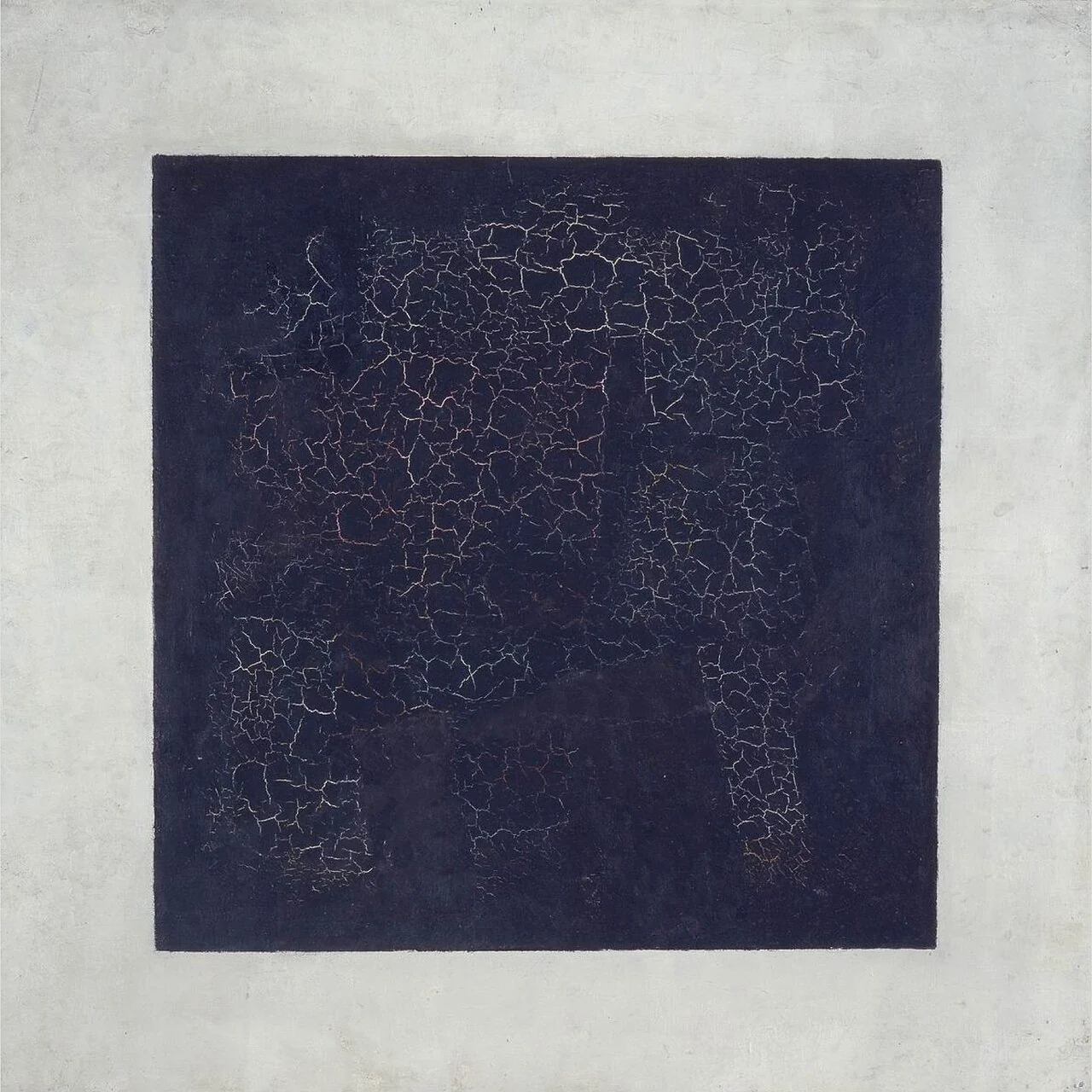
The Tretyakov Gallery in Moscow owns this first painted version. A dark quadrilateral occupies most of a light field; the visible ageing of its surface is part of the surviving object. Our reading is that the small remaining margin makes the relation between shape and support unusually insistent. The work's importance includes its exhibition placement and subsequent repetitions, not just the number of geometric elements present. Wikimedia Commons, Tretyakov Black Square; Wikipedia, Suprematism

Red Square, 1915
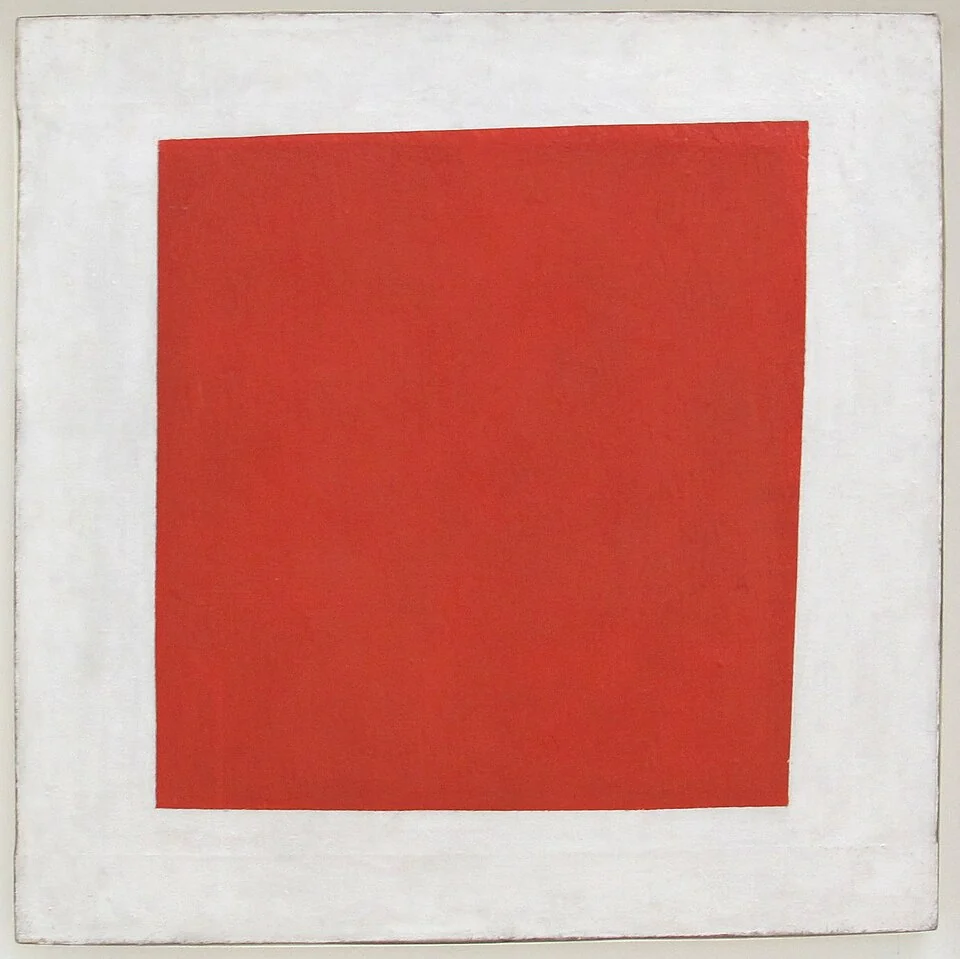
The Russian Museum in St Petersburg owns this work, also known through its longer title referring to a peasant woman in two dimensions. Its red form departs from the mathematically perfect square a digital thumbnail might lead us to expect. Our interpretation is that the discrepancy matters: the painting operates through painted relations and directional pressure, not through the demonstration of a geometry textbook's definition. Wikimedia Commons, Red Square documentation

Suprematist Painting: Eight Red Rectangles, 1915
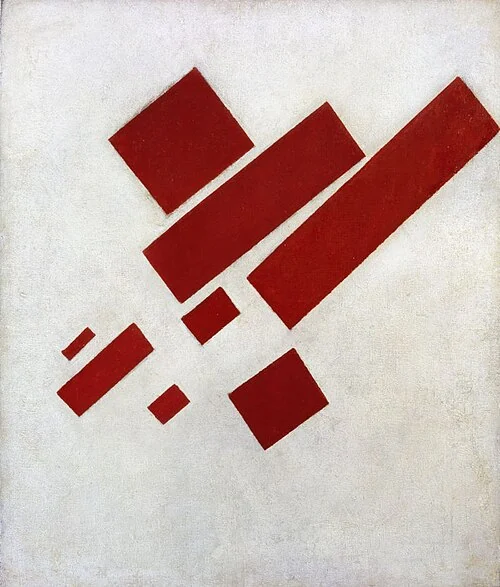
The Stedelijk Museum in Amsterdam holds this early composition, documented among works shown at 0.10. Separate red rectangles vary in size and direction across a pale field. Our reading is that repetition produces differences rather than a regular pattern: a change of angle or spacing alters the apparent relations among forms without requiring an identifiable story about what they represent. Wikimedia Commons, Stedelijk painting

Supremus No. 55, 1916
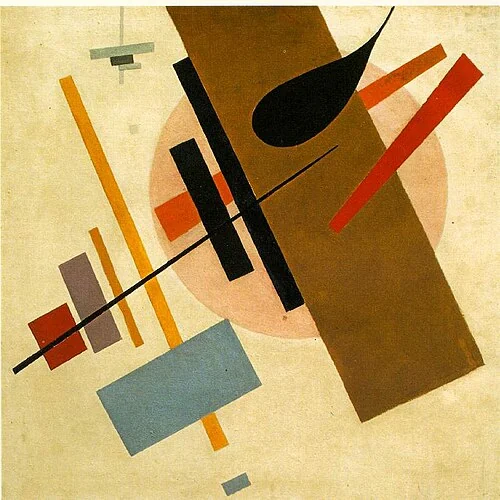
This Krasnodar museum painting extends the vocabulary into a multi-coloured arrangement on a square support. The documented date distinguishes it from both the first 1915 presentation and the later white paintings. Our reading emphasises how circles, bars and differently weighted areas establish several competing directions, giving geometric abstraction a dynamic register rather than simply making it more austere. Wikimedia Commons, Supremus No. 55

Suprematist Composition: White on White, 1918
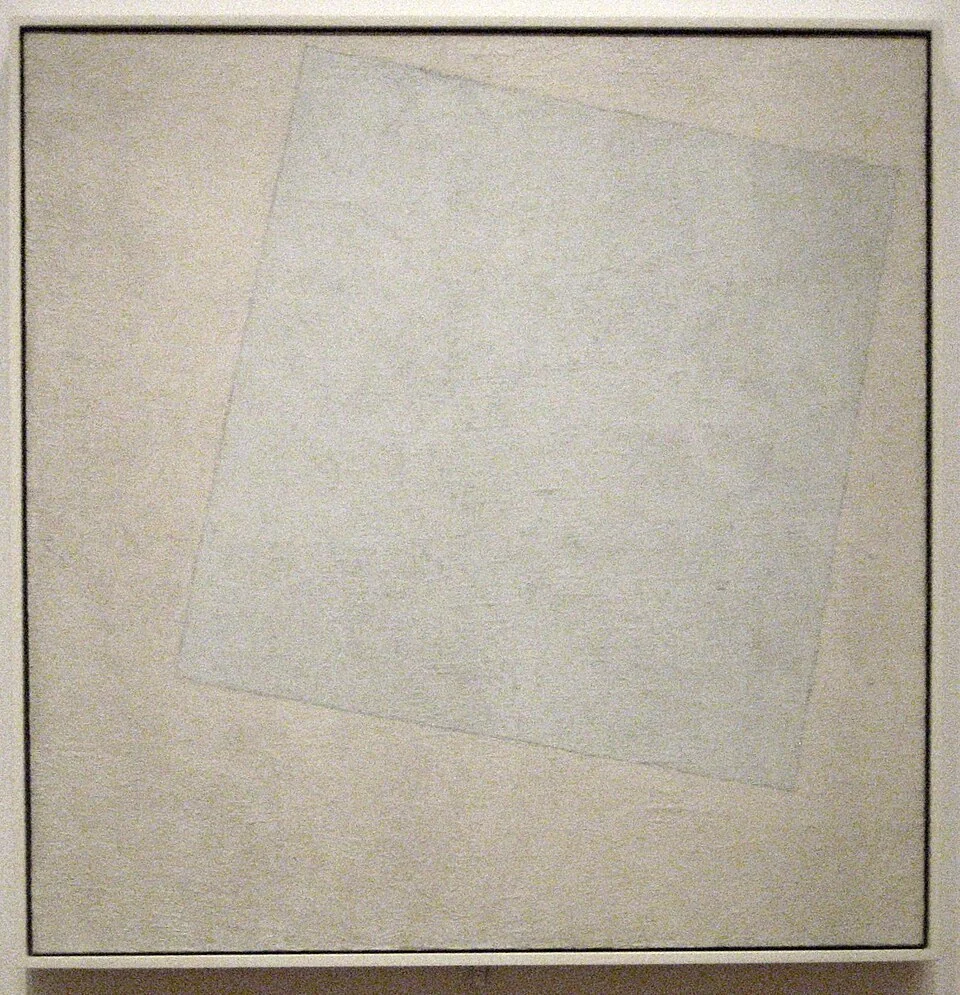
MoMA in New York owns this oil painting. Its inner quadrilateral tilts within a warmer surrounding white; brushwork prevents the apparent near-erasure of colour from becoming the absence of a material surface. The museum treats it as a radical reinvention of painting with aesthetic and social implications after the Revolution. Those implications are an interpretation of its historical setting, not a narrative literally depicted on the canvas. MoMA, White on White
Black Circle, motif 1915, painted 1924
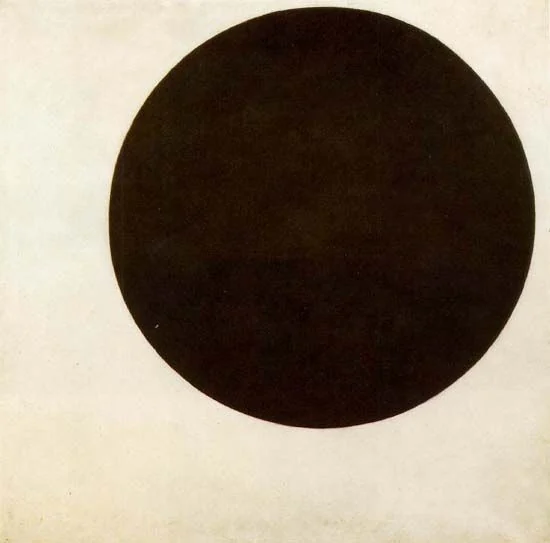
This Russian Museum version revisits the circular form in a later painting. The distinction between motif and execution prevents a common caption error. Our reading compares the circle's relation to the surrounding square support with Black Square's near-occupation of its field: one shape turns attention towards the interval around it, while the other seems to compress that interval. Wikimedia Commons, Black Circle
Black Cross, motif 1915, painted 1924
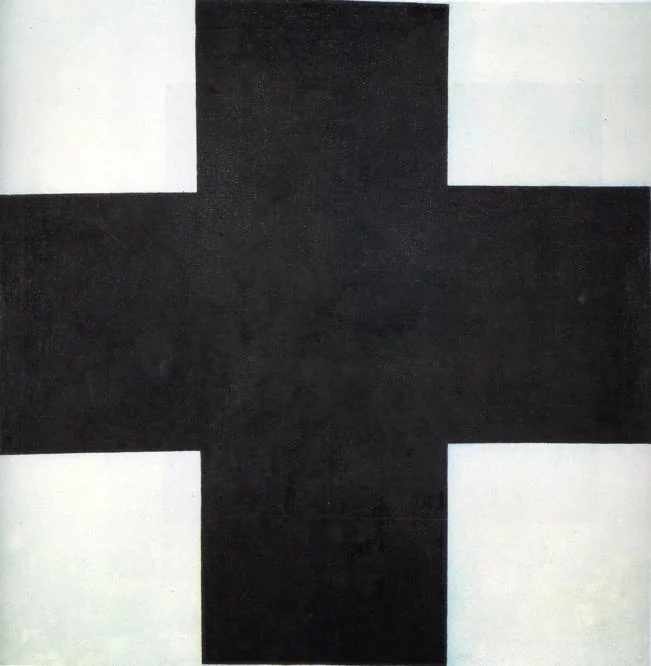
Also documented in the Russian Museum, this later execution shows how a small vocabulary can generate different spatial problems. The cross stretches towards the edges while retaining the white corners. Our interpretation is that its outward reach reverses the circle's self-containment. The comparison concerns visible form; it does not assign a universal religious meaning to every occurrence of a cross. Wikimedia Commons, Black Cross
The 0.10 installation photograph, 1915
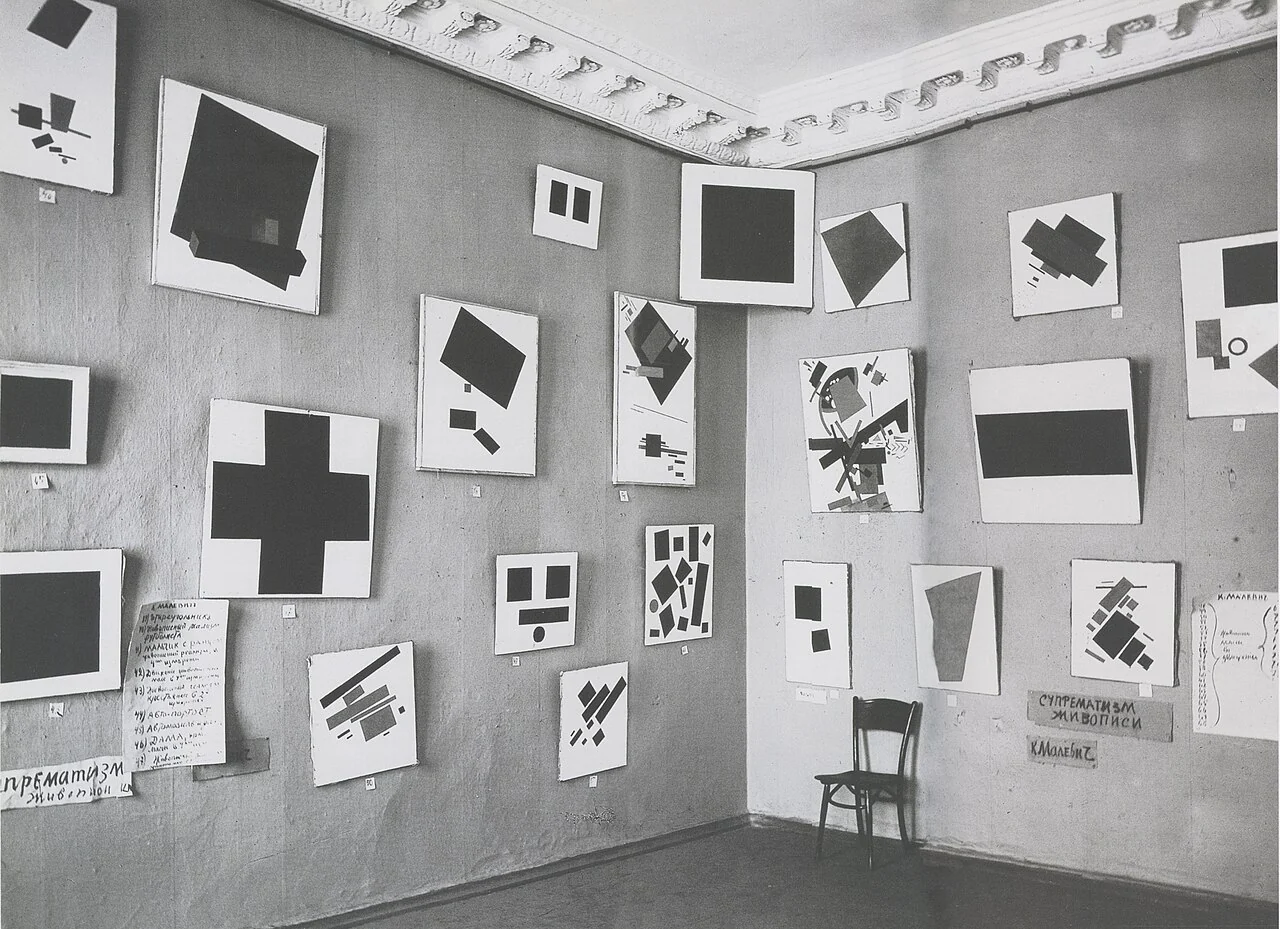
The photograph records a crowded presentation rather than today's familiar isolated masterpiece on a museum wall. Black Square appears high in the corner among other canvases. This evidence restores exhibition-making to the history: the movement was announced through the relations between several objects, their hanging and the viewer's position, not through one icon detached from its original public encounter. Wikimedia Commons, historical installation photograph
What do museums, galleries and auction houses say?
Britain's Tate frames Suprematism through its elementary shapes, colour in space and foundational role in modernism. New York's MoMA draws attention to the human hand within a seemingly impersonal geometry. Its description of White on White as possessing a “breathing quality” is a concise corrective to the assumption that non-objective means emotionally neutral. These readings differ in emphasis without requiring mutually exclusive definitions. Tate; MoMA
London's Annely Juda Fine Art presented Malevich with François Morellet in 2011. Its announcement, preserved by Artmap, described Morellet's neon responses to the circle, square and cross and included Malevich drawings and a museum loan from Thessaloniki. The exhibition made reception into an explicit dialogue between generations. A later artist's adaptation is evidence of engagement, not proof that the original theory and the new work mean the same thing. Annely Juda Fine Art, exhibition announcement via Artmap
The auction language can be more emphatic. Christie's described the 1916 Suprematist Composition as a major example of Malevich's early geometry and linked it to his ideas of higher-dimensional consciousness. On 15 May 2018 in New York it realised $85,812,500, a world auction record for the artist at that sale. The result concerns one rare, identified painting; it cannot price an anonymous geometric composition or guarantee the next sale. Christie's, May 2018 sale report
Our practical collecting distinction is between historical identity and visual resemblance. Read the artist, date, medium, catalogue reference, provenance and exhibition record before comparing prices. The captions above already demonstrate why: motifs recur in later versions, and similar general titles can describe different works. A record result belongs to a documented object, while a poster reproducing its shapes belongs to an entirely different category. Wikimedia Commons, version documentation; Christie's, identified sale object
What survived beyond the first paintings?
Suprematism crossed borders through exhibitions, Lissitzky's exchanges and publication. The 1927 Bauhaus book places Malevich within the same publishing environment as other investigations of modern form, while applied work and architectural experiments reveal the theory's productive contradictions. The subsequent imposition of Socialist Realism curtailed its institutional opportunities; its later international significance should not be mistaken for uninterrupted official support in the Soviet Union. Wikipedia, Suprematism; Tate
Our comparison with De Stijl is deliberately limited: both make geometric relations central, but Mondrian's horizontal and vertical equilibrium is different from Malevich's floating fields and defence of pure feeling. Nor is every later monochrome a delayed Suprematist painting. The most illuminating legacy is a set of questions about what painting needs to retain once representation is no longer its primary obligation. Tate, De Stijl; Tate, Suprematism
Artists
Malevich, Rozanova, Kliun, Puni, Popova and Lissitzky belong to this movement's core historical discussion. For comparison, our guides to Piet Mondrian and Wassily Kandinsky trace other routes into abstraction. They are comparisons, not a list of Suprematist members. Wikipedia, Suprematism
Questions people ask about Suprematism
What is Suprematism in simple words?
Suprematism is art built from basic geometric forms and colour without depicting recognisable objects. Malevich wanted feeling and perception to take priority over representation. White space and floating shapes are characteristic. Tate
When and where did it begin?
Its public breakthrough was the 0.10 exhibition in Petrograd in 1915. Malevich traced parts of its development to his 1913 theatrical work. The different dates describe different stages, rather than proving that every Black Square was painted in 1913. Wikipedia, Suprematism
Who were the main Suprematist artists?
Kazimir Malevich was the central theorist. The wider circle included Olga Rozanova, Ivan Kliun, Ivan Puni, Liubov Popova, Nadezhda Udaltsova and Aleksandra Ekster. El Lissitzky became an important interpreter and international bridge. Wikipedia, Suprematism
How is it different from Constructivism?
Suprematism gave priority to non-objective feeling, while Constructivism increasingly connected art with material production and social use. Artists and forms overlapped, but their purposes differed. Geometry alone cannot identify which argument a work makes. Wikipedia, Suprematism
Why is Black Square important?
It made a non-objective geometric form the focus of painting and occupied the icon corner at the 1915 exhibition. Its importance includes that public presentation and the theory around it. The Tretyakov Gallery owns the first painted version. Wikipedia, Suprematism
Is White on White just a blank canvas?
No. It contains a tilted white quadrilateral on a slightly warmer white field, with visible texture and brushwork. MoMA interprets the arrangement through movement, limitless space and the material presence of paint. MoMA, White on White
Where can I see the key works?
Black Square is in the Tretyakov Gallery, White on White at MoMA, Eight Red Rectangles at the Stedelijk, and the circle, cross and Red Square examples here in the Russian Museum. Ownership does not guarantee current display; consult the collection and visitor information before travelling. Works and collection sources
What is the auction record and what can collectors compare?
Christie's New York reported $85,812,500 for the 1916 Suprematist Composition on 15 May 2018, an artist record then. It is a historical sale result, not a price for the movement as a whole. Compare documented objects of the same artist, medium and period rather than shapes alone. Christie's
Sources and image credits
Sources opened and compared on 26 October 2026. Core comparisons: Wikipedia, Suprematism; Tate; MoMA, White on White; Christie's, May 2018 sale report. The account adds object-specific documentation, international reception and dated market evidence. Passages identified as our readings are interpretations.
Each figure links to the Commons file page whose rights statement was checked. Public-domain reproductions are shown at reduced size; the separately licensed Red Square photograph retains its attribution and licence. Low-resolution documentary images retain their native display width.
- Tate
- Wikipedia, Suprematism
- MoMA, White on White
- MoMA, Suprematism
- Christie's, 1916 composition
- Wikimedia Commons, 0.10 installation photograph
- Wikimedia Commons, later Black Circle
- Wikimedia Commons, Black Cross documentation
- Wikimedia Commons, public domain
- Wikimedia Commons, photograph by Sailko
- CC BY-SA 3.0
- Wikimedia Commons, public domain
- Wikimedia Commons, public domain
- Wikimedia Commons, public domain
- Annely Juda Fine Art, exhibition announcement via Artmap
- Tate, De Stijl
