Thinkers / No. 005
Ashtavakra Gita: what is its central teaching?
The Ashtavakra Gita, a Sanskrit dialogue attributed to the sage Ashtavakra and King Janaka, teaches that freedom is recognising oneself as unattached, nondual awareness rather than as the body, mind or doer of actions. Lala Baijnath's public-domain translation, opening instruction
The historical author and date are uncertain. The legendary sage, the literary speaker and the person who composed the surviving poem need not be the same individual. Read the text as a carefully voiced exchange: Janaka asks, responds with astonishment and is challenged again, rather than merely receiving a collection of inspirational statements. Baijnath's introduction and dialogue
Read the change of speaker
Our reading exercise: mark every change between Ashtavakra and Janaka in the opening chapters. Beside each statement, write whether it asks a question, gives instruction, announces understanding or tests that announcement. This exposes the difference between a teacher describing awareness and a student claiming to recognise it. It also stops a sentence spoken by Janaka from being automatically quoted as Ashtavakra's own speech. John Richards translation, chapters I–III
The opening question concerns knowledge, liberation and detachment. The answer begins with conduct before making its radical claim about identity: the aspirant should avoid attachment to sense objects and cultivate qualities rendered in translations as forgiveness or tolerance, sincerity, compassion, contentment and truthfulness. A summary that says the text contains no ethical language misses its second verse. Ashtavakra Gita I.1–2; Baijnath, opening instruction.
Legend and textual history
- The epic sage: the Mahabharata tells of Ashtavakra, whose name refers to eight bends, debating Vandin at Janaka's court. The account of a curse and bodily difference is a literary narrative, not a medical history or an independently dated biography of the Gita's author. Baijnath's discussion of the epic narrative.
- An uncertain composition date: Radhakamal Mukerjee proposed roughly 500–400 BCE; J. L. Brockington placed the work much later, in the eighth or fourteenth century CE. These divergent estimates are attributed positions, not the endpoints of a securely established lifespan. Dating discussion and references.
- Early nineteenth century: an anonymous Company School painter depicts the legendary Ashtavakra. The British Museum work, reproduced below, belongs to the sage's artistic reception, not to the text's composition history. Commons work record.
- Early twentieth century: Lala Baijnath translates the work into English; the opened Internet Archive copy is catalogued as 1904, while bibliographies also list a 1907 edition. Edition metadata should not be used to determine the age of the Sanskrit poem. Archive metadata; Translation bibliography.
- 1929–1931 and after: Nityaswarupananda's translation first appears serially and becomes an influential edition with Sanskrit, word meanings and commentary. Later English renderings include Thomas Byrom and John Richards. Translator's preface; Later editions.
- 1968: Thomas Merton records reading Hari Prasad Shastri's translation. His journal offers a dated instance of the text being received by a writer outside its Indian philosophical setting. Thomas Merton Center, 18 April 1968.

Awareness, freedom and action
The witness and what it witnesses
The first chapter distinguishes the self from earth, water, fire, air and space, then from caste, stage of life and bodily appearance. Its speaker identifies the self with awareness witnessing these conditions. This is a philosophical claim about what someone essentially is; it does not say that bodies have no characteristics or that social identities have never had practical consequences. Gita I.3–7
The same chapter attacks the identification of oneself as a doer. Actions and their results belong to the body-mind complex, while the self is presented as unattached. This sharply separates the poem's liberating address from an ordinary programme of improving a personality. In the poem's own framework, the problem is mistaking a role within experience for the awareness in which the role appears. Baijnath translation, first chapter
Freedom is recognition rather than manufacture
The text repeatedly states that the self is already free. Seeking to produce freedom as a new condition can therefore perpetuate the assumption of being a bound individual. In chapter VIII, desire, grief, grasping, rejection and the sense of a separate I describe bondage; their absence describes freedom. The argument is about identification and attachment, not a guarantee that repeating an assertion instantly resolves every human difficulty. Gita I.11–15 and VIII
This creates a deliberate tension in the teaching. One passage recommends resting in awareness, while another warns that the effort to still the mind can itself become a bond. The difference concerns whether a means is being used to recognise what the text regards as present, or whether someone assumes the self can be manufactured through effort. Reading these sentences together is more informative than collecting only the most effortless-sounding line. Gita I.4 and I.15
Why the poem keeps returning to water, cloth and space
Janaka's second-chapter response compares waves, foam and bubbles with water, cloth with threads, and sugar with the sweetness of its source. Each image connects a distinguishable manifestation with what makes it possible. Their task is not identical: threads analyse composition, waves show form within a continuous medium, and sweetness indicates a quality pervading a product. The accumulation makes one claim accessible through several relations. Gita II.4–6
The mirror and jar-space images likewise distinguish awareness from the forms appearing within or apparently delimiting it. A reflection does not alter the mirror's basic status, and the jar's outline does not produce the space it seems to contain. The poem uses these images to assert the self's independence from bodily attributes, while its ocean imagery gives appearances movement without making them a second ultimate substance. Gita I.19–20 and VII
The rope mistaken for a snake provides the model of error and correction. Recognition changes what is taken to be present; it does not require killing a real snake. In the text's nondual account, self-knowledge removes a mistaken world of independent separations. Accepting the physical example does not automatically require accepting the full metaphysical extension: the analogy is the poem's argument, not an experiment proving it. Baijnath translation, opening chapters
The student's declaration is tested
After Janaka announces understanding, Ashtavakra questions whether attachment to wealth, sensual desire, praise, blame and fear can remain compatible with that announcement. The dialogue consequently distinguishes verbal enthusiasm from the dispositions that would follow recognition. Chapter III is especially useful against readings that treat the poem as unconditional approval of whatever an individual happens to want. Gita III
The long eighteenth chapter develops portraits of freedom through contrasts with the seeker, the agitated mind and the person chasing conditions. Action can continue without being treated as an ego's route to completion. Its descriptions of ease, lack of possessiveness and independence from praise belong to the poem's picture of a knower, not to a historical diary documenting what every liberated person has actually done. Gita XVIII
What remains when the distinctions have done their work?
The closing chapters let Janaka question the final status of bondage, liberation, teacher, disciple, knowledge and object of knowledge. The method eventually withdraws the distinctions it initially used. That gives the ending its spare force: freedom is no longer another possession acquired by the character who began the conversation. It also explains why the text cannot be reduced to a checklist of behaviours that mechanically produces its promised recognition. Baijnath translation, closing dialogue
What people say: different routes through the poem
Indian translator Nityaswarupananda calls it “not a philosophical treatise in the technical sense.” In the introduction excerpt reproduced by Vedanta Hub, he contrasts intellectual conviction with direct realisation and stresses preparation and guidance. This is his interpretation of the work's purpose. It should not be presented as evidence that the poem has no argument or that its metaphysical claims are beyond critical examination. Nityaswarupananda's attributed introduction
The same page quotes Shantananda Puri describing a radically immediate approach without prerequisites or prescribed practices. Juxtaposing these two interpreters exposes a real reception dispute: does the poem address an already prepared reader, or is its instruction sufficient without such preparation? The opening ethical verse and the later criticism of effort are relevant evidence for assessing both positions. The site's inclusion of their views is descriptive, not an affiliation or recommendation to join either organisation. Puri and Nityaswarupananda excerpts; Gita I.
In the United States, the writer and monk Thomas Merton read the poem in Shastri's English translation. On 18 April 1968, he described it as “very much what I have been needing.” This is Merton's response, recorded in his journal and indexed by the Thomas Merton Center. It establishes a particular encounter with the work, rather than permission to assign every sentence of his later writing to Ashtavakra's influence. Merton Center, journal reference
French reception includes Alexandra David-Néel's Sanskrit-to-French translation, listed as Astavakra Gîtâ in 1951. English literary reception includes Thomas Byrom's The Heart of Awareness. The editors of Realization.org particularly admire the lightness and immediacy of Byrom's rendering, explicitly presenting that response as their opinion. These are documented translations and reader responses; they do not resolve the scholarly dispute over how late the original poem is. Translation bibliography; Realization.org, editorial reception.
Scott R. Stroud's 2004 article is explicitly titled Narrative as Argument in Indian Philosophy: The Astavakra Gita as Multivalent Narrative. Its bibliographic record offers an academic counterweight to the assumption that a dialogue conveying recognition is philosophically inert. Our reading of the opening speaker changes follows that general question of how narrative can do argumentative work; it is not offered as a detailed summary of Stroud's paywalled analysis. Stroud, journal record
Nandini Sahu, a professor of English at IGNOU in New Delhi, brings disability representation into the discussion. Her 2024 article asks how ability, bodily difference and identity are constructed through the narrative and its philosophical language. This opens a critical question that a purely metaphysical summary can overlook: what happens to the significance of an embodied character when a teaching declares the self independent of bodily form? Her reading is a contemporary scholarly approach, not proof of the anonymous composer's original intention. Sahu, The Grammar of the Disabled-Able Agency Construing Hindu Studies
The sharpest historical disagreement concerns date and authorship. Mukerjee's early dating and Brockington's much later proposals imply very different relations to classical Advaita. Baijnath's own introduction already cautions that the Janaka of this poem cannot confidently be identified with every famous Janaka elsewhere. A shared sage or royal name is not enough to collapse different literary settings into one datable event. Dating positions; Baijnath, introduction.
The text, its structure and a first translation
The work is also called Ashtavakra Samhita. Common modern editions have twenty chapters, moving from instruction and Janaka's recognition through detachment and the character of freedom to the closing withdrawal of distinctions. The long eighteenth chapter dominates the latter part. Chapter headings are editorial aids and vary across translations; they are not a substitute for checking who speaks in the verses. Richards text and chapter structure
The opened Baijnath edition has an additional chapter headed as a list of contents. Its introduction and closing enumeration do not simply reproduce the modern twenty-chapter arrangement, and its OCR contains conspicuous errors. This is why verse numbers and wording should be checked within a named edition. Our conceptual references use the common modern chapter arrangement unless the citation explicitly points to Baijnath's introduction or translated passage. Baijnath, final contents chapter and errata
For a free historical primary translation, start with Baijnath and consult the scanned edition where OCR is unclear. For Sanskrit with word meanings and explanatory comments, Nityaswarupananda is our suggested comparison. For a literary first encounter, Byrom's The Heart of Awareness offers a different reading experience. These are recommendations by this page, based on the editions' documented formats, not a claim that one English rendering is the definitive Sanskrit original. Baijnath archive record; Nityaswarupananda preface and edition; Byrom edition and editorial response.
Do not confuse this dialogue with the Bhagavad Gita. The Ashtavakra text stages Janaka's inquiry into identity and freedom, rather than Krishna's instruction to Arjuna within the Mahabharata's battlefield narrative. Its compressed treatment of nonduality has a different dramatic situation and emphasis. The shared word gita, song, does not establish a common author, date or programme of duties. Text overview and comparison
Ashtavakra, beauty and silence
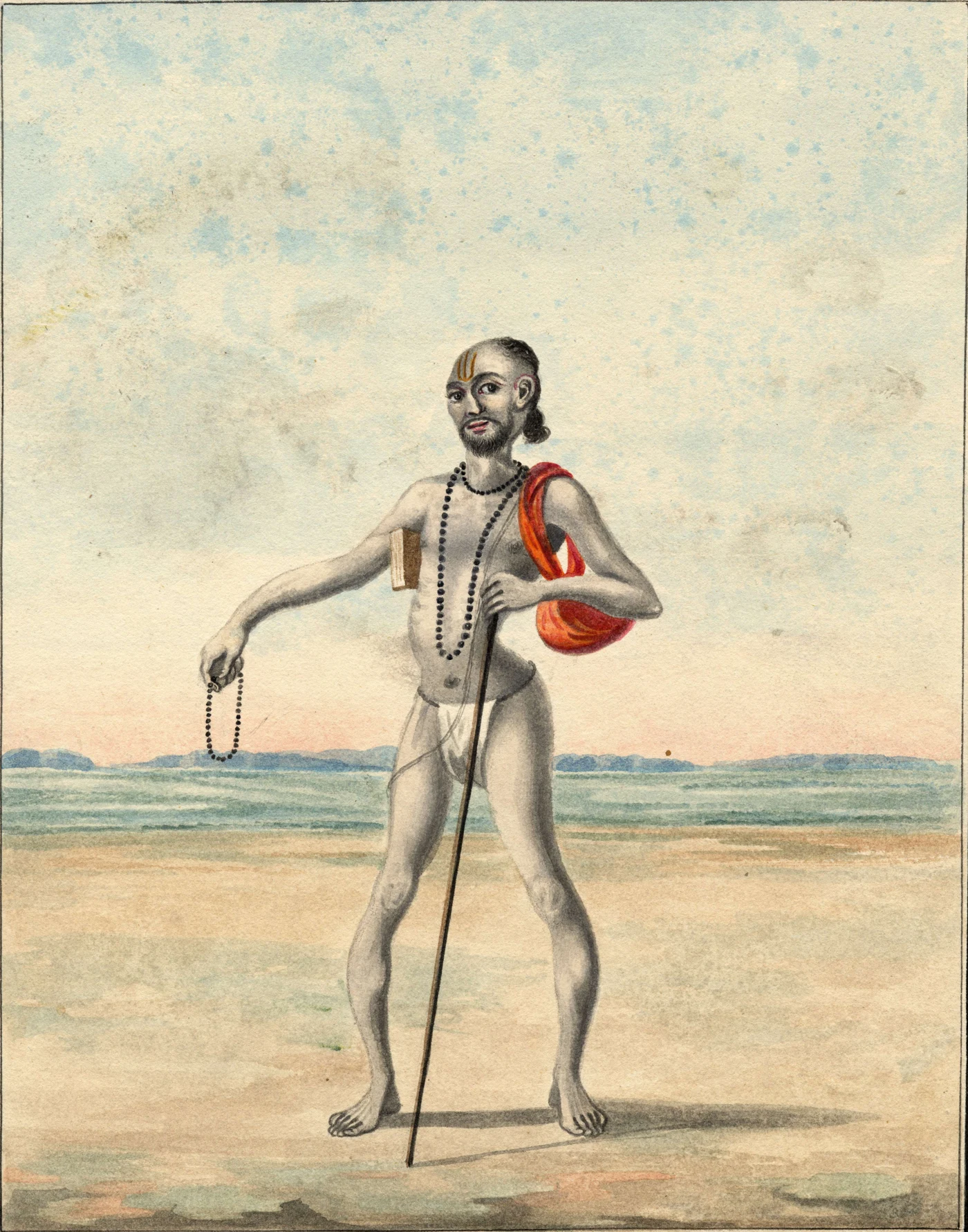
The watercolour gives a concrete artistic reception of the bodily difference central to the legend. The figure's bent limbs, staff and beads make him recognisable through iconography. The painting does not depict the appearance of the Gita's recoverable historical author, because such an identity has not been established. It is evidence of how the sage was imagined and represented much later. Commons, description, author and date
The poem's own relevant concern is the distinction between visible form and awareness. In the third chapter, the self is described in terms of purity and beauty, while the speaker challenges continued fixation on sensual objects. This is not a developed theory of painting or musical composition. Merton's reading and the French and English translations provide documented links to writers; a specific lineage of abstract artists influenced by the poem is not established here. Gita III.4; Merton's reception.
Our interpretation of the poem's silence would be a sculpture with a continuous surface and a few interruptions that gradually lose their dominance as someone walks around it. The aim would be to make attention to a whole outlast the demand to identify separate features. This proposed visual exercise draws on the ocean and space images; it is not the sage's documented artistic prescription, and physical quiet alone does not represent the text's understanding of freedom. Gita I.19–20, VII and XX
Why its directness keeps provoking readers
The work's afterlife includes Ramakrishna, Vivekananda and Ramana Maharshi, alongside later commentators and translators. These are distinct readers with different settings and methods. Its compressed voice makes it unusually portable, but that portability also encourages isolated quotations detached from the dialogue's questions, ethical opening and tests of attachment. Reading the sequence restores the differences between aspiration, assertion and the understanding the poem describes. Reception overview; Opening dialogue and tests.
Questions people ask about Ashtavakra and the Ashtavakra Gita
What is the central teaching of the Ashtavakra Gita?
It identifies the self with unattached, nondual awareness rather than the body, mind or individual doer. Freedom is recognising that identity, rather than manufacturing a new self. The dialogue develops this claim through instruction, Janaka's responses and repeated challenges to attachment. Baijnath translation
What does freedom mean in the Ashtavakra Gita?
Freedom means the end of identification with a separate, grasping I. Chapter VIII connects bondage with desire, grief, grasping and rejection, and freedom with their absence. The poem's assertion that the self is already free is a metaphysical teaching, not a guarantee that adopting its words resolves every practical difficulty. Gita VIII
How does the Ashtavakra Gita describe the Self?
The self is described as formless, unattached awareness, the witness of the body and its experiences. Mirrors, space, water and waves illustrate the relation between awareness and appearances. These are the text's philosophical images, rather than scientific measurements of consciousness. Gita I–II and VII
How is the Ashtavakra Gita connected to Tat Tvam Asi?
Both connect self-understanding with a reality exceeding the separate individual. Tat Tvam Asi belongs to Uddalaka's instruction in Chandogya 6; the Ashtavakra Gita gives a later or otherwise differently situated nondual dialogue. Similarity of teaching does not establish that the works share an author, historical occasion or secure date. Upanishadic background; Gita, dating and teaching.
How can the silence of the Ashtavakra Gita be represented in art?
Our suggestion is a continuous sculptural surface in which separate features become less commanding as attention settles on the whole. This interprets the poem's space and ocean images and its closing withdrawal of distinctions. It is an artistic proposal, not a documented instruction from Ashtavakra or a literal picture of awareness. Gita VII and XX
Who was Ashtavakra, and when was the Gita written?
Ashtavakra is a legendary sage also represented in the Mahabharata. The Gita's actual author and date are uncertain: Mukerjee proposed roughly 500–400 BCE, while Brockington suggested an eighth- or fourteenth-century CE setting. The legendary speaker's identity cannot settle this disagreement. Dating and identification
Which translation of the Ashtavakra Gita should I read first?
Our free historical starting point is Baijnath's public-domain translation, checked against its scan where OCR is unclear. Compare Nityaswarupananda for Sanskrit and word meanings or Byrom for a literary rendering. Chapter divisions and phrasing vary, so identify the edition when quoting a verse. Baijnath; Byrom edition.
Does the Ashtavakra Gita reject practice and ethics?
It criticises effort that assumes freedom must be produced, but its opening instruction explicitly commends ethical qualities. Commentators disagree about whether preparation is presupposed or unnecessary. Read I.2 alongside I.15 and the tests of attachment in chapter III before concluding that the poem licenses indifference to conduct. Primary text; Contrasting commentators.
Who outside India is documented as reading the Ashtavakra Gita?
Thomas Merton's journal records reading Shastri's translation in April 1968. Alexandra David-Néel translated the work into French, and Thomas Byrom produced an influential English literary version. These documented encounters support a specific international reception without requiring invented links to painters, scientists or every form of nondual thought. Merton Center; Translation history.
Sources and image credits
Sources consulted on 26 October 2026. Primary texts, later interpretations and this page’s proposed art exercises are distinguished above. Image rights are linked in their captions.
- The Ashtavakra Gita, translated by Lala Baijnath; public-domain primary text, archive OCR
- Ashtavakra Gita, translated by John Richards; modern translation, Wikisource transcription has an unverified-source notice
- Wikipedia, Ashtavakra Gita: benchmark overview and cited bibliography
- Wikimedia Commons, Ashtavakra: unknown artist, early nineteenth century; public-domain rights record
- Internet Archive, Lala Baijnath edition metadata and scan links
- Swami Nityaswarupananda, Ashtavakra Gita, translator’s preface in the 2023 Fingerprint edition preview
- Thomas Merton Center, dated journal and correspondence references to Hinduism
- Vedanta Hub, attributed excerpts from Nityaswarupananda and Shantananda Puri; commentary reception
- Realization.org editors, Ashtavakra Gita: translation references and explicitly marked reader opinion
- Scott R. Stroud, Narrative as Argument in Indian Philosophy: The Astavakra Gita as Multivalent Narrative, Philosophy and Rhetoric 37.1 (2004), 42–71; bibliographic record
- Nandini Sahu, The Grammar of the Disabled-Able Agency Construing Hindu Studies: Perusing the Ashtavakra Gita, Creative Saplings (2024)
- Brian Black, The Upanisads, Internet Encyclopedia of Philosophy