Thinkers / No. 006
Abhinavagupta
Abhinavagupta, the Kashmiri philosopher and aesthetician active around 1000 CE, explains rasa as the shared savour of emotion in art, through which a spectator can experience consciousness beyond immediate private concerns. David Lawrence, Oxford Bibliographies
A Kashmiri philosopher working around the year 1000, he joined arguments about recognition, theatrical performance and poetic suggestion. This guide separates his metaphysical claims from what a viewer can try in front of a sculpture. It also asks why the connection between aesthetic pleasure and liberation remains disputed. Kashmiri Shaiva Philosophy; Edwin Gerow
How to begin: a feeling without a private emergency
Our looking exercise: stand before a sculpture and distinguish three things. Describe its material arrangement, name the feeling it suggests, and notice what personal memory that feeling awakens. A bowed head might suggest grief without requiring you to identify a particular bereavement. The distinction is a contemporary exercise inspired by rasa theory, not a procedure prescribed by Abhinavagupta for sculpture.
The historical point of departure is theatrical and literary reception. In his account, the spectator does more than recognise an actor's gesture as a sign of an emotion. Personal emotional dispositions become available for a different kind of enjoyment, freed from the practical demands of the corresponding event in ordinary life. Gnoli's account emphasises tasting and immersion rather than merely identifying a represented emotion. Gnoli's introduction
A life and transmission in five moments
- Tenth to early eleventh century: Abhinavagupta lives in Kashmir. Reference works give differing approximate dates: Wikipedia uses about 950 to 1016; David Lawrence's Oxford introduction uses about 950 to 1020. These are scholarly estimates, not a securely documented birth and death certificate. Biography; Lawrence
- Education: His father Narasiṃhagupta teaches him grammar, logic and literature; his wider education includes Bhaṭṭa Tauta and the Kaula teacher Śambhunātha. Biographical account
- Around 1000: Commentaries on recognition philosophy, the Tantrāloka and works on poetics develop different aspects of his synthesis. Lawrence, IEP
- Eleventh century: His disciple Kṣemarāja carries the recognition system into more concise works, including the Pratyabhijñāhṛdaya. IEP
- 1910 onward: L. D. Barnett publishes an English Paramārthasāra; later translators and interpreters make his aesthetics an international scholarly subject. Wellcome catalogue; Gnoli, 1956 edition
Recognition, manifestation and aesthetic emotion
Recognition is a claim about the knower
Pratyabhijñā means recognition. The school developed by Utpaladeva and elaborated by Abhinavagupta argues that individual experience belongs to a universal, active consciousness, identified with Śiva. Liberation means recognising an identity already present, rather than producing a new absolute. Lawrence's account distinguishes this monistic system from the dualistic Śaiva Siddhānta also present in medieval Kashmir. The geographical label “Kashmir Shaivism” therefore covers more than one doctrine. IEP, historical development and recognition
The Paramārthasāra gives that argument a sequence of perceptual analogies. A clear crystal takes on different colours; the moon seems to move in moving water; a face becomes visible in a clean mirror. In each case the appearance changes without a corresponding division of the underlying principle. These comparisons explain Abhinavagupta's account of consciousness. They are not experimental demonstrations that the world has a single divine subject. Paramārthasāra, Barnett translation, verses 6 to 9
The world appears within consciousness
Verses 12 and 13 compare the universe with a town reflected in a mirror. Houses remain distinguishable from one another, yet their reflected appearance is inseparable from the mirror. Abhinavagupta uses this to explain how difference can appear within nonduality. His claim is stronger than saying that people have similar feelings: objects and subjects themselves are manifestations of consciousness. Keeping the architecture of the analogy visible prevents “everything is connected” from replacing the argument. Sanskrit text, verses 12 and 13; Barnett translation
The same text describes limitation through māyā, restricted knowledge, restricted agency, desire, time and necessity. These are ways in which universal consciousness appears as an individual who knows only something, can do only certain things and exists at a particular moment. The thirty-six tattvas provide a graded account running from consciousness to the material elements. This is a philosophical cosmology, not a classification of substances recognised by contemporary physics. Paramārthasāra, verses 14 to 24
The analysis includes the faculties through which a world becomes available. Verses 19 to 22 distinguish intelligence, ego and mind, then the organs of knowing and acting, the subtle sensory contents and the gross elements. Hearing, touching, seeing, tasting and smelling are thus located within the same account as speech and bodily action. Perception is not an isolated eye looking out from nowhere: it belongs to an organised field of capacities, limitations and objects. Paramārthasāra 19 to 22
Verse 26 adds a different image: syrup, molasses, sugar and other preparations retain their origin in sugarcane juice despite their different conditions. Unlike the mirror, which emphasises appearance within a single field, this analogy emphasises variety without a change of fundamental identity. Reading the two together prevents unity from being represented only as blankness. In the philosopher's account, a diversity of experiences can be explained through one source without ceasing to appear different to a limited perceiver. Barnett, Paramārthasāra 25 and 26
Another important distinction concerns the three powers of will, knowledge and action. In the commentary translated by Barnett, their changing relations help explain the higher stages of manifestation. The source is therefore not a merely passive witness separated from everything done or known. That active character makes artistic invention and philosophical recognition intelligible within the same larger framework, although the specific theory of rasa still needs its own arguments. Paramārthasāra 14, with commentary
Rasa is tasted, not merely decoded
The Sanskrit word rasa can mean juice, flavour or savour. In aesthetic theory it names the quality enjoyed through a work, rather than the actor's private psychological condition. Raniero Gnoli's account describes a collaboration of sight and hearing in drama, producing an experience that ordinary emotion labels do not fully capture. This explains why recognising sadness in a scene and undergoing an aesthetic experience of sadness are different achievements. Gnoli, reproduced introduction to The Aesthetic Experience According to Abhinavagupta
The traditional framework relates determinants, expressive consequences and changing emotional states to an enduring emotional disposition. A setting, a gesture and a passing reaction work together: none is a sufficient formula on its own. The spectator's prior capacities matter. Gnoli's account distinguishes latent emotional dispositions from their appearance in an actual aesthetic encounter, explaining why the ingredients of a play are not the same thing as the spectator's experience of it. Gnoli, on Bharata's framework
Why can represented suffering be enjoyed?
A spectator can relish a tragic scene without wanting its events to happen. Generalisation loosens the immediate division between my loss, another person's loss and a fictional character's loss. This does not mean that suffering is secretly pleasant in ordinary life. Virosh Singh Baghel's account emphasises how theatrical spectators share generalised emotions and temporarily cease to organise experience through their private causal relationships. Baghel, Theorising the Idea of Aesthetic Self in Abhinavagupta
Śānta, the rasa of tranquillity, sharpens the difficulty. If the other rasas arise around recognisable emotions, what supplies the stable basis of tranquillity? Is its enjoyment already liberation, an analogy with liberation, or a distinct aesthetic condition? Gerow argues that defending śānta's place among the rasas is an aesthetic problem in its own right. Treating every calm response to art as metaphysical awakening erases the problem the commentary actually works through. Gerow, 1994, especially pages 191 to 193
What this changes in looking at art
Abhinavagupta's major aesthetic commentaries concern Bharata's Nāṭyaśāstra and Ānandavardhana's Dhvanyāloka. The first supplies a theory of performance; the second makes poetic suggestion central to meaning. The Locana, his commentary on the Dhvanyāloka, belongs to a discussion in which a poem's force exceeds literal statement. A work can give a feeling a perceptible shape without naming that feeling as a proposition. Works and commentaries
Our application to sculpture: make two readings of an open, curved form. First describe its contour as a physical boundary. Then describe the changing relation between the enclosed space and the surrounding room. If it begins to feel protective, vulnerable or expansive, specify which visible relationship supports that response. This transfers a question about attentive reception into another medium; it does not establish that Abhinavagupta discussed abstract sculpture.
Our second exercise concerns generalisation. Look at a face or bodily gesture, then put its possible story aside. Ask whether grief, resolve or tenderness remains legible without a named protagonist. A sculptor could test different inclinations of a head or distances between two masses. The proposed test concerns how form makes a feeling available, not whether a particular arrangement guarantees a universal response.
A documented modern artistic connection comes through cinema. Darius Cooper reads Satyajit Ray's Apu Trilogy and Jalsaghar through rasa, suggestion and wonder. He places Ray's Indian artistic education alongside Hollywood, French cinema and Italian neorealism. This is a critic's historically situated interpretation of Ray, not proof that every shot deliberately illustrates an Abhinavagupta passage. Cooper, The Cinema of Satyajit Ray, chapter 1
What scholars around the world say, and contest
In India, K. C. Pandey made the relation between aesthetic theory and the wider monistic philosophy central to modern study. Gerow quotes Pandey's stated aim to “put his aesthetic theory in the proper perspective of his general philosophy.” The speaker is Pandey, quoted by Gerow. Gerow proposes reversing the explanatory direction and asking how aesthetic experience might illuminate the metaphysics. Gerow, page 186, note 1
Italy's Raniero Gnoli published The Aesthetic Experience According to Abhinavagupta in Rome in 1956, bringing Sanskrit passages, translation and exposition together. Its contents place the translated discussion beside Sanskrit texts rather than presenting an isolated collection of inspirational sayings. Translation is part of the reception: the relation between such terms as emotion, consciousness and enjoyment must be argued through particular passages. Gnoli edition record
In the United States, Loriliai Biernacki brings Abhinavagupta into discussion with contemporary philosophy of consciousness, including David Chalmers and Thomas Nagel. Her 2014 article proposes that his account may help connect the material and the phenomenal, while explicitly acknowledging that he is not a materialist. This is a comparative philosophical proposal, not experimental confirmation of a medieval cosmology. Biernacki, A Cognitive Science View of Abhinavagupta's Understanding of Consciousness
Gerow also objects to J. L. Masson and M. V. Patwardhan's treatment of tranquillity, arguing that they make its defence too directly metaphysical. He calls their pioneering translation difficult to replace while disputing important details. This is consequential disagreement: if aesthetic relish and liberation are distinguishable experiences, a theatre performance cannot simply substitute for the discipline of liberation. Gerow, pages 187 and 192
Key texts and a Śaiva image
For aesthetics, begin with translated selections from the Abhinavabhāratī and Locana. For a compact metaphysical argument, use the Paramārthasāra. For the larger philosophical and ritual synthesis, the Tantrāloka is the demanding reference work; the Tantrasāra condenses that project. These books answer different questions, so reading one as a substitute for all the others obscures his range. Works; IEP bibliography
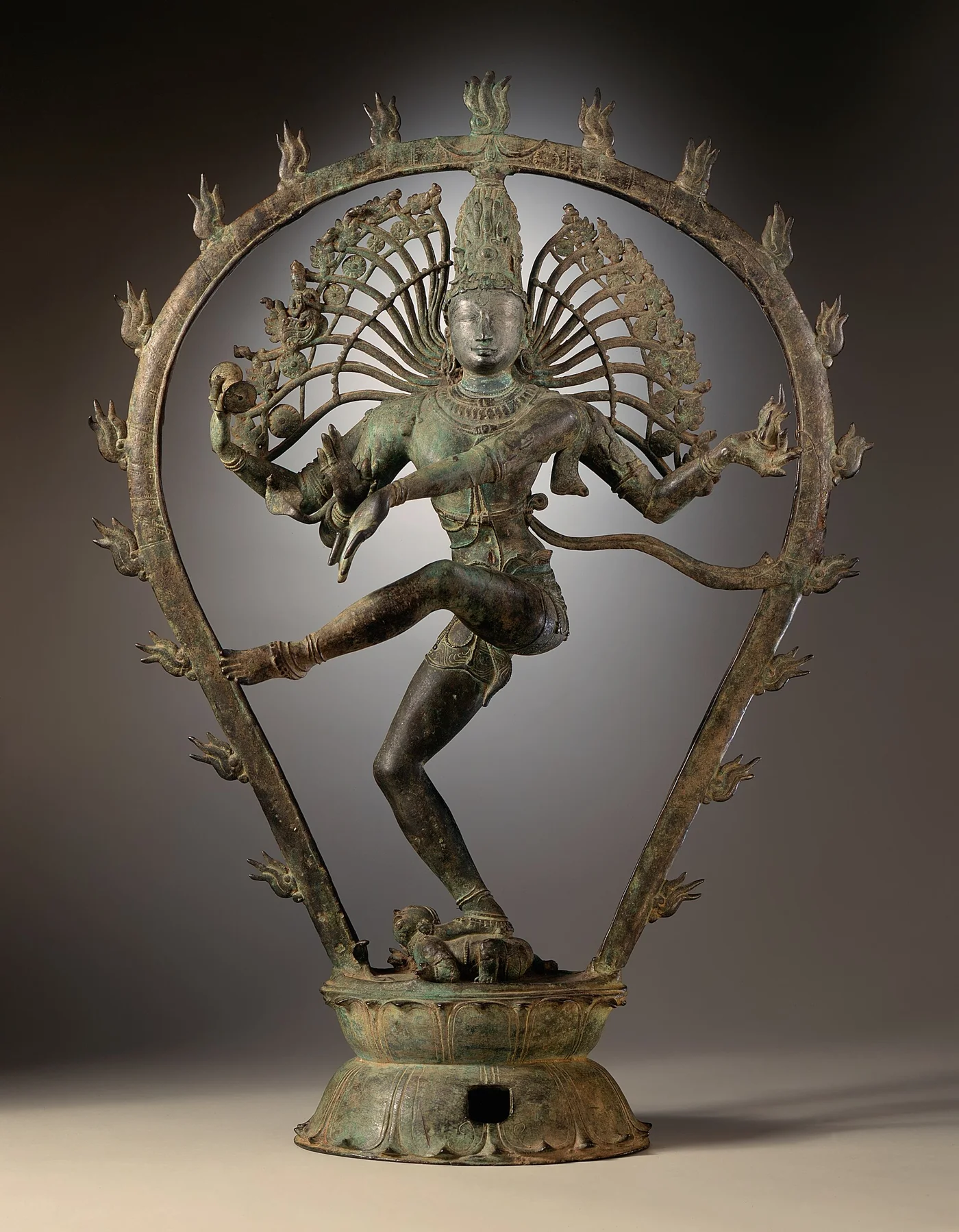
Śiva as Lord of Dance, about 950 to 1000
A legacy of explaining reception
Abhinavagupta's distinctive contribution is to ask what happens in a receptive consciousness, not only which formal ingredients an artwork contains. Lawrence's Oxford account describes his aesthetics as “homologous to” the realisation sought in his religious philosophy. That wording identifies a structured resemblance while leaving room for the differences debated by later interpreters. Lawrence
His system also provokes a philosophical objection. Recognising that objects are known through awareness does not, by itself, settle whether they exist independently of it. The recognition school argues against external objects and Buddhist accounts of momentary cognition; its inference to a universal subject is part of the dispute. Readers can examine its account of aesthetic attention without silently accepting that further metaphysical conclusion. IEP, arguments for idealistic monism
Questions people ask about Abhinavagupta
What does rasa mean for Abhinavagupta?
Rasa is the aesthetic savour of an emotion made available through art, particularly drama and poetry. It differs from an actor's own feeling and from the practical emotion of a spectator facing a real emergency. The account concerns a responsive viewer who can enjoy an emotional quality without being confined to its immediate private consequences. Gnoli's introduction
How does Abhinavagupta connect art with consciousness?
He understands aesthetic enjoyment as an unusual mode of conscious experience in which everyday personal restrictions loosen. Within his wider philosophy, all experience manifests universal consciousness. The connection makes art philosophically significant, but interpreters disagree about how closely aesthetic relish approaches liberation. A resemblance between the two experiences should not be treated as their unqualified identity. Lawrence; Baghel
What makes aesthetic experience special for Abhinavagupta?
It generalises emotion and makes it available for enjoyment beyond the viewer's ordinary practical interests. A tragic scene can therefore be relished without making an actual tragedy desirable. The spectator's emotional capacities and receptivity remain essential: a list of theatrical devices does not mechanically produce rasa in every audience member. Baghel
How does Abhinavagupta's nonduality differ from Shankara's Advaita?
Both place liberation in knowledge that corrects a mistaken understanding of selfhood. Abhinavagupta's recognition school emphasises consciousness as active, self-aware power and the world as its manifestation. Shankara's Advaita distinguishes ultimate Brahman from the dependent reality of the experienced world. “Nondual” therefore names a comparison, not a guarantee that the two schools mean the same thing. Kashmiri Shaiva Philosophy; Advaita Vedanta
How can Abhinavagupta's thought deepen a sculpture?
Our proposal is to examine how a material arrangement makes a feeling available without dictating a personal story. Compare contour, gesture and surrounding space, then state which visible relationships sustain your response. This is an application of questions from his aesthetics to sculpture, not a historical claim that he devised a programme for modern abstract art.
Who was Abhinavagupta, and when did he live?
He was a Kashmiri Sanskrit philosopher, commentator and aesthetic theorist active around 1000 CE. His dates are approximate: common reference estimates begin around 950 and end in the early eleventh century. He belongs to the intellectual history of recognition philosophy and Sanskrit poetics, rather than to the modern category of an independent art critic alone. Biography; Oxford Bibliographies
Which Abhinavagupta text and translation should I read first?
For art, our suggested starting point is Gnoli's The Aesthetic Experience According to Abhinavagupta, which combines translated passages and discussion. For metaphysics, Barnett's 1910 Paramārthasāra provides a public-domain entry, although its old terminology and notes need care. The Tantrāloka is a much larger undertaking. These are different entrances into the corpus, not interchangeable summaries. Gnoli; Barnett edition record
Who has been influenced by Abhinavagupta?
Kṣemarāja developed his teacher's recognition philosophy; modern scholars including Pandey, Gnoli and Gerow have interpreted his aesthetics in different ways. Cooper connects the rasa tradition with Satyajit Ray's cinema. That last connection is a documented critical reading of films, which is a different kind of evidence from a disciple's explicit continuation of a philosophical system. IEP; Cooper
Sources and image credits
Sources consulted on 26 October 2026. Each factual passage links to its evidence; looking exercises are marked as our interpretations. The captions link to the Commons file records and identify creators and rights. Images are local WebP conversions. Image provenance rechecked on 27 October 2026.
- David Lawrence, Oxford Bibliographies
- IEP, historical development and recognition
- Gerow, 1994, especially pages 191 to 193
- Gnoli, reproduced introduction to The Aesthetic Experience According to Abhinavagupta
- Works and commentaries
- Barnett edition record
- Gnoli edition record
- Paramārthasāra, Barnett translation, verses 6 to 9
- Sanskrit text, verses 12 and 13
- Baghel, Theorising the Idea of Aesthetic Self in Abhinavagupta
- Cooper, The Cinema of Satyajit Ray, chapter 1
- Biernacki, A Cognitive Science View of Abhinavagupta's Understanding of Consciousness
- Advaita Vedanta