Teachers / No. 005
Swami Brahmananda Saraswati
Swami Brahmananda Saraswati, known to followers as Guru Dev, was an Indian Advaita Vedanta monk who taught that the deepest Self is identical with ultimate reality, joining this teaching with meditation, devotion and discipline. He served as Shankaracharya of Jyotir Math from 1941 to 1953 and taught Maharishi Mahesh Yogi. Guru Dev Legacy Trust biography; Jyotirmath teaching account
Begin with the full identity: this is a teacher whose monastic office, recorded discourses and later musical reception belong to different parts of one history. Conflicting dates remain visible throughout the guide.
Which Brahmananda, and what does Guru Dev mean?
Guru Dev is an honorific, commonly translated as divine teacher, rather than a unique personal name. Here it refers to the Brahmananda Saraswati who held the northern monastic seat of Jyotir Math between 1941 and 1953 and taught Maharishi Mahesh Yogi. He is not Swami Brahmananda, the disciple of Ramakrishna whose earlier name was Rakhal Chandra Ghosh. Searching only for Brahmananda can easily combine different biographies, institutions and books. Guru Dev Legacy Trust; Ramakrishna's disciples
His most important public role preceded his worldwide posthumous fame. He helped restore an active Shankaracharya seat in northern India, taught publicly in Hindi and attracted disciples within an existing monastic world. Maharishi later carried his image and name into an international meditation movement. The teacher should be understood through his own recorded discourses and institutional setting as well as through that more familiar pupil. Jyotirmath Seva Samiti biography; archived recordings
Even the basic chronology needs qualification. The Legacy Trust gives 1870 as his birth year; the Jyotirmath biography and Wikipedia give 21 December 1871. They agree on his death on 20 May 1953. This guide retains that disagreement instead of using an exact birth date in the structured data. The date of installation also varies between accounts, although his accession in 1941 is shared. Trust biography; Jyotirmath account; cross-check
From Rajaram to the northern monastic seat
- About 1870 to 1871: born Rajaram in the Ayodhya region of Uttar Pradesh. The Trust identifies Gana; the Jyotirmath account names Surhurpur. Trust; Jyotirmath
- Childhood and youth: traditional biographies describe leaving home at nine and meeting his teacher, Krishnanand Saraswati, at fourteen in Uttarkashi. Treat these as the received life narrative. Trust biography
- Early adulthood: received sannyasa initiation at the Kumbh Mela in Prayag; long periods of seclusion followed, including in central India. Robert C. Sanders, biography
- 1941: accepted the position of Shankaracharya of Jyotir Math. Matthew Clark's academic history places the installation on 11 May; the Trust's longer biography gives 1 April. Clark, pp. 143 to 144; Sanders
- 1947 to 1953: discourses appeared in print; surviving recordings include a Lucknow discourse from March 1952. Vaksudha; recording archive
- 1953: died in Kolkata on 20 May. Accounts describe his body's return to Varanasi and immersion in the Ganga. Paul Mason's documentary introduction
What did Guru Dev teach?
Know the Self, rather than continually seek outside
The recorded teaching belongs to Advaita Vedanta: the deepest Self, or Atman, is understood as identical with Brahman, ultimate reality. Ignorance of that identity is treated as the root of bondage; liberation concerns its realisation. These are the tradition's philosophical and religious claims, not findings established by this website. The Jyotirmath biography stresses inner silence, meditation, devotion and traditional discipline together. Jyotirmath Seva Samiti; Sanders, introductory discussion
Silence is explained through an image
In a discourse from the 1947 Vaksudha reproduced by Paul Mason, Guru Dev compares the mind to water whose movement prevents a clear reflection. When agitation subsides, the Self can be recognised. The image clarifies the intended relation between yoga and knowledge: stilling is not simply a pleasant rest but serves a religious understanding of what the practitioner is. The analogy is an explanation within a teaching, not experimental proof of its conclusion. Mason, translation and reference to Vaksudha, p. 86
Renunciation did not prevent public responsibility
His biography presents a tension between a long preference for solitude and acceptance of institutional duties. As Shankaracharya he travelled, addressed audiences and oversaw restoration of the monastic centre. A familiar portrait of a silent forest sage therefore captures only one part of the life. Printed sermons and recordings also show a public teacher using words, examples and institutional authority. Trust biography; recordings; institutional restoration
The office matters
The restoration had a material dimension. The biographical overview describes a two-storey, thirty-room building at Jyotir Math and work on the Purnagiri Devi shrine. Sanders also identifies an ashram established in Alopibagh, Prayag, in 1950. These locations and buildings help explain what accepting the office entailed: land, construction, teaching and administration accompanied the personal religious authority remembered by disciples. restoration of the monastery; Sanders, ashrams
A Shankaracharya is not simply anyone whose followers call him enlightened. In this setting it is a monastic office associated with the transmission of Shankara's Advaita. Sringeri's account places Jyotir Math among four principal directional seats, with its own lineage and geographical responsibilities. That is the tradition's institutional account; modern historians examine how these lineages and their claims developed, rather than assuming every foundation story has equal documentary support. Sringeri, Amnaya Peethams; Clark, history of the order and mathas
How should a beginner approach the practice?
Our suggested entry is to read an attributed discourse, compare its English translation with the accompanying Hindi when possible, and use the archived voice to notice emphasis and delivery. For personal practice, ask a qualified instructor to explain the method, commitments and lineage being offered. This is an editorial study route. The surviving material does not authorise this page to invent a universal Guru Dev initiation or advertise an online mantra as his exact instruction to every student. Vaksudha archive; recordings and translations
What people say, and how far the evidence reaches
India: reverence and public authority
The Legacy Trust and Sanders's biography attribute the praise “Vedanta Incarnate” to a president of India, without naming the speaker in those passages. The Trust also records contact with prominent public figures and remembers his public teaching as a spiritual revival. These are attributed assessments of authority, not neutral measurements of enlightenment. Trust biography; Sanders, public encounters
Maharishi's remembered formulation was “In his ashram he manufactured me,” as reproduced by Paul Mason. The short sentence presents the pupil as the product of a formative relationship. Maharishi's tributes are important primary evidence for his own understanding of the lineage, but affection and institutional dependence make them interested testimony. They should not be used as independent verification of every detail in the guru's childhood story. Mason, attributed Maharishi statement; Trust collection of Maharishi's recollections
Britain and international scholarship
Matthew Clark's history places the 1941 appointment within a larger institutional story, including endorsements, rival claims and disputes about succession. This adds something devotional biography tends to soften: recognition of a spiritual office is also produced through institutions, patrons, documents and competing communities. His account is not a verdict on the teacher's inward experience. It is a history of how an order functions and remembers its authority. Clark, The Dasanami-Samnyasis, pp. 142 to 144
Paul Mason's documentary work collects editions, photographs, translations and recollections that make the teacher accessible beyond brief references in TM histories. It also distinguishes source material from later organisational claims. His introduction reproduces an address attributed to philosopher Paul Schilpp praising Guru Dev as “the seer, the sage.” That rhetoric belongs to the reception being studied; it is not this page's own description of a proven spiritual rank. Mason's introduction and documents
The United States and Germany: archival recovery
The US-based Guru Dev Legacy Trust was formed in 2014 to locate and preserve materials about him. Robert C. Sanders's A Short Biography of Guru Dev supplies a substantial illustrated narrative. It is written from an admiring standpoint, but its accounts of publications, locations and remembered conversations give readers materials to compare. An archive's preservation work and the truth of every devotional statement it preserves are separate matters. Sanders, publication information and preface
A German edition, translated by Jens Petersen and published by Alfa-Veda in 2021, shows a further channel of reception. Its importance is specific: a Hindi-speaking teacher's life reaches German readers through an English-language biography and translation. This does not justify inventing a broad German artistic movement inspired directly by him. The available record is strongest for translators, archivists, disciples and the indirect musical afterlife. German publisher's sample and translation credits
His image also entered American legal history. The 1979 Malnak v. Yogi opinion describes offerings to Guru Dev during a puja required by the school course at issue. This documents a later ritual use of his remembered person in a different country; it does not imply that he designed the curriculum or participated in the litigation. court opinion
Criticism, uncertain dates and disputed succession
After his death, Shantanand Saraswati and Krishnabodhashram were installed by rival factions, according to Clark. The Trust favours an account in which a will designated Shantanand; other institutional histories foreground another succession. This page takes no side in present claims to the seat. The disagreement is historically important because it prevents a list of spiritual successors from being treated as an uncomplicated family tree. Clark, pp. 143 to 144; Trust's account
Reference works need checking too. The TM entry in Jones and Ryan's Encyclopedia of Hinduism identifies Guru Dev's relationship to Maharishi but gives a conflicting death year in its narrative. The biographies and surviving publication record support 1953. A reputable reference label should therefore prompt comparison, not automatic copying. Claims about an exactly 165-year vacancy or a precisely dated childhood episode deserve the same care about whose chronology is being followed. encyclopedia, TM entry, pp. 451 to 452; chronology; Clark
Which texts and recordings should you begin with?
Vaksudha, 1947
The Legacy Trust presents Shri Shankaracharya Vaksudha as an early collection of discourses and provides access to archival material. It is a better beginning for his own teaching than a modern list of unattributed inspirational quotations. Editions and transliterations vary, so use the collection title, original language and publication context when tracing a sentence. A translated passage should remain connected to the discourse from which it came. Vaksudha archive
The archive's index makes the range of that collection visible. Alongside yogic success and the destruction of habitual desires, it includes karma yoga, relinquishing possessions, the relation of form to the formless, and the responsibilities of government toward dharma. That is a wider programme than a manual of relaxation. Some subjects concern individual discipline, while others locate the teacher within the public and religious concerns of his period. Vaksudha, contents
Amrit Kana and 108 Discourses
Amrit Kana is a collection associated with Brahmachari Mahesh, later Maharishi Mahesh Yogi. It is therefore also evidence for the pupil's presentation of the guru. Paul Mason's bilingual edition of 108 Discourses of Swami Brahmananda Saraswati provides another substantial route into the sermons; the publisher identifies Hindi and English together. Keep these collections distinct instead of assuming their similar devotional titles designate one book. Amrit Kana archive; Indica Books catalogue, p. 34
The teacher and art: a painted image, a recorded voice, a refrain
Mason's introduction reproduces a painting of Guru Dev credited to M. T. V. Acharya. It also documents the large portrait displayed behind Maharishi and the Beatles at Rishikesh. That is a concrete visual connection: an image of a deceased Indian teacher became part of a widely circulated encounter between a meditation movement and British popular music. The image's presence does not mean Guru Dev met the Beatles; he died fifteen years before their visit. Mason, painting credit and Rishikesh photograph
The phrase “Jai Guru Deva” in John Lennon's Across the Universe supplies the best-known musical trace. Mason identifies it with Maharishi's teacher; the Beatles' visit history also places the phrase within the movement's vocabulary. This is indirect influence through a pupil, a greeting and popular song, not a composition by Guru Dev or evidence that Lennon personally studied with him. No further lyrics are needed to establish the connection. Mason; Beatles in India
The archive preserves a more direct artistic connection: his own voice. Its recordings include devotional recitation identified as Bhaja Govindam, Uma Maheshwara Stotram, Narmada Ashtakam and Guru Pranaam, alongside Hindi discourse. These are documented vocal performances of inherited sacred material; they should not be represented as a catalogue of original songs composed by him. Guru Dev Legacy Trust, recordings
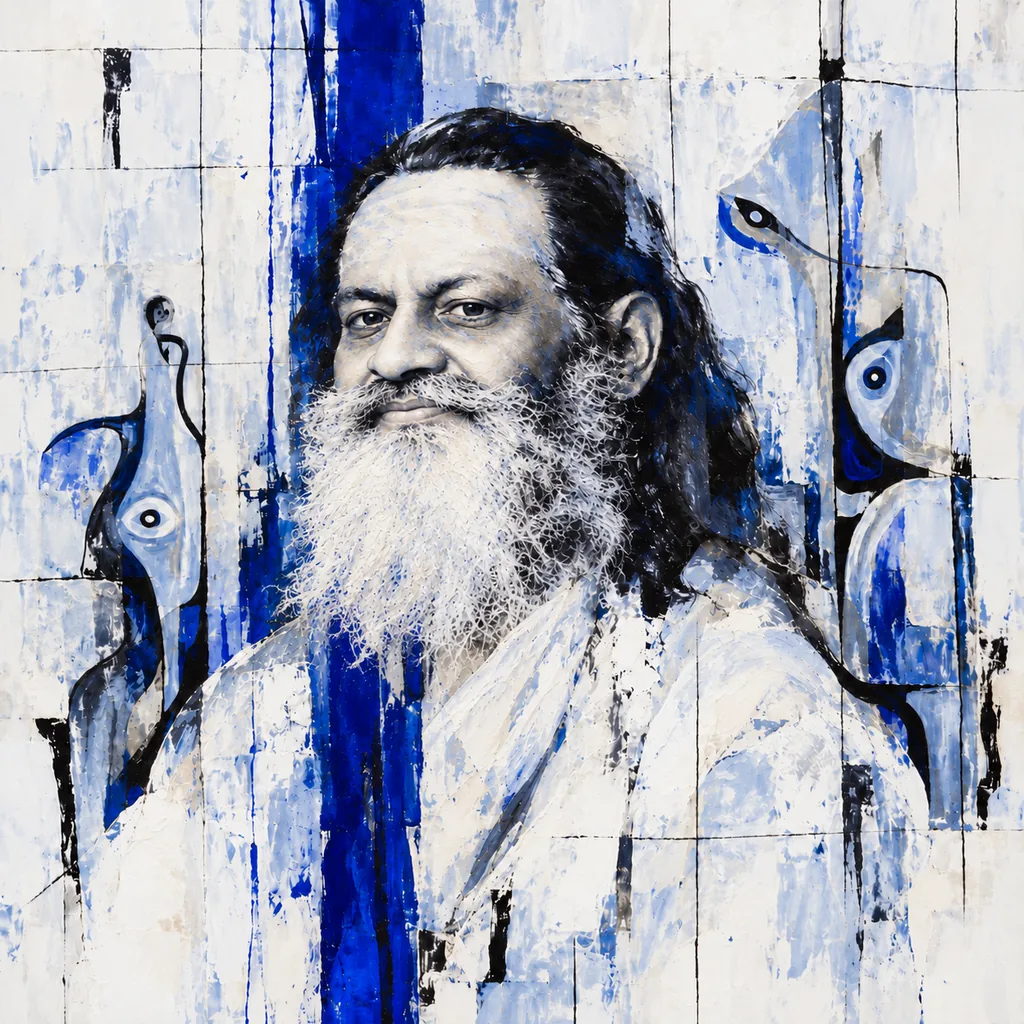
Our reading of Baudoin's portrait is that the restricted blue, black and white gives the face a different tempo from the surrounding eyes and upright marks. The painting presents an encounter with a remembered teacher through a contemporary visual language. It is the site's own artwork, not Acharya's historical portrait and not an image commissioned by a monastic seat.
Where can you visit or study the legacy today?
Jyotir Math, Uttarakhand: the northern monastic seat is the principal institutional place associated with his public office. Clark's account describes restoration after a long interruption and the disputes that followed. A visitor should distinguish a historical connection with Guru Dev from an endorsement of any contemporary claimant to authority. Check the institution's current access and travel arrangements rather than relying on a general biography as a visitor timetable. Jyotirmath biography; Clark
Varanasi and Prayagraj: Sanders identifies Brahma Niwas in Varanasi and the Alopibagh ashram in Prayag as places connected with his work. Mason describes jal samadhi, immersion of the body in the Ganga after death, rather than an ordinary burial in a tomb. A reader seeking his samadhi should therefore avoid assuming there is one universally identified grave to visit. Memorial images, institutional shrines and the funeral location are different things. Sanders, ashrams; Mason, funeral account
Study and retreats: the Trust's online archive provides access to texts and recordings without requiring travel. Modern TM centres teach Maharishi's later system and may offer residential programmes, but a course should not be advertised as a personal retreat with a teacher who died in 1953. This independent art site has no affiliation with the Trust, any monastic seat or a meditation provider. Trust publications; current TM course and retreat information
Questions people ask about Guru Dev
Who was Swami Brahmananda Saraswati, known as Guru Dev?
He was an Indian Advaita Vedanta monk who served as Shankaracharya of Jyotir Math from 1941 until his death in 1953. He taught Maharishi Mahesh Yogi. Sources differ between 1870 and 1871 for his birth year, so this page leaves that uncertainty visible. Trust biography; Jyotirmath account
What does Guru Dev mean?
It is an honorific commonly translated as divine teacher. Here it identifies Maharishi's teacher, not a separate person with Guru as a first name. The title is not unique, so use the full name and Jyotir Math association when searching. Guru Dev Legacy Trust
What was his core teaching?
His teaching joined Advaita's account of the Self and ultimate reality with meditation, inner silence, devotion and discipline. These are attributed religious claims. His surviving discourses provide a firmer route into the teaching than isolated quotations without a source or publication context. Jyotirmath biography; Discourse archive
How can a beginner start studying or practising?
Our suggested start is an attributed discourse, a short biography and a recording with its translation. For personal instruction, ask an instructor to explain the method and lineage being offered. This page does not invent a universal Guru Dev initiation or supply an authenticated mantra for every reader. Recordings; Books
Which books should I read first?
Read Sanders's A Short Biography of Guru Dev for the life, then Vaksudha or the bilingual 108 Discourses for the teaching. Amrit Kana is a separate collection associated with Brahmachari Mahesh, later Maharishi. Keep the editions and translators visible when comparing passages. Trust publications; Indica Books catalogue
Who were his teacher and students?
His teacher was Krishnanand Saraswati. His disciples included Maharishi Mahesh Yogi, Karpatri, Shantanand Saraswati and Swaroopanand Saraswati. Their later roles and claims differ; Maharishi's international meditation movement should not be treated as identical with the monastic office of Shankaracharya. Trust biography; Disciples and succession
Where are his ashram and samadhi?
His institutional history is associated with Jyotir Math, Brahma Niwas in Varanasi and Alopibagh in Prayag. Accounts describe immersion of his body in the Ganga after death, rather than burial in an ordinary tomb. Confirm present memorial and visitor arrangements directly with the relevant institution. Sanders; Funeral account
Is he the same Brahmananda who followed Ramakrishna?
No. Ramakrishna's disciple Brahmananda was earlier named Rakhal Chandra Ghosh. Guru Dev was the Brahmananda Saraswati associated with Jyotir Math and Maharishi. The shared monastic name should not be used to combine their books, dates or lineages. Ramakrishna's disciples; Guru Dev biography
How is Guru Dev connected with the Beatles and art?
His portrait appeared behind Maharishi and the Beatles at Rishikesh, and the phrase Jai Guru Deva entered Lennon's Across the Universe. These connections were mediated through Maharishi; Guru Dev died before the Beatles' visit. The archive also preserves his devotional recitations, and this page uses Piet Baudoin's contemporary portrait. Mason; Recordings
Sources and image credits
Sources opened and read for this page on 26 October 2026. Institutional biographies document a community's account; scholarship and reference works provide comparison. Interpretations marked as ours belong to this independent art site.
Portrait © Piet Baudoin. Painted for this site and supplied by the artist; all rights reserved. No historical photograph or third-party artwork is reproduced.
- Guru Dev Legacy Trust, Biography, institutional account of Brahmananda Saraswati
- Wikipedia, Ramakrishna, chronology, disciples and scholarly responses
- Jyotirmath Badarikashram Seva Samiti, Jagadguru Sri Brahmananda Saraswati Ji Maharaj, lineage biography
- Guru Dev Legacy Trust, Recordings, Hindi discourse and devotional recitation
- Wikipedia, Brahmananda Saraswati, chronology and succession sources
- Robert C. Sanders, A Short Biography of Guru Dev, Guru Dev Legacy Trust (2020)
- Matthew Clark, The Dasanami-Samnyasis: The Integration of Ascetic Lineages into an Order, Brill (2006), especially pp. 142 to 144
- Guru Dev Legacy Trust, Vaksudha, 1947 collection and index
- Paul Mason, Introduction to the Lifestory and Teachings of Guru Dev, translations, documents and image references
- Sringeri Sharada Peetham, The Amnaya Peethams, traditional institutional account
- Guru Dev Legacy Trust, Maharishi about Guru Dev, attributed recollections and talks
- Robert C. Sanders, Guru Dev: Eine Kurzbiographie, translated by Jens Petersen, Alfa-Veda (2021), publisher sample
- Malnak v. Yogi, 592 F.2d 197, Third Circuit Court of Appeals (1979), opinion preserved by Columbia University
- Constance A. Jones and James D. Ryan, Encyclopedia of Hinduism (2007), Neem Karoli Baba, p. 310, and Transcendental Meditation, pp. 451 to 452
- Guru Dev Legacy Trust, Amrit Kana, collection and Maharishi foreword
- Indica Books, catalogue, 108 Discourses of Swami Brahmananda Saraswati, p. 34
- Wikipedia, The Beatles in India, visit, songwriting and reception
- Guru Dev Legacy Trust, Books related to Guru Dev, editions and publication information
- Maharishi Foundation UK, current course, teaching structure and follow-up information