Teachers / No. 003
Sri Ramakrishna
Sri Ramakrishna (1836 to 1886) was a Bengali Hindu priest and teacher at Dakshineswar whose conversations and religious practices inspired the later Ramakrishna movement and its account of many paths to God. Belur Math biography
The route here leads from the temple and the recorded conversations to the books, writers and debates that shaped his reception. Claims of spiritual experience are attributed to their sources.
A temple priest whose conversations became a library
Ramakrishna's historical setting is unusually specific: a village upbringing in Bengal, priestly work at the Kali temple of Dakshineswar, and conversations with householders, reformers, actors and young men who later became monks. He did not write the books through which most readers now meet him. His speech survives through witnesses, above all Mahendranath Gupta, known as M, whose records became the Bengali Kathamrita and the English Gospel of Sri Ramakrishna. Belur Math biography; UCLA, MANAS
The distinction between conversation and transcription is essential. A speaker's audience, a recorder's selection and a translator's choices all affect the book a later reader encounters. His disciples regarded him as an avatar, a divine incarnation; scholars investigate how that understanding developed and how the surviving texts construct it. This page treats the belief as part of the history without asking the reader to accept it as an established supernatural fact. biography and textual sources; University of Chicago Press, Kali's Child
His example is also more difficult than a slogan about all religions being the same. Devotion to a particular goddess, practices taught by particular teachers, renunciation and an intense account of religious experience remain central. His openness did not remove those commitments. The official account presents different paths as capable of reaching one ultimate reality, while keeping the disciplines themselves distinct. Belur Math, message and practices
A short life in six moments
- 1836: born Gadadhar on 18 February at Kamarpukur in Bengal. His parents were Kshudiram Chattopadhyaya and Chandramani Devi. Belur Math
- 1855 to 1856: the Dakshineswar Kali temple was consecrated; after his brother Ramkumar's death, Ramakrishna assumed priestly responsibilities. UCLA
- 1859: married Sarada Devi while she was a child. She later joined him at Dakshineswar and became a teacher in her own right. biographical chronology
- 1860s: received instruction from Bhairavi Brahmani and Totapuri; accounts also describe Islamic and Christian practice. Belur Math
- 1872: Sarada came to Dakshineswar; the tradition records his ritual worship of her as the Divine Mother. official account
- 1885 to 1886: developed throat cancer and was cared for by disciples; died at Cossipore on 16 August 1886. Belur Math; chronology
What did he teach, and what did he ask people to do?
Realisation rather than second-hand certainty
Ramakrishna's teaching makes direct knowledge of God the purpose of spiritual life. In the tradition's presentation, this knowledge transforms conduct and desire, rather than merely adding opinions. He commonly used domestic and natural images to explain what abstract language could obscure. The authority claimed for his teaching came from experience, not academic credentials: his official biography describes little enthusiasm for formal schooling alongside considerable ability in song, storytelling and painting. Belur Math, childhood and message
Kali, devotion and the formless
His worship of Kali was not a preliminary embarrassment later corrected by philosophy. The personal Divine Mother and the impersonal absolute belong together in the remembered teaching. The official account associates his Tantric training with Bhairavi Brahmani and nondual instruction with Totapuri. Advaita, or nonduality, concerns an ultimate reality without a second; bhakti concerns loving devotion. Ramakrishna's importance lies partly in the way his followers saw these operating within one life. Belur Math, spiritual practices; UCLA on devotion and nondualism
Many paths, practised seriously
His reported Islamic and Christian disciplines underpin his teaching that different religious paths can lead to the same goal. These reports come through his community's accounts and require that attribution. They do not establish, by historical method alone, that he exhausted the possibilities of every religion or proved their metaphysical identity. The formula is a theological interpretation of experience, not a survey in which every tradition was studied on its own terms. Belur Math, following other faiths
Householders and renunciants received different advice
He taught people with families alongside those preparing for monastic life. The official biography explicitly distinguishes those audiences. Household responsibilities were not simply an error from which every devotee had to escape; the question was how to remember God while carrying them out. The young future monks received a more demanding training in renunciation. Taking one severe instruction out of that setting can make his teaching appear both more uniform and less humane than the source allows. Belur Math, coming of the devotees
His warnings about desire and money require similar contextual attention. The vocabulary of lust, greed and attachment belongs to a renunciant religious world, and translations can carry gendered assumptions. This remains a live interpretive issue rather than a reason to smooth every difficult expression into modern self-help language. The dispute over Kali's Child demonstrates how much can turn on the interpretation of Bengali terms, bodily imagery and supposedly private speech. Kripal's argument and second-edition response; scholarship and controversy
A beginning that does not imitate the ecstasies
Our proposed starting route is to read a short conversation in the Gospel, note who was listening, and follow one practice or ethical instruction into its context. A reader interested in devotional practice can ask a centre about introductory instruction and the meaning of mantra. This is a study suggestion rather than an initiation. Christopher Isherwood's account explains mantra as repeated sacred words received from a teacher and places character, not spectacle, at the centre of the inquiry. Isherwood, Who is Ramakrishna?
What people say around the world
India: religion made visible
Mahatma Gandhi described the life as “a story of religion in practice,” in a passage reproduced by the Vedanta Society of Southern California. It is an admirer reading a life as an example, rather than a historian establishing each reported event. The sentence helps explain why Ramakrishna's reception extends beyond a philosophical school: the remembered person becomes an argument for what religion might look like when lived. Vedanta Society, collected assessments
France and Germany: universality and the intimate document
The same collection attributes to Romain Rolland the phrase “individuality and universality,” and to Thomas Mann an appreciation of the Gospel's intimate portrayal of a mystic. Rolland's French literary reception and Mann's German literary voice show two different attractions: a figure who might speak across cultures, and a document that makes an unusual personality seem close. Neither response amounts to an independent eyewitness account of Ramakrishna's life. Rolland and Mann, quoted by the Vedanta Society
Britain and the United States: the novelist's problem
Christopher Isherwood opens his biography with “This is the story of a phenomenon.” The British-born novelist, later based in America, also wrote an extended explanation of who Ramakrishna was and what followers mean when they ask who he is. His method makes the distinction between historical person and continuing religious significance explicit. That distinction is valuable even for readers who do not share his faith. quoted opening; Isherwood's essay
Isherwood's literary work developed through the Vedanta Society and his relationship with Swami Prabhavananda. Alongside Gerald Heard and Aldous Huxley, he helped carry Vedantic ideas into English-language literary culture. This was mediated reception: twentieth-century writers encountered the tradition through teachers, translation and institutions, rather than through personal acquaintance with a man who died in 1886. Isherwood's publications and collaborations; legacy
Criticism: gender, class and the interpretation of experience
UCLA's MANAS account questions the fit between Ramakrishna's devotional and sometimes gender-crossing religious life and the masculine ideals of later nationalism. It also discusses the anxieties of the educated Bengali middle class that became an important constituency of the movement. This is an interpretive argument about reception and social expectations, not a diagnosis of the teacher or a claim that all his followers held one political position. UCLA, MANAS
Jeffrey J. Kripal's Kali's Child interprets the texts through mystical and erotic dynamics, including a contested homoerotic reading. The University of Chicago Press describes both its academic recognition and cross-cultural controversy. Critics dispute its translation, interpretation and treatment of devotional sources. The responsible formulation is that scholars disagree over how to read the evidence; neither a publisher's endorsement nor devotional rejection alone resolves the underlying historical questions. Chicago Press; overview of responses
Which books bring you closest to the teaching?
The Gospel of Sri Ramakrishna
Begin with the conversations recorded by Mahendranath Gupta. The English rendering associated with Swami Nikhilananda was released in 1942. Read by dated encounter rather than searching only for a maxim: the speaker may be responding to a householder, a sceptical visitor or a future monk. The distinction between the Bengali Kathamrita, its publication history and an English translation is part of understanding what the book can tell us. Belur Math, Gospel; textual sources
Sri Ramakrishna the Great Master
Swami Saradananda's substantial biography provides the fuller narrative of practices, teachers and disciples that individual conversations assume. It is an account from within the movement, written by a disciple, and its devotional framework should remain visible. UCLA lists it alongside the Gospel and Rolland among the principal works for approaching the life. Use it for the tradition's developed narrative, not as a substitute for comparing sources. UCLA, further reading
Isherwood, Rolland and critical scholarship
Ramakrishna and His Disciples offers an accessible literary entrance; Rolland's Life of Ramakrishna offers a European response to the figure's wider significance. For a contrasting scholarly approach, read Kripal with awareness of the debate around his method. These books answer different questions: how a disciple's community remembers a life, how a novelist tells it, and how a scholar interprets difficult textual evidence. UCLA reading list; Chicago Press
The teacher and art: song, story, image and architecture
There is a direct connection with Bengali theatre through the actor, director and playwright Girish Chandra Ghosh, a householder disciple. Ramakrishna attended a performance of Ghosh's Chaitanyalila at the Star Theatre in 1884. Ghosh's career included religious drama and a Bengali translation of Shakespeare's Macbeth. This relationship places Ramakrishna within a working urban artistic culture, alongside the literary and devotional circles more often emphasised in summaries of his life. Ghosh, career and relationship with Ramakrishna
The connection begins in his own activities. Belur Math's biography describes him as able to sing and paint, and recalls the childhood experience of white cranes against dark clouds that his community understands as an early ecstasy. That is a reported autobiographical or devotional episode, not proof that a colour contrast produces mystical states. It shows how visual experience entered the remembered narrative of his life. Belur Math, childhood
His teaching was carried by image-rich speech, songs and stories rather than books he authored. The later Gospel gives that oral world literary form, while Isherwood's biography gives it another narrative audience. These are documented links between religion and artistic transmission. Belur Math on conversations; Isherwood
Photography supplied a different kind of image. One surviving photograph was taken at the Bengal Photographers studio in Calcutta on 10 December 1881. The later familiarity of such portraits can make them seem timeless, but they have particular settings and dates. A nineteenth-century photograph and the contemporary painted portrait on this page are different objects with different relationships to the historical person; the photograph is discussed here without reproducing it. photograph identification
The Ramakrishna temple at Belur Math makes a further statement in architecture. Its institutional guide identifies references to Buddhist cave halls, church-like spatial organisation, and Rajput and Mughal forms around the sanctum. The building is a later memorial, conceived through the order's work, rather than a structure designed by Ramakrishna. Its combination of forms translates the movement's account of religious harmony into a place people can enter. Belur Math, temple architecture
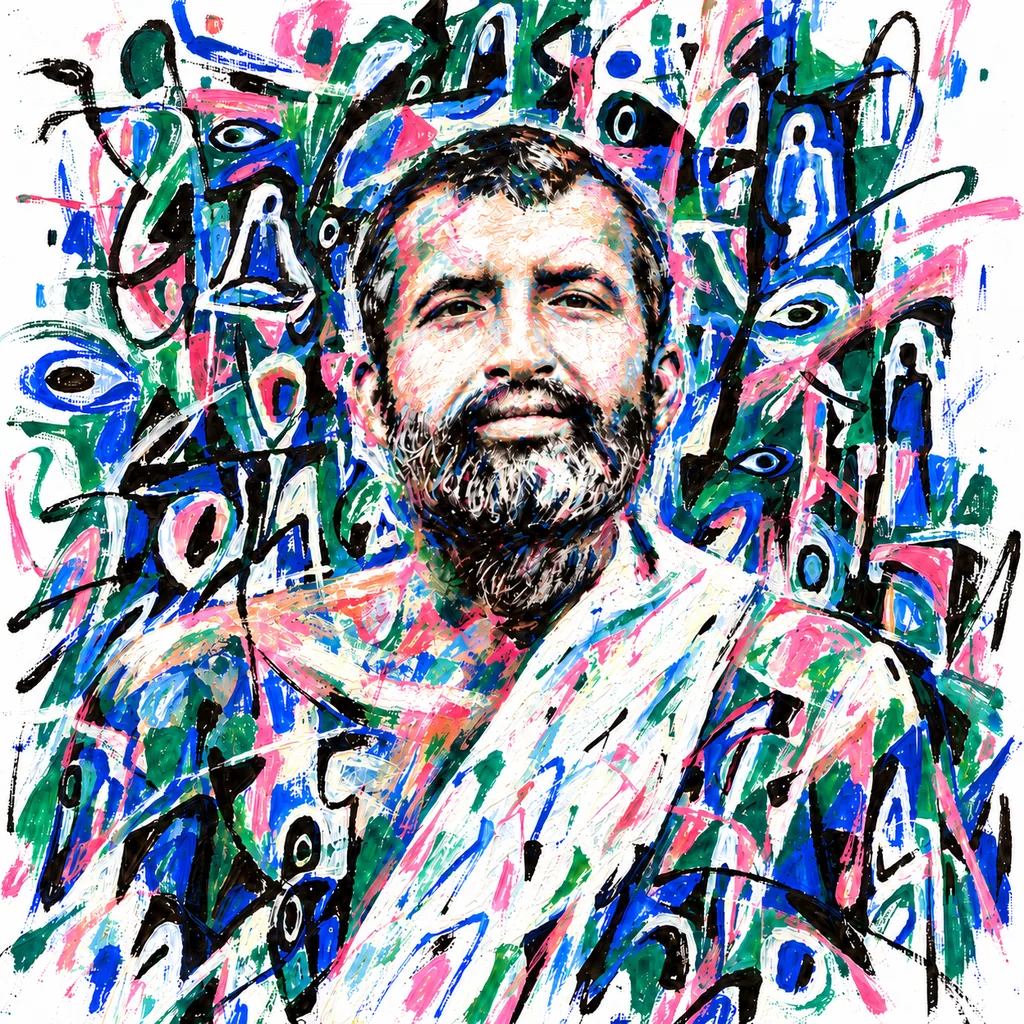
Our reading of Baudoin's portrait notices the calm, direct face amid animated eyes and small outlined figures. The contrast makes the surrounding marks feel like a field of attention rather than a diagram of doctrine. It is a contemporary painting for this site. Its colours and recurring shapes should not be mistaken for symbols supplied by Ramakrishna or for a historical portrait painted during his life.
Where can you visit, and what continues today?
Dakshineswar: the Kali temple near Kolkata provides the setting for his priestly life and many recorded encounters. Kamarpukur: his birthplace supplies the village context that an account focused entirely on Calcutta can lose. Cossipore: the garden house belongs to the final illness and the gathering of young disciples. These sites answer different historical questions, so choosing one is more useful than treating them as interchangeable spiritual destinations. Belur Math biography; places and chronology
Belur Math: the later headquarters houses the principal temple and his enshrined relics. It is the relevant destination for the institutional memorial, while Dakshineswar is the setting of much of his teaching life. The temple guide gives the building's history and design; the monastery's website supplies current visitor information. Confirm programmes and accommodation rather than assuming a day visit includes a retreat or personal instruction. Ramakrishna temple; visitor information
Sarada Devi, Vivekananda, Brahmananda and the other disciples carried the legacy in different ways. The Ramakrishna Mission was founded by Vivekananda after Ramakrishna's death; it should not be dated back to a formal organisation founded by Ramakrishna himself. Contemporary Vedanta centres offer different public programmes and preserve a living religious interpretation. This site presents that history independently and has no institutional affiliation. founding of the Mission; disciples
Questions people ask about Sri Ramakrishna
Who was Sri Ramakrishna?
Ramakrishna was a Bengali Hindu priest and religious teacher who lived from 1836 to 1886 and taught mainly at Dakshineswar near Kolkata. His conversations, devotional practices and influence on disciples became the foundation of the later Ramakrishna movement. His followers regard him as a divine incarnation. Belur Math biography
What was his central teaching?
He placed the realisation of God at the centre of life and taught that different religious paths can lead to one ultimate reality. Devotion, purity of intention and practice mattered more than argument alone. This is his tradition's theological claim, not a conclusion that historical research can independently prove. Belur Math, message
How can I begin practising or studying?
Our suggested beginning is to read one Gospel conversation with attention to its audience and context, then ask a centre about introductory practice if desired. Mantra and devotion appear in the tradition, but this page provides no initiation. Do not treat the reported ecstasies as experiences a beginner must reproduce. Isherwood on practice
Which book should I read first?
Begin with The Gospel of Sri Ramakrishna, drawn from Mahendranath Gupta's records of conversations. Saradananda's Sri Ramakrishna the Great Master supplies fuller biography, while Isherwood's Ramakrishna and His Disciples offers a literary introduction. Ramakrishna himself did not write these books. Gospel history; UCLA reading list
Who were his teachers and students?
Bhairavi Brahmani and Totapuri were important teachers in accounts of his spiritual training. Vivekananda was his most internationally influential disciple; Sarada Devi became a major teacher herself. Householders and other future monks also preserved the conversations and developed the movement. Belur Math, practices and disciples
Where can I visit his temple or memorial?
Dakshineswar is the setting of his priestly and teaching life, Kamarpukur his birthplace, and Cossipore the place of his final illness. Belur Math houses the later principal temple with his enshrined relics. Check current arrangements with each institution before planning a stay or programme. Biography; Belur Math temple
Did he teach that all religions are identical?
His teaching presents different paths as capable of reaching the same ultimate goal, rather than saying that their practices and doctrines have no differences. His own remembered life remained rooted in Kali devotion and specific spiritual disciplines. Treat the universal conclusion as an attributed religious interpretation. Belur Math, following other faiths
What is controversial about modern interpretations?
Scholars debate the relation between devotional biography, gender, bodily imagery and historical evidence. Jeffrey Kripal's Kali's Child offered a contested mystical and erotic interpretation; critics dispute aspects of its translations and conclusions. Neither its argument nor its rejection should be presented as an uncontested verdict. Chicago Press; Responses
How is Ramakrishna connected with art?
His biography describes singing and painting, and his teaching used vivid stories and images. Writers including Isherwood and Rolland shaped his literary reception; the later Belur Math temple translates the movement's ideals into architecture. The portrait here is a contemporary interpretation by Piet Baudoin. Biography; Temple
Sources and image credits
Sources opened and read for this page on 26 October 2026. Institutional biographies document a community's account; scholarship and reference works provide comparison. Interpretations marked as ours belong to this independent art site.
Portrait © Piet Baudoin. Painted for this site and supplied by the artist; all rights reserved. No historical photograph or third-party artwork is reproduced.
- Belur Math, Sri Ramakrishna, institutional biography, teaching and Gospel history
- UCLA, MANAS, Ramakrishna, biography, critical interpretation and bibliography
- Wikipedia, Ramakrishna, chronology, disciples and scholarly responses
- University of Chicago Press, Jeffrey J. Kripal, Kali's Child: The Mystical and the Erotic in the Life and Teachings of Ramakrishna, second edition (1998)
- Christopher Isherwood, Who is Ramakrishna?, Vedanta Society of Southern California, 2001 publication
- Vedanta Society of Southern California, Sri Ramakrishna, collected attributed assessments
- Wikipedia, Girish Chandra Ghosh, theatre career and relationship with Ramakrishna
- Belur Math, Sri Ramakrishna Temple, history and architectural guide
- Belur Math, Swami Vivekananda, institutional biography and reading list