Teachers / No. 001
Neem Karoli Baba
Neem Karoli Baba (about 1900 to 1973) was an Indian Hindu devotional teacher known for joining love of God with service to others, whose ashrams and disciples carried his teaching far beyond northern India. Encyclopedia of Hinduism
This guide begins with the limits of the record, follows the teaching through books and music, and distinguishes places of pilgrimage from current learning opportunities. Use the questions below for direct answers.
What can we know about a teacher who left no books?
Neem Karoli Baba taught through encounters rather than a published system. The central historical problem is that the surviving record consists largely of other people's memories: Indian householders, wandering ascetics and, late in his life, visitors from America. Katya Langmuur's freely accessible University of Kent thesis distinguishes the few recoverable biographical facts from accounts of how Indian and Western disciples sustained his charismatic authority after his death. Langmuur, Becoming the Breath of Ram
That distinction matters when reading accounts of miraculous knowledge, sudden appearances or healing. These stories document what disciples believed they experienced; their repetition does not independently establish supernatural events. An encyclopedia can establish his place in twentieth-century bhakti, while a memoir can convey a particular relationship. Neither kind of source should be silently substituted for the other. Jones and Ryan, Encyclopedia of Hinduism, p. 310; Langmuur
Names also require care. Neem Karoli, Neeb Karori and Neeb Karauri are transliterations associated with the village from which his best-known name developed. Maharajji is the respectful name his devotees use, not a separate person. Sources give variants of his birth name, including Lakshmi Narayan Sharma and Lakshman Narayan Sharma; his birth is usually placed around 1900 rather than securely dated to a particular day. Jaya Prasada, Penguin excerpt; biographical cross-check
A life between household, pilgrimage and ashram
- About 1900: born in a Brahmin family at Akbarpur, Uttar Pradesh, according to the encyclopedia and devotional biographies. Jones and Ryan
- Early life: accounts describe an arranged marriage, wandering as an ascetic, and a return to family responsibilities. He had two sons and a daughter. These episodes resist a simple story of permanent withdrawal from society. Wikipedia
- 1964: the first temple at Kainchi was inaugurated in June, after preparations described in the ashram history from 1962. Kainchi history
- 1967: Ram Dass met him in India; the Vrindavan ashram's first temple was also inaugurated that year. Langmuur; Vrindavan history
- 1973: he died on 11 September. His memorial shrine stands within the Vrindavan ashram. biographical record; ashram guide
What did he teach, in plain words?
Love has a practical object
The Taos ashram sums up his teaching in a compact instruction: “love everyone, serve everyone, remember God, and tell the truth.” Feeding people was a recurring expression of this outlook. The point is concrete: devotion should change how a person treats someone hungry, inconvenient or outside their own circle. In the encyclopedia's account, the welfare of others remains central even when advice varies between students. Taos ashram; Jones and Ryan
Bhakti, Ram and Hanuman
Bhakti means a path of devotion: love directed toward God, expressed through remembrance, prayer, singing and service. Ram and Hanuman occupy a particular place in the remembered teaching. Hanuman is revered as a model of devoted service to Ram. Many followers understand Neem Karoli Baba as an embodiment of Hanuman; that is a religious interpretation held by devotees, not a historical identity established by this page. Taos account; Langmuur, discussion of Hanuman and the guru
The often-repeated phrase sab ek, rendered “all is one,” belongs beside that devotional language. It should not erase the actual names, rituals and relationships of the community. Langmuur places him within Hindu bhakti while finding no securely established formal Vaishnava succession for him. A recognisable religious setting and a documented initiation lineage are different kinds of claim. Taos teaching summary; Langmuur, consideration of lineage
Individual instruction rather than a single technique
The accounts describe jokes, abrupt directions, food, domestic situations and apparently ordinary conversations as occasions for teaching. They do not supply one universally prescribed meditation sequence. Ram Dass's period in India included instruction from Hari Dass in yoga and related disciplines. Treating all of those methods as a single secret technique personally invented by Neem Karoli Baba would confuse a network of teachers with one person's recorded words. Langmuur, Western disciples and pedagogical methods
How a beginner can start
Our suggested starting point is modest: read a few dated recollections, learn what a chant means before repeating it, and choose a specific act of service that meets an actual need. This is an editorial route into the documented themes, not an initiation or a promise of spiritual results. The Taos community offers temple practice and service; Krishna Das's resources explain the call-and-response form of kirtan. Taos programme; Krishna Das on chanting
What people say, and what their testimony can show
Indian remembrance
Jaya Prasada's Sri Siddhi Ma presents an Indian devotional memory centred on the woman who continued the ashram's life after his death. The Penguin excerpt describes a man who refused conspicuous saintly insignia, sometimes directing visitors asking for the famous Baba toward Hanuman's temple instead. Prasada calls him “divine love incarnate.” That is her devotional judgement, and its attribution is essential to understanding the passage. Prasada, excerpt from Sri Siddhi Ma
American books and music
Ram Dass made the relationship legible to an American readership through autobiography, teaching and collected reminiscence. His caution, “Facts are few, stories many,” appears in the Penguin excerpt's quotation from Miracle of Love. It is a useful warning even inside an admiring account: the book offers a many-voiced portrait assembled after encounters, not a diary continuously kept by the teacher. Prasada quoting Ram Dass; community bibliography
Krishna Das describes his own response in musical terms: “I will sing to you in America.” His biography connects that remembered resolve with the kirtan he later led in New York. It also describes his return from India, grief after his teacher's death and the eventual development of a public singing practice. Here influence is traceable through a named musician's work and recollection, rather than inferred from celebrity photographs. Krishna Das, official biography
A British academic assessment
Larry Brilliant's recollections connect the teaching of service with a particular public-health career. In the interview material preserved by Langmuur, he describes Neem Karoli Baba directing him toward work on smallpox eradication and explains how the guru's photograph helped open conversations with officials in India. The account shows religious authority operating within a practical network of trust. It is Brilliant's retrospective testimony about motivation and access, not evidence that a prophecy caused a disease to disappear or that the achievement belonged to one spiritual community. Langmuur, interview with Larry Brilliant and discussion of smallpox
Fame, technology and a common chronological mistake
Steve Jobs travelled to India in 1974, after Neem Karoli Baba's death in 1973. He therefore could not have met him on that journey. Accounts of Jobs's interest belong to the teacher's posthumous reception. They do not establish that an ashram visit caused Apple's success or that the teaching offers a route to business wealth. Those stronger claims exceed the chronology recorded in the biographical sources. Wikipedia, legacy and cited biographies
The central critical issue in the sources opened here is evidential: later recollection, uncertain early dates and claims of extraordinary powers. Langmuur also shows how the Western satsang became an interpreter of an Indian guru for new audiences. That transfer changes which voices become prominent. A responsible reading keeps Indian householders and local devotional life in view alongside the internationally familiar Americans. Langmuur, community and Western satsang
Which books should you read first?
Miracle of Love
Ram Dass's collection is the direct starting point for the remembered Neem Karoli Baba: many short accounts organised around encounters and teachings. Read the speaker and situation as carefully as the surprising event. The community bibliography identifies it among the principal books about Maharajji. Its title announces the devotional register; it is not a critical biography or a work authored by the teacher. Books about Maharajji
Be Here Now and By His Grace
Be Here Now introduces Ram Dass's transformation and the broader spiritual vocabulary through which many readers first encountered his guru. Dada Mukerjee's By His Grace supplies a different perspective rooted in long personal association. Read the pair as situated witnesses: the American traveller and the Indian householder have different narrative positions, and neither speaks for every member of the community. community reading list; Langmuur's evaluation of memoir sources
For the musical route, Krishna Das's Chants of a Lifetime combines autobiography with reflection on chanting, while Flow of Grace concerns the Hanuman Chalisa. His biography identifies both books and the documentary One Track Heart. These are useful because they expose the work of transmission: a student has to find words, musical forms and a daily practice after the teacher is no longer physically present. They should remain attributed to Krishna Das rather than be catalogued as writings by Neem Karoli Baba. Krishna Das, books and film
The teacher and art: voice, film and portrait
The best-documented artistic connection is music. Krishna Das learned kirtan while living around the ashram community, then adapted its musical presentation for Western audiences. His biography describes influences from gospel, blues, country and rock, while retaining the repetition of sacred names. The documented result is a changed musical form carrying an explicit devotional intention, not evidence that the guru composed the later recordings. Krishna Das
Film adds another form of reception. Japna Tulsi's Windfall of Grace combines devotees' narratives, places and kirtan; its own website describes its aim as conveying an experience of Maharajji's presence. The film was made available online in 2021, with a longer version also released that year. Its avowed devotional purpose is useful context: viewers encounter a community's testimony through editing, sound and chosen images. film website and release notes
The film's afterlife also connects representation with material service. Its website describes a Feed with Love initiative using contributions from viewers for regular bhandaras, communal meals. The same source records a separate kirtan album launched in February 2021. Film, recorded music and feeding thus form three distinct activities around one remembered teacher. The programme is reported by its organisers; the page does not independently audit its finances or claim that viewing a film itself constitutes service. Windfall of Grace, album and service initiative
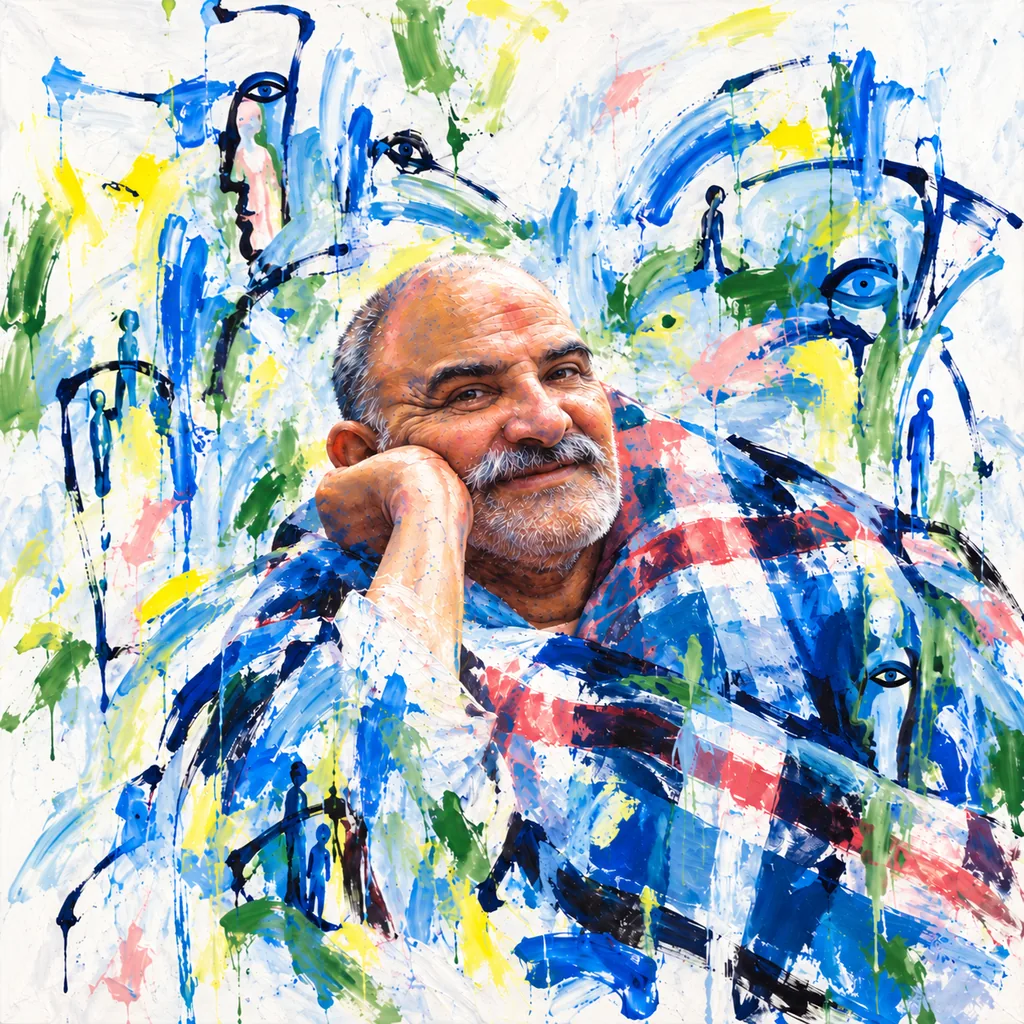
Our reading of Piet Baudoin's portrait is that its relaxed hand and smiling face bring an intimate human scale to a figure often surrounded by miracle narratives. The repeated eyes, small silhouettes and sweeping blue marks belong to this site's contemporary painted interpretation. They are not presented as historical symbols designed by Neem Karoli Baba or as evidence of his appearance at a particular meeting.
Where can you encounter the legacy today?
Kainchi Dham, Uttarakhand: the mountain ashram and Hanuman temple are the principal destination associated with his later life. The community guide distinguishes daytime temple visits from staying inside the ashram. It requires prior arrangements and a reference for accommodation, rather than describing an open residential retreat. Its annual June observance also means a pilgrimage date may be much busier than an ordinary visit. Confirm arrangements directly before travelling. Kainchi visitor information
Vrindavan, Uttar Pradesh: the ashram on Parikrama Marg contains his mahasamadhi memorial and several temples. It is the relevant place for someone specifically seeking his samadhi, rather than simply any temple bearing his name. The guide again distinguishes outside lodging from the limited possibility of staying within the ashram and asks visitors to arrange that beforehand. Vrindavan visitor information
Taos, New Mexico: the Neem Karoli Baba Ashram and Hanuman Temple maintains a living community of worship, chanting and service in the United States. Its website currently flags limitations to daily offerings caused by staffing shortages. Use the live programme instead of assuming that an old retreat listing remains valid. A temple visit, public kirtan and a residential course are different arrangements. Taos ashram's current notices
The lineage is best described through documented relationships: Ram Dass, Dada Mukerjee, Krishna Das and other disciples transmitted different aspects through books, service, music and ashram life. This page is an independent cultural guide. Piet × Baudoin × AI has no affiliation with the teacher's ashrams, foundations or devotional communities. Langmuur, disciples and the continuing community
Questions people ask about Neem Karoli Baba
Who was Neem Karoli Baba?
Neem Karoli Baba was an Indian Hindu devotional teacher, born around 1900 and deceased in 1973, associated especially with Ram, Hanuman, service and the ashrams at Kainchi and Vrindavan. Devotees call him Maharajji. His international reputation grew largely through disciples' books and music. Encyclopedia of Hinduism
What was his core teaching?
His remembered teaching joins love, service, truthfulness and remembrance of God. Feeding and helping other people are practical expressions of devotion. The Taos ashram presents these themes as central, while accounts of individual encounters show that his advice varied with the person. Taos teaching summary
What practice can a beginner start with?
Our suggested introduction is to read several recollections, learn the meaning of a devotional chant and undertake a useful act of service. This is an editorial suggestion, not a formal initiation. Kirtan and temple service are documented practices in the continuing community. Krishna Das on kirtan; Taos ashram
Which book should I read first?
Start with Ram Dass's Miracle of Love for collected encounters with Neem Karoli Baba. Read Be Here Now for Ram Dass's own journey, and By His Grace for Dada Mukerjee's perspective. These are disciples' accounts, not books written by the teacher. Community bibliography
Where are his ashram and samadhi?
Kainchi Dham is in Uttarakhand; his samadhi memorial is at the Vrindavan ashram in Uttar Pradesh. Taos, New Mexico, has a continuing ashram and Hanuman temple. Check the institutions' current visitor information, particularly for overnight accommodation. Kainchi; Vrindavan; Taos
Who were his best-known students?
Ram Dass, Dada Mukerjee, Krishna Das and Larry Brilliant are among the documented disciples associated with his wider reception. Their activities differ: memoir, spiritual teaching, devotional music and service do not amount to one uniform curriculum. Langmuur studies these relationships within the larger Indian and Western community. University of Kent thesis
Did Steve Jobs meet Neem Karoli Baba?
Jobs's 1974 journey to India occurred after Neem Karoli Baba's death in September 1973. He did not meet him on that trip. Accounts of Jobs's interest therefore describe posthumous influence, not a face-to-face apprenticeship. Biographical chronology
Are the miracle stories established historical facts?
They are devotional testimony preserved by followers. Langmuur finds that very little substantive evidence survives outside largely hagiographical sources. The stories matter for understanding belief and community, but this page does not treat supernatural explanations as independently demonstrated. Langmuur's source assessment
How is he connected with art and music?
Krishna Das explicitly connects his kirtan practice with his relationship to Neem Karoli Baba. Windfall of Grace presents devotees' memories through documentary film and music. The portrait on this page is a contemporary interpretation painted for this site by Piet Baudoin. Krishna Das; Film website
Sources and image credits
Sources opened and read for this page on 26 October 2026. Institutional biographies document a community's account; scholarship and reference works provide comparison. Interpretations marked as ours belong to this independent art site.
Portrait © Piet Baudoin. Painted for this site and supplied by the artist; all rights reserved. No historical photograph or third-party artwork is reproduced.
- Constance A. Jones and James D. Ryan, Encyclopedia of Hinduism (2007), Neem Karoli Baba, p. 310, and Transcendental Meditation, pp. 451 to 452
- Katya Langmuur, Becoming the Breath of Ram: The Life and Teachings of Neem Karoli Baba, University of Kent PhD thesis (repository date 2011; submitted 2010)
- Jaya Prasada, excerpt from Sri Siddhi Ma, Penguin Random House India, 25 July 2022
- Wikipedia, Neem Karoli Baba, biographical cross-check and references
- Maharajji community archive, Kainchi Ashram, history and visitor information
- Maharajji community archive, Vrindavan Ashram, memorial and visitor information
- Neem Karoli Baba Ashram and Hanuman Temple, Taos, About Sri Neem Karoli Baba
- Neem Karoli Baba Ashram and Hanuman Temple, Taos, programmes and current notices
- Krishna Das, official biography, music, books and recollections
- Maharajji community archive, The Books About Maharajji
- Japna Tulsi, Windfall of Grace, film, album and release information