Teachers / No. 010
Anandamayi Ma
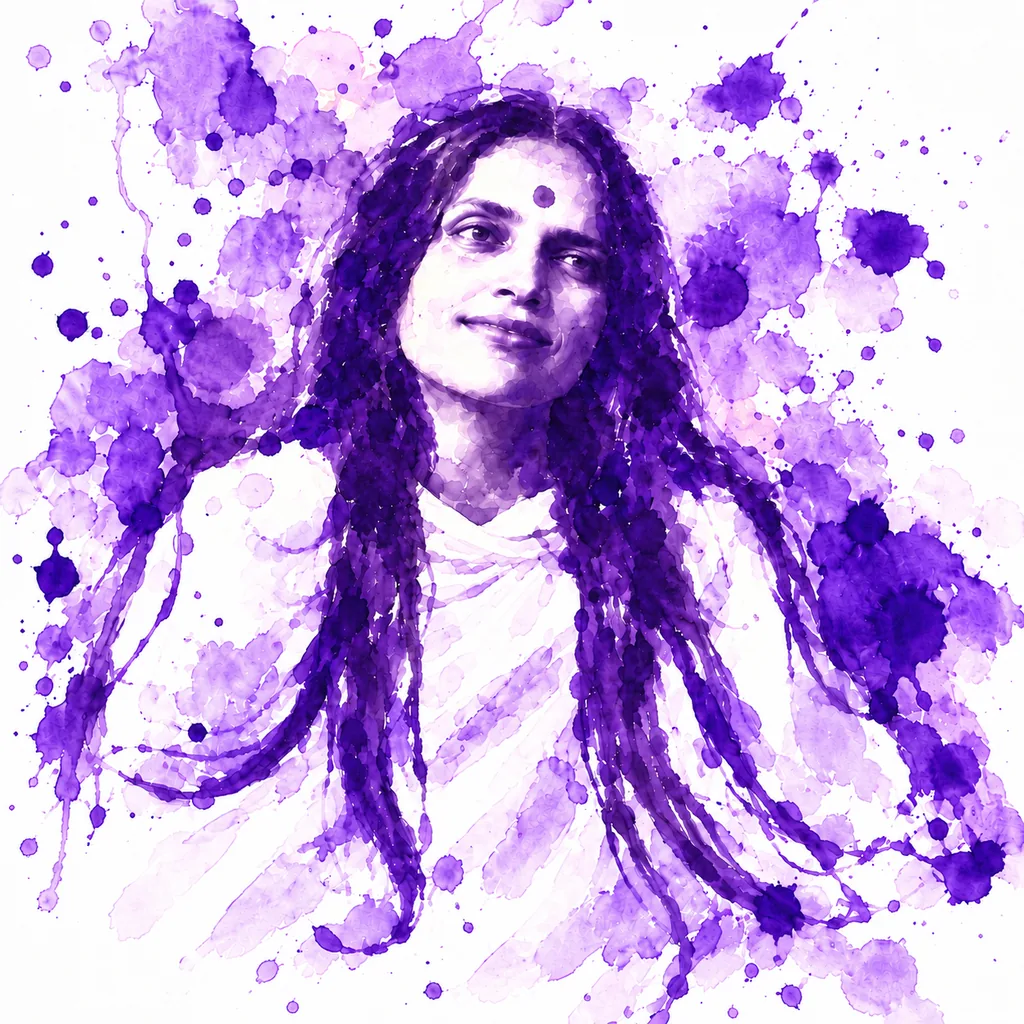
Anandamayi Ma (1896 to 1982), born Nirmala Sundari in what is now Bangladesh, was a Hindu spiritual teacher whose conversations, devotional life and travelling community made self-realisation central to her followers’ lives. Encyclopedia of Religion; Official biography
She left no single systematic treatise or universally prescribed method. Her teaching survives through recorded replies, translators, diaries, photographs and the accounts of people who met her. This guide keeps those kinds of evidence distinct while explaining how to begin reading and what can still be visited. The recorded teaching and its publications
What did she mean by spiritual life?
The practical centre is the search for one’s own true nature, often expressed through remembrance of God. Her recorded answers move between personal devotion and the claim that the divine is not separate from the Self. These are theological and experiential propositions within the teaching, not statements that this page asks readers to accept as established fact. The vocabulary shifts with the questioner, which is one reason a short quotation can sound more exclusive or more permissive than the surrounding conversation. Words of Sri Anandamayi Ma
She did not prescribe one technique for everyone. The scholarly encyclopedia describes a teacher who adapted her guidance to the person, while directing people towards self-realisation as their principal aim. The official teaching selection recommends making time for remembrance even where other duties remain. That combination matters: flexibility of method does not mean indifference about effort, and devotion does not require every visitor to reproduce the unusual events described in her biography. Shukla-Bhatt’s account; Selected teaching
The archive identifies the people who made such a varied record possible. Bhaiji wrote an early account; Gurupriya Devi, also called Didi, belonged to the first close circle at Dhaka; Atmananda translated and compiled conversations for English readers. These names describe different kinds of work around the teacher: remembering, recording, organising and translating. Treating every printed sentence as an unmediated utterance would erase that labour. The early circle; Authors and translators
From Kheora to a travelling community
- 1896: born on 30 April in Kheora, East Bengal, now Bangladesh, as Nirmala Sundari. The official biography describes a religious family of limited means. Early life
- 1908: married Ramani Mohan Chakravarti while still a child. He later became known as Bholanath and came to regard her as his spiritual guide. Marriage and Bholanath
- 1918 to 1924: accounts place a period of intense, apparently spontaneous spiritual practice at Bajitpur. The reported self-initiation in 1922 is central to how followers understand her independence from a conventional training lineage. Bajitpur and initiation
- 1924 and the later 1920s: moved to Shahbag in Dhaka as Bholanath took employment there. Devotees gathered, and Jyotish Chandra Roy, known as Bhaiji, gave her the name Anandamayi. Sources differ in dating parts of this developing public recognition. Shahbag and the early community; Naming and recognition
- 1932: left Dhaka with Bholanath and Bhaiji, beginning a new phase around Dehradun and extensive travel in India. Departure from Dhaka
- 1938 onward: after Bholanath’s death she continued travelling and meeting seekers; ashrams and a community of recorders, organisers and residents developed around her. Teaching and travel
- 1982: died on 27 August in the Dehradun area. Her body was taken to Kankhal, near Haridwar, where her samadhi became a principal pilgrimage place. Final days and funeral; Kankhal memorial collection
Remembrance, the Self and the limits of a label
Devotion and self-knowledge
In the conversations compiled by Atmananda, remembrance, prayer and the search for the Self are connected rather than treated as mutually exclusive routes. A questioner may be directed towards a divine name or form, while another reply speaks of the nameless and formless. Our interpretation is that the shift is responsive: the language is intended to work on a particular question, not necessarily to establish a final vocabulary that eliminates all the others. Recorded conversations and translation
Why does she refer to “this body”?
Her recurrent way of referring to herself is one feature of the recorded speech. Followers interpret it as detachment from personal identity and a sign that her true nature was unchanging. A neutral account can describe that usage without adopting the interpretation as proof. Translation also matters: the English reader is encountering speech recorded and rendered by other people, not a philosophical autobiography in her own English prose. Speech and self-description; Translator’s preface
Was she a guru?
The answer depends on whether the word identifies an informal guiding function or formal initiation. Hallstrom’s chapter abstract describes a paradox: she encouraged people to seek a true guru, yet her community did not ordinarily classify her as one because she did not provide conventional diksha, or initiation. Her conversations nevertheless performed a guiding role. The early narrative of initiating herself and Bholanath should therefore not be confused with establishing a routine initiation system for everyone who later visited. Hallstrom, chapter abstract; Early initiation account
Does a joyful appearance mean an easy teaching?
The name Anandamayi is associated with bliss, and images of her laughter have shaped her reception. The recorded advice is also insistent about regularity, restraint and sustained effort. The Samyam Saptah programme combines meditation, religious recitation, study and devotional singing across a full week. Her public image can therefore mislead if it is reduced to the proposition that feeling good is the entire purpose of the spiritual life. Purpose and model programme; Selected practical advice
What can a beginner actually do?
The most accessible starting point is the practical teaching addressed to people with duties. The official selection asks for a place for remembrance morning and evening, even if a person initially manages little. It recommends turning ordinary work towards the divine rather than waiting for a perfectly arranged life. This is advice within a devotional framework, not a claim that all readers must adopt a particular name or belief before they can understand the historical teacher. Daily remembrance and work
In the letters and related recorded exchanges, repetition of a divine name can accompany the senses and the organs of action as they continue their work. The intent is continuity of remembrance, not the physical abandonment of every activity. A reader who is deciding whether the practice fits should first distinguish that religious intention from a concentration exercise borrowed for another purpose. The words may be similar while the commitments differ. Remembrance in activity
Samyam Saptah means a week devoted to restraint and practice in company. The archive gives a model timetable with silent meditation, scriptural recitation, teaching, singing, meals and rest. It explains the week as a taste of a dedicated life that participants might continue, as possible, during the year. That is a description of the programme’s purpose, not evidence that an event is currently running at a particular ashram. Use the current calendar and the organisers for that question. Model week; Calendar and visiting information
The conversations collected in Words also advise a person who has not found a guru to keep a chosen divine name or form as a constant companion, while seeking appropriate guidance. The advice joins personal practice to relationship with a teacher; it does not imply that inventing a private initiation is the standard route. This is a specific example of how an accessible recommendation can coexist with demanding claims about spiritual authority. Words, conversation on seeking a guru
Which books preserve the strongest entry points?
Words of Sri Anandamayi Ma
Begin here if your main question concerns practice. Atmananda’s preface explains the aim of preserving both meaning and the character of her speech. Text and translator’s preface
Matri Vani and Sad Vani
Matri Vani provides a more compact collection of teachings. The archive identifies Sad Vani, recorded by Bhaiji, as an early printed collection, originally issued in Bengali in 1935. Collections of short sayings offer an easy entrance, but remove much of the conversational situation. Our preference is to alternate them with longer exchanges so a memorable line remains connected to the practical problem it is meant to address. Matri Vani; Publication details
Mother as Revealed to Me
Bhaiji’s account is a close devotee’s record, useful for understanding the early community and the meanings followers attached to events. Read it as witness literature. Its intimacy and its commitment belong together: closeness can supply details unavailable elsewhere, while reverence shapes how those details are interpreted. It is a different undertaking from a critical historical biography, and neither the reader nor the book benefits from pretending otherwise. Bhaiji’s account
Mother of Bliss and Her Life and Wisdom
Hallstrom’s Mother of Bliss is the scholarly route into sainthood, gender and the recognition of spiritual authority. Richard Lannoy’s Anandamayi: Her Life and Wisdom joins remembered encounters, photographs and translated teaching; the archive notes that the online version omits the printed photographs. These books answer different questions. Our reading recommendation is to place a scholarly analysis beside a community account, rather than expecting either to offer the only legitimate view. Oxford overview; Lannoy publication details
What do people around the world say?
India: the scholar Gopinath Kaviraj introduced the collection Mother as Seen by Her Devotees. Its contributors include writers with long associations and others describing a first impression. The collection declares its participants’ admiration, which makes its position clear. The scholarly encyclopedia also records the interest of public figures including Indira Gandhi. These connections establish a broad social reception; they do not turn political prestige or scholarship into verification of divine identity. Collected testimonies; Public reception
France: Jean Herbert’s translated preface describes her as “an incarnation of joy”. This is devotional appraisal, and should remain in quotation marks and attached to its author. Arnaud Desjardins’s contribution describes the power of seeing her photographs before meeting her. The written responses give a more precise account of international influence than saying she was simply admired everywhere: particular images, translations and encounters carried the interest. Herbert and Desjardins
Britain: photographer and writer Richard Lannoy records both commitment and difficulty in finding an audience. He recalls a French publisher’s dismissive response to an early book proposal, “Elle est ratee!”, which he translates as “she’s a dud”. It is Lannoy’s report of an editor’s reaction, not a statement by the teacher or a reasoned critique of her teaching. Its value is historical: international recognition was uneven and did not automatically follow the enthusiasm of a witness. Publishing history in Lannoy’s afterword
Germany: Melita Maschmann’s books and diaries provide another long encounter. The German community’s bibliography describes her years near Anandamayi Ma from 1963 and lists diary material from 1977 to 1982. This is a sustained literary record rather than a celebrity endorsement. A bibliography establishes the existence and scope of those writings; it does not allow a reader to claim to have checked every reported event inside the books. Maschmann books and diaries
The United States and academic study: Hallstrom’s work asks how devotees recognise a woman as a manifestation of the divine. The gender chapter’s abstract identifies interviews with twelve women devotees and asks whether such a relationship empowers them. The question is deliberately more precise than assuming that reverence for one exceptional woman automatically transforms the social position of women generally. Only the overview and chapter abstracts, not the full book, were available for this page. Hallstrom, gender chapter; Book overview
Criticism: caste, service and women’s authority
Shukla-Bhatt’s encyclopedia entry documents a tension between an inclusive teaching at the level of the Self and purity rules maintained by ashram administrators. It records criticism that she appealed to elites and higher castes, and that charitable service was not sufficiently central, while also noting educational and medical institutions associated with the ashrams. These are documented criticisms of social practice. A general assertion that she stood beyond every hierarchy would erase the very issue the source asks readers to examine. Caste, criticism and institutional service
Her authority also unsettled some conventional expectations: a wife becoming her husband’s spiritual guide does not fit a simple picture of female submission. Yet Hallstrom’s research treats the effect on women as an empirical and interpretive question. Our assessment is that both facts belong in view: an exceptional woman can widen the imaginable possibilities of spiritual life without automatically removing the rules and inequalities around her. Admiration should make the question sharper, not disappear. Question of empowerment; The guiding role
Photographs, film, music and things made by hand
Photographs were active agents in her reception. Desjardins describes first encountering her image in Autobiography of a Yogi and, years later, in Lannoy’s book India. He says the pictures “stirred me so profoundly” that they remained with him. That is a documented chain from a printed image to a later meeting. It is more informative than assigning her a vague influence on visual culture or inventing a school of painters who followed her. Desjardins’s first-person account
Lannoy also records a French television documentary by Desjardins and the role of Jean Herbert’s French publications. Film, photography and translation therefore helped carry her presence beyond the people who could travel with her. Our reading is that a close portrait can make a viewer feel personally addressed, but that feeling should not be mistaken for historical access to what the subject was thinking. The record documents the response, not a direct transfer of interior experience. International circulation
Music belonged to the community’s ordinary religious life. The official kirtan page preserves songs, transliterations and translations, showing how the voice and repetition carry material that a philosophical summary leaves out. The Matri Smriti Museum in Kankhal lists cymbals used during kirtan, handicrafts including a carpet, family photographs and paintings of her life. These objects make the connection with art specific: singing, making and memorial representation all have a material record. Songs and translations; Museum collection
Where can you visit her ashrams and samadhi?
Kankhal, near Haridwar, is the main destination for the samadhi and Matri Smriti Museum. The museum preserves rooms and objects associated with her final period, alongside images tracing the journey from Kheora. A visit can therefore combine a living devotional setting with a historical collection. The official directory supplies the ashram’s current contact route; check opening arrangements and accommodation directly rather than assuming every part of the site is always accessible. Museum and memorial; Ashram directory
The directory also lists ashrams at Varanasi, Dehradun and other locations. The calendar and visiting page gives context for observances and stays. A historically described Samyam week is not a bookable retreat until the organisers confirm a current event and space. For readers elsewhere, the archive’s translations, recordings and community information offer ways to study without treating travel as a prerequisite for understanding the teaching. Locations and contacts; Visiting information; Online texts
Questions people ask about Anandamayi Ma
Who was Anandamayi Ma?
Anandamayi Ma was a Hindu spiritual teacher, born Nirmala Sundari in Kheora in 1896, in what is now Bangladesh. She travelled extensively in India, answered seekers’ questions and became the centre of a community of devotees and ashrams. She died in 1982. Official biography
What is her central teaching in plain words?
Make the search for your true nature central to life, through remembrance of God and a practice suited to you. Her replies connect devotion with self-realisation rather than prescribing one technique for everybody. These are her religious teachings, not claims of affiliation by this site. Selected teaching; Recorded conversations
How can a beginner start?
Her practical advice includes setting aside time morning and evening for remembrance while continuing ordinary duties. Our suggested first step is to read a complete exchange in Words of Sri Anandamayi Ma and identify the question it answers. Avoid turning advice to one person into a universal rule. Daily practice; Words
Which books should I read first?
Start with Words of Sri Anandamayi Ma for conversations or Matri Vani for shorter teachings. Read Mother as Revealed to Me as a devotee’s witness account, and Hallstrom’s Mother of Bliss for scholarly questions about authority and gender. This is our suggested route for different interests. Words; Matri Vani; Bhaiji; Hallstrom
Where are her samadhi and ashrams?
Her samadhi is at Kankhal near Haridwar, where the Sangha also maintains the Matri Smriti Museum. The official directory lists other ashrams, including Varanasi and Dehradun. Check directly for current access and accommodation. Museum; Ashram contacts
What is Samyam Saptah, and can I attend one?
It is a week of concentrated practice and community, with meditation, study, recitation and devotional singing. The archive’s model timetable explains the form, but does not guarantee a present event. Check the current calendar and ask the relevant ashram about participation and places. Programme; Calendar
Did she have a guru or a formal lineage of students?
Her early biography describes self-initiation and her husband becoming her disciple. Hallstrom distinguishes her later informal guiding role from a conventional system of initiation. Important associates included Bhaiji, Gurupriya Devi and translators such as Atmananda; later claims of succession need their own evidence. Early life; Hallstrom’s abstract; Recorders and translators
Was she simply a teacher of effortless bliss?
No. Her smiling image and name can obscure the recorded emphasis on regular remembrance, restraint and sustained practice. The weeklong Samyam programme is one concrete example. Accounts of extraordinary states describe followers’ interpretations and should not be offered as guaranteed results for a beginner. Practical advice; Samyam Saptah
Sources and image credits
Sources opened and checked on 26 October 2026. The comparison uses Wikipedia, the official archive, Shukla-Bhatt’s Encyclopedia of Religion entry and Hallstrom’s Oxford overview and chapter abstracts. Testimonies are named as testimonies. The whole Oxford book was not available; our interpretations are marked. This independent art site has no affiliation with this teacher, any lineage or any organisation mentioned here.
- Wikipedia, Anandamayi Ma
- Bithika Mukerji, Introduction to Sri Ma’s Life, official archive
- Neelima Shukla-Bhatt, Anandamayi Ma, Encyclopedia of Religion, 2005
- Lisa Lassell Hallstrom, Mother of Bliss, Oxford University Press, overview
- Hallstrom, Anandamayi Ma and Gender, chapter abstract
- Hallstrom, Anandamayi Ma as Guru, chapter abstract
- Official archive, Sri Ma’s Teachings
- Words of Sri Anandamayi Ma, translated and compiled by Atmananda
- Matri Vani, online text in the official archive
- Bhaiji, Mother as Revealed to Me, online text
- Official archive, books online and publication details
- Mother as Seen by Her Devotees, collected testimonies
- Richard Lannoy, Anandamayi: Her Life and Wisdom, 1996, online text
- German-language Anandamayi community, bibliography and Maschmann diaries
- Official archive, Samyam Saptah, purpose and model programme
- Official archive, ashram contacts
- Official archive, calendar and visiting information
- Shree Shree Anandamayee Sangha, Matri Smriti Museum and Research Centre
- Official archive, Ashram Kirtan, songs and translations
- Official archive, letters and recorded conversations