Movements / No. 006
De Stijl
De Stijl is the Dutch movement founded around Theo van Doesburg's 1917 journal that used abstract geometry, independent colour and asymmetrical balance to rethink painting, furniture and the built environment. Museum De Lakenhal
The name means “The Style”. Its familiar red, yellow and blue rectangles are the entrance to a larger project: changing the relationship between individual expression and shared life. This guide separates the movement from Mondrian's particular rules, identifies works and collections, and puts museum interpretations beside the language of the art market. Tate; Museum De Lakenhal
How do you recognise De Stijl?
Look for an arrangement built from straight lines, rectangular areas and clearly separated colours, with equilibrium achieved without mirror symmetry. In painting, horizontal and vertical lines can divide a white field into unequal intervals. In architecture and furniture, intersecting planes and bars can make a solid object seem like an open assembly of independent parts. The purpose is a coherent relationship between elements, rather than an ornamental pattern applied after the object has been designed. Städel Museum; Wikipedia, De Stijl
Primary colours are useful clues, but a poor membership test. Kunsthal KAdE's exhibition on De Stijl colour showed that its protagonists held different theories: Huszár used Wilhelm Ostwald's ideas about colour mixtures; Vantongerloo developed a seven-colour system; Rietveld treated colour as a means of clarifying perception and construction. Our reading is that the decisive question is what colour does within an arrangement, rather than whether all three primaries appear. Kunsthal KAdE, The Colours of De Stijl
When and where did it happen?
- 1914–1917: war interrupts Mondrian's return to Paris. In the Netherlands he exchanges ideas with Bart van der Leck, while Van Doesburg gathers collaborators for a new publication. Wikipedia, De Stijl
- 1917: Van Doesburg establishes the journal in Leiden; Mondrian's contributions develop the theory of neo-plasticism. Museum De Lakenhal; Tate
- 1918: the first manifesto articulates a new balance between individual and universal; Rietveld joins the circle. De Stijl manifesto, Wikimedia Commons; Wikipedia, De Stijl
- 1921–1924: Van Doesburg promotes the ideas in Weimar, collaborates on architectural projects and develops the diagonal compositions associated with Elementarism. Städel Museum; Wikipedia, De Stijl
- 1924: the Rietveld Schröder House in Utrecht gives an inhabited form to the movement's spatial ambitions. Wikipedia, De Stijl
- 1931–1932: Van Doesburg dies in 1931; a commemorative final journal issue follows in 1932. The circle's principal organising force disappears, although members continue their individual work. Wikipedia, De Stijl

The end of the movement is therefore different from the end of its visual language. Mondrian's later paintings and Rietveld's later designs belong to careers extending beyond the original association. Describing a 1940s Mondrian as a legacy of De Stijl is more precise than suggesting the journal's collective still existed then. Wikipedia, De Stijl
What were the artists trying to change?
A universal art after a destructive war
De Lakenhal places the movement's ambition against the First World War. Van Doesburg regarded excessive individualism as a cause of catastrophe and wanted a new art capable of addressing people on equal terms. The objective was a more harmonious society, reached through relations that transcended an individual subject or personal anecdote. This was a historical aspiration, not evidence that rectangular paintings actually produced social harmony. Museum De Lakenhal
Mondrian called his approach Nieuwe Beelding, usually translated as neo-plasticism. “Plastic” here concerns the formation of a visual image, not synthetic material. His restrictions removed naturalistic colour and recognisable objects in favour of primary colour, non-colours and horizontal and vertical relations. De Stijl provided a publishing platform for these ideas, but included artists whose practices did not permanently follow every restriction. Tate; Wikipedia, De Stijl
From the canvas to a whole environment
The movement's sources were not exclusively geometric paintings by its own members. Its architectural thinking engaged with Hendrik Petrus Berlage and Frank Lloyd Wright, while Mondrian's exchanges with M. H. J. Schoenmaekers formed another intellectual context. Schoenmaekers published The New Worldview in 1915 and Principles of Formative Mathematics in 1916. These connections help distinguish a historically situated search for universal relations from the claim that a small set of colours and lines simply emerged without predecessors. They also explain why painting, philosophy and construction could enter the same discussion. Wikipedia, De Stijl
Kunstmuseum Den Haag emphasises the abolition of hierarchies between artistic disciplines. Painters and architects wanted to redesign the human environment, so the movement encompassed interiors, buildings, furniture and urban planning. A painting could test the balance of areas; a room could turn those relations into an experience involving bodily movement. The programme was larger than either the saleable canvas or a recognisable graphic identity. Kunstmuseum Den Haag
Rietveld's Red and Blue Chair and the house designed with Truus Schröder are central examples. The chair's separate members and the house's planes challenge the appearance of a closed, weighty block. Oud's Café De Unie in Rotterdam and Van Doesburg's work on the Aubette in Strasbourg extend the story into commercial and communal spaces. These projects require attention to use, collaboration and reconstruction, as well as to the original drawings. Wikipedia, De Stijl; Kunstmuseum Den Haag
A movement with disagreements
Van Doesburg's diagonal Elementarism is the best-known challenge to Mondrian's horizontal and vertical system. Even introductory sources disagree about when Mondrian's withdrawal should be dated: Tate gives 1923, while Wikipedia's narrative places the rupture in 1924. The secure point is the disagreement over direction and equilibrium during the mid-1920s. Treating a single date as a settled explanation conceals the extended development of their positions. Tate; Wikipedia, De Stijl
The journal also admitted experiments that resist the stereotype of solemn geometry. Van Doesburg's Dada writing under the name I. K. Bonset brought disruptive typography and sound poetry into the same publishing enterprise. His network depended heavily on correspondence and changing collaborations. A unified brand is a convenient retrospective description, but the historical movement was more argumentative and less institutionally fixed. De Stijl, November 1921, Wikimedia Commons; Wikipedia, De Stijl

Which works matter, and where can you see them?
The sequence includes paintings and printed documents, followed by two later works that reveal the movement's afterlife. Dates and collections identify objects, not guaranteed current displays. For the spatial dimension, consult the Rietveld Schröder House in Utrecht and the Aubette in Strasbourg alongside museum collections. Wikipedia, De Stijl
Van Doesburg, Composition VII: The Three Graces, 1917
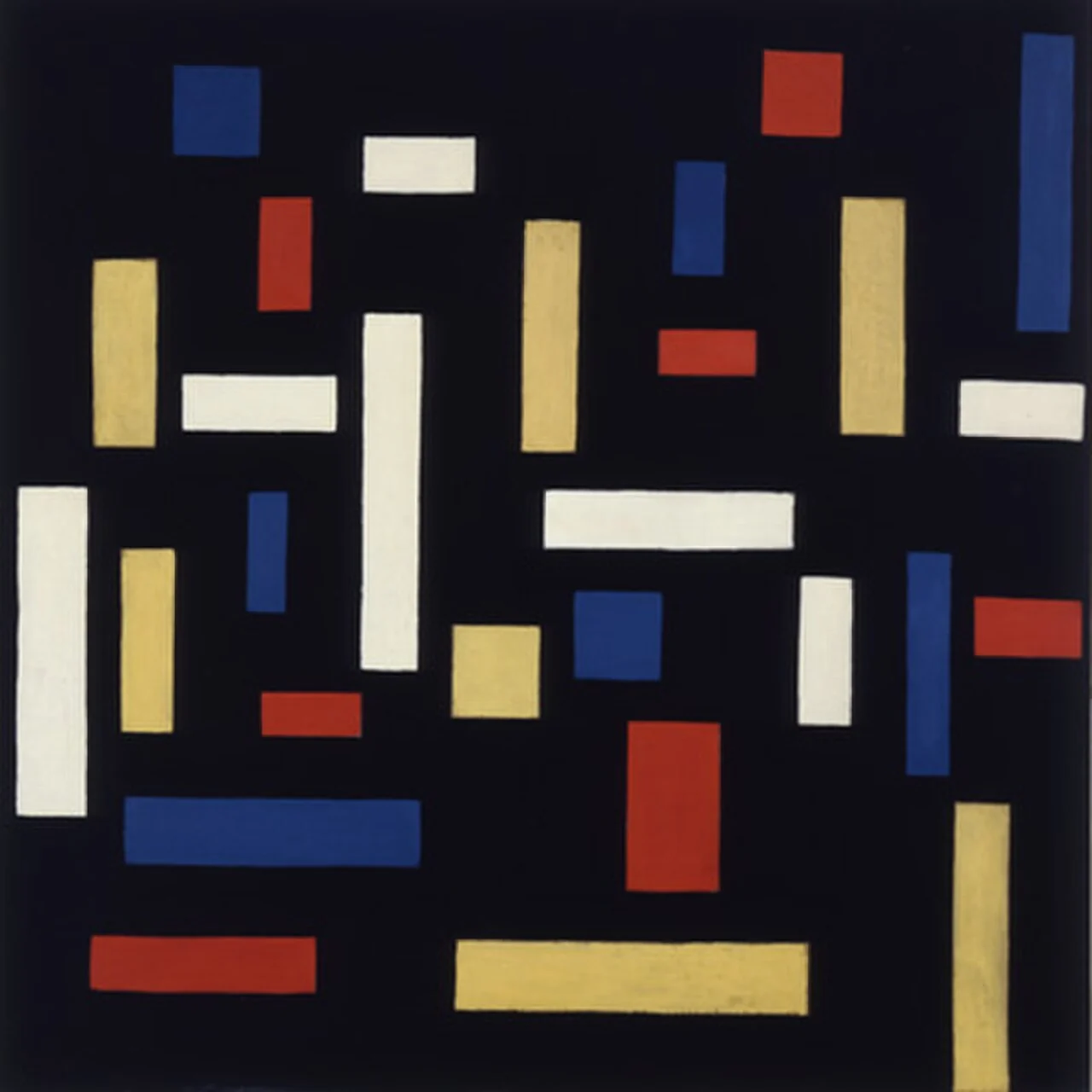
This painting belongs to the Mildred Lane Kemper Art Museum in St Louis. The title retains a traditional figurative subject while the surface converts it into interlocking rectangles. Our reading is that this tension makes an unusually clear starting point: the new vocabulary emerged through transforming existing subjects, rather than arriving as a completely finished geometric code. Wikimedia Commons, Kemper collection details

Mondrian, Composition in Colour A, 1917
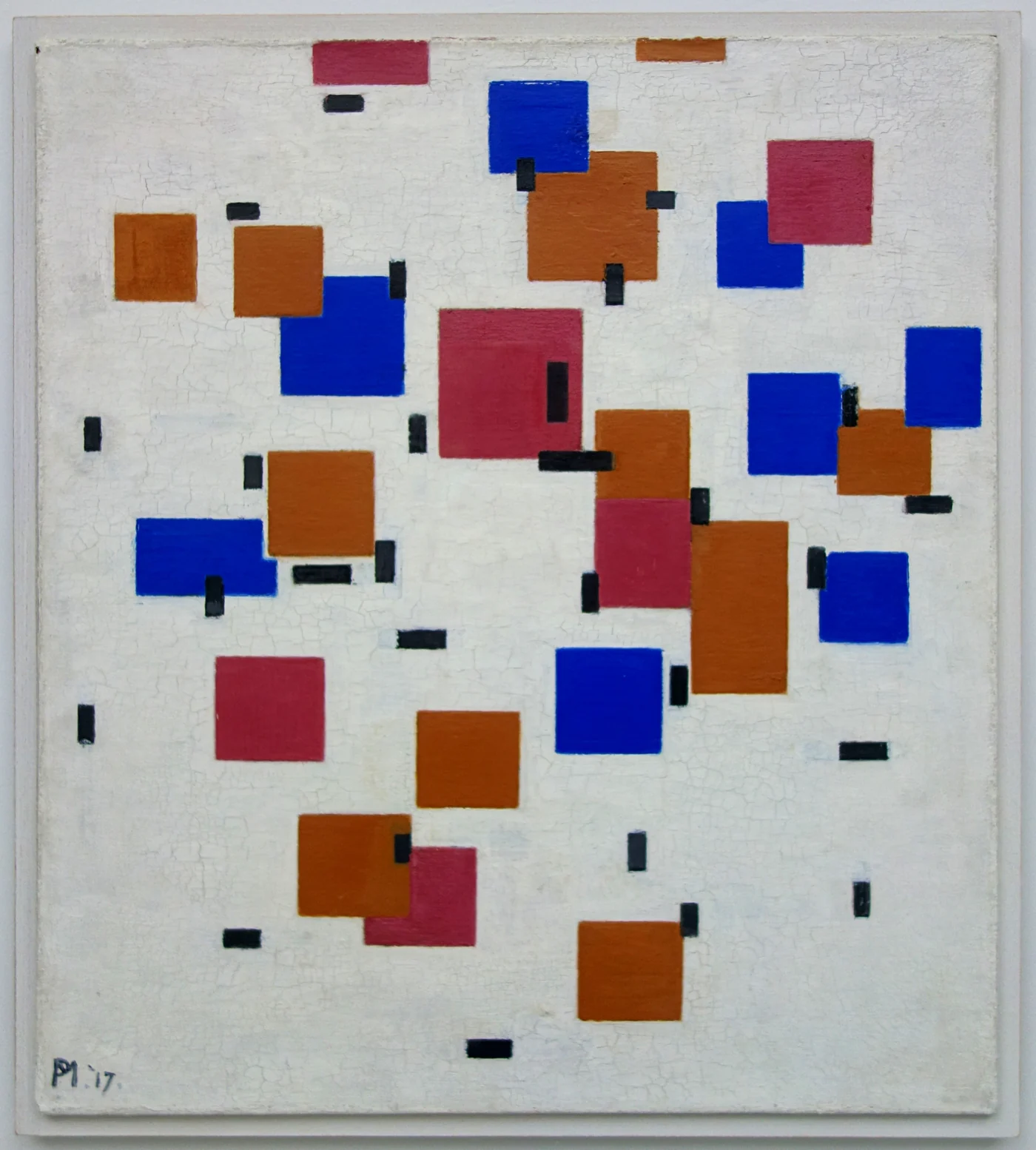
The Kröller-Müller Museum in Otterlo owns this small canvas. Separate coloured and dark marks operate without the continuous black grid familiar from later paintings. Its importance here is chronological: 1917 marks the journal's beginning, not the instant when every member adopted an identical surface style. Our comparison with the later works shows a vocabulary being tested and tightened. Wikimedia Commons, Kröller-Müller collection details

The first manifesto, 1918
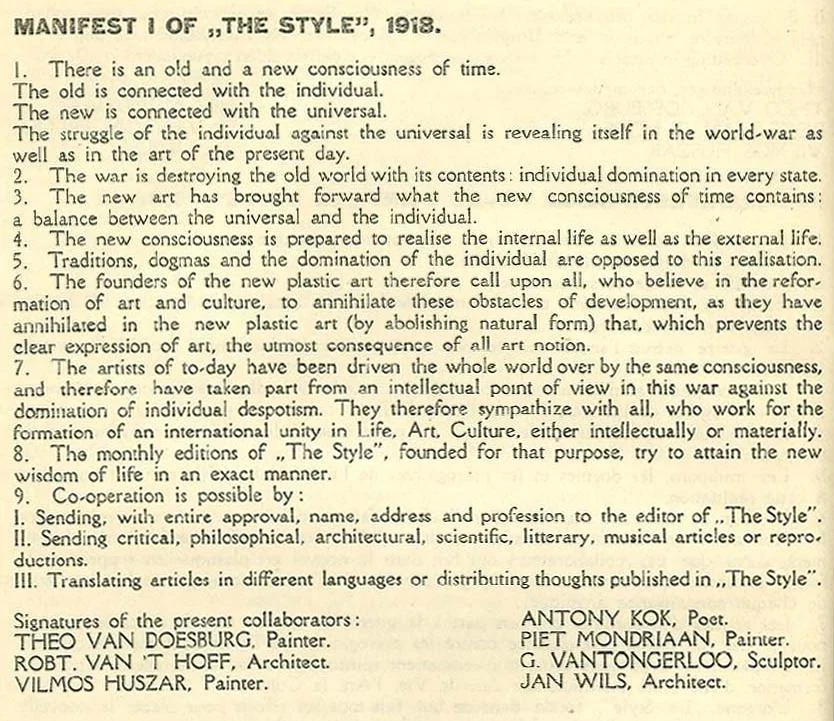
The manifesto printed in the journal's second volume is a work of collective self-definition. Its numbered form makes the desire for a new order explicit, while the signatures locate the programme in a network of named participants. Reading the document beside the pictures helps distinguish what the artists wanted to change in society from what their individual compositions actually demonstrate. Wikimedia Commons, De Stijl manifesto; Museum De Lakenhal
Mondrian, Tableau I, 1921
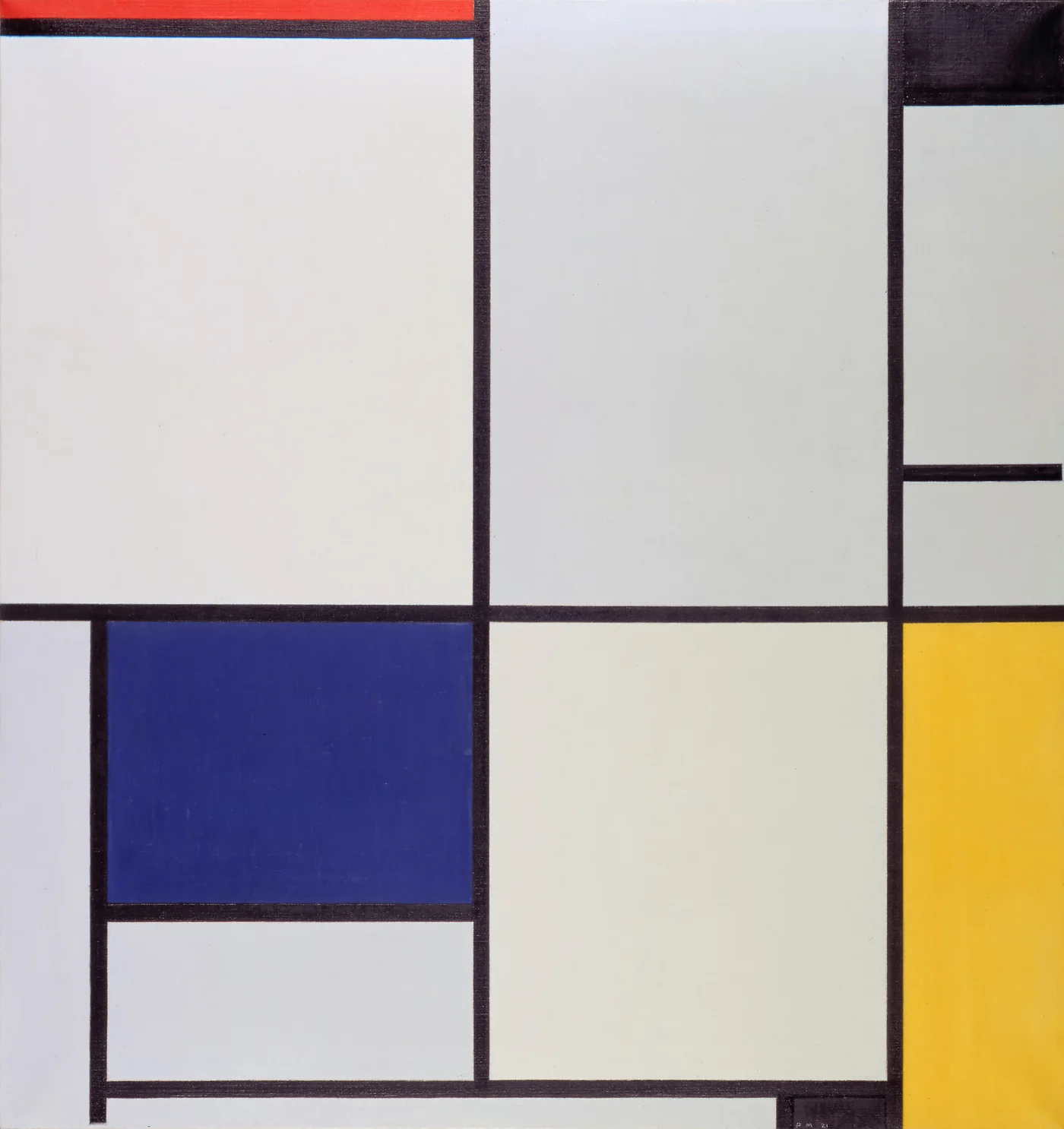
Held by Kunstmuseum Den Haag, this painting brings the recognisable grid and primary-colour vocabulary into focus. Unequal areas make balance a matter of weight and interval rather than matching halves. This last sentence is our formal reading; the owning museum situates such painting within an environment-wide programme shared with architecture and design. Wikimedia Commons, Tableau I; Kunstmuseum Den Haag

Van Doesburg as I. K. Bonset, sound-poetry page, 1921
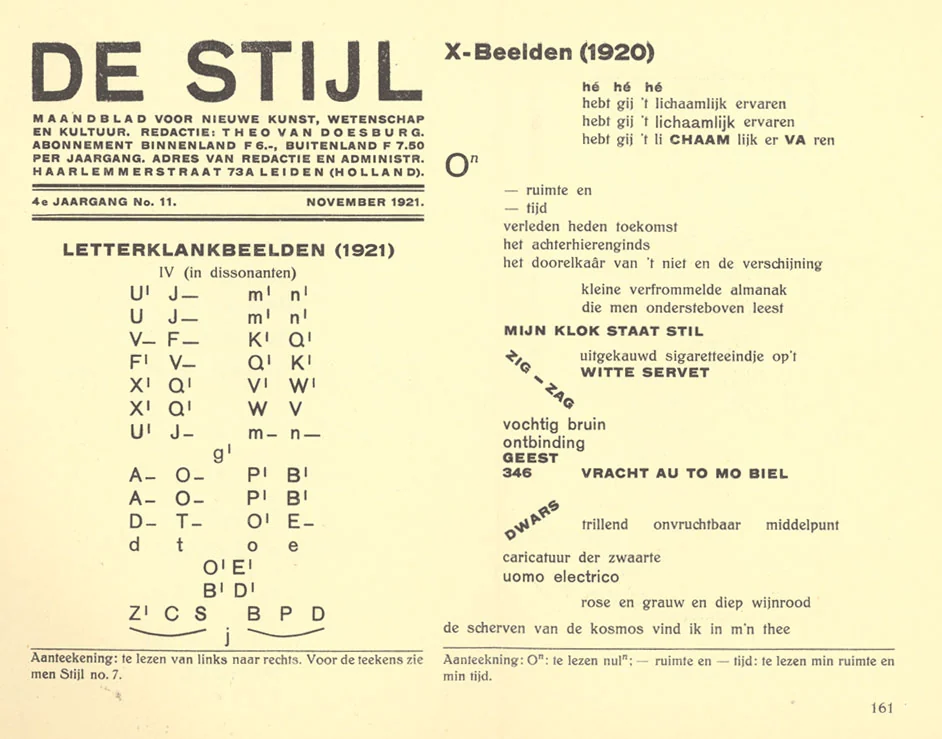
This extract from the November 1921 journal introduces the Dada side of the editor's practice. Letters become visual material and cues to sound. Unlike a painting of a room, the printed page can circulate as a reproducible vehicle for an argument. Its presence complicates any account of De Stijl as exclusively a disciplined grammar of rectangles. Wikimedia Commons, De Stijl sound poetry
Mondrian, Composition II in Red, Blue and Yellow, 1930
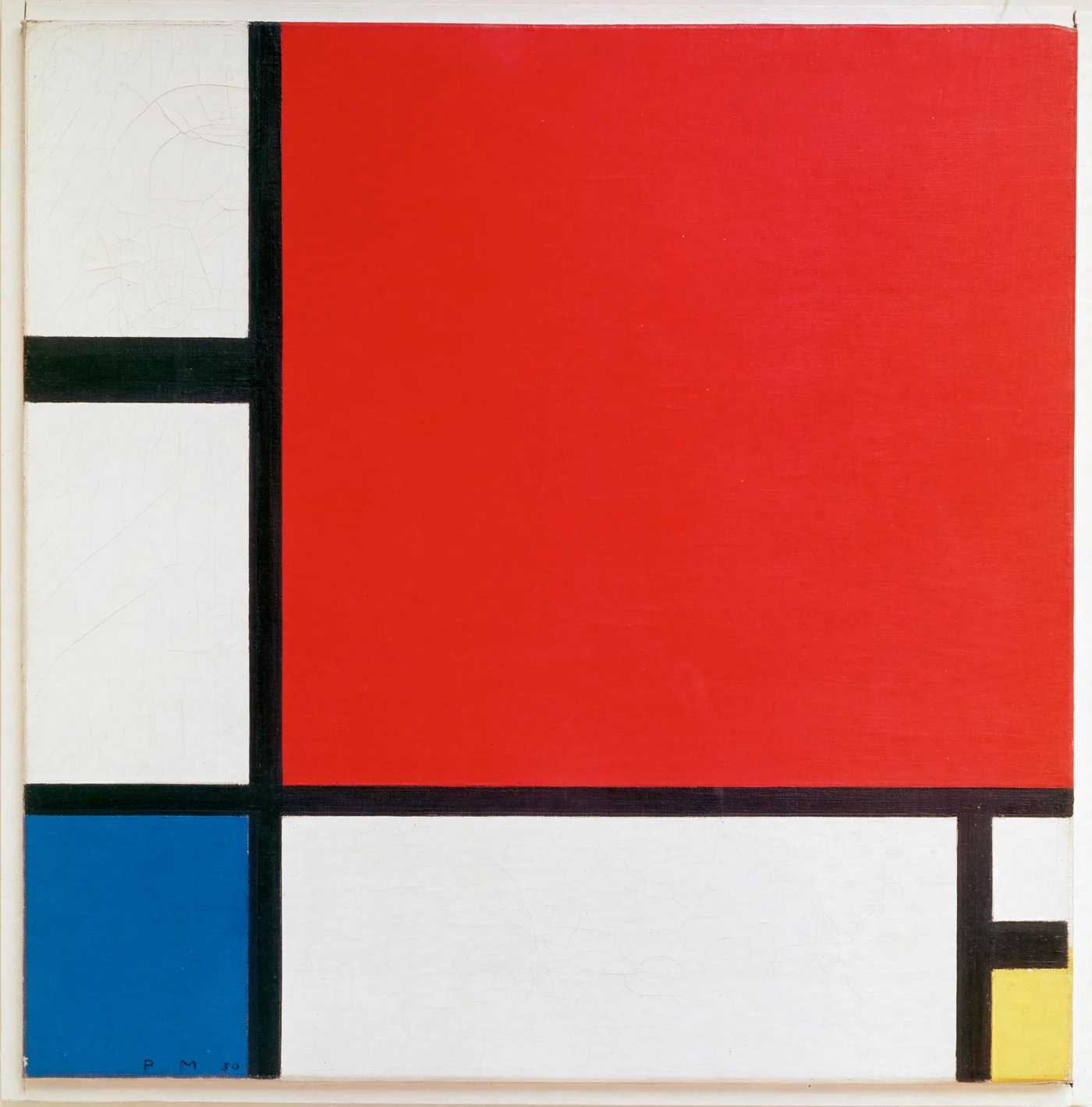
The Kunsthaus Zürich painting concentrates a large red area against narrow divisions and smaller coloured accents. It should not be confused with the similarly titled Composition No. II sold at Sotheby's in 2022. Repeated composition titles make the date, dimensions, collection and catalogue identity essential. Our reading of this example concerns the pressure between large and small areas, not a fixed symbolic meaning for red. Wikimedia Commons, Zürich painting; Sotheby's, Composition No. II

Van Doesburg, Counter-Composition VII, 1924
For a public counterpart to Mondrian's right-angled painting, De Lakenhal owns Van Doesburg's Counter-Composition VII, painted in Paris in 1924. The museum acquired it at a London auction in March 2017, the centenary of the journal's founding. That acquisition makes Leiden a destination for examining the movement's internal development, rather than only its origins. Read beside the manifesto and the later diagonal experiments, the painting offers a concrete object through which to investigate disagreement over balance and direction. It is discussed here without an additional reproduction. Museum De Lakenhal, Counter-Composition VII
Mondrian, Composition No. 10, 1939–1942
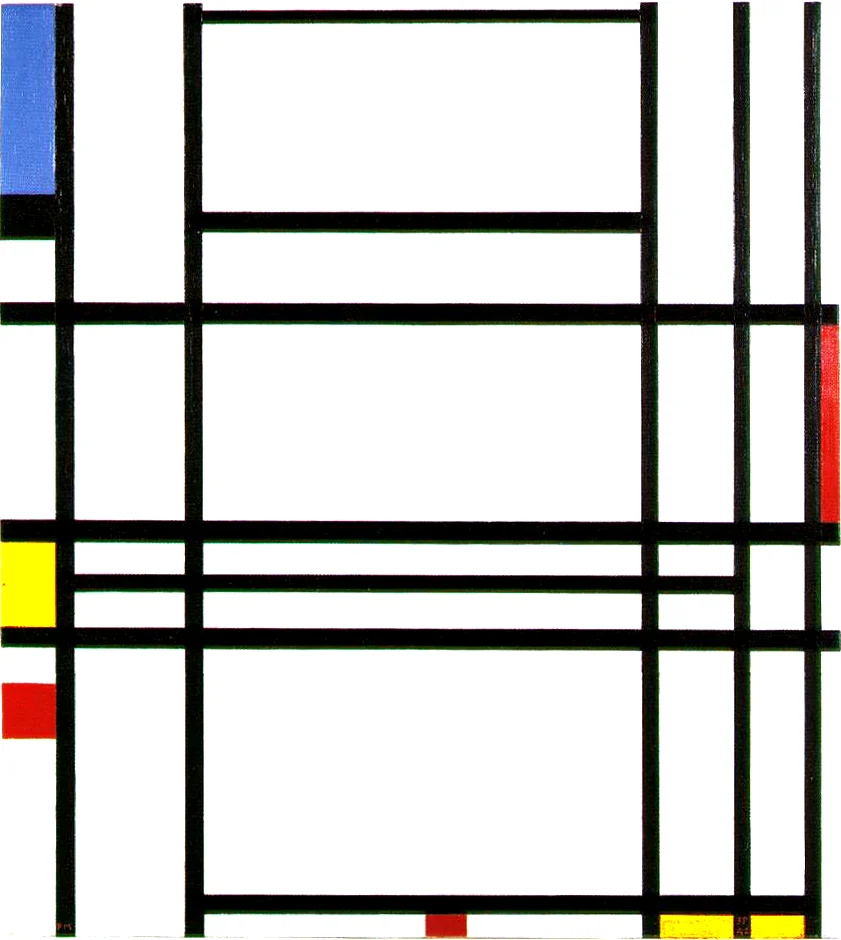
This privately held painting extends the grid beyond the association's lifetime. It is included as an example of continuity in Mondrian's own investigation, rather than a late collective manifesto. A private collection reference also means there is no permanent public gallery to promise a visitor. The work's documentation should be distinguished from a current exhibition itinerary. Wikimedia Commons, Composition No. 10

Mondrian, Victory Boogie Woogie, 1942–1944
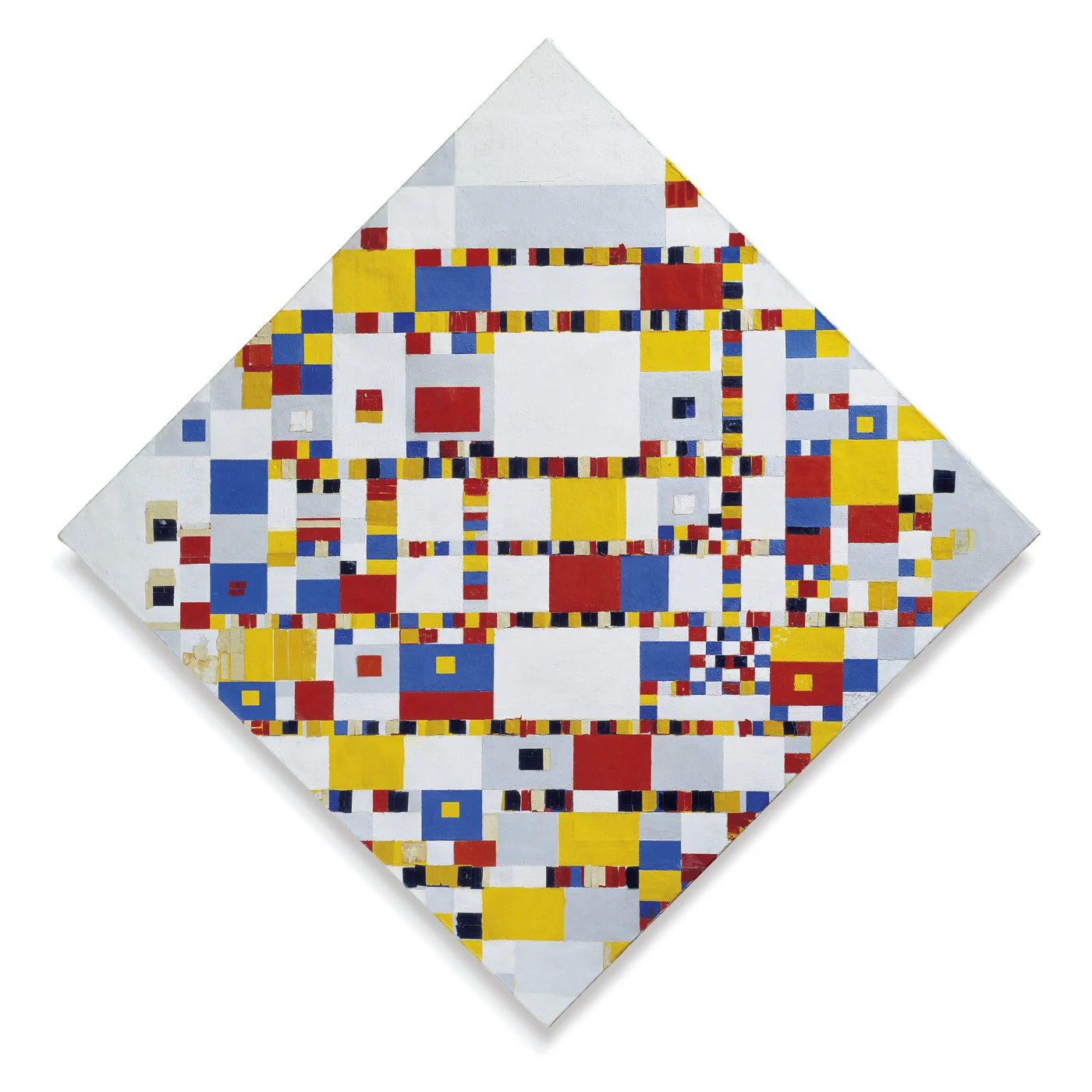
Kunstmuseum Den Haag's unfinished late painting breaks the grid into flickering coloured units. It belongs to the artist's New York period and is a destination for understanding how far his practice travelled after De Stijl. Our reading is that its restless density makes a useful corrective to the idea that his entire career sought an identical, static calm. Kunstmuseum Den Haag; Wikimedia Commons, Victory Boogie Woogie

What do museums, galleries and the market say?
In the Netherlands, De Lakenhal explains De Stijl through its social ambition and Leiden origins; Kunstmuseum Den Haag presents painting with models, interiors and furniture. In Germany, the Städel stresses universal proportion and the transfer from painting into a complete environment. These complementary emphases make the movement both an intellectual project and a material history of designed things. Museum De Lakenhal; Kunstmuseum Den Haag; Städel Museum
Reception includes resistance from later artists. KAdE's account of Barnett Newman explains his wish to release primary colours from the didactic system he associated with De Stijl. He regarded Mondrian as decorative. This is a reported critical position, not our judgement of the paintings, and shows that influence can take the form of opposition as well as admiration. Kunsthal KAdE
The commercial framing can be narrower. New York's Acquavella places a 1921–1925 tableau and New York / Boogie Woogie among its sold masterworks, bringing early and late Mondrian into the same prestige category. Sotheby's Oliver Barker calls Composition No. II “an undeniable masterwork”. That phrase expresses a seller's evaluation; it does not establish a consensus about every work associated with the movement. Acquavella Galleries; Sotheby's, Oliver Barker
On 14 November 2022, Sotheby's New York sold Mondrian's 1930 Composition No. II for a reported $51 million to a collector in Asia, setting an artist auction record at that sale. This is a dated transaction, not a current valuation for De Stijl as a category. Its relevance is the international demand for a rare, securely identified painting by one participant, rather than a representative price for a magazine, drawing or piece of furniture. Sotheby's, November 2022 results
How does De Stijl differ from its neighbours?
De Stijl was a journal-centred network; the Bauhaus was an educational institution with workshops, teachers and successive directors. Van Doesburg's activities in Weimar brought the two into contact, but he did not turn De Stijl into a Bauhaus department. Suprematism shares a geometric vocabulary while proposing its own philosophy of non-objective feeling. These are overlapping histories, not interchangeable names for any red square on white. Städel Museum; Wikipedia, De Stijl; Tate, Suprematism
The enduring legacy includes abstract painting and modern architecture, but also later investigations of autonomous colour. KAdE's exhibition linked the earlier debates to Josef Albers, Richard Paul Lohse, monochrome painting and contemporary light installations. This is an exhibition's comparative genealogy, not proof that all later colour art descends from one Dutch source. The movement remains useful because its arguments about relations can be tested in materially different settings. Kunsthal KAdE
Artists
Piet Mondrian is the subject of our related artist guide. The wider movement also requires Van Doesburg, Van der Leck, Huszár, Rietveld, Oud and Vantongerloo; reducing it to one painter loses its publishing, architectural and sculptural dimensions. Tate
Questions people ask about De Stijl
What is De Stijl in simple words?
De Stijl was a Dutch movement that used abstract shapes and independent colour to seek order across painting, furniture and architecture. It began around a journal founded by Theo van Doesburg in 1917. Its aim extended to a more harmonious shared environment. Museum De Lakenhal
When and where did De Stijl begin and end?
The journal began in Leiden in 1917. Van Doesburg's death in 1931 ended its main organising force; a commemorative issue appeared in 1932. Individual artists continued working with the movement's ideas afterwards. Wikipedia, De Stijl
Who were its key artists?
Piet Mondrian and Theo van Doesburg were central, alongside Bart van der Leck, Vilmos Huszár, Georges Vantongerloo and architects Gerrit Rietveld and J. J. P. Oud. Their contributions ranged from painting and sculpture to publishing, buildings and furniture. Tate
How can I recognise De Stijl?
Look for simplified geometry, independent areas of colour and asymmetrical balance, often using horizontal and vertical relations. Red, yellow and blue with black, white and grey are characteristic, but members held different colour theories. Van Doesburg's later Elementarism introduced diagonals. Kunsthal KAdE; Wikipedia, De Stijl
What is the difference between De Stijl and neo-plasticism?
De Stijl names the journal and its changing artistic network. Neo-plasticism names Mondrian's theory and type of abstraction, developed through contributions to that journal. The terms overlap, but De Stijl includes practices beyond Mondrian's strict rules. Tate
How is De Stijl different from the Bauhaus?
De Stijl was a publishing and collaboration network, while the Bauhaus was a school. They exchanged ideas, particularly through Van Doesburg's activities in Weimar, but were separate organisations. Their shared concern with modern environments does not make them identical styles. Städel Museum; Wikipedia, De Stijl
Which works should I see and where?
Start with Mondrian's Tableau I and Victory Boogie Woogie at Kunstmuseum Den Haag, Composition in Colour A at the Kröller-Müller Museum, and the Rietveld Schröder House in Utrecht. Check current display and access arrangements before travelling. Kunstmuseum Den Haag; Wikipedia, De Stijl
What do De Stijl works cost today?
There is no single price for the movement. Sotheby's reported $51 million for Mondrian's Composition No. II on 14 November 2022, an artist record at that sale. That exceptional painting is not a comparable price for a print, journal or later furniture edition. Sotheby's, November 2022 results
Sources and image credits
Sources opened and compared on 26 October 2026. Core comparisons: Wikipedia, De Stijl; Tate; Museum De Lakenhal; Städel Museum. The account adds object-specific documentation, international reception and dated market evidence. Passages identified as our readings are interpretations.
Each figure links to the Commons file page whose public-domain statement was checked. Reproductions are shown at reduced size. Low-resolution documentary images retain their native display width.
- Museum De Lakenhal
- Tate
- Städel Museum
- Wikipedia, De Stijl
- Kunsthal KAdE, The Colours of De Stijl
- De Stijl manifesto, Wikimedia Commons
- Kunstmuseum Den Haag
- De Stijl, November 1921, Wikimedia Commons
- Wikimedia Commons, public domain
- Wikimedia Commons, public domain
- Wikimedia Commons, public domain
- Wikimedia Commons, public domain
- Sotheby's, Composition No. II
- Wikimedia Commons, public domain
- Wikimedia Commons, public domain
- Acquavella Galleries
- Sotheby's, November 2022 results
- Tate, Suprematism