Which artists use concrete as an art material?
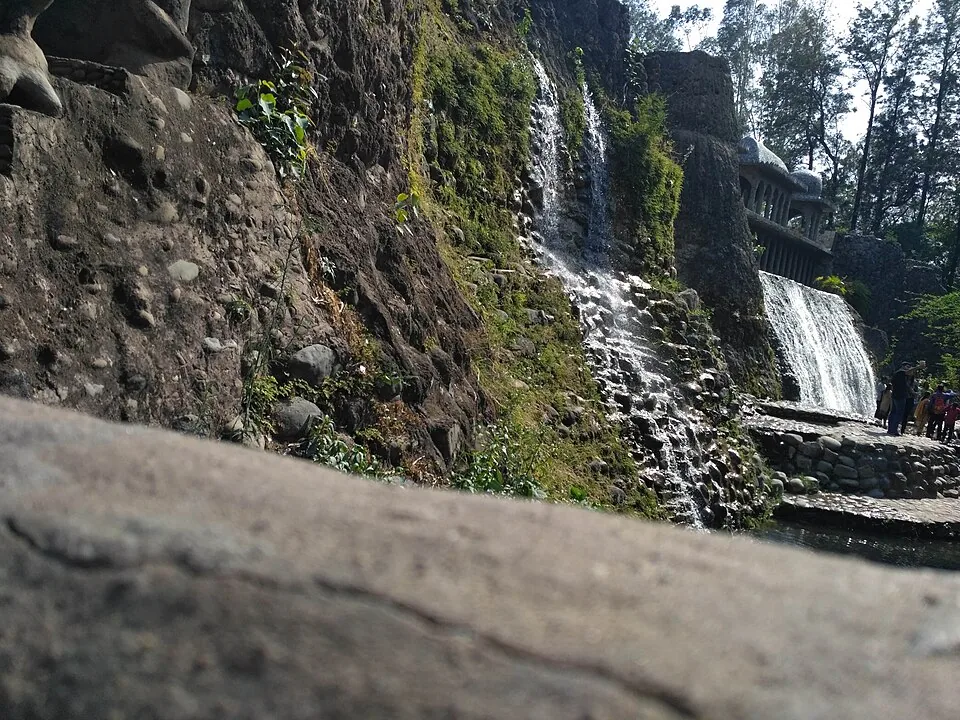
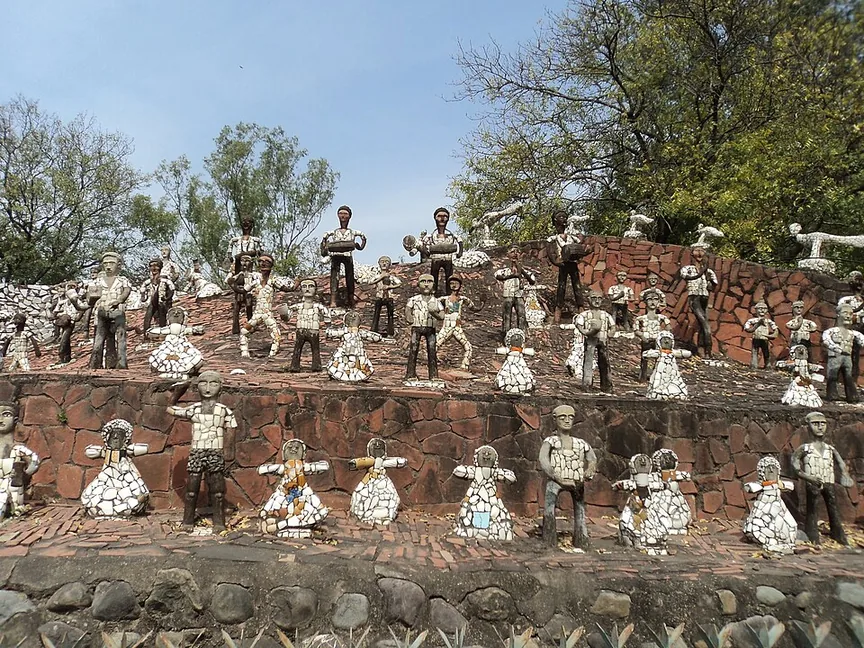
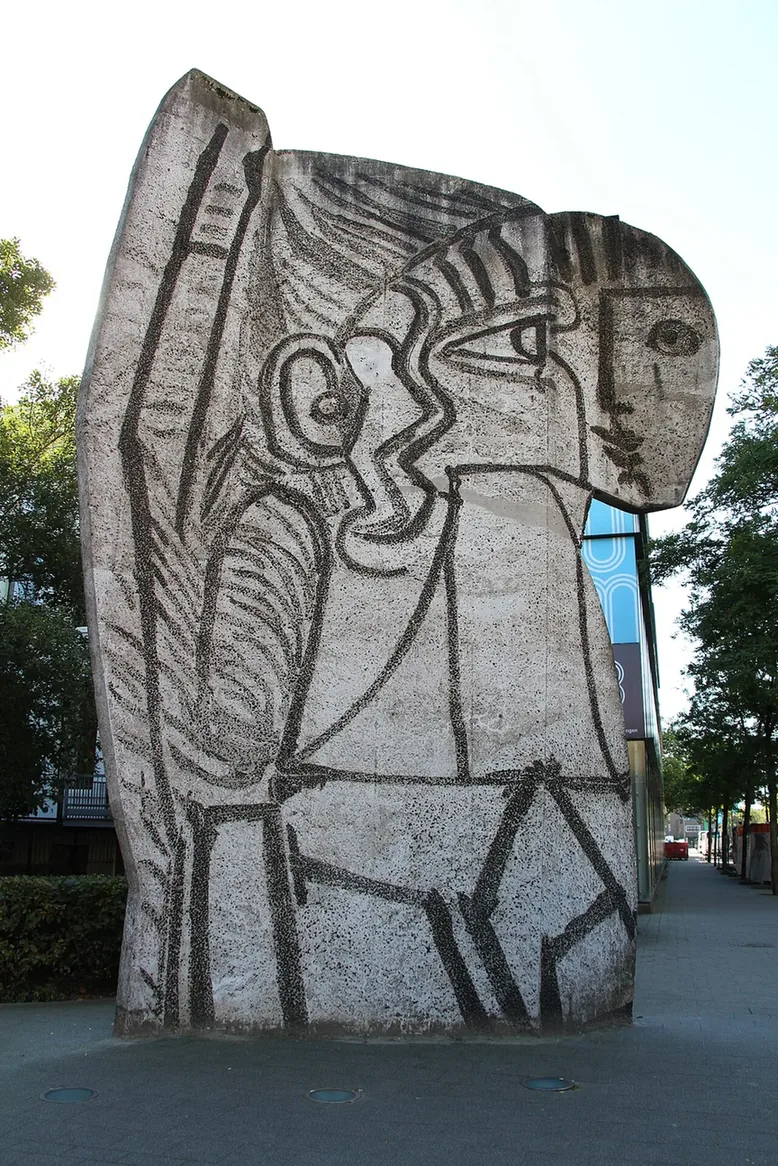
Concrete as an art material appears in Henry Moore’s Head of a Woman (1926) and Picasso and Carl Nesjar’s Sylvette (Rotterdam, 1970). Wolf Vostell enclosed a Cadillac in Concrete Traffic (Chicago, 1970); Rachel Whiteread cast domestic space in House (London, 1993). Nek Chand built Chandigarh’s Rock Garden from discarded materials and cementitious binders, beginning in 1957. Concrete lets artists preserve impressions, bind fragments, obstruct familiar objects and give empty space a solid body.
What is concrete, and how is it different from cement?
Concrete is a composite in which a cementitious binder joins aggregates with the help of water; cement is the binder rather than the finished composite. Modern Portland-cement concrete hardens through hydration, a chemical reaction with water. The aggregate, water content, additives and curing conditions change the material’s behaviour. American Cement Association, Applications of Cement, research accessed 30 October 2026
Mortar generally contains fine aggregate, while conventional concrete also contains coarser aggregate. Grout is formulated to fill spaces and can be more fluid; the names describe different jobs as well as ingredients. An artwork labelled “cement” in a collection catalogue should retain that catalogue wording unless its composition has been established. A cement-and-sand sculpture belongs in this material history without being misdescribed as a coarse-aggregate concrete casting. NRMCA, CIP 22: Grout, 2019
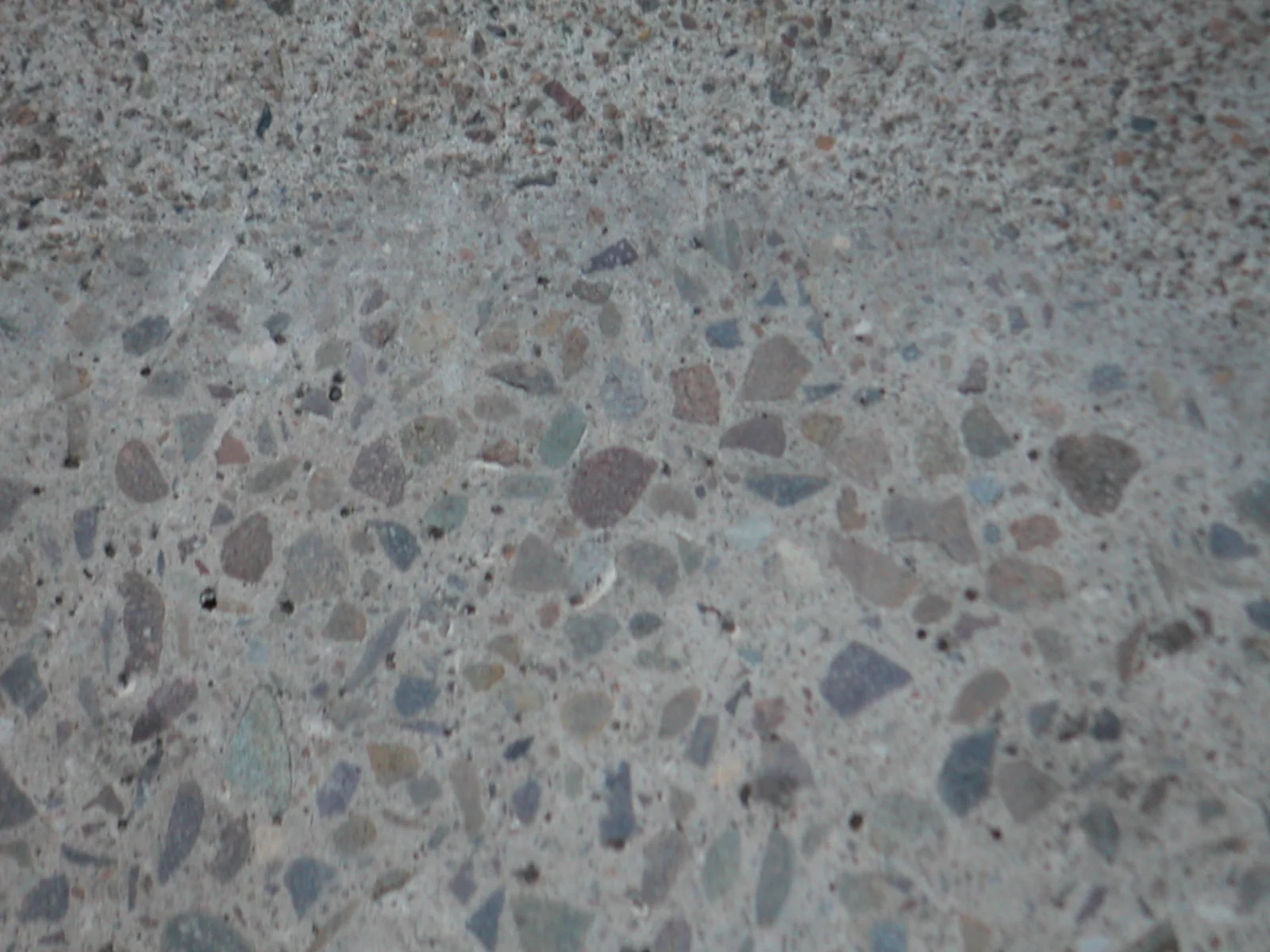
Concrete’s surface is evidence of a process. A mould can transfer grain, seams and indentations; later abrasion can expose stones that were hidden beneath the cement-rich skin. Compare the ground surface above with the aggregate below: the image an artist makes can come from the material’s interior, from the mould, or from a later intervention. JamFactory, 2019; photographer’s description of the ground surface

Is Concrete Art the same as art made of concrete?
Concrete Art is a movement of geometric abstraction, not a requirement to use concrete the building material. Theo van Doesburg established art concret in 1930 around objective geometric composition. Max Bill, Verena Loewensberg, Richard Paul Lohse and Camille Graeser formed the Zurich group associated with that approach. A Concrete Art painting can contain no cement at all. Wilhelm-Hack-Museum, Concrete Art, accessed 30 October 2026
Concrete the material crosses that stylistic boundary. Figurative reliefs, expressive surfaces, architectural fragments and conceptual casts all belong to the subject of this page. Search by a material and a named work when you want cast concrete; search Van Doesburg or Max Bill when you want the movement.
How does concrete change the experience of an artwork?
Concrete can make a familiar object unusable or make a heavy form appear unexpectedly light. Vostell’s car cannot move; Whiteread’s cast interior cannot be occupied; Chillida suspends a mass above an open gap. Those changes in function and support give more precise starting points than treating every grey surface as a symbol of permanence. Smart Museum, 2017; Artangel
A mould seam, plank impression or exposed stone also makes the process legible. Kuijer’s cast containers keep recognisable contours while sharing one material. Nesjar’s sandblasting turns aggregate into drawn lines. Side light can reveal such shallow relief, while a frontal view can make a slab read as a drawing. These are ways to compare the works’ visible construction. Frits Scholten, Living Concrete, 2013; BKOR
Which concrete artworks should you know, and where can you see them?
When were the key works made, and what does concrete do in each?
Concrete’s material history includes cast objects, mortar-built environments and architectural impressions. This chronological comparison gives work dates, locations and processes; the linked entries below supply the collection sources. Museum holdings and catalogue references do not guarantee display.
| Artist | Work | Year | Place | Concrete’s role | Process |
| Ferdinand Cheval | Palais idéal | 1879 to 1912 | Hauterives, France | Joins found stones | Mortar and wire |
| Simon Rodia | Watts Towers | 1921 to 1954 | Los Angeles, US | Holds mosaic skin | Mortar on steel |
| Henry Moore | Head of a Woman | 1926 | Hepworth Wakefield, UK | Records a model | Cast concrete |
| Peter László Péri | Mother and Children Playing | 1951 to 1952 | Horton House, London, UK | Gives relief colour | Coloured concrete on mesh |
| Nek Chand | Rock Garden | 1957; opened 1976 | Chandigarh, India | Binds reclaimed fragments | Built-up figures and mosaic |
| Picasso and Carl Nesjar | Sylvette | 1970 | Westersingel, Rotterdam, NL | Makes a drawing monumental | Cast; sandblasted aggregate |
| Wolf Vostell | Concrete Traffic | 1970 | Campus North garage, Chicago, US | Immobilises a car | Encases a Cadillac |
| Eduardo Chillida | Lugar de encuentros III | 1972; installed 1978 | La Castellana, Madrid, Spain | Suspends a mass | Reinforced cast |
| Isa Genzken | Family; Sophienterrasse; Mittelweg | 1991 | MoMA catalogue records | Suggests windows | Poured concrete; some epoxy |
| Rachel Whiteread | House | 1993; demolished 1994 | Grove Road, London, UK | Makes an interior solid | Architectural casting |
| Doris Salcedo | Untitled | 1998; 2008 | SFMOMA; Guggenheim Bilbao | Blocks furniture’s use | Concrete with domestic materials |
| Thomas Sayre | Gyre | 1999 | NCMA park, Raleigh, US | Retains a trace of earth | Pigmented earth casting |
| Rachel Whiteread | Nameless Library | 2000 | Judenplatz, Vienna, Austria | Closes an unreadable library | Reinforced concrete |
| Ruud Kuijer | Waterworks | 2001 to 2013 | Lage Weide, Utrecht, NL | Unifies disparate shapes | Casts from found moulds |
For access, consult the Palais idéal and Watts Towers visitor sites. Kuijer’s visitor pavilion is on Isotopenweg. The entries below distinguish surviving outdoor works from museum objects and demolished projects.
How did Ferdinand Cheval build the Palais idéal?
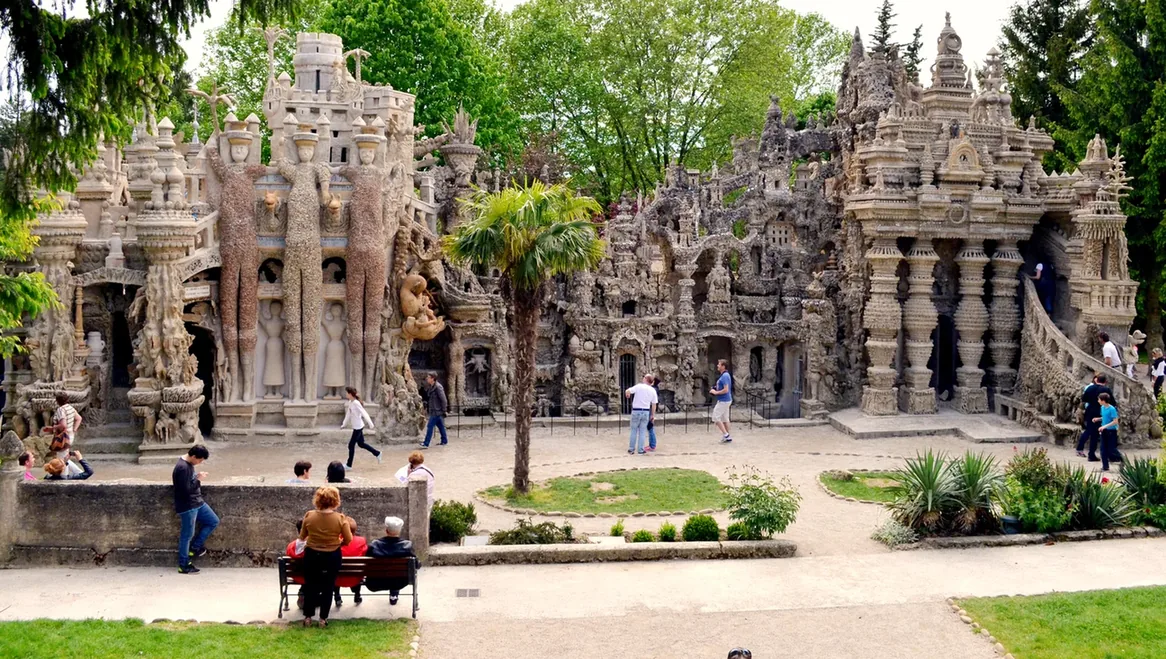
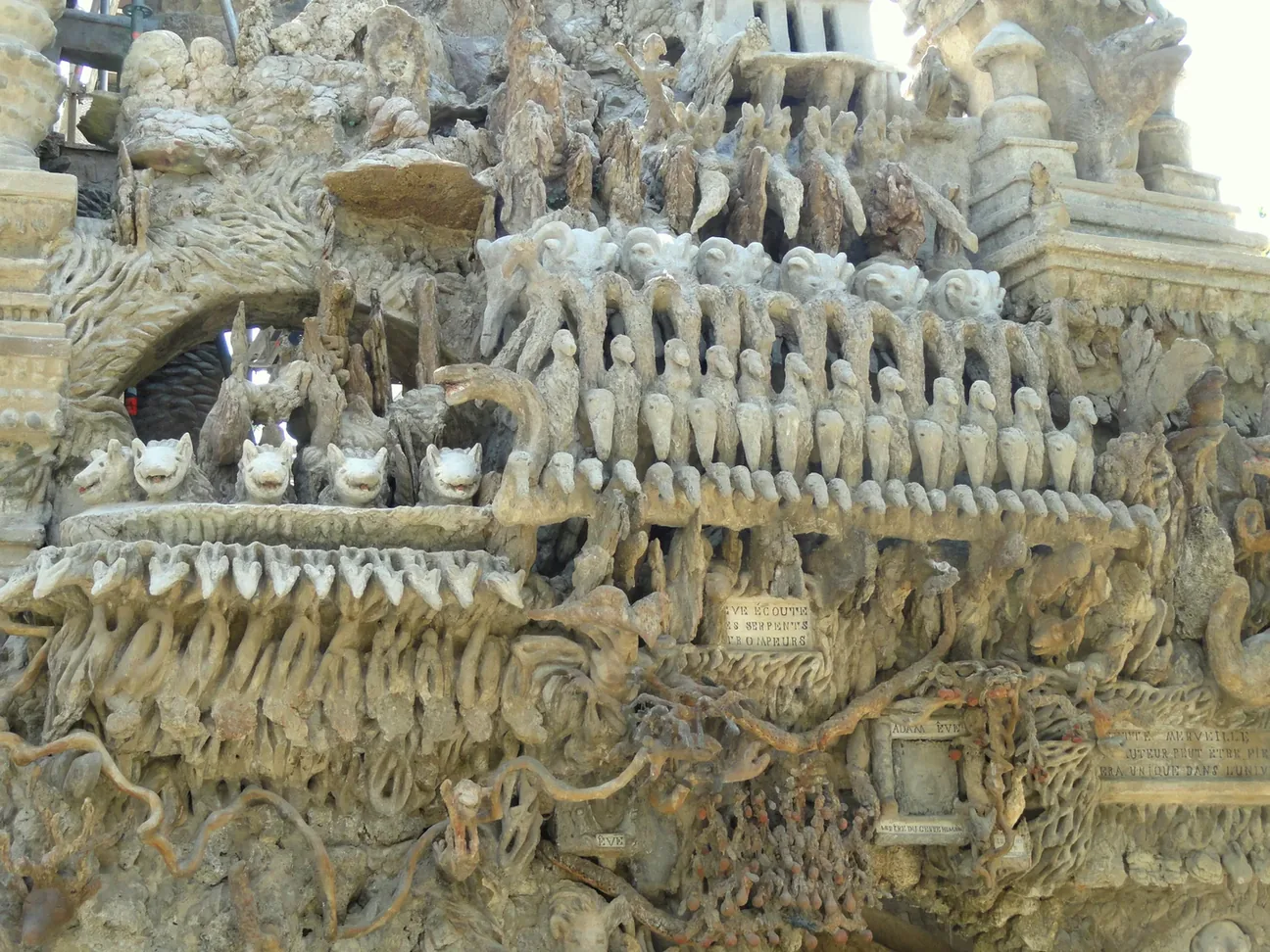
Ferdinand Cheval’s Palais idéal is an assembled environment rather than one poured object. The official history identifies lime mortar; SPACES documents cement, collected stone and supporting wire. The binder turns many small found forms into a walkable whole. Official history; Jo Farb Hernández, SPACES, 2011
Are Simon Rodia’s Watts Towers made of concrete?
Simon Rodia called Watts Towers Nuestro Pueblo. The Watts Towers Arts Center records seventeen major sculptures with wired steel reinforcement and mesh rather than a welded inner armature. Mortar supports a skin of glass, shells, clay, stone and other mosaic fragments. The skeletal structure and dense ornament make different contributions to the whole. Watts Towers Arts Center; LACMA photographic archive
What did Henry Moore make from concrete?
Henry Moore’s concrete experiments included masks, heads and figures. The Hepworth Wakefield records Head of a Woman at 22 × 15.7 × 27 cm and discusses its pock-marked grain. Half Figure No. 1, dated 1929 in the British Council Collection, provides another documented cast. These intimate works complicate the assumption that concrete sculpture must be monumental. Hepworth Wakefield; British Council
How did Peter László Péri use coloured concrete?
Peter László Péri’s Mother and Children Playing uses red ochre, tan and yellow concrete over expanded metal mesh, according to Historic England’s 2016 listing. Colour belongs to the relief’s body. Péri developed the material known as Pericrete and also made The Sunbathers for the Festival of Britain in 1951; its subsequent recovery required conservation. Listed relief record; The Sunbathers
What makes Nek Chand’s Rock Garden different?
Nek Chand’s Rock Garden combines discarded domestic and industrial objects with concrete, mortar and mosaic. Broken ceramics remain recognisable within figures and enclosing walls. India’s Ministry of Tourism describes a sequence of linked courtyards and installations, so the material’s role extends from individual sculptures to the visitor’s route. Incredible India; Chandigarh district
Who made Picasso’s concrete Sylvette sculptures?
Pablo Picasso supplied designs and Carl Nesjar developed their large concrete realisations. Nesjar’s Betograve exposes dark aggregate by sandblasting selected areas of the surface. Rotterdam’s figure enlarges a sheet-metal model arising from Picasso’s 1954 portraits of Sylvette David; the related Bust of Sylvette at New York’s Silver Towers dates from 1968. BKOR; NYC landmark documentation, 2018
Rotterdam’s work moved from Weena to Westersingel in April 2004. Sculpture International Rotterdam catalogues it at 750 × 500 × 200 cm; BKOR reports a narrower width. The catalogues therefore do not constitute an agreed dimensional survey. Rotterdam collection and relocation history
Who encased a Cadillac in concrete?
Wolf Vostell made Concrete Traffic during a public event commissioned by MCA Chicago. The museum records a 1957 Cadillac, 16 metric tons of wet concrete and five days before removal of the wooden enclosure. Those figures describe this casting rather than a general curing schedule. The public act of construction belongs to the work alongside its immobile result. MCA, commission and making account; University of Chicago, present collection record
Vostell also used concrete as an image across films, collages and prints. The Smart Museum’s 2017 exhibition connected these works to German reconstruction, American urban renewal, civil-rights marches, the Paris student protests, Vietnam and the Cold War. Concrete’s physical strength acquired meanings within those specific histories. Smart Museum, Vostell Concrete 1969 to 1973
How can Eduardo Chillida’s concrete seem to float?
Eduardo Chillida’s Lugar de encuentros III, also called La sirena varada, hangs beneath a bridge. Madrid’s collection account describes white reinforced concrete, visible formwork marks and an opening between expanding straight and curved forms. The work was removed in 1973 and definitively installed on 2 September 1978 after a dispute over its intended setting. Suspension makes the gap beneath the mass part of the composition. Ayuntamiento de Madrid
Why does Isa Genzken’s concrete resemble architecture?
Isa Genzken’s window-like sculptures make architectural fragments into objects of personal and social experience. MoMA’s 2013 retrospective catalogue discusses hinged forms and selected epoxy elements alongside poured concrete. An opening frames a view while the fragment withholds the rest of the building; the transparent resin changes that relationship again. MoMA retrospective catalogue
What was Rachel Whiteread’s House?
Rachel Whiteread’s House cast the interior of a Victorian terraced house. Artangel commissioned and produced the work, which survives through documentation. Former rooms and impressions of the enclosing structure became an outward-facing record of domestic space. The archive also preserves the public debate around the temporary work. Artangel, project archive, 1993 to 1994
What does Whiteread’s Nameless Library commemorate?
Rachel Whiteread’s Judenplatz memorial commemorates the 65,000 Austrian Jews murdered under National Socialism. The reinforced-concrete block resembles library walls turned outward, with the books’ page edges facing the viewer. The unreadable books give the work a specific relation to lives and histories lost, rather than an abstract claim about permanence. Hebrew University, memorial record; Vienna Tourist Board
Why does Doris Salcedo put concrete into furniture?
Doris Salcedo’s concrete-filled furniture addresses the aftermath of violence. SFMOMA’s cabinet combines glass, steel and clothing with wood and concrete; the Bilbao work combines wood, metal and concrete within a series grounded in Colombia’s political history. The obstructed compartments retain the scale and memory of domestic use. Concrete is one material in these particular objects, rather than a description of her whole practice. SFMOMA, 1998 work; Guggenheim Bilbao, 2008 work
How did Thomas Sayre cast Gyre in the earth?
Thomas Sayre cast Gyre into elliptical trenches and lifted the cured forms from the ground. The museum records reinforced concrete, iron-oxide colour and earth retained on the surface. A month of curing belongs to this project’s making history. The earth serves both as mould and as a visible trace of the site. NCMA, work record and 2024 label
Where are Ruud Kuijer’s Waterworks?
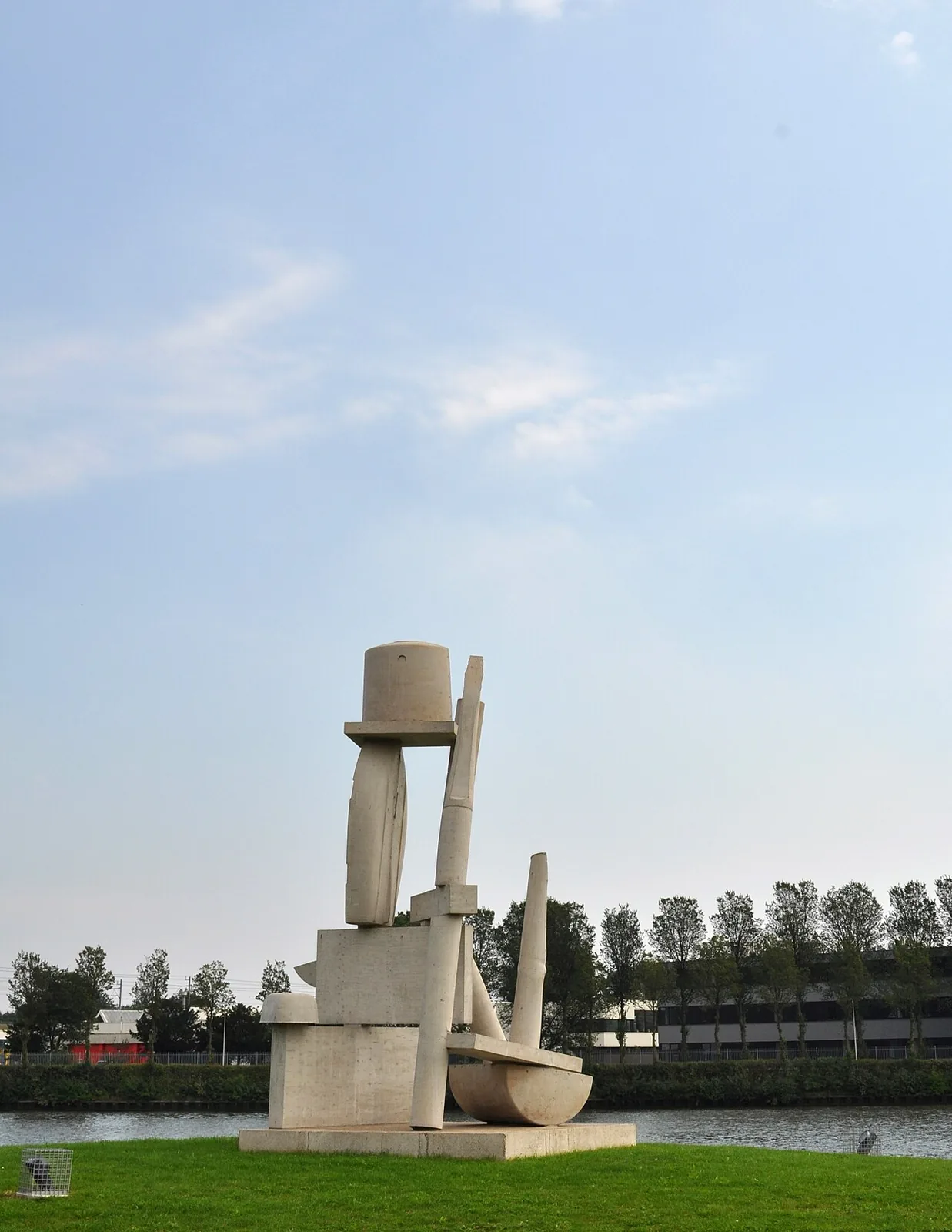
Ruud Kuijer’s seven Waterworks sculptures use containers, pipes and other found objects as moulds. The individual works begin with Waterwerk I, Forward in 2002; Waterwerk II, Bearable Lightness followed in 2003. Their abstract balance sits beside working canal infrastructure. Frits Scholten describes how casting preserves the differences between disparate shapes while giving them a shared material. Studio project descriptions; Scholten, 2013
Which other artists use concrete today or developed its possibilities?
Concrete artists also work at the scale of the body, the wall, a model building and an interactive surface. The following names extend the historical route with documented material uses.
- Michael Dean translates writing into reinforced-concrete forms and installations with steel and other materials. His language-based, bodily sculpture offers a different route from concrete as a miniature building. Andrew Kreps Gallery, artist account
- Ledelle Moe makes large concrete-and-steel bodies, including Memorial (Collapse) V, 2005, shown in the exhibition When at MASS MoCA beginning in 2019. Hollow construction complicates the apparent solidity of the figures. MASS MoCA, exhibition guide, 2019
- David Umemoto makes modular architectural concrete sculptures. House for Seven, 2021, is a documented small concrete work; its imagined architecture is presented as sculpture. Umemoto, work record
- Jeff Muhs calls his process Dynamic Free Casting. His studio’s essay dates his concrete sculpture to Decommissioned Chair, 2011, and describes flexible constraints that shape wet material into bodily volumes. Muhs studio, The Uncanny Valley
- William Mitchell developed cast and wet-worked concrete reliefs. Corn King and Spring Queen, 1964, combines coloured cast-concrete sections with ceramic, mosaic, flint and pebble inclusions. Historic England, listed sculpture record
- Carole Vincent explored coloured and polished concrete in public sculpture. Colloquy is reproduced as a black-and-white polished concrete example in the Irish Concrete Society’s Concrete through the Ages. Irish Concrete Society, illustrated material history
- Milène Guermont develops selected concrete works with tactile, light or sound responses, described by her studio as Béton Polysensoriel. Interaction is a designed feature of those works, not a property of ordinary concrete. Guermont, studio account
- Oscar Tuazon combines concrete with structures and everyday use. People, 2012, incorporated concrete, an oak trunk, a basketball hoop and lamps in Brooklyn Bridge Park. The materials invite activity as well as looking. Louis Comfort Tiffany Foundation, 2013 artist record
- Isabel Bloom developed both direct modelling in cement and mould-cast concrete figures. Her studio history records Snowball Boy and Girl with Rabbit in a 1957 Davenport Municipal Art Gallery exhibition. The distinction between a modelled original and a later casting matters here. Isabel Bloom studio, illustrated history
Which contemporary artists experiment with concrete’s surface and mixed materials?
Contemporary concrete experiments include image transfer, textiles, pigment, found objects and lighting. EXPRESSAN’s Monographic IV brings twelve practices together. The work dates below follow its captions; interpretations are attributed to that survey or to the artists’ interviews.
- Blackie Swart, associated with Oxford, works with concrete, weathering steel and found objects around time, memory and the inaccessible. Untitled V (2021) places an element in a central cavity. EXPRESSAN reads the inaccessible contents as a lost object, idea or memory. Swart describes layering pigmented concrete, scraping it while wet and embedding or concealing canvas, rusted steel and notes. Artist interview, 2022; work and cavity interpretation
- Marlies Hoevers, born in Hollandsche Rading in 1979, combines art and interior decoration. Her concrete and textile experiments register everyday emotional experience. In QUIETUDE, nº 8 (2021), pigmented concrete enters cracked grey areas while formwork marks remain visible. EXPRESSAN relates the contrast to compression and homes’ multiple uses during the pandemic. Her interview explains why texture can make concrete seem delicate or soft. Hoevers interview, 2022; work record and interpretation
- Marina Rodrigues, born in São Paulo in 1988, constructs imagined cities through sculpture, canvases and installations. Fabrica Tangerina (2021) balances steel plates, differently textured concrete elements and a small ceramic piece. Its skyline changes with the viewpoint. Rodrigues describes construction and deconstruction, utopian space and visual balance as recurring concerns; found iron and cast bases also bring reuse into her process. Rodrigues interview, 2022; materials record
- Antonio J. Fonseca, born in Seville in 1961, works primarily with photography, collage and assemblage, addressing environmental destruction, isolation and time. Fantasía para sociópata y metro cuadrado (2021) arranges pigmented concrete blocks as a city. A seated figure looks through a large window in the tallest form. The survey reads that elevated viewpoint as power reducing the city to a simplified image. Monographic IV
- João Braun, born in Lisbon in 1988, combines concrete sculpture with transfers of his own minimalist drawings. The City, captioned La Ciudad (2011), consists of 36 concrete cubes carrying transferred images and drawings. Individual day and night scenes assemble into a collective urban identity. Concrete becomes a support for printed imagery as well as a sculptural volume. Monographic IV, count, date and process
- Bram Braam, born in the Netherlands in 1980, makes sculpture, wall reliefs and large installations from displaced urban materials. EXPRESSAN presents Sunrise Adventures #11 (2021, courtesy Galerie Burster, Berlin) through architectural transformation and the life cycles of built elements. Ruined walls and ground fragments can carry nostalgia alongside possibilities for rebuilding. Braam’s own record for Sunrise Adventures #18 (2023) specifies concrete, wood, spray paint and posters. Monographic IV; artist’s material list
- oneprocessart reinterprets construction processes as designed objects. Industrial Sky (2021), from the Lamp City series, uses a concrete lamp body to outline industrial buildings on Seville’s outskirts. Illumination makes the skyline suggest dawn. The piece crosses sculpture, architecture and functional lighting, while variations in the concrete forms give the series its visual vocabulary. Monographic IV
- Juan López, born in Cantabria in 1979, makes temporary, site-responsive installations and sculptural interventions using architecture as a language. Locals Only (2018) translates letters and signs from an urban signature into a cement bas-relief inside a museum. The rearrangement shifts their meaning from a readable inscription toward sculptural form. The catalogue specifies cement, which should not be silently relabelled as coarse-aggregate concrete. Monographic IV
- Ines Schaikowski, born in Brandenburg in 1981, examines sociocultural, natural and urban places through Hybride Heimat, a project about home and belonging. Its untitled Cubo work (2020) lets facial wipes protrude from a rectangular concrete block. The survey contrasts an urban exterior with intimate habits of inhabitation. GEDOK’s 2021 exhibition account describes the wider method: cast around familiar objects so that they emerge, disappear or lose their function. work record; GEDOK, exhibition introduction
- Lara Ruiz, born in Salamanca in 1986, works with installation, sculpture and painting alongside teaching and cultural management. Tiempo y Materia (2021), or Time and Matter, belongs to Terreno Modular. Its pigmented concrete tile meets sea waves, making water a measure of passing time. Urban relief and colour become a kind of archaeology; the wider project proposes collaborative exchanges of tiles between cities. Ruiz interview and project footage, 2022; series and pigment record
- Harley Fry, an Australian artist and director of The Pluto Program, uses the proprietary cement called Bloom. HAMERSLEY combines that material with hand-worked steel and suggests an iceberg or rocky landscape. The contrast stages a relationship between natural and industrial processes. The programme presents Bloom as part of an effort to develop environmentally minded landscape products. The work is undated in the survey. Monographic IV
- Andreas Zingerle, born in Bressanone, Italy, in 1963, works in painting and sculpture. His Head works, captioned Cabezas (2012 to 2015), transform an inflatable sex doll’s light, malleable shell into heavy, static concrete. The process turns void into mass and moves an intimate object toward public display. Concrete lets Zingerle reconsider everyday objects through density, volume and displacement from their usual setting. Monographic IV
Concrete also crosses art and design in the Australian exhibition CONCRETE: art design architecture. Its 2021 Cowra presentation included Abdul-Rahman Abdullah, Anna Horne, Jamie North, Megan Cope, Sanne Mestrom and Tom Borgas. Abdullah’s David, 2018, is listed as concrete, enamel and oxide, measuring 390 × 480 × 310 mm. The exhibition’s wider participants include designers and architects, so participation does not make every exhibitor a sculptor. Cowra Regional Art Gallery, 2021 exhibition
The Cowra exhibition’s complete participant list also names Adam Goodrum, Alexander Lotersztain, Baldasso Cortese Architects, Candalepas Associates, CHEB (Deb Jones and Christine Cholewa), Convic, Durbach Block Jaggers Architects, Edition Office, Elvis Richardson, Glenn Murcutt, Kyoko Hashimoto and Guy Keulemans, Inari Kiuru, Rhiannon Slatter, SMART Design Studio and WOOD Melbourne. The JamFactory learning resource extends the exhibition’s discussion.
Which artists use concrete beyond conventional gallery sculpture?
Concrete’s applied and community-facing possibilities include Buddy Rhodes’ hollow sculptural forms, Carole Vincent’s public work and the mosaic environments of Marvin and Lilli Ann Rosenberg. Rosemary Camozzi’s 2003 Concrete Decor feature documents these practices across making, public space and decorative work. A studio’s particular mix is evidence of that process, not a recipe for all sculptures. Camozzi, Meet 3 Concrete Inspired Artists, June/July 2003
Concrete-artist directories can help discover additional makers, including The Concretely. Check a named work against an artist’s or collection’s material record before repeating a directory description. Similar-looking objects can use plaster, resin, stone, steel or cementitious mixtures with quite different properties.
When is concrete architecture also experienced as sculpture?
Concrete architecture can produce a sculptural experience through mass, light, surface and movement, while remaining architecture with a programme, structure and inhabited interior. Le Corbusier’s Notre-Dame-du-Haut at Ronchamp, dated 1950 to 1955, is an example: the Fondation Le Corbusier describes curves, coloured light, raw concrete and other materials working together. The building should not be reduced to one freestanding concrete sculpture. Fondation Le Corbusier, Ronchamp record
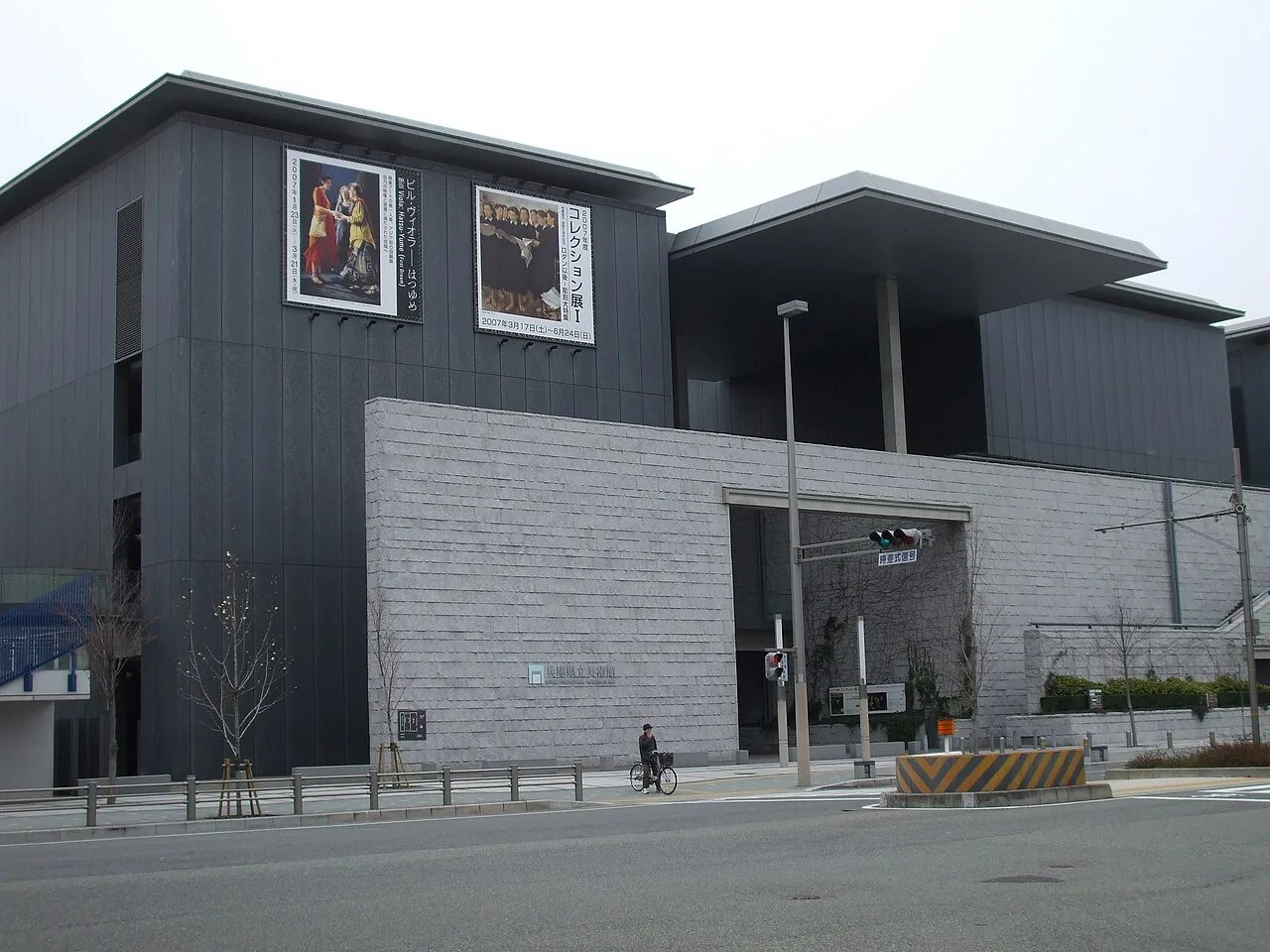
Tadao Ando offers a different architectural use of concrete. In his 1995 Pritzker essay, Kenneth Frampton describes how fair-faced concrete, enclosed courts and controlled light create a bodily experience of space. Looking at an Ando building therefore means attending to a route and changing illumination, as well as to the wall’s finish. Frampton, Thoughts on Tadao Ando, 1995
Brutalism is a mid-20th-century architectural style associated with exposed materials, structural clarity and post-war reconstruction. MoMA distinguishes that history from the casual use of “Brutalist” for any large exposed-concrete building. A concrete sculpture’s surface alone does not establish that classification. MoMA, Brutalist Architecture Likewise, Gordon Matta-Clark’s building cuts are architectural interventions rather than evidence that every cut building was a concrete casting. Canadian Centre for Architecture, Matta-Clark research and archive
How do critics, scholars and the public around the world see concrete art?
Concrete art has been read as poetic, domestic, communal, oppressive, playful and vulnerable in different places and moments. The accounts below belong to named people or institutions, with their dates; they do not stand for a whole country’s opinion.
Why do Australian curators emphasise concrete’s contradictions?
Concrete’s contradictory character is central to curator Leigh Robb’s Monochrome Memory in the 2019 JamFactory education kit. Robb links fluid casting and faithful impressions with stone-like solidity. Design writer Penny Craswell considers the material’s associations with progress, permanence, erasure and political power. These readings explain why the same substance can feel ordinary in a pavement and charged in a gallery. JamFactory, essays, 2019
How do Indian residents understand Nek Chand’s garden?
Nek Chand’s Rock Garden is understood by local defenders as a public inheritance worth protecting from changes to the city. Raj Machhan’s Chandigarh report, published on 28 March 2025 and updated on 29 April, describes residents rallying after part of the outer wall was removed for a road and parking project. Public attachment here concerns an entire place and its authorship, not simply admiration for an unusual material. Machhan, Civil Society, 2025
Chandigarh’s art history also resists a simple opposition between the trained modernist architect and the isolated self-taught maker. Iain Jackson and Soumyen Bandyopadhyay’s 2007 study places Nek Chand and Le Corbusier in relation to aesthetic and political questions; Tracy Ann Buck Bonfitto’s 2017 dissertation examines the garden through memory, community and the city’s operations. Jackson and Bandyopadhyay, South African Journal of Art History, 2007; Bonfitto, dissertation, 2017
How do Japanese and Chinese accounts read architectural concrete?
Tadao Ando’s concrete is read through light, texture and the body rather than through industrial severity alone. The Chinese journal World Architecture published Light, Material, Space, credited to Ando, Xu Maoyan and Bai Lin, on 18 February 2001. Its abstract connects concrete’s texture and colour with Japanese architectural experience and the design of light. Frampton’s 1995 essay adds an account of enclosure and bodily perception. World Architecture, 2001, abstract in Chinese and English; Frampton, 1995
How do Colombian and Middle Eastern perspectives change the reading?
Doris Salcedo’s concrete-filled furniture is grounded in testimony and Colombia’s political violence in the Guggenheim Bilbao’s account of Untitled, 2008. The museum quotes her 2000 conversation with Carlos Basualdo about making sculpture from first-hand evidence of war’s victims. The interpretation moves from generic “urban material” to specific interrupted lives. Guggenheim Bilbao, work essay and interview references
Concrete’s role in militarised and speculative building is the subject of Nissim Gal’s Visual Resources article (volume 38, no. 2, dated 2022; published online 13 March 2024), Concrete-philia in Contemporary Art. Gal examines Israeli artists’ responses to real estate, commemoration and separation, and cites Palestinian-American scholar Saree Makdisi’s reading of the wall through erasure. Those situated arguments show why concrete cannot carry one innocent or universal political meaning. Gal, Visual Resources, pp. 119 to 155
Why do public reactions differ from an artist’s intention?
Concrete artworks enter existing neighbourhoods and institutions, so public meanings can exceed the maker’s account. Emma R. Silverman’s 2018 dissertation traces how Watts Towers was interpreted through immigrant achievement, modern art and race. Artangel’s archive of House, 1993 to 1994, records admiration and opposition around Whiteread’s cast. Neither case supports a single, settled “public view”. Silverman, The Watts Towers from Eyesore to Icon, 2018; Artangel, House archive
Concrete’s critical reception can also concern form rather than symbolism. Rotterdam’s Dutch-language Sylvette essay preserves the objection that the sculpture reads as an enlarged flat drawing. The Smart Museum’s 2017 Vostell exhibition instead treats permanence, inflexibility, strength and violence as associations activated by particular works. Ask which observation the object supports before adopting an interpretation. Sculpture International Rotterdam, accessed 30 October 2026; Smart Museum, 2017
How do artists make and care for concrete art? Questions and answers
Concrete making begins with the intended form, surface, handling and exposure, then a mix and process suited to those requirements. A small detailed cast, a modelled relief and a large suspended work need different decisions. The notes below explain the choices; product technical data and engineering establish a particular object’s specifications.
What is the best concrete mix for sculpture?
A concrete sculpture mix must suit the smallest detail, the thickness of the form and the intended method of placing the material. Fine-aggregate casting mixes help where coarse stones would obstruct details; clay-like artisan mixes can suit pressing or modelling. Buddy Rhodes distinguishes a pressable Craftsman Mix from GFRC systems that can be poured, sprayed or trowelled. Craftsman Mix, manufacturer information; GFRC Blended Mix, manufacturer information
Water content changes workability and performance. Follow the specified amount instead of adding water until a stiff mix flows. A compatible water reducer is a different intervention from dilution. NRMCA explains water reducers and other admixtures in terms of the properties they change; compatibility still belongs to the chosen system. NRMCA, CIP 15: Chemical Admixtures for Concrete
Does concrete sculpture need reinforcement?
Concrete sculpture needs reinforcement decisions based on shape and loading, especially where thin projections, bending, lifting or suspension are involved. Concrete’s tensile and flexural behaviour differs from its compressive behaviour; a high compressive-strength figure alone does not establish the safety of an arm, a narrow neck or a hanging object. NRMCA, CIP 16: Flexural Strength of Concrete
What is GFRC in sculpture?
GFRC, or glass-fibre reinforced concrete, uses an appropriate glass-fibre system within a cementitious matrix. Specify alkali-resistant fibres intended for concrete and follow the loading, placement and curing instructions. Some products sold as GFRC base mixes do not contain the fibres already. A thin shell can reduce material volume, but its connections and handling still need to be designed. Buddy Rhodes, AR glass fibre; GFRC base-mix documentation
How do moulds and casting change the finished artwork?
Concrete casting transfers the mould’s geometry and contact surface into a new material. Plan seams, release, undercuts and a route for placing the mix before pouring. Kuijer’s work is a useful demonstration of how containers, pipes and fabricated formwork can become a vocabulary of shapes. Kuijer, individual mould descriptions
Consolidation helps fresh concrete fill its form and reduces unintended voids. NRMCA describes careful placing, tamping and vibration for conventional concrete; the appropriate method depends on the mix. Excess water and excessive working can harm the surface. An intentionally pitted finish should be a controlled choice, rather than a substitute for sound material. NRMCA, CIP 14: Finishing Concrete Flatwork, 2017
How long does a concrete sculpture need to cure?
Concrete curing means managing moisture and temperature so hydration can develop the intended properties. Setting, demoulding, safe lifting, drying for a coating and strength development are different milestones. Protect the casting as its technical instructions require; premature drying is not a shortcut to stronger concrete. NRMCA, CIP 11: Curing In-Place Concrete, 2017
The familiar 28-day period is not a universal demoulding or “fully cured” rule for sculpture. The Tile Council of North America discusses it as a commonly suggested slab-curing interval before tiling and lists variables that prevent a single answer. A maker should use the actual mixture’s requirements and the loads involved in handling the object. TCNA, Concrete Curing, accessed 30 October 2026
How do you make through-coloured concrete?
Through-coloured concrete receives compatible pigment within the mixture, so the coloured material extends into the body rather than existing only as a coating. Cement colour, aggregate, pigment dose, mixing, curing and later finishing all affect the result. White-base artisan mixes provide one starting point; manufacturer pigment guidance governs the chosen formulation. Buddy Rhodes, white-base mix and pigmentation; colour systems
Through-colour, exposed aggregate, stain and paint create different relationships between surface and body. A small cast sample can reveal whether an edge, a ground area and the untouched face belong to the same visual field. Keep the sample with its recorded mix, pigment, curing and finish so a later batch can be compared rather than guessed.
Can concrete be modelled, carved or polished?
Concrete can be modelled with a suitable fresh mix and worked after hardening by cutting, grinding or polishing. Grinding exposes aggregate; abrasion and sandblasting can become a graphic technique, as in Nesjar’s Betograve. The process chosen changes both the image and the surface. Buddy Rhodes, modelling and pressing mix; BKOR, Nesjar’s technique
What paint or sealer works on concrete art?
Concrete paint and sealing require a system compatible with the substrate, moisture condition, exposure and desired appearance. A sealer can change sheen and colour, so evaluate it on a sample before treating the work. The tinted-sealer example below shows why “coloured concrete” does not always mean colour throughout the body. Buddy Rhodes, sealer systems
A concrete maker’s useful record includes the product and batch, measured water, pigment amount, reinforcement, mould and release agent, curing conditions, demoulding and handling dates, finishing sequence and sample photographs. This is a suggested studio record: the next cast should be able to learn from the previous one.
How durable is concrete art outdoors?
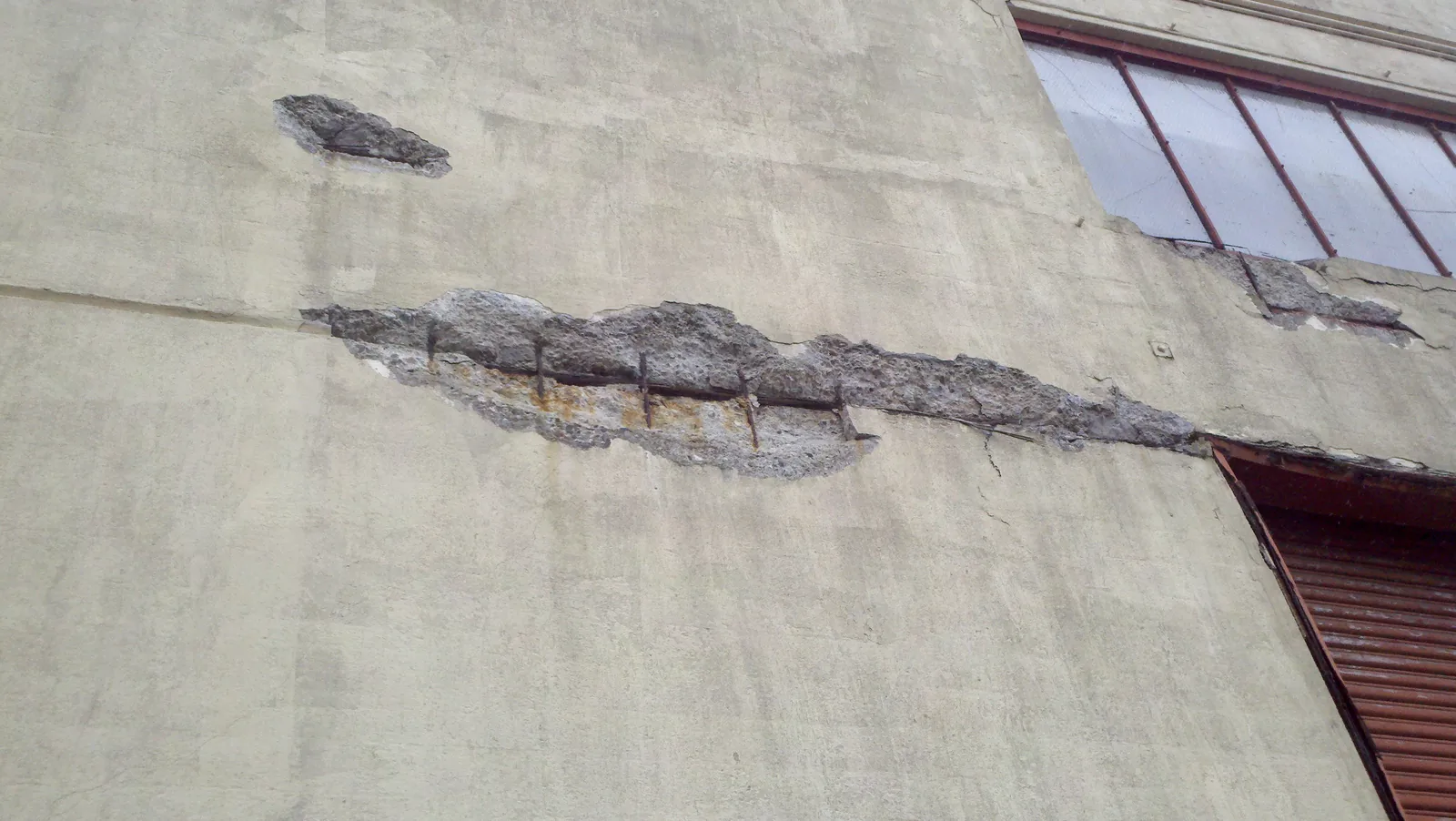
Concrete art can endure outdoors, but water and corrosion of internal metal can cause cracking, staining and material loss. Freeze-thaw exposure adds another demand on the mixture. A surface coating cannot substitute for suitable construction and care. National Park Service, Preservation Brief 15, 2007; NRMCA, CIP 2: Scaling Concrete Surfaces
Concrete conservation needs an account of the original material, surface and cause of deterioration. Compatible repairs should respect deliberate texture while addressing damage. Roughness alone cannot establish whether a surface is healthy. Gaudette and Slaton, 2007
Chillida’s Lugar de encuentros III shows how conservation belongs to the artwork’s continuing history. Madrid’s account of the centenary-era treatment describes cleaning, treating exposed iron, addressing small cracks and reintegrating lost volumes. The existence of a treatment does not mean every rough patch was accidental or every change has been resolved. Madrid heritage department, restoration account
How should makers assess concrete art’s environmental impact?
Concrete art’s environmental assessment should include the binder as well as the visible mass. The International Energy Agency tracks cement production, energy demand and carbon emissions together; its June 2026 update uses World Energy Outlook 2025 data. Reclaimed decorative fragments alone cannot establish a complete footprint. IEA, Cement, June 2026
A useful studio question is how much material the work needs over its intended life. Record the mix, material volume, transport, supports, expected repairs and options for reuse. That is a proposed assessment method, rather than a claim that every small cast, recycled aggregate or thin shell is automatically sustainable.
Is there a 70/30 rule for concrete art?
Concrete art has no 70/30 material recipe established by the technical sources used here. A composition heuristic cannot specify cement, aggregate, water or reinforcement; use the selected mix’s technical data. Product-specific mix instructions
Can an artist’s name establish an artwork’s material?
An artist’s name cannot establish a work’s material. Richard Serra’s Guggenheim record, Carl Andre’s Dia collection and Isamu Noguchi’s Rain Mountain at M+ provide object-level evidence across different media. M+ identifies Noguchi’s work as hot-dipped galvanised steel. A concrete-looking surface is insufficient evidence for adding an object to a concrete survey.
Sources and image credits
Research and image records checked on 30 October 2026. Collection records identify materials and locations; artist and manufacturer pages describe their own practices and products. Dates attached to works are work dates. Undated online records were consulted for this edition. Interpretive looking exercises are the author’s suggestions.
Art, interpretation, material guidance and visiting records:
- The Hepworth Wakefield: Henry Moore, Head of a Woman (1926), material, dimensions and interpretation
- Sculpture International Rotterdam: Picasso and Nesjar, Sylvette (1970), collection essay
- University of Chicago Campus Art: Wolf Vostell, Concrete Traffic (1970)
- Artangel: Rachel Whiteread, House, project archive (1993 to 1994)
- Ministry of Tourism, India: Rock Garden, Chandigarh
- JamFactory / Cowra Regional Art Gallery: CONCRETE Education Kit (2019), including essays by Leigh Robb and Penny Craswell
- American Cement Association, Applications of Cement, research accessed 30 October 2026
- NRMCA, CIP 22: Grout, 2019
- Wilhelm-Hack-Museum: Concrete Art, Van Doesburg and the Zurich artists
- Frits Scholten, Living Concrete, 2013
- Madrid’s collection account of Chillida
- Guermont’s studio account, accessed 30 October 2026
- Palais idéal: official history, construction and recognition
- Watts Towers Arts Center: Rodia, materials, construction and site history
- LACMA: Simon Rodia’s Towers in Watts, photographic exhibition by Seymour Rosen
- British Council Collection: Henry Moore, Half Figure No. 1 (1929)
- Historic England: Péri, Mother and Children Playing (1951 to 1952), list entry 1430263
- Historic England’s account of The Sunbathers
- Rock Garden, Chandigarh: official site and work images
- New York City landmark documentation: Bust of Sylvette at Silver Towers (2018)
- MCA Chicago, commission history
- Smart Museum, Vostell Concrete 1969 to 1973, 2017
- MoMA: Isa Genzken retrospective catalogue preview (2013)
- Hebrew University of Jerusalem, Center for Jewish Art: Judenplatz Holocaust Memorial, Vienna
- Vienna Tourist Board: memorial for the Austrian Jewish victims of the Shoah
- SFMOMA: Doris Salcedo, Untitled (1998), collection record
- Guggenheim Museum Bilbao: Doris Salcedo, Untitled (2008), work essay and 2000 interview references
- North Carolina Museum of Art: Thomas Sayre, Gyre (1999), collection record and 2024 label
- Kuijer, project and individual-work descriptions
- Andrew Kreps Gallery: Michael Dean, work images and artist account
- MASS MoCA: Ledelle Moe, When, exhibition guide (2019)
- David Umemoto: House for Seven (2021), studio work record
- Jeff Muhs studio: The Uncanny Valley, concrete and Dynamic Free Casting
- Historic England: Mitchell, Corn King and Spring Queen (1964), list entry 1031590
- Irish Concrete Society: Concrete through the Ages, illustrated material history and Carole Vincent
- Bram Braam: work list including Sunrise Adventures #18 (2023)
- Louis Comfort Tiffany Foundation, 2013 artist record
- Isabel Bloom studio, illustrated history
- EXPRESSAN, Monographic IV, accessed 30 October 2026
- Cowra Regional Art Gallery, 2021 exhibition
- Camozzi, Meet 3 Concrete Inspired Artists, June/July 2003
- The Concretely
- Fondation Le Corbusier, Ronchamp record
- Frampton, Thoughts on Tadao Ando, 1995
- Canadian Centre for Architecture, Matta-Clark research and archive
- Raj Machhan: In Nek Chand’s memory, rallies and a Chandigarh Chipko, Civil Society (28 March 2025, updated 29 April)
- Iain Jackson and Soumyen Bandyopadhyay: Nek Chand’s rock garden and Le Corbusier in Chandigarh: reconsidering the primitive (2007)
- Tracy Ann Buck Bonfitto: The Rock Garden: A Study of Memory, Place-Making, and Community in Chandigarh, India, dissertation (2017)
- Tadao Ando, Xu Maoyan and Bai Lin: Light, Material, Space, World Architecture (18 February 2001), Chinese and English abstracts
- Nissim Gal: Concrete-philia in Contemporary Art: Israeli Art Between Real Estate Gluttony and Militaristic Architecture, Visual Resources 38, no. 2 (2022), pp. 119 to 155; online 13 March 2024
- Emma R. Silverman: The Watts Towers from Eyesore to Icon: Race and the Spaces of Outsider Art, dissertation (2018)
- Paul Gaudette and Deborah Slaton: Preservation of Historic Concrete, National Park Service, Preservation Brief 15 (2007)
- Buddy Rhodes: Craftsman Mix, formulation, pressing, pigmentation and technical bulletin
- Buddy Rhodes: GFRC Blended Mix, ingredients, fibre requirements and placing methods
- NRMCA, CIP 15: Chemical Admixtures for Concrete
- NRMCA, CIP 16: Flexural Strength of Concrete
- Buddy Rhodes, AR glass fibre
- NRMCA, CIP 14: Finishing Concrete Flatwork, 2017
- NRMCA, CIP 11: Curing In-Place Concrete, 2017
- TCNA, Concrete Curing, accessed 30 October 2026
- Buddy Rhodes: concrete colour systems, pigments and glazes
- Buddy Rhodes, modelling and pressing mix
- BKOR: Picasso and Nesjar, Sylvette (1970), materials, sandblasting and location
- Buddy Rhodes: concrete sealing systems
- NRMCA, CIP 2: Scaling Concrete Surfaces
- Madrid heritage department, restoration account
- International Energy Agency: Cement, production, energy demand and emissions (June 2026)
- Palais idéal: official visitor site
- Watts Towers Arts Center: visitor and conservation information
- Studio visitor information
- Guggenheim, Serra
- Dia, Andre
- M+ Museum: Isamu Noguchi, Rain Mountain, medium and object record
- Jo Farb Hernández: Palais Idéal, SPACES Archives (2011), cement, stone and wire
- MoMA: Brutalist Architecture, definition and history
- EXPRESSAN: Blackie Swart interview (2022)
- EXPRESSAN: Marlies Hoevers interview (2022)
- EXPRESSAN: Marina Rodrigues interview (2022)
- EXPRESSAN: Lara Ruiz, project and interview (2022)
- GEDOK Brandenburg: Johanna Huthmacher, exhibition introduction on Hybride Heimat (2021)
- Hyogo Prefectural Museum of Art: Ando Gallery, architect and building history
- Visual Resources 38, no. 2 (2022): publisher contents, Gal article dates and pages
Image rights: Cheval’s depicted work is in the public domain. The photographs of permanent sculpture in Rotterdam and Utrecht use Dutch freedom of panorama (Auteurswet, article 18); the Chandigarh views use Indian freedom of panorama (Copyright Act, section 52). The Ando building uses Japanese architectural freedom of panorama (article 46). Photograph licences and transformations appear in the captions. The original header is an AI-generated interpretation, © Piet Baudoin.
Commons photographs, in filename order; reuse terms are linked in each figure:
- 01.webp / Polyparadigm / Photograph date not recorded; uploaded 10 July 2005 / Public domain dedication
- 02.webp / Benoît Prieur / 8 May 2014 / CC0 1.0
- 03.webp / Daderot / 27 April 2011 / Public domain dedication
- 04.webp / Fred Romero / 30 September 2015 / CC BY 2.0
- 05.webp / Ayush R / 25 May 2017 / CC BY-SA 4.0
- 06.webp / Simbu123 / 23 March 2013 / CC0 1.0
- 07.webp / Brbbl / 3 September 2011 / CC BY-SA 3.0
- 08.webp / Mass Ave 975 / 15 March 2007 (Exif date) / CC BY-SA 3.0
- 09.webp / Cullen328 (Jim Heaphy) / 10 February 2012 / CC BY-SA 3.0


