Artists / No. 003
Willem de Kooning
Willem de Kooning (1904 to 1997) was a Dutch-born American Abstract Expressionist who used restless drawing, revision and gestural paint to make bodies and abstract space inseparable. Museo Thyssen-Bornemisza
Why do his paintings look simultaneously skilful and unfinished? Follow the contours, the revisions and the arguments around the women. This guide connects the Rotterdam apprenticeship, New York breakthrough, Long Island landscapes and spare late paintings, with an object-specific approach to looking and collecting.
How to look at de Kooning
Our looking exercise starts with an unstable boundary. Find a contour that seems to describe a shoulder, then follow it until it could equally describe surrounding space. Ask where the body ends and the background begins. Try identifying three different speeds: a long sweeping stroke, a short jab and a scraped or rubbed passage. These are our proposed observations, not a code that unlocks every painting. They help make a difficult picture specific: you can disagree about a face while agreeing on where a line changes direction.
In Excavation, the Art Institute of Chicago identifies fragments resembling eyes, teeth, jaws, birds and fish within an open network of contours. It also describes a sustained process of adding paint and scraping it away, sometimes over months. That evidence changes the familiar impression of instantaneous action painting. An energetic surface can be the result of prolonged revision. Look for both activities: the mark that launches a movement and the revision that interrupts it. Art Institute of Chicago: Excavation
Then compare a figurative painting with a late abstraction. Our question is whether the same contour can carry different kinds of pressure when a recognisable person disappears. Avoid reducing the comparison to early violence and late calm. Test the spacing, the width of a ribbon of colour and how much white remains active between forms. A reproduction can suggest these relationships; a collection record supplies the actual medium, dimensions and date. Those are different kinds of information, and both matter.
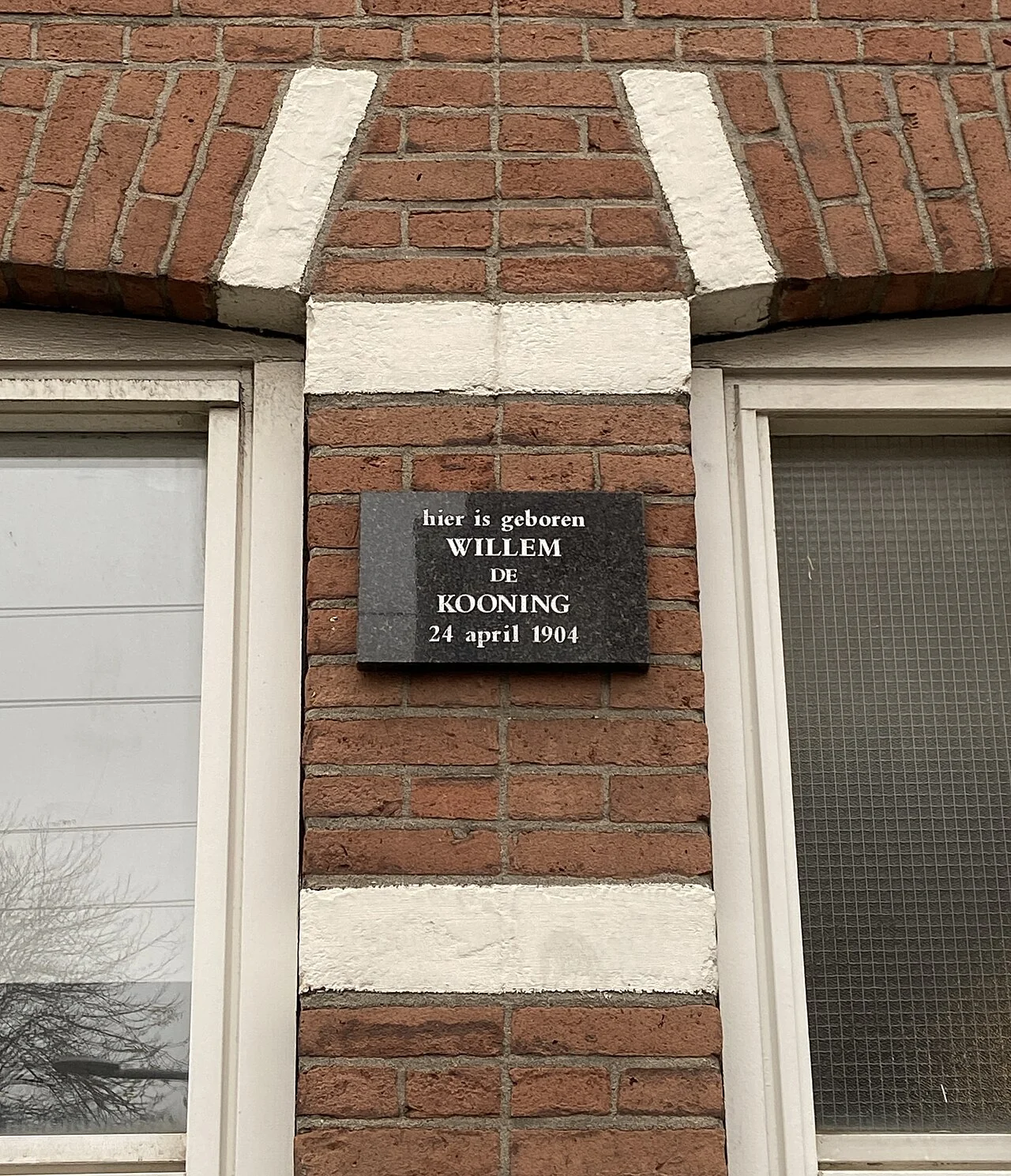
A working life across two continents
- 1904 to 1924. Born in Rotterdam on 24 April 1904, de Kooning combined commercial-art apprenticeship with evening study at the city's art academy. Decorative painting and lettering were practical foundations for his later work. Gagosian: Willem de Kooning
- 1926 to 1927. He arrived in the United States as a stowaway in 1926 and settled in New York the following year, supporting himself through commercial and manual work. Museo Thyssen-Bornemisza
- The 1930s. Friendships with Arshile Gorky, Stuart Davis and John Graham brought European modernism into his New York life. Federal Art Project employment and early male figures belong to this apprenticeship, before the celebrated women. Wikipedia: Willem de Kooning
- 1938 to 1948. He met Elaine Fried, later Elaine de Kooning, in 1938; they married in 1943. His first solo exhibition took place at Charles Egan Gallery in 1948, with black-and-white abstractions central to the breakthrough. Wikipedia: Willem de Kooning
- 1950 to 1953. Excavation and the major Woman paintings established the tension between abstraction and the figure. The 1953 Sidney Janis exhibition provoked objections both to their treatment of women and to the return of recognisable imagery. Museo Thyssen-Bornemisza
- 1959 to 1969. Italian visits in 1959 and 1969 broadened his practice. After moving permanently to Springs, Long Island, in 1963, he developed new relations between the body, landscape and later sculpture. Gagosian: de Kooning and Italy Wikipedia: Willem de Kooning
- The 1970s to 1997. Expansive colour paintings were followed by more open abstractions in the 1980s. Memory loss and Alzheimer's disease complicate discussion of the last work. He died on 19 March 1997, aged 92. Wikipedia: Willem de Kooning
- 2011 to 2026. MoMA's comprehensive retrospective and later exhibitions in Venice and Amsterdam have kept redrawing the career's boundaries, with drawing and the Italian encounters receiving particular attention. MoMA: 2011 retrospective Gagosian: de Kooning and Italy Rijksmuseum: Willem de Kooning at work, 2026
What makes the work distinctive?
Abstraction and the body remain entangled
De Kooning was a leading member of the New York School and is associated with Abstract Expressionism and action painting. Yet he repeatedly crossed the supposed border between abstract and figurative art. Madrid's Thyssen-Bornemisza traces his development from still lifes and male figures to women whose broken planes increasingly merge with their surroundings. Picasso, Miró, Arp and Surrealism supplied possibilities, rather than a single recipe. The mature work belongs to an American movement while retaining a long engagement with European painting. Museo Thyssen-Bornemisza
Our reading is that a de Kooning often makes recognition provisional. A patch of pink can be flesh before it becomes paint again; a dark hook can suggest a mouth without completing a face. This does not make every form a hidden body part. It gives the viewer a changing responsibility: decide what is visible now, and notice what the next mark does to that decision. The uncertainty is located in the painting, rather than in a missing explanatory story.
Drawing survives inside painting
MoMA's record for Painting (1948) explains that he transferred fragments of figurative drawings using tracing paper before adding oil and enamel sign paint. Forms approach bodies or letters without becoming fully legible. Drawing therefore worked as a resource that could be moved, interrupted and recombined. Industrial sign paint also connects the mature abstraction to his practical training; the materials are part of the object's history, not merely a metaphor for modernity. MoMA: Painting
The Rijksmuseum's 2026 exhibition treats drawing as investigation through repeated revision, rather than simply preparation for a finished painting. That approach offers a concrete answer to the question of skill. His academic training did not vanish when the work became loose: it furnished conventions he could deliberately disturb. Our suggested comparison is to look at a carefully modelled early drawing before a much later sheet. Ask which habits of pressure, contour and correction remain available even when their original purpose has changed. Rijksmuseum: Willem de Kooning at work, 2026
Landscape changes the body's surroundings
From the mid-1950s, the figure increasingly merged with urban and then more open landscape-like spaces. His move to Long Island matters within that development, but it should not turn every broad brushstroke into a literal description of a beach. Gagosian's account of the 2024 Venice exhibition stresses the effects of the two Italian journeys, including the later experiments in sculpture. Different places and materials changed the conditions of his looking. Museo Thyssen-Bornemisza Gagosian: de Kooning and Italy
For the 1977 paintings, Christie's describes his attention to the moving reflections around Louse Point: water could combine land, sky and figures in an unstable surface. It also cites the critic David Sylvester's high assessment of that year's production. The catalogue is a commercial interpretation, but its account provides a useful alternative to the assumption that abstraction must originate in a rejection of the visible world. Here the visible world itself was already changing and difficult to separate into objects. Christie's: Untitled XXV essay
What museums, dealers and critics say
New York and Madrid: one career, several kinds of value
MoMA's 2011 retrospective brought together almost 200 paintings, drawings, sculptures and prints. Its structure resisted making the early 1950s the only moment that mattered: academic beginnings, black-and-white paintings, urban abstractions, renewed figuration and late work all entered the account. This was an institutional argument for continuity across nearly seven decades, rather than a verdict that every period was equally successful. The breadth of the selection is itself evidence of how the museum asked audiences to reconsider him. MoMA: 2011 retrospective
The Thyssen-Bornemisza makes the double controversy of the women explicit. Some viewers found their treatment of women sexist; others objected to recognisable figures in an avant-garde expected to move towards abstraction. Those objections ask different questions. Our reading is that formal inventiveness cannot by itself settle the ethical objection, while the presence of a figure cannot establish that a painting is historically conservative. Keeping both questions open is more useful than treating controversy as proof of greatness. Museo Thyssen-Bornemisza
Dealer interpretation and an Italian perspective
Gagosian foregrounds the persistence of bodily space and the artist's commercial-art training. Its exhibitions and publications also give substantial attention to the 1980s, extending beyond the familiar Woman I narrative. In Venice, Willem de Kooning e l'Italia, curated by Gary Garrels and Mario Codognato in 2024, gathered about 75 works to examine the Italian encounters. This is an international reading of an American career built by a Dutch immigrant. It also restores sculpture to a story too easily told through paintings alone. Gagosian: Willem de Kooning Gagosian: de Kooning and Italy
Critics disagree about the women
Writing in The New Yorker on 2 October 2011, Richard Brody endorsed Peter Schjeldahl's reading of the female subject as gaining power through the painter's attacks. Brody found a psychologically searching force in the dense passages of the paintings. This is a critic's response, not evidence of what every viewer should feel. Set it beside the documented accusations of sexism: a powerful depicted figure and an aggressive manner of depiction can coexist, leaving the question of the artist's attitude unresolved. The New Yorker Museo Thyssen-Bornemisza
In his 8 October 2026 Guardian review, Ben Eastham calls the Rijksmuseum exhibition's recurring struggle with inherited rules “thrilling to watch”. His response is qualified rather than uniformly celebratory: he values drawing's persistence while finding later paintings uneven. That is a useful counterweight to an uninterrupted triumphal narrative. The same career can support admiration for invention and discrimination between individual works. The Guardian
What the auction record actually says
Woman as Landscape (1954 to 1955) sold for US$68,937,500 at Christie's New York on 13 November 2018. The house reported it as an artist auction record; it remains the record identified by Christie's artist overview checked for this page. This price includes the buyer's premium. The older Untitled XXV result of US$66,327,500 in 2016 is therefore a previous record, not the current benchmark. Christie's: Ebsworth collection and realised prices Christie's: Ebsworth sale results, 13 November 2018 Christie's
Interchange is a separate case: the roughly US$300 million figure widely attached to it concerns a reported private sale in 2015. It should not be substituted for a public auction result. Nor does either figure value an unfamiliar drawing, a print or another painting. Our collecting recommendation is to compare like with like, including medium, date, condition and the evidence behind an attribution, before comparing headline prices. Wikipedia: Willem de Kooning
Six works and groups to know
Painting, 1948
MoMA's black-and-white canvas uses oil and enamel. At 108.3 by 142.5 centimetres, it is substantially smaller than Excavation. The transferred drawing fragments and compressed shapes make it a strong first comparison for understanding how figuration survives in abstraction. Our looking suggestion is to follow a white passage as actively as a black one: decide which appears to sit in front, then test whether the relationship reverses. MoMA: Painting
Excavation, 1950
The Art Institute of Chicago's painting measures 205.7 by 254.6 centimetres and entered its collection in 1952. The museum connects its starting point to women in a rice field in the Italian film Bitter Rice (1949). The resulting network carries scattered anatomical suggestions without resolving into a scene from the film. Our reading is to notice how many local recognitions the canvas permits while denying one continuous story: its density is organised, but the organisation keeps shifting. Art Institute of Chicago: Excavation
Woman I, 1950 to 1952
This oil and metallic-paint canvas in MoMA measures 192.7 by 147.3 centimetres. The dates are important: it belongs to a sustained period of work, rather than a single outburst. Our proposed reading starts with the large eyes and toothy mouth, then follows the broken contours into the surrounding field. Ask whether the apparent attack on the figure weakens her presence or makes it more forceful. The disagreement outlined above can begin with that visible question. MoMA: Woman I
Woman as Landscape, 1954 to 1955
The oil-and-charcoal painting that set the auction record belongs near the point where body and surroundings become harder to separate. Its title is useful without being a literal decoding instruction. Our reading is to move between the scale of a body and the spread of a terrain, asking where each becomes plausible. Christie's supplies the date, medium, dimensions and realised price; the analogy between figure and landscape remains a way of looking that you can test. Christie's: Ebsworth collection and realised prices
The 1977 abstractions
Untitled XXV offers a concentrated example of the expansive, layered colour associated with the late 1970s. Christie's account connects this period with renewed activity after sculpture and with watery surroundings on Long Island. Our suggestion is to compare the continuous sweep of a stroke with the smaller colour changes inside it. Rather than labelling the result spontaneous and stopping there, ask how a large gesture holds several different sensations at once. Christie's: Untitled XXV essay
The spare paintings of the 1980s
The open late canvases replace much earlier congestion with curving bands and larger intervals. MoMA included this period in the full career, and Gagosian has made it a substantial part of its exhibition history. Their relative spareness should not be confused with a settled account of the artist's health or working assistance. Our reading is to describe the painting first, then distinguish those observations from questions about authorship and capacity, which require documentary evidence. MoMA: 2011 retrospective Gagosian: Willem de Kooning Wikipedia: Willem de Kooning
What survives, and what a collector needs to ask
De Kooning's example makes revision central to the history of gestural painting. The scraping described in Excavation and the movable fragments in Painting complicate the idea of a purely immediate mark. Our inference is that his importance lies partly in keeping incompatible possibilities productive: figure and abstraction, craft and disruption, the body and its surrounding space. This is a reading of the evidence, rather than a claim that every later expressive painter descends directly from him. Art Institute of Chicago: Excavation MoMA: Painting
Elaine de Kooning should enter that history as an artist in her own right and as a consequential partner. Their marriage included long separations and later reunion; the biography also records alcoholism and his later cognitive decline. These circumstances matter to the life, but cannot automatically explain the quality of a particular canvas. A responsible account keeps the chronology precise and avoids turning illness into either proof of authenticity or a reason to dismiss a whole period. Wikipedia: Willem de Kooning
Our recommendation for a potential buyer is to establish whether an object is a unique painting, a drawing, an original editioned print or a later reproduction. Request the provenance, exact medium and dimensions, publication references and condition documentation. Ask what substantiates the attribution and what remains uncertain. The range of media in MoMA's retrospective is a reminder that the artist's name alone does not define an object category; the answer has to follow the particular work. MoMA: 2011 retrospective
For a visit planned from this page's date, the Rijksmuseum lists Willem de Kooning at work from 9 October 2026 to 17 January 2027. Excavation is in the show and Woman I hangs alongside it in the Gallery of Honour, so the owning museums' permanent collection pages are insufficient guides to where a painting is today. Check the exhibition's official information before travelling. This is also why this page distinguishes ownership from display. Rijksmuseum: Willem de Kooning at work, 2026
Questions people ask about Willem de Kooning
What is Willem de Kooning famous for?
He is famous for gestural paintings that keep abstraction and the human figure in tension, especially the Woman paintings and Excavation. He was a major member of the New York School and also made drawings, prints and sculpture. His career includes substantial changes of approach rather than one signature formula. Museo Thyssen-Bornemisza MoMA: 2011 retrospective
Was Willem de Kooning Dutch or American?
De Kooning was born in Rotterdam in 1904 and arrived in the United States in 1926. He became an American citizen in 1962 and spent most of his working life in New York and Long Island. Both his Dutch training and his American artistic context are essential to the career. Wikipedia: Willem de Kooning
What is action painting, and did he only paint quickly?
Action painting emphasises the physical act of making a painting, and de Kooning is associated with it. His surfaces can nevertheless involve prolonged revision: the Art Institute describes repeated building and scraping in Excavation. An energetic mark does not establish that the whole picture was completed quickly. Museo Thyssen-Bornemisza Art Institute of Chicago: Excavation
Why are the Woman paintings controversial?
The paintings prompted accusations of sexist or aggressive depictions of women and objections to figuration within avant-garde abstraction. Some critics instead emphasise the depicted women's power. These are competing readings, so neither formal innovation nor the artist's reputation settles the disagreement. Museo Thyssen-Bornemisza The New Yorker
What is Willem de Kooning's auction record?
Woman as Landscape sold for US$68,937,500 including buyer's premium at Christie's New York on 13 November 2018. Christie's identifies it as the artist's auction record. The widely reported roughly US$300 million Interchange price concerns a private sale, not an auction. Christie's: Ebsworth collection and realised prices Christie's Wikipedia: Willem de Kooning
Did de Kooning have Alzheimer's disease?
His later life included memory loss and Alzheimer's disease, and the circumstances of the late work have prompted debate. A diagnosis alone does not tell us how any specific painting was made. Our recommendation is to distinguish the object's documented working history from assumptions based on its appearance. Wikipedia: Willem de Kooning
Where can I see Woman I and Excavation?
Woman I belongs to MoMA in New York, and Excavation belongs to the Art Institute of Chicago. Excavation is on loan to the Rijksmuseum's Willem de Kooning at work exhibition, listed for 9 October 2026 to 17 January 2027, and Woman I hangs alongside it in the museum's Gallery of Honour. Check current loan and display information before making a visit. MoMA: Woman I Art Institute of Chicago: Excavation Rijksmuseum: Willem de Kooning at work, 2026
How can I assess something sold as a de Kooning?
Our recommendation is to identify the medium and object category before looking at a headline price. Request documented provenance, publication references and an independent condition assessment, and distinguish a unique work from an original print or reproduction. The career encompasses several media whose values cannot be inferred from the name alone. MoMA: 2011 retrospective
Sources and image credits
Sources opened and checked on 26 October 2026. Our looking notes and suggested exercises are interpretations. The benchmark combined Wikipedia: Willem de Kooning, MoMA: 2011 retrospective, Museo Thyssen-Bornemisza, Gagosian: Willem de Kooning. Collection records govern titles, dates and ownership; auction results distinguish realised prices from estimates. Each image caption links to its individual rights statement.
- Museo Thyssen-Bornemisza
- Art Institute of Chicago: Excavation
- Gagosian: Willem de Kooning
- Wikipedia: Willem de Kooning
- Gagosian: de Kooning and Italy
- MoMA: 2011 retrospective
- Rijksmuseum: Willem de Kooning at work, 2026
- MoMA: Painting
- Christie's: Untitled XXV essay
- The New Yorker
- The Guardian
- Christie's: Ebsworth collection and realised prices
- Christie's: Ebsworth sale results, 13 November 2018
- Christie's
- MoMA: Woman I