Artists / No. 014
Karel Appel
Karel Appel (1921 to 2006) was a Dutch painter and sculptor, a founder of CoBrA, who combined forceful colour, material experiment and unstable human and animal forms across a career much longer than the group’s brief existence. Kunstmuseum Den Haag: retrospective Karel Appel Foundation: Franz W. Kaiser’s biography
The familiar combination of bright paint and childlike creatures is an entrance, not a complete account. This guide follows the trained artist behind the public persona, the difference between spontaneity and preparation, and the international career that developed between Amsterdam, Paris and New York.
How do you look beyond the first burst of colour?
Our exercise begins with a shape that seems almost recognisable: a head, a bird, a body or a pair of eyes. Name what makes the recognition possible, then identify the part that resists it. Does one coloured area act as an eye in one reading and as a separate mark in another? Keep both possibilities available long enough to compare them.
Next, look at the boundary between forms. Our questions concern contact: is a contour enclosing a figure, cutting into it or joining it to its surroundings? Compare an area that feels sharply separated with one that seems to merge. A creature can remain present without becoming a stable anatomical diagram.
Then attend to material. A thick painted ridge, a flat coloured surface and a built object ask for different kinds of attention. Do not assume that a forceful image must have been made without preparation. Nina Siegal’s report on the 2016 retrospective discusses preliminary drawings as evidence against that habitual assumption. Nina Siegal, The New York Times, 4 February 2016, archived by BLUM
Our final pass changes the scale of your description. Replace a general adjective such as wild with something you could point to: an off-centre eye, a tilted body, a colour crossing a boundary. Specific observations make disagreement useful. Another viewer can test them without having to adopt the same emotional response.
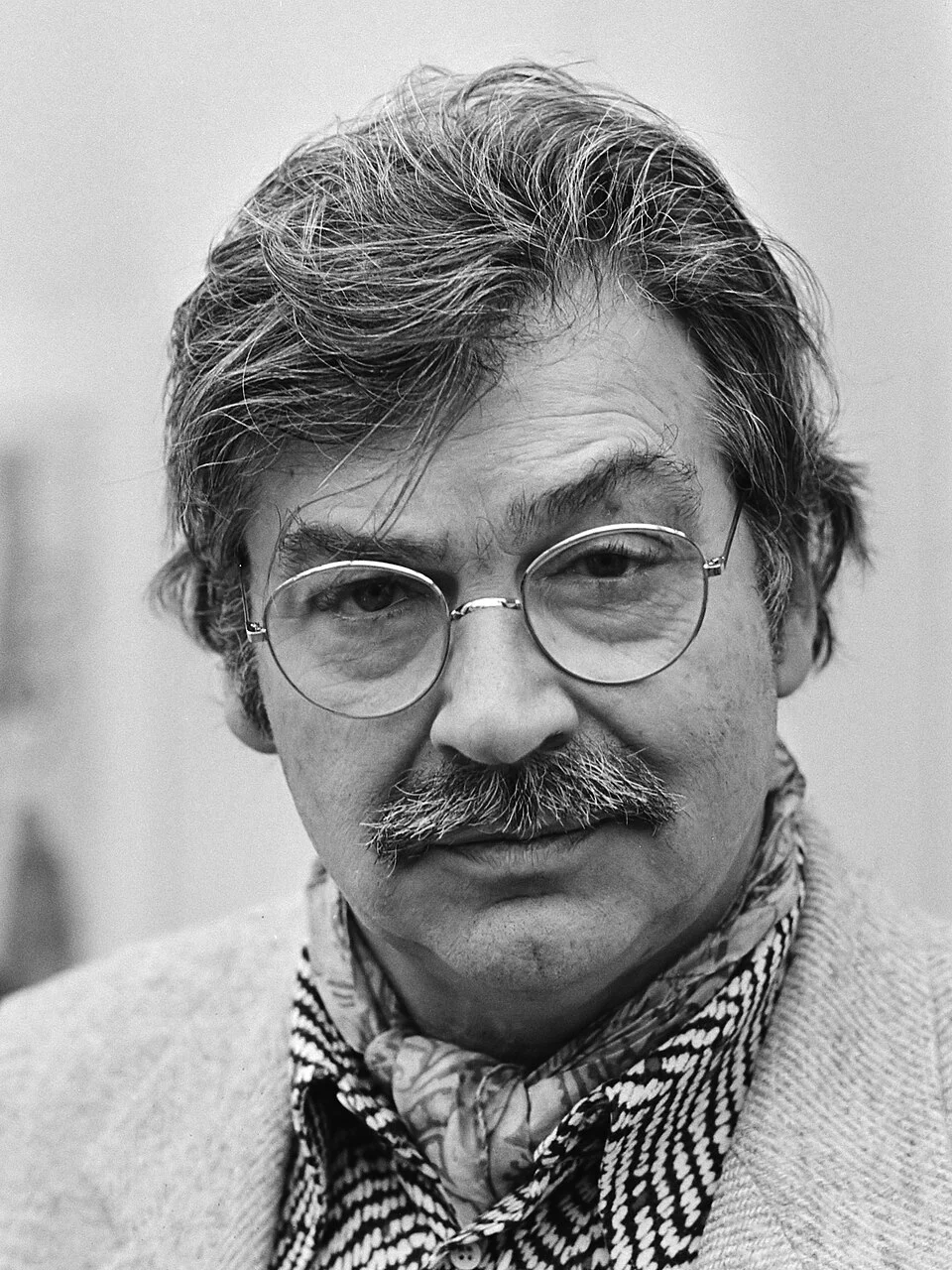
From an Amsterdam barber’s shop to an international career
- 1921 to the 1930s: Christiaan Karel Appel was born in Amsterdam on 25 April 1921, the son of a barber. An uncle gave him paints and an easel for his fifteenth birthday and helped introduce him to painting instruction. Karel Appel Foundation: early years
- 1942 to 1944: The Foundation dates his admission to the Rijksakademie to 1942, where he met Corneille. During the occupation, study and the effort to avoid forced labour intertwined; he later went into hiding. This chronology is more specific than summaries giving an earlier start to his academy studies. Foundation: wartime chronology Wikipedia: contrasting summary chronology
- 1948 to 1951: Appel helped establish the Dutch experimental group and then CoBrA in Paris on 8 November 1948. Major group exhibitions followed in Amsterdam in 1949 and Liège in 1951, after which CoBrA disbanded. Foundation: formation and end of CoBrA
- 1950 to 1957: He moved to Paris in 1950. Critic and organiser Michel Tapié connected him with international networks and dealer Martha Jackson. Her first Appel exhibition took place in New York in 1954; his first Atlantic crossing followed in 1957. Almine Rech: Martha Jackson and Appel Foundation biography
- 1954 to 1960: The Foundation also records a UNESCO award at the 1954 Venice Biennale, the 1958 UNESCO mural commission in Paris, the painting award at the 1959 São Paulo Biennial and a Guggenheim International Award in 1960. These milestones place his recognition across European and American institutions. Foundation: awards and public commissions
- 1960s to 2006: Flat forms associated with Pop, sculpture, lithography, portraits, nudes and landscapes extended the work. Later studios included New York, Connecticut, Monaco and Tuscany. Appel died in Zürich on 3 May 2006 and was buried at Père-Lachaise in Paris. Almine Rech: artist overview Foundation: later work and death
This sequence makes CoBrA a crucial early episode within more than sixty years of work. Both the 2016 Hague retrospective and the Phillips Collection survey were explicitly organised to widen that frame. They provide a useful starting point when familiarity with a famous period starts to obscure the rest. Kunstmuseum Den Haag The Phillips Collection
The ideas: CoBrA, children, material and the moving figure
CoBrA is an international network
The name combines Copenhagen, Brussels and Amsterdam. The founding network included Appel, Constant, Corneille, Asger Jorn and Belgian poets Christian Dotremont and Joseph Noiret. The Foundation describes magazines, exhibitions and shared work across countries rather than a single national school. The group’s existence was short, but its experimental exchange gave Appel an important context. Wikipedia: CoBrA name Foundation: the founding network
Our reading distinguishes a shared commitment from a uniform recipe. An interest in invention, children’s art or collective work does not mean that every member painted the same way. Compare particular decisions before using the movement’s name as an explanation. The label should help locate relationships rather than conceal the differences between individual artists.
Children’s imagery can carry historical pressure
The Foundation links Appel’s already existing Questioning Children theme with the new impact of seeing children begging for food in war-damaged Germany. The chronology is important: the encounter added a perspective, rather than necessarily originating the entire theme. The 1949 Amsterdam city-hall mural then caused protests and was covered with wallpaper. Foundation chronology: children and the city-hall mural
Our interpretation keeps playfulness and vulnerability together. A simplified body can look comic, exposed or demanding depending on its placement and the forms around it. Calling an image childlike does not establish that it lacks thought. Ask what the simplified figure can communicate because of what has been omitted, and where the viewer’s expectation of innocence becomes uncomfortable.
Art outside the academy was an encounter, not an absence of training
The Hague retrospective foregrounded Appel’s engagement with what it calls Outsider Art. The Foundation describes his encounter with drawings by psychiatric patients in Paris and his transformation of an accompanying publication into the Psychopathological Notebook. Those encounters belong beside, rather than instead of, his academy training and continuing use of established genres. Kunstmuseum Den Haag: scope of the retrospective Foundation: the notebook
Our caution in reading this history concerns language. Historical accounts often group very different makers under categories such as primitive or outsider. Those labels can obscure individual people and circumstances. Rather than repeat them as a judgement of ability, ask what Appel actually saw, took into his practice and changed. That question preserves the specificity of the encounter.
Figuration and abstraction keep interrupting one another
Almine Rech describes Appel’s position between abstraction and figuration and argues that a strictly national identity misses his long career in Paris and New York. The Foundation likewise treats portraits, nudes and landscapes as recurring subjects, transformed through his own handling of paint. The traditional genres remained available even when their usual descriptive clarity did not. Almine Rech: international position and figuration Foundation: recurring genres
Our exercise is to describe an area twice: once as part of a body, once as colour and direction. Does either account exhaust it? If the painting keeps switching between the two, that instability may be central to the experience. Abstraction need not require the total disappearance of recognition, and recognition need not require a return to conventional depiction.
Experiment can mean changing material
The Foundation traces movement from painting into reliefs, sculpture, lithographs and later found-object hybrids. It also identifies Appel’s selective engagement with the flatter imagery of Pop in the 1960s. This range complicates the belief that the whole career consists of thick, spontaneously applied paint. Foundation: materials and Pop-related experiments
Our comparison asks what happens when a painted creature becomes a built object. A silhouette now has an actual edge; a mass occupies space that a viewer can move around. Compare those differences before claiming the sculpture simply repeats a painting in three dimensions. The material changes the terms of the encounter even when a motif remains recognisable.
Jazz and architecture widen the picture
The Foundation records Appel making portraits of Dizzy Gillespie, Miles Davis, Count Basie and Sarah Vaughan during his 1957 New York visit, working in Sam Francis’s studio. It also describes collaborations with architects using ceramic and marble tiles, stained glass and glass in concrete. The large Wall of Energy project in Rotterdam in 1955 was part of this architectural strand. Foundation: jazz portraits and architectural work
Our comparison separates a painting seen alone from an image integrated into a building. Scale, approach and movement through a room can change the encounter. Likewise, a musician’s portrait can retain an individual subject without becoming conventional description. Those examples make experimentation a matter of specific situations and media, not simply an adjective attached to the public persona.
What museums, critics, dealers and auctions say
The Netherlands and Washington: beyond the familiar group
The Hague’s 2016 retrospective included sixty-seven paintings, twelve sculptures and more than sixty drawings. Its declared purpose was to reconsider an oeuvre often reduced to CoBrA. The Phillips Collection’s twenty-two-work survey, A Gesture of Color, similarly presented a long career through paintings and sculpture, with attention to traditional subjects and stylistic experiments. Kunstmuseum Den Haag: exhibition statement The Phillips Collection: 2016 survey
A critic and an American dealer describe different audiences
In her 2016 New York Times report, Nina Siegal described the reappraisal through changes in taste, new research and the role of the Foundation. BLUM’s archive preserves the article. She reported curator Franz Kaiser and dealer Matt Bangser identifying different tasks: Dutch audiences needed to see beyond CoBrA, while American audiences often needed an introduction to it. Nina Siegal, The New York Times, archived by BLUM
Our inference is that reputation depends partly on where an audience starts. A familiar national figure can need defamiliarising at home and basic contextualisation elsewhere. Neither response alone measures the paintings. It does explain why an international guide should include more than a single market’s account of importance.
France and Denmark: energy with a broader geography
Almine Rech’s artist overview argues for understanding Appel as international rather than assigning him exclusively to Dutch art. The gallery’s account of Barber barbar at Denmark’s Carl-Henning Pedersen & Else Alfelts Museum, from September 2025 to March 2026, emphasised physical energy and the range of the work. These are attributed curatorial and dealer positions, not an impartial global consensus. Almine Rech: Appel overview Barber barbar: Denmark exhibition statement
The market high and the difference between price conventions
Christie’s Paris lot record reports €841,000 realised for Two birds and a Flower, 1951, sold on 3 December 2012, against a €300,000 to €500,000 estimate. MyArtBroker’s January 2026 guide identifies the same painting and sale as Appel’s record, but quotes €700,000. Preserve the distinction: the primary lot’s realised figure is the one used here. Christie’s: Two birds and a Flower, lot 7 Chess Heward, MyArtBroker, updated 9 January 2026
Our reading is that combining auction figures without checking their conventions can create false disagreement or false precision. Work in the sale’s original currency, name the source and keep a recorded total separate from a hammer figure or a conversion. A print, an early oil painting and a later sculptural object require different comparisons even when the artist’s name is identical.
Eight works and projects across the full range
The titles, dates, materials and collection details below follow the linked records. The proposed looking questions are ours. Repeated titles identify related themes rather than automatically identifying the same object.
1. Questioning Children, 1947, drawing
Kunstmuseum Den Haag records a wax-crayon drawing on paper, 65 by 48 centimetres, with this title. Kunstmuseum Den Haag: Questioning Children Our exercise attends to what a simplified figure retains: posture, relation to another figure, a sense of request or exposure. The object is a drawing, distinct from the later mural. Keeping medium and date visible prevents a familiar title from collapsing several separate works into one.
2. Questioning Children, 1949, city-hall mural
The Foundation’s chronology describes the commission for the cafeteria of Amsterdam’s city hall and its concealment with wallpaper after protests. Foundation chronology: Amsterdam mural Our reading asks what changes when the imagery enters a communal workplace rather than an exhibition. The documented reaction belongs to its reception; it does not prove that the imagery had one uncontested meaning for every person who encountered it.
3. The Elephant, 1950, cast in 1989
The Phillips Collection identifies the work with both its 1950 conception and the 1989 cast, received as a Foundation gift in 2016. The Phillips Collection: The Elephant Our looking question concerns a silhouette becoming an object. Compare recognition of an animal with the way separate masses occupy space. For a collector, the distinction between a model’s date and a particular cast’s date is also part of identifying what is being offered.
4. Two birds and a Flower, 1951
Christie’s records oil on canvas, 114.5 by 120 centimetres, with a signature and a reverse inscription locating it in Liège. The catalogue also documents exhibition in that city’s 1951 international experimental-art show. Christie’s: work details and exhibition history Our proposed reading follows the relation between the title’s creatures and their shared surrounding space. Ask where a form remains separate and where colour connects the parts into a larger event.
5. The Desert Dancers, 1954
The Phillips survey borrowed this painting from the Musée d’Art Moderne de la Ville de Paris. The Phillips Collection: The Desert Dancers Our viewing question concerns the title’s suggestion of movement. Do the figures seem to move because of their poses, the directions around them or the spacing between them? Identify the visual evidence before using dance as a general synonym for energetic paint.
6. Woman with Flowers, No. 1, 1963
The Phillips Collection lists this painting as another 2016 Foundation gift. The Phillips Collection: Woman with Flowers, No. 1 Our reading asks how person and surrounding motif stay distinguishable while participating in the same arrangement. Try describing the composition without the title, then restore the title and see what changes. Neither the figurative description nor the abstract arrangement has to cancel the other.
7. Psychopathological Notebook, begun in 1950
The Foundation describes Appel drawing and collaging over the text of a publication associated with a Paris exhibition of psychiatric patients’ work, retaining the transformed booklet throughout his life. Foundation: Paris encounter and notebook Our suggested question concerns the page as an existing object: what changes when printed explanation becomes a support for another visual act? The source’s terminology belongs to that historical setting and should not be treated as a modern clinical judgement.
8. Roman Infantryman, 2000
The Phillips survey included this late work, gifted by the Foundation in 2016, alongside works dating back to the 1940s. The Phillips Collection: Roman Infantryman Our comparison returns to the earliest creatures without demanding a story of steady stylistic progress. Ask which kinds of recognition remain available and which material decisions have changed. A work made almost fifty years after CoBrA disbanded deserves attention on its own terms.
How should Appel be understood today?
The Foundation’s biography and the Hague and Washington surveys agree on a central correction: Appel’s experimentation continued long after CoBrA. The record includes material changes, conventional genres transformed through abstraction, and sustained work on both sides of the Atlantic. That correction gives a viewer more precise comparisons than the public caricature of an untrained painter simply throwing colour. Foundation biography Kunstmuseum Den Haag The Phillips Collection
Our contemporary exercise is to make one recognisable form unstable. Change its boundary, colour or relation to a neighbouring form and compare the results. Keep a record of what you alter. This is our proposal for learning through variation, not an authentic Appel studio recipe and not a claim that a recognisable manner can be reduced to a prompt.
The same discipline helps a reader or buyer. Ask what this particular object contributes to the career, what the documented history establishes and what remains interpretation. A strong account should make room for humour, vulnerability, formal judgement and international reception without pretending they are all the same thing.
Questions people ask about Karel Appel
What is Karel Appel famous for?
Karel Appel is famous as a founder of CoBrA and for forceful colour, expressive human and animal forms, and experiments in painting and sculpture. His career continued for decades after CoBrA disbanded in 1951. The major museum surveys deliberately look beyond that group. Kunstmuseum Den Haag
What does CoBrA stand for?
CoBrA combines Copenhagen, Brussels and Amsterdam, the cities associated with its Danish, Belgian and Dutch founding network. The group was founded in Paris in 1948 and disbanded in 1951. It involved publications, exhibitions and exchanges as well as individual paintings. Wikipedia Foundation chronology
Why do Appel’s paintings look childlike?
Children’s imagery and forms of art outside academic conventions were important to his experiments. That appearance does not mean he lacked training: he studied at the Rijksakademie. Our suggested reading asks what simplification makes possible in a particular image instead of equating it with a lack of skill. Foundation biography
Was Karel Appel really just messing around?
That phrase became a limiting public cliché. The Hague retrospective and Siegal’s report discuss a much wider practice, including preparatory drawing, established genres and material experimentation. Apparent spontaneity should be compared with the evidence for how a specific work developed. Kunstmuseum Den Haag Nina Siegal’s report
Was Appel an abstract or figurative artist?
His work repeatedly moved between the two. Bodies, animals, portraits and landscapes could remain recognisable while colour and material disrupted their conventional appearance. Almine Rech makes that intermediate position central to its account. Almine Rech artist overview
What is Karel Appel’s documented auction record?
Christie’s reports €841,000 realised for Two birds and a Flower, 1951, in Paris on 3 December 2012. MyArtBroker’s January 2026 guide identifies the same sale as his record but uses a different price figure. The primary realised total is the figure used here. Christie’s lot record MyArtBroker record guide
How should a collector compare Appel paintings, prints and sculptures?
Our suggested checks begin with the exact medium and object. For a print, examine edition and publisher information; for sculpture, distinguish the model’s date from the cast’s date. Compare provenance and condition with relevant works rather than applying an oil painting’s record to every medium. Phillips Collection: dated works and casts
Where can I see Karel Appel’s work?
Institutions discussed here include Kunstmuseum Den Haag, the Phillips Collection and the Musée d’Art Moderne de la Ville de Paris. The Foundation and gallery records identify further collections and exhibitions. Confirm current display with the museum, because a historical exhibition or ownership credit is not a promise that the work is on view. Kunstmuseum Den Haag The Phillips Collection
Sources and image credits
Sources opened on 26 October 2026. Biography, museum interpretation, commercial presentation and our looking notes are distinguished throughout. Collection ownership does not guarantee current display.
- Nina Siegal’s report
- Wikimedia Commons file
- Karel Appel Foundation: Franz W. Kaiser’s biography
- Wikipedia
- Almine Rech: Martha Jackson and Appel
- Almine Rech artist overview
- Kunstmuseum Den Haag: retrospective
- The Phillips Collection
- Barber barbar: Denmark exhibition statement
- Christie’s lot record
- MyArtBroker record guide
- Kunstmuseum Den Haag: Questioning Children

Photograph rights and conversion are stated in the caption. No reproductions of this artist’s paintings are hosted here.