Artists / No. 010
Joan Mitchell
Joan Mitchell (1925 to 1992) was an American abstract painter who used oil paint, colour and gesture to transform remembered landscapes and feelings into compositions, working between the New York School and France. Joan Mitchell Foundation biography
How can a picture evoke a place without depicting its appearance? Start there. This guide follows the difference between an observed view, a remembered sensation and the painting that results. It separates museum interpretation from gallery advocacy and auction evidence.
How do you look at a Joan Mitchell?
Our looking exercise begins with distance. Open a museum’s reproduction through one of the work links below, then let the whole arrangement register before examining individual strokes. Locate the darkest concentration, the widest interval and the colour that interrupts its surroundings. Write down their positions rather than deciding immediately whether the painting feels happy or angry.
Next, follow one colour across the surface. Ask whether it joins distant areas or becomes different beside each neighbour. Our proposed third pass is to look at white: does it appear as untouched fabric, an applied layer, an opening or an interruption? The Whitney’s discussion of Hemlock distinguishes exposed canvas from white paint that covers earlier coloured passages. Whitney audio guide: Hemlock
Finally, allow associations such as branches, water, traffic or weather. Treat them as hypotheses that need visible support. A useful personal reading names both an association and the mark that prompted it. If another viewer sees something else, compare the evidence. The exercise requires neither a hidden object nor access to the artist’s private emotions.
A life between Chicago, New York and France
- 1925 to 1950: Born in Chicago on 12 February 1925, Mitchell studied at Smith College and the School of the Art Institute of Chicago. She earned a BFA in 1947 and an MFA in 1950; a travelling fellowship enabled work in France. David Zwirner: biography Wikipedia: early life
- 1949 to 1952: She married publisher Barney Rosset in France in 1949, returned to New York, joined its artistic circles and participated in the 1951 Ninth Street Show. Her first New York solo exhibition followed in 1952; the marriage ended that year. Wikipedia: New York years
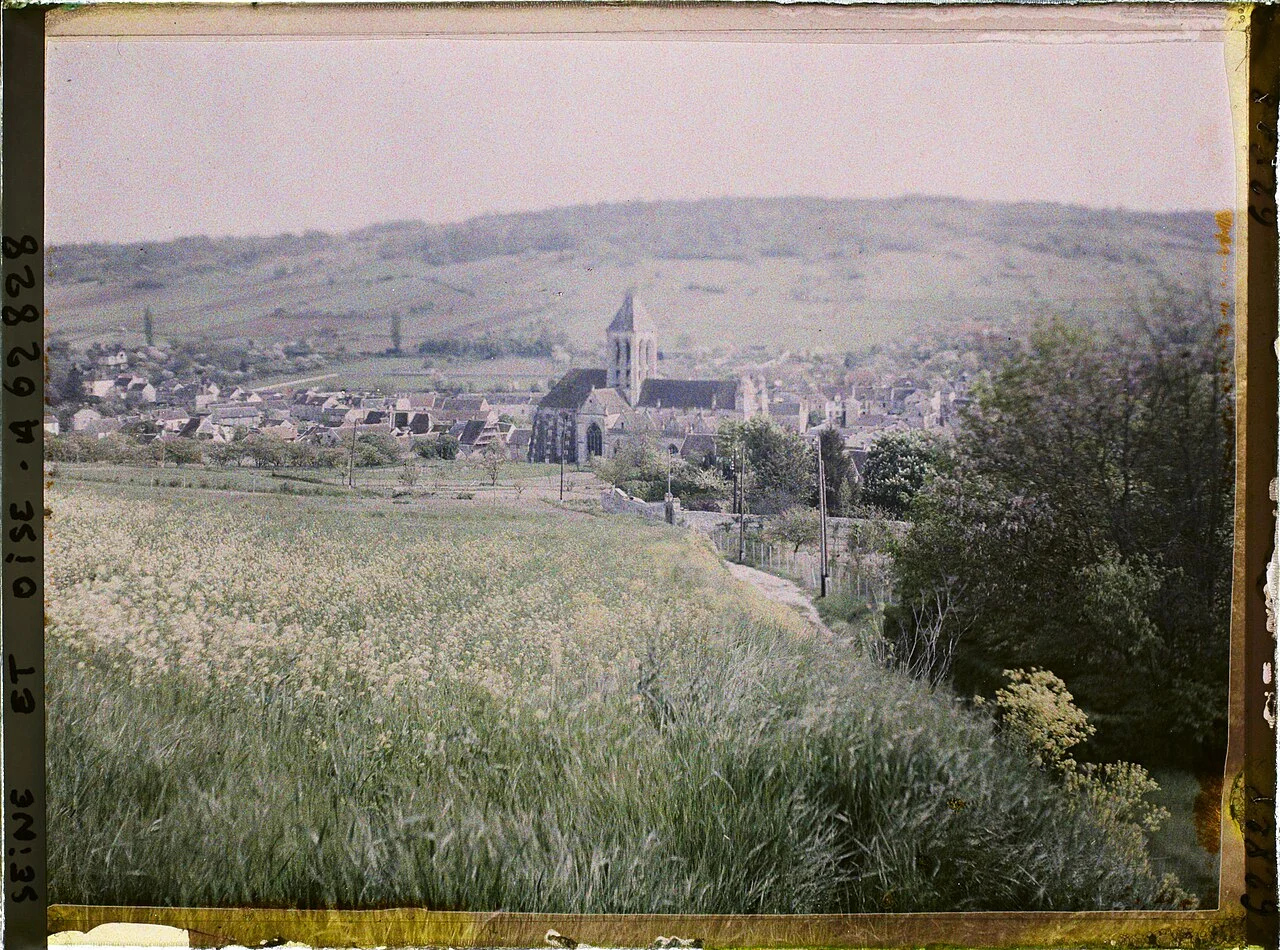
- 1955 to 1968: She divided her time between New York and France from 1955, settled permanently in France in 1959 and moved to Vétheuil in 1968. Her relationship with Canadian painter Jean-Paul Riopelle formed part of this transatlantic life. Foundation biography Wikipedia: life and career
- 1974 to 1992: The Whitney presented a substantial exhibition in 1974; Paris’s Musée d’Art moderne staged a solo show in 1982. Mitchell continued working through illness and died on 30 October 1992. Her will provided for a foundation supporting artists. Foundation: exhibitions and legacy
The geographical sequence matters because moving to France did not erase Mitchell’s American relationships. The Foundation describes a continuing exchange with New York, including travel and visitors. Read the career as a conversation across the Atlantic, rather than a simple departure from one school into another. Foundation biography
Memory, colour, poetry and the space between panels
Landscape becomes an experience rather than a view
Mitchell’s subjects included cities, fields, lakes, trees, music, people and dogs. Her Foundation stresses the relationship between painting and everyday experience. Those references explain why an abstract work can remain connected to a particular life without containing an identifiable horizon or building. They do not provide a dictionary in which one colour always means one feeling. Foundation: sources of inspiration
Our distinction is between the origin of a painting and its visible organisation. Knowing the originating place can sharpen attention, but it cannot replace looking. Ask whether a painting gathers, scatters or interrupts attention before treating its title as a description. A productive reading can hold a precise personal reference and a formally independent arrangement together.
Gesture includes decisions about structure
David Zwirner’s presentation emphasises Mitchell’s revision of figure and ground. That is a useful starting point for examining a concentrated painted area and the space around it. The dealer includes smaller paintings, drawings and prints alongside the large canvases for which she is best known. David Zwirner: artist overview
Our reading asks what a stroke does after it has been made. Does it connect two patches, conceal an earlier layer or establish an edge? The movement of the hand is one element; the arrangement that remains is another. Try describing a passage using verbs such as gathers, crosses and disperses. They invite observation without pretending that every mark records a recoverable emotion.
Poetry offers a relationship, not an illustration key
Writing and music were sustained sources of stimulus. SFMOMA’s retrospective included letters, photographs and sketchbooks as well as paintings, making those relationships part of the evidence. Its account of To the Harbormaster links the work with Frank O’Hara’s poem and Mitchell’s exchanges across the Atlantic. SFMOMA retrospective SFMOMA: eight paintings
Our suggested comparison is to read a poem once for its narrative and once for its intervals and changes of pace. Then try the same distinction with a painting. This is an analogy for viewing, not a claim that a particular brushstroke translates a particular word. A poem and a painting can share an emotional occasion while remaining different kinds of object.
Multiple panels make relationships physically legible
A diptych has two panels, a triptych three; the division belongs to the work’s construction. SFMOMA identifies The Bridge of 1956 as an early diptych and presents the later growth of Mitchell’s multipart formats. Their scale is important to how the works occupy a viewer’s field of vision. SFMOMA: The Bridge and later works
Our exercise is to read a join first as a break and then as a connection. Follow a colour towards it and notice whether the adjacent panel answers, reverses or refuses the movement. On a screen, avoid letting a cropped detail substitute for the full structure. A detail can reveal a surface relationship while concealing the balancing passage several feet away.
What museums, critics and the market say
United States: a career larger than its New York beginning
SFMOMA and the Baltimore Museum of Art organised the 2021 to 2022 retrospective as an account of the whole career. Early work, archival material and monumental later paintings shared the exhibition. Its premise placed Mitchell’s continued experimentation beside her established place in Abstract Expressionism, rather than ending the story with her emergence in the 1950s. SFMOMA: exhibition statement
Reviewing that exhibition in 2021, Bridget Quinn argued that Mitchell’s colour and scale resist reproduction. She described the need to move and back away, especially before the huge multipart paintings. This is a critic’s account of an encounter, rather than evidence that every visitor will respond identically. It explains why an online guide should direct readers towards full collection records and physical viewing. Bridget Quinn, Hyperallergic, 11 October 2021
France: the Monet comparison has a limit
Fondation Louis Vuitton’s 2022 to 2023 pairing distinguished Monet’s sustained observation of a motif from Mitchell’s transformation of remembered feelings. Their shared connection to the Seine and immersive colour made comparison productive; the Foundation acknowledged Mitchell’s insistence on artistic independence. Calling her simply a successor to Monet loses that distinction. Fondation Louis Vuitton: Monet and Mitchell
Britain: abstraction as contact with the world
The Foundation’s record of Tate Modern’s 2023 to 2025 display reproduces Tate’s explanation of abstraction as a connection with the outside world. It also records Mitchell’s objection to the limiting designation of second-generation Abstract Expressionist. The British museum’s emphasis adds a useful qualification to the American movement label and the French comparison with Monet. Tate Modern display text, preserved by the Joan Mitchell Foundation
International galleries: formal intelligence as well as emotion
David Zwirner foregrounds colour, figure-ground relationships and the movement between people, places and moments. The gallery calls the compositions “emotionally charged”. That is an attributed commercial presentation. Its useful contribution is the attention to pictorial relationships that accompanies the emotional claim. David Zwirner: Joan Mitchell
Auction evidence: a recorded result
Christie’s reported an artist auction record of US$29,160,000 for Untitled, circa 1959, in New York on 9 November 2023. The published realised result differs from the presale estimate and from any private transaction. The lot measures 247.7 by 219.7 centimetres. Christie’s: November 2023 sale results Christie’s: Untitled lot record
Christie’s Paris referred back to that world record in September 2024 while promoting a different, smaller work. Our reading of this evidence is limited: it documents demand for a particular painting on a particular date. It supplies no reliable shortcut for pricing another canvas, a pastel or an editioned print. Christie’s Paris, 20 September 2024
Ten works that make the changes visible
Titles, dates and collections follow the linked sources. The viewing suggestions are our readings, offered for comparison with the museum reproductions. These are selected landmarks, rather than a ranking by price or a complete catalogue.
1. Lyric, circa 1951
SFMOMA places Lyric in Mitchell’s first New York solo exhibition and identifies its collection as the Frances Lehman Loeb Art Center at Vassar College. SFMOMA: Lyric Our starting point is the interval between marks. Look for a rhythm that continues without requiring an evenly repeated unit. The title need not imply a particular song; notice how a passage can feel interrupted and still belong to a larger sequence.
2. City Landscape, 1955
The Art Institute of Chicago owns this City Landscape; Mitchell used the title for more than one painting. SFMOMA: City Landscape Our reading begins with congestion rather than buildings. Track where marks crowd together and where they loosen. A city association can come from accumulated encounters and interrupted movement without a recognisable street plan. Keep this painting’s identity separate from other works with the same title.
3. Hemlock, 1956
The Whitney describes a dark central concentration, branching green passages and white that alternates between exposed canvas and applied paint. Whitney: Hemlock, 1956 Our test reads the white as an active participant. Does it cut into the dark mass or support it? Allow the tree association, then return to the surface. The difference between depicting foliage and constructing a sensation of surrounding space is the useful question here.
4. To the Harbormaster, 1957
SFMOMA relates this work to O’Hara’s poem and the period of Mitchell’s frequent movement between Paris and New York. SFMOMA: To the Harbormaster Our looking note follows the intervals between strokes as if they were pauses, without assigning them words. Compare any impression of motion with the areas that hold it in place. The poetic relationship gives context; the arrangement must establish its own rhythm.
5. My Landscape II, 1967
SFMOMA’s checklist identifies this painting with the Smithsonian American Art Museum. SFMOMA: retrospective checklist Our suggestion is to put pressure on the word my. What makes an arrangement feel particular? Test an answer against the distribution of colour and character of the marks. A personal title permits a biographical question, but does not make every association you bring to the image a documented memory of Mitchell’s.
6. Weeds, 1976
This diptych belongs to the Hirshhorn Museum and Sculpture Garden. SFMOMA discusses its close, immersive relationship to vegetation through curator Sarah Roberts’s interpretation. SFMOMA: Weeds Our exercise alternates between the thicket of marks and the full two-panel span. Notice whether the join offers relief or continues the density. The modest subject can become an extensive painted environment without acquiring the literal structure of a garden illustration.
7. Salut Tom, 1979
Quinn describes this four-panel memorial to critic Thomas B. Hess as roughly twenty-six feet wide, with yellow suspended over greens, pale blue, white and dark accents. Quinn: Salut Tom Our reading asks how a memorial might remain luminous. Compare the whole span with one isolated panel. Do not assume that remembrance has to use sombre colours, or that brightness cancels loss. The work gives those expectations something concrete to confront.
8. Two Sunflowers, 1980
The Foundation’s Tate display record identifies this large oil painting with Fondation Louis Vuitton and gives its dimensions as 280 by 360.7 centimetres. Foundation: Two Sunflowers in Tate’s display Our looking exercise compares a flower association with the span of the painted arrangement. Ask how a concentrated form relates to its surrounding intervals. A sunflower need not be rendered botanically for its growth, weight or vulnerability to become an available association.
9. La Grande Vallée, 1983
The Foundation’s individual record identifies an oil on canvas measuring 260.4 by 200 centimetres, in Fondation Louis Vuitton’s collection. Joan Mitchell Foundation: La Grande Vallée Our question concerns immersion: does a valley association depend on an identifiable view, or can it come from surrounding density and depth? Distinguish this specific canvas from other paintings with related titles. A series name is a useful context, but dimensions and object records identify the work you are actually discussing.
10. Bracket, 1989
SFMOMA’s exhibition caption dates Bracket to 1989 and identifies it with the Doris and Donald Fisher Collection at the museum. SFMOMA: Bracket caption Our comparison is with Lyric: look for intervals and directional shifts while allowing a different scale. A late work should not be treated automatically as a farewell. Ask what is being tested, what remains unresolved and how a large structure retains local surprise.
What remains useful about Mitchell today?
Mitchell’s Foundation connects the preservation of her papers and work with direct support for living artists. Its remit follows her own practice of helping younger artists and writers. That gives the legacy an institutional and practical dimension alongside the paintings and their exhibitions. Foundation: support and legacy
Our exercise compares two accounts of the same work: a museum’s formal description and an auction house’s account of importance. Underline what each can demonstrate. Provenance, dimensions and exhibition history answer different questions from the felt rhythm of a painted passage. A rich understanding needs both kinds of information, with their purposes visible.
For a contemporary maker, our lesson is specific: preserve the difference between a remembered source and a finished composition. Describe the relationships you want to examine, make alternatives and judge the results. That exercise can be done with paint, drawing or digital tools. It is our proposal for learning from Mitchell’s work, not a recipe she endorsed.
Questions people ask about Joan Mitchell
What is Joan Mitchell best known for?
Joan Mitchell is best known for gestural abstract paintings that transform remembered landscapes and feelings through colour and oil paint. Her career developed in New York and France and included drawings, pastels and prints. David Zwirner overview
Was Joan Mitchell an Abstract Expressionist?
Yes. She participated in the New York School and the 1951 Ninth Street Show, and is associated with Abstract Expressionism. The label identifies a context; her later French work continued to develop beyond her New York beginnings. Wikipedia biography
How did Joan Mitchell paint landscapes without depicting them?
She worked from remembered experiences of places and the feelings they left behind, rather than simply copying a visible view. Fondation Louis Vuitton distinguishes that approach from Monet’s sustained observation of motifs. A title supplies context without making the painting a literal scene. Fondation Louis Vuitton
Did Joan Mitchell live in Monet’s house?
The cited exhibition account places Mitchell at La Tour in Vétheuil, near a house where Monet had lived. It does not identify their homes as the same house. Their connection is a shared locality and a productive artistic comparison. Fondation Louis Vuitton
Was Joan Mitchell married to Jean-Paul Riopelle?
Mitchell’s husband was publisher Barney Rosset; they married in 1949 and divorced in 1952. Riopelle was her long-term partner, rather than that husband. Their relationship began in 1955. Wikipedia biography
What is Joan Mitchell’s documented auction record?
Christie’s reported US$29,160,000 for Untitled, circa 1959, sold in New York on 9 November 2023 as an artist auction record. This dated realised result is not a valuation of every Mitchell work or a statement about private sales. Christie’s sale results
What should a collector check before buying a Joan Mitchell?
Our suggested checklist is the exact work’s identity, medium, dimensions, provenance, exhibition history and condition, plus edition information for a print. Compare like objects and distinguish estimates from realised prices. The cited lot shows how these details attach to one canvas. Christie’s lot record
Where can I see Joan Mitchell’s paintings?
Collections discussed here include the Art Institute of Chicago, the Whitney, the Hirshhorn, the Smithsonian American Art Museum and SFMOMA. A collection credit does not promise current display. Check the owning museum’s current information for the specific work. SFMOMA collection credits Whitney
Sources and image credits
Sources opened on 26 October 2026. Biography, museum interpretation, commercial presentation and our looking notes are distinguished throughout. Collection ownership does not guarantee current display.
- Whitney
- Wikimedia Commons file and CC0 1.0 dedication
- David Zwirner overview
- Wikipedia biography
- Joan Mitchell Foundation biography
- SFMOMA collection credits
- SFMOMA: Weeds
- Quinn: Salut Tom
- Fondation Louis Vuitton
- Foundation: Two Sunflowers in Tate’s display
- Christie’s sale results
- Christie’s lot record
- Christie’s Paris, 20 September 2024
- Joan Mitchell Foundation: La Grande Vallée

Photograph rights and conversion are stated in the caption. No reproductions of this artist’s paintings are hosted here.