Artists / No. 002
Jackson Pollock
A Pollock drip painting works by laying unstretched canvas on the floor and pouring, flinging and dripping fluid paint from above, so that each line records a controlled movement of the body; Jackson Pollock (1912 to 1956), the American Abstract Expressionist, made this an independent language of line and rhythm. Whitney Museum, MoMA
What makes a Pollock more than splashes? Start with the differences between one line and another, then look at how the whole surface holds together. This guide follows his early imagery, the breakthrough of painting on the floor, the black paintings and the arguments that still surround his work. It also separates a documented auction result from the less transparent world of private prices.
How to look at a Jackson Pollock
Our suggested first move is to stop searching for a central object. Choose a passage near an edge and follow one painted line until it disappears beneath another. Notice whether it thickens, breaks, loops or pools. Then step back and ask whether that small sequence belongs to a larger rhythm. Try the same exercise in a quieter area. A useful description might be: this corner slows me down, while that long curve pulls me across. Those are observations you can test against the picture, rather than a demand to admire it.
There is a material reason for this approach. In MoMA's account of One: Number 31, curator Ann Temkin explains that Pollock varied the paint's speed, thickness and weight with considerable control. Painting on an unstretched canvas on the floor allowed him to move around and over it. A line could therefore record a hand movement, a change of direction and the behaviour of fluid paint simultaneously. The familiar word “drip” captures only part of the method. Ann Temkin, MoMA
Our second exercise is to compare close and distant looking. Up close, separate matte passages from reflective ones and open canvas from dense layering. From farther away, see whether those differences produce depth without a conventional horizon. Do not assume every visible strand represents a single uninterrupted gesture: crossings can conceal intervals and revisions. Finally, compare a drip painting with an early figurative work and a black painting. Ask what persists when colour, density and recognisable imagery change.
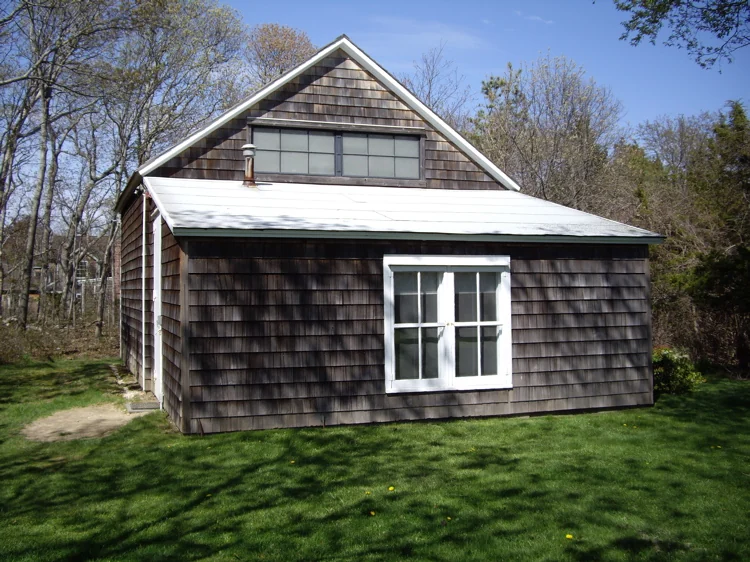
Pollock in eight moments
- 1912 to 1930. Born in Cody, Wyoming, on 28 January 1912, Pollock grew up in the American West. He moved to New York in 1930 and studied with Thomas Hart Benton at the Art Students League. National Gallery of Art
- The 1930s. Federal art work, the Mexican muralists and David Alfaro Siqueiros's experimental workshop brought him into contact with large surfaces and unconventional materials. National Gallery of Art
- 1943. Peggy Guggenheim gave him his first solo exhibition at Art of This Century and commissioned Mural for her New York home. Getty: Mural conservation MoMA: The She-Wolf
- 1945. He married fellow painter Lee Krasner; the couple moved to Springs on Long Island. Whitney Museum
- 1947 to 1950. His mature poured paintings emerged. The principal breakthrough was a way of making the entire surface active through layered lines. Whitney Museum
- 1949. A Life magazine feature turned his artistic prominence into mass-media celebrity. Wikipedia: Jackson Pollock
- 1951 onwards. Black poured paintings reopened questions of figures and images within abstraction. National Gallery of Art
- 1956 and after. Pollock died in a car crash on 11 August, aged 44. MoMA mounted a memorial retrospective that year; subsequent retrospectives helped consolidate his international reputation. Whitney Museum
What changed in Pollock's painting?
The whole canvas becomes a field
“All-over” describes a composition in which attention travels throughout the surface instead of repeatedly returning to one privileged subject. Pollock's floor-based process helped him approach a canvas from different directions and distribute marks across it. This is one reason he became central to the New York School, the loose constellation of artists associated with postwar Abstract Expressionism. The label describes a shared historical situation; it does not mean that Pollock, Rothko and de Kooning used the same methods. Whitney Museum
Our reading is that an all-over painting creates a particular difficulty for the viewer: where to stop looking. A portrait gives a face a strong claim on attention. In a Pollock, a pause may instead emerge from a gap, a dense knot or a rhythm changing direction. Try describing those intervals before calling the work chaotic. The question is whether variety remains intelligible as a whole, not whether the picture resembles a tidy diagram.
Improvisation has a history
Pollock's method did not arrive without preparation. Benton supplied training in drawing and compositional rhythm. Picasso and Surrealism offered other approaches to imagery; Mexican mural painting offered ambitious scale. Jungian therapy supplied an additional context for his early symbolic drawings. These are different kinds of influence, not interchangeable explanations. In particular, the National Gallery's account includes Native American sand painting and Asian calligraphy among his sources. Such cross-cultural encounters belong in the history alongside the familiar story of an isolated American innovator. National Gallery of Art
Material evidence can correct the legend
Getty's investigation of Mural found strong documentary and technical evidence that most of it was painted upright. The researchers could reproduce a stringy pink effect by flicking paint at a vertical test surface; it did not require the floor technique familiar from later photographs. Conservation also removed a dull varnish and addressed a sagging canvas with a carefully shaped support. The lesson is concrete: distinguish what a particular object reveals from what the artist's later reputation makes us expect. Getty: Mural conservation
Our practical comparison is to put a detail of Mural beside a detail of Number 1A, 1948. Ask which marks seem brushed, which seem projected and which belong to a later layer. The aim is not to reconstruct every movement from a photograph. It is to see why one description of “splashing” cannot account for a career's changing surfaces.
What people say around the world
American museums: invention and its costs
The Whitney places Pollock at the opening of a new pictorial freedom while acknowledging the split between critics who valued immediacy and those who saw randomness. It also identifies Krasner as an important influence on his career and legacy. That matters because the heroic image of a solitary man working in a barn can obscure the artistic relationships through which the work developed and survived. Whitney Museum
The National Gallery of Art connects his breakthrough to a much longer apprenticeship and records Clement Greenberg's support. Its biography also describes alcoholism and psychological instability. Those facts warrant care in a life story; they do not establish that addiction caused artistic quality. Our reading is to examine what the paintings do before using biography to explain why they do it. National Gallery of Art
Dealers: looking beyond the famous drips
Gagosian's exhibition history includes Black Enamel Paintings in New York in 1990 and a London drawings exhibition in 2004. These choices document sustained dealer interest in areas outside the familiar multicoloured canvases. They are evidence of how a major international gallery presents the artist, not proof that it represents his estate or that its commercial interests are neutral. Our inference is that the range of media offers a stronger route into Pollock than one signature look. Gagosian: Jackson Pollock
Britain and Australia: different arguments
Reviewing Tate Liverpool in 2015, Laura Cumming argued that the black paintings revealed continuity between Pollock's figurative and abstract work. Laura Cumming, The Guardian, 5 July 2015
Australia's reception was far more publicly political. The National Museum of Australia records the 1973 acquisition of Blue Poles for A$1.3 million and the dispute around it. Opponents treated the purchase as government extravagance; supporters understood it as an assertion of international cultural ambition. The episode shows how a painting can become an argument about a country's place in the world as well as about pictorial merit. A later valuation is a separate category from the actual 1973 purchase price. National Museum of Australia: Blue Poles
The auction room in 2026
On 18 May 2026, Number 7A, 1948 sold at Christie's New York for US$181,185,000, a new artist auction record. Christie's published the result in its sales-week report updated on 22 May. This is a realised auction price, including the buyer's premium, rather than an estimate or a private-sale rumour. It supersedes the lower Pollock auction records still repeated in older introductions. The figure records one exceptional transaction; it does not price every painting, drawing or print. Christie's: May 2026 results
Six works that explain the range
The She-Wolf, 1943
MoMA's painting uses oil, gouache and plaster on canvas. Its heavy animal outline and dense internal marks belong to Pollock's early engagement with myth and symbolic imagery. The museum cautiously connects the wolf to Rome's founding story, while noting that Pollock refused a specific identification. It was included in his first solo exhibition. MoMA: The She-Wolf
Our looking note: follow the animal's back, then inspect how the surrounding marks interrupt its readability. The point is not to solve an illustrated riddle. It is to recognise that a figure and an active abstract surface already coexist. That coexistence makes the later return of suggestive bodies less surprising.
Mural, 1943
Commissioned by Peggy Guggenheim, this oil-and-casein painting now belongs to the University of Iowa's Stanley Museum of Art. At roughly six metres wide, it gives a sequence of upright forms an architectural scale. The museum's collection record supplies the medium, dimensions and credit; Getty's conservation project supplies the technical investigation. Stanley Museum of Art: Mural Getty: Mural conservation
Our reading: walk your eyes along its length as if following a procession, then try reading the same forms as strokes without bodies. That oscillation helps explain its transitional importance. The mural format lets an image occupy a room while remaining a portable canvas, a practical distinction that matters to its later history.
Number 1A, 1948
This MoMA canvas combines oil and enamel. Handprints at the upper right place the maker's body inside a field otherwise associated with suspended tools and fluid paint. MoMA also records that the picture initially remained unsold and that the added “A” distinguished it from later numbered work. Fame did not make its initial reception automatic. MoMA: Number 1A, 1948
Our looking note: use a handprint as a measure. Then move away from that immediately recognisable shape and judge how the much finer strands create another order of scale. Numbering discourages an anecdotal reading, but it does not remove physical evidence of touch.
One: Number 31, 1950
MoMA's work measures about 2.7 by 5.3 metres and combines oil and enamel on canvas. Temkin's account emphasises a spectrum of controlled movements rather than a single repeated action. Ann Temkin, MoMA
Our reading: first look for large dark arcs, then let the finer lines interrupt them. The picture becomes more interesting when its scales compete. A small digital reproduction can help locate passages, but stand at different distances from the original if the opportunity arises; the physical relation of body to canvas is part of our proposed viewing exercise.
Number 7, 1951
The National Gallery of Art's enamel painting places black lines and blotches against a pale ground. Its collection description identifies areas suggesting faces and bodies. This is a useful specific example of the black paintings, where recognisable imagery and abstraction are difficult to separate neatly. National Gallery of Art
Our looking note: alternate between naming a suggested form and refusing to name it. See whether the black line changes from contour into independent mark. Do not assume this amounts to a retreat: compare the concentration of the surface with the apparent expansiveness of the 1950 painting.
Blue Poles, 1952
The National Gallery of Australia's celebrated painting became a national cultural landmark after its 1973 purchase. The blue uprights give the viewer a strong recurring structure within the surrounding painted activity. The purchase debate belongs to its reception, not to the process that originally made the canvas. National Museum of Australia: Blue Poles
Our reading: treat the poles as a beat against which other rhythms run, then cover one with your hand at a safe distance from the work or reproduction. Ask how much the balance changes. This is a viewing experiment, not an assertion that the painting illustrates music.
Legacy, originality and collecting
Pollock's posthumous retrospectives, including the 1998 to 1999 presentations at MoMA and Tate, helped make the floor-painting method part of the standard history of modern art. The Whitney's account nevertheless keeps early symbolism, Surrealist automatism and the black paintings in view. A useful legacy is therefore a set of expanded possibilities: line without outlining an object, scale without a mural fixed to a wall, and a surface that distributes attention. Whitney Museum
Our distinction for contemporary makers is between borrowing an effect and making a decision. Paint can be flung in seconds. Sustaining different densities, intervals and rhythms across a surface is a separate challenge. For an exercise, restrict yourself to one colour and three densities. Make several versions, then identify which passages actually contribute to the whole. Apply the same test to an AI-generated image: the fact that it resembles poured paint says little about whether its arrangement rewards looking.
For a collector, our checklist starts with the exact object: painting, drawing, authorised print or reproduction. Ask for a documented ownership history, publication and exhibition references, an independent condition report and a precise account of any restoration. These are proposed due-diligence questions, not an authentication service. Getty's Mural project illustrates why support, varnish and previous treatment can materially affect what a viewer sees. Getty: Mural conservation
Our final market caution is about categories. An auction record includes fees under that auction's terms; a hammer price does not. An insurance valuation is not a sale. A reported private transaction has a different evidential basis. Keep the date attached to every number and compare objects of similar medium, period and status before drawing conclusions. The documented 2026 result is a useful benchmark precisely because its work, venue, date and realised amount are identifiable. Christie's: May 2026 results
Questions people ask about Jackson Pollock
What is Jackson Pollock famous for?
Pollock is famous for making layered poured and dripped paintings on unstretched canvas laid on the floor, especially from 1947 onwards. They made movement and the behaviour of liquid paint central to an all-over composition. His earlier symbolic pictures and later black paintings are also essential to understanding the career. Whitney Museum
How did Jackson Pollock paint?
He used sticks, hardened brushes and other tools to pour, fling and drip fluid paint while moving around a canvas. In the mature floor paintings he could approach the surface from several directions. He also made brushed and figurative paintings, so this method should not be applied to every work he produced. Whitney Museum
Are Pollock's paintings random?
They involve fluid materials and improvisation, but that does not mean they lack control. MoMA curator Ann Temkin points to deliberate variation in line thickness, weight and speed. A useful way to judge them is to compare the rhythms and density of different passages rather than treating every splash as equivalent. Ann Temkin, MoMA
Why did Pollock use numbers instead of titles?
Numbering helped direct attention towards the painting rather than a suggested story. MoMA quotes Lee Krasner's explanation that numbers were neutral and encouraged looking at painting itself. Number 1A, 1948 also demonstrates a practical issue: the added letter distinguished it from more recent numbered works. MoMA: Number 1A, 1948
What is Pollock's auction record?
Number 7A, 1948 sold for US$181,185,000 including buyer's premium at Christie's New York on 18 May 2026. Christie's reported it as a new auction record for Pollock. This documented auction result should be distinguished from reported private sales and later valuations. Christie's: May 2026 results
Who was Lee Krasner?
Lee Krasner was a painter and Pollock's wife, whom he married in 1945. The Whitney identifies her as an important influence on his career and legacy. She belongs in the account as a fellow artist as well as a partner. Whitney Museum
Where can I see Jackson Pollock's paintings?
The collections discussed here include MoMA in New York, the National Gallery of Art in Washington, the Stanley Museum of Art in Iowa and the National Gallery of Australia in Canberra. Ownership does not guarantee that a work is currently displayed or available to visit. Check the museum's current collection and visitor information before travelling. Stanley Museum of Art: Mural National Museum of Australia: Blue Poles MoMA biography National Gallery of Art
How should a buyer assess a work attributed to Pollock?
Our recommendation is to establish the exact medium, ownership history, publication record and condition before considering price. Seek independent specialist advice and distinguish an original work from an authorised print or decorative reproduction. A resemblance to Pollock's surface is not evidence of authorship; Getty's technical research shows how much object-specific evidence can matter. Getty: Mural conservation
Sources and image credits
Sources opened and checked on 26 October 2026. Our looking notes and suggested exercises are interpretations. The benchmark combined Wikipedia: Jackson Pollock, Whitney Museum, National Gallery of Art, Getty: Mural conservation. Collection records govern titles, dates and ownership; auction results distinguish realised prices from estimates. Each image caption links to its individual rights statement.
- Whitney Museum
- Ann Temkin, MoMA
- National Gallery of Art
- Getty: Mural conservation
- MoMA: The She-Wolf
- Wikipedia: Jackson Pollock
- Gagosian: Jackson Pollock
- Laura Cumming, The Guardian, 5 July 2015
- National Museum of Australia: Blue Poles
- Christie's: May 2026 results
- Stanley Museum of Art: Mural
- MoMA: Number 1A, 1948
- MoMA biography