Artists / No. 013
Helen Frankenthaler
Helen Frankenthaler (1928 to 2011) was an American abstract painter whose soak-stain technique let diluted paint enter raw canvas, helping connect Abstract Expressionism with Colour Field painting and opening new relationships between colour, surface and space. Gagosian biography Kunstmuseum Basel: Helen Frankenthaler
Mountains and Sea is a beginning, not a complete explanation of six decades. This guide follows the stained canvas into thicker paint, historical references, works on paper and technically demanding woodcuts. The question throughout is how a material process becomes a particular visual experience.
How do you look at colour that seems to float?
Our first exercise follows an edge. Open one of the museum reproductions linked below and ask whether a coloured area stops sharply, bleeds, fades or encounters another colour. Describe the difference before naming a landscape. A field of colour becomes more particular when you notice where its behaviour changes.
Our next pass considers exposed canvas. Is it functioning as light, an interval, a separate shape or simply a place you have not yet examined? Compare it with a pale painted passage. This is a proposed viewing method, not a diagnostic test of materials from a screen. Kunstmuseum Basel explains that the soak-stain process makes the fabric’s structure visible through diluted paint. Kunstmuseum Basel: technique and support
Then compare close and distant views. Our suggestion is to ask what appears effortless from across the room and what becomes complicated nearby. Are there traces of layers, an unexpected mark or a variation in density? Resist the assumption that a work’s openness proves it was easy to make. The prints discussed later offer an especially clear reason to distinguish a finished effect from the labour required to achieve it.
Finally, put a possible landscape association into a sentence that names its visual cause: this passage feels like distance because its edge dissolves, or this area resembles a shore because two colours meet unevenly. Such readings remain ours. They gain precision by explaining what prompted them and leave room for another viewer’s different account.
From New York training to six decades of experimentation
- 1928 to 1949: Born in New York on 12 December 1928, Frankenthaler studied with Rufino Tamayo at the Dalton School and with Paul Feeley at Bennington College, graduating in 1949. Brief study with Hans Hofmann followed. Gagosian: education and early career
- 1950 to 1952: Adolph Gottlieb selected her work for Fifteen Unknowns in 1950. A solo exhibition at Tibor de Nagy and inclusion in the Ninth Street Show followed in 1951. In 1952 she made Mountains and Sea, the pivotal soak-stain painting. Gagosian biography
- 1958 to 1969: She married Robert Motherwell in 1958; they divorced in 1971. A Paris Biennale prize in 1959, a Jewish Museum exhibition in 1960, participation in the 1966 Venice Biennale and a Whitney retrospective in 1969 established international visibility. Wikipedia: life and exhibitions Gagosian: museum recognition
- 1960s to 1980s: Acrylic paint, new surface effects, ambitious works on paper and print collaborations extended her practice. Her first woodcut with Tatyana Grosman at ULAE, East and Beyond, dates to 1973; work with Kenneth Tyler produced Essence Mulberry in 1977. Kunstmuseum Basel: materials and later work William Davie: print collaborations
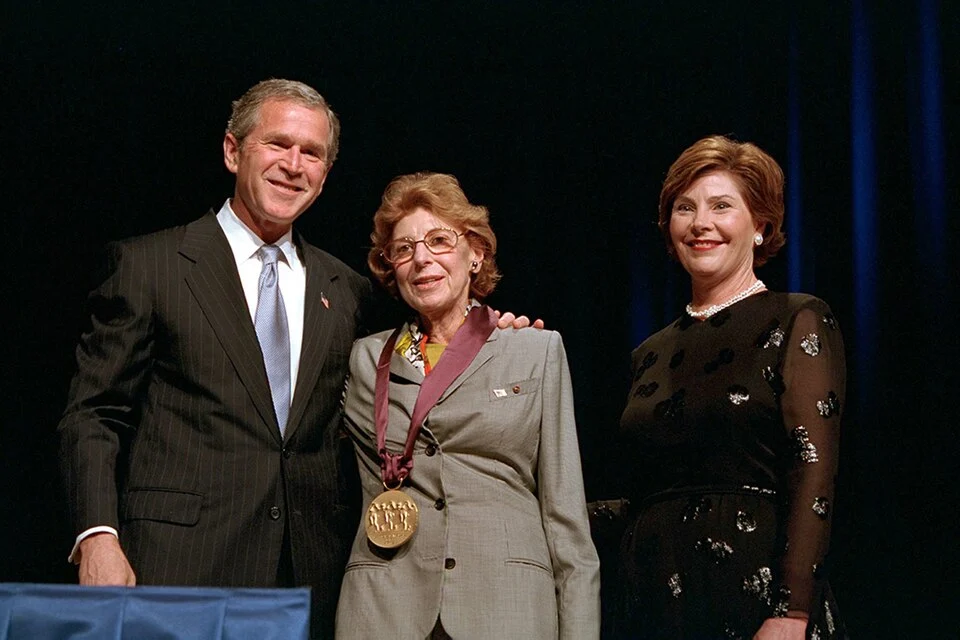
- 1989 to 2011: A major travelling retrospective included MoMA in 1989. She received the National Medal of Arts for 2001, married Stephen M. DuBrul Jr. in 1994 and continued experimenting into the new century. She died in Darien, Connecticut, on 27 December 2011. Wikipedia: later life and recognition
The chronology combines public recognition with changes in the work. Our reading resists making either professional success or a celebrated early invention the measure of everything that followed. The later surfaces and prints have questions of their own.
The ideas: support, chance, history and collaboration
What actually happens in soak-stain?
In the breakthrough method, Frankenthaler placed unprimed canvas on the floor and applied heavily diluted oil paint. The colour entered the fabric instead of remaining only as an opaque layer above it. Basel describes working from different sides with brushes, sponges and other tools, balancing unpredictable material behaviour with compositional judgement. Kunstmuseum Basel: soak-stain process
Our distinction is between allowing an event and accepting every event. Paint can spread in ways a painter does not fully predict, but the finished arrangement still involves decisions about where to begin, when to intervene and what to retain. Looking for those decisions gives chance a specific role without turning it into a complete explanation of the image.
Colour Field is a connection, not the whole identity
The technique affected Morris Louis and Kenneth Noland and became important to Colour Field painting. Gagosian describes Frankenthaler’s pivotal position between that development and Abstract Expressionism. Her career also encompassed sculpture, ceramics, tapestry and printmaking, so the label identifies an influential connection rather than exhausting the work. Gagosian: influence and range
Our comparison asks what remains of gesture when a conspicuous brushstroke is no longer the dominant event. A stain has direction, an edge has a history and a large interval has weight. Rather than treating fields and gestures as mutually exclusive categories, test their relationships in a particular work. The answer may change from one decade to the next.
Staining was not simply abandoned
Basel’s 2026 presentation explicitly says Frankenthaler kept returning to the soak-stain technique while developing other methods. It discusses acrylics, floorboard impressions, thicker layers, reversed canvases and later returns to thin veils of colour. This fuller account corrects an overly simple progression from early staining to a permanently different mature method. Kunstmuseum Basel: materiality and experimentation
Our reading treats a technique as one available instrument. Compare a transparent area with an opaque one and ask what each accomplishes in context. An artist can revisit an earlier procedure because a new arrangement requires it. Returning to a method does not automatically mean returning to an earlier artistic problem.
Old paintings become new questions
Basel places Frankenthaler in dialogue with art from the fifteenth through twentieth centuries, including her encounters with European painting and Japanese prints. Its curatorial argument concerns transformation and paraphrase, rather than copying a historical image intact. AWARE’s account of the 2019 Venice exhibition similarly places panoramic landscape at the centre of a changing practice. Kunstmuseum Basel: historical conversations Mathilde Bartier, AWARE, 13 October 2019
Our suggestion is to compare a spatial problem rather than hunt for a borrowed motif. How does light emerge from a dark ground? What makes an expanse seem to open beyond its physical support? A historical reference becomes useful when it helps you identify a decision that the new work transforms.
Printmaking makes collaboration visible
William Davie’s account distinguishes work with Tatyana Grosman at Universal Limited Art Editions from later collaboration with Kenneth Tyler and specialist printers. His examples show woodcuts built through technical experiment, trials and exchanges of expertise. The medium offered a different route to a painterly effect, rather than merely supplying reproductions of existing canvases. Davie, Gagosian Quarterly, 29 July 2022
Our reading asks you to hold effect and procedure apart. A print can look fluid while depending on carefully prepared blocks and multiple impressions. Its spontaneity as an experience does not tell you how quickly it was produced. This distinction is also useful when comparing a unique work on paper with a numbered print.
What museums, critics, dealers and auctions say
Switzerland, Spain and Italy: a wider historical range
Kunstmuseum Basel’s 2026 exhibition brought together more than fifty works across six decades and foregrounded conversations with historical art. Guggenheim Bilbao’s 2025 Painting Without Rules, organised with Florence’s Palazzo Strozzi and the Foundation, placed Frankenthaler beside contemporaries including Pollock, Rothko, Motherwell and David Smith. These are different ways to situate her within relationships rather than isolate one invention. Kunstmuseum Basel: 2026 exhibition Guggenheim Bilbao: Painting Without Rules
Britain: beauty can be technically demanding
Laura Cumming’s 2021 Observer review of the Dulwich woodcuts emphasised the contrast between the prints’ seeming liberation and the difficult procedures behind them. Her attention to wood grain, trial proofs and material complexity makes beauty an outcome that calls for examination. It is a critic’s strongly appreciative response, not a neutral measurement of quality. Laura Cumming, The Observer, 19 September 2021, Foundation archive
International galleries: looking beyond the canonical canvas
Gagosian’s presentation includes early mixed-material painting, the famous stained canvas and later work. Its accompanying print scholarship gives named collaborators a place in the account. Our reading of these commercial sources is to separate their useful object details and interviews from the general language of importance. A gallery’s enthusiasm can direct attention; it cannot make the encounter on your behalf. Gagosian artist overview Gagosian Quarterly: collaboration
A dated auction high
Sotheby’s published ranking for 2018 through the first half of 2023 lists Royal Fireworks, 1975, at approximately US$7.9 million, sold in New York on 29 June 2020. The original catalogue identifies acrylic on canvas, 152.4 by 398.8 centimetres, and a US$2 million to US$3 million estimate. The realised figure and the estimate answer different questions. Sotheby’s: auction-results table Sotheby’s: Royal Fireworks lot record
We present that as a documented auction high with an explicit source period, rather than a live price index. Our proposed collector comparison begins with the exact object: canvas, unique paper work or editioned print, followed by date, scale, provenance and condition. No single record supplies a standard price for all of them.
Nine works beyond a one-painting reputation
The records provide the titles, dates and materials; the looking suggestions are ours. Links lead to institutional or documented commercial reproductions. The page itself hosts a government photograph of Frankenthaler, with no reproductions of her paintings or prints.
1. Mountains and Sea, 1952
Gagosian identifies oil and charcoal on unsized, unprimed canvas and credits the Helen Frankenthaler Foundation, on extended loan to the National Gallery of Art in Washington. Gagosian: Mountains and Sea Our exercise compares the apparent openness with the actual placement of coloured areas and lines. Ask what would change if one interval became narrower. The breakthrough concerns a material procedure and a particular arrangement, not simply the presence of diluted paint.
2. Open Wall, 1953
Bilbao lists this oil painting with the Foundation and gives its width as 332.7 centimetres. Guggenheim Bilbao: Open Wall Our proposed reading tests the title against your sense of space. Does an area open because of a light interval, a change in density or an edge that seems incomplete? Keep that answer specific enough that another viewer could find the same passage without having to share your association.
3. Riverhead, 1963
Basel received Riverhead as a Foundation gift in 2024 and identifies it as a catalyst for the 2026 exhibition. Kunstmuseum Basel: Riverhead and the exhibition Our looking note asks how a broad colour field acquires internal variation. Compare its edge, centre and neighbouring colours before deciding that a large area is visually uniform. The collection history supplies context; the field still asks for extended attention.
4. Flood, 1967
Basel discusses Flood as an example in which the colour field remains central, before the renewed prominence of autonomous line in subsequent works. Kunstmuseum Basel: line and surface Our exercise compares how you read an area and how you follow a line. Does one invite sustained immersion while the other establishes a route? Treat those as possibilities to test rather than fixed properties shared by every field and line.
5. Moveable Blue, 1973
Bilbao identifies acrylic on canvas, 177.8 by 617.8 centimetres, in the ASOM Collection. Guggenheim Bilbao: Moveable Blue Our reading begins with the unusually wide span. Compare the point where you first enter visually with the point that keeps you moving. A narrow digital reproduction compresses that encounter, so keep the actual dimensions in mind while examining a full view.
6. East and Beyond, 1973
Davie identifies this as Frankenthaler’s first woodcut with Grosman at ULAE and describes cutting a block into separate pieces using a jigsaw. Davie: East and Beyond Our suggested question is how a planned division becomes a visual interval. Compare the knowledge of an assembled printing process with the completed surface. Does understanding the procedure sharpen your attention without exhausting the work’s effect?
7. Essence Mulberry, 1977
Gagosian Quarterly identifies eight colours and four woodblocks, and describes collaboration with Tyler and printer John Hutcheson. Davie: Essence Mulberry Our exercise gives the unprinted paper as much attention as the printed area. Notice how a margin can function within the whole rather than merely contain it. The print offers a precise case in which leaving something apparently empty can be an affirmative compositional decision.
8. Madame Butterfly, 2000
The published technical record specifies a 102-colour woodcut from forty-six blocks on three sheets. Davie: Madame Butterfly technical record Our looking note compares the full triptych with the sheet boundaries. Ask whether the joins interrupt the experience or become part of its continuity. Extensive preparation and a fluid final appearance can coexist; the technical count does not replace looking, but makes that coexistence tangible.
9. Southern Exposure, 2002
Bilbao’s exhibition lists acrylic on paper, 153.7 by 187.6 centimetres, with the Foundation. Guggenheim Bilbao: Southern Exposure Our suggestion is to compare the scale with your assumptions about paper. Does knowing the support change an expectation of intimacy? A late paper work belongs to the same investigation of colour and space while asking to be understood as an independent object.
What is still open in Frankenthaler’s work?
The Venice, Bilbao and Basel presentations all extend the conversation beyond a single early painting. Their differing emphases include panoramic space, artistic friendships and historical paraphrase. Taken together, they provide concrete ways to compare periods without assuming a simple linear march from invention to repetition. AWARE: Venice exhibition Guggenheim Bilbao Kunstmuseum Basel
Our contemporary exercise follows the material rather than an artist’s name. Choose a support, a limited range of colours and one kind of edge to investigate. Make several arrangements, then compare what the support contributes to each. This is our learning proposal, not an instruction to duplicate a historical process or a conservation recommendation.
For a reader or collector, the lasting question is equally practical: what sort of object are you looking at? A stain, a thick layer and a woodcut impression may produce related visual effects through different means. Recognising those differences gives both the technical achievement and the individual work more room to be understood.
Questions people ask about Helen Frankenthaler
What is Helen Frankenthaler best known for?
Helen Frankenthaler is best known for pioneering soak-stain painting and helping shape Colour Field painting. Her career also included ambitious works on paper and printmaking, particularly woodcuts. Mountains and Sea, 1952, is the pivotal early example. Gagosian biography
What is the soak-stain technique?
Diluted paint is applied to unprimed canvas so that colour enters the fabric instead of remaining only on its surface. Frankenthaler worked with the canvas on the floor and manipulated paint from different sides. The resulting openness still depended on compositional decisions. Kunstmuseum Basel
How did Frankenthaler influence Morris Louis and Kenneth Noland?
Her breakthrough use of stained colour demonstrated possibilities that Louis and Noland developed within Colour Field painting. Gagosian identifies Mountains and Sea as an influential work for both artists. That relationship does not make their paintings interchangeable with hers. Gagosian biography
Did Frankenthaler stop using soak-stain after the 1950s?
No simple permanent break is supported by Basel’s 2026 account. It says she kept returning to staining while exploring acrylics, thicker paint and other surface effects. Her practice expanded rather than following a single irreversible technical progression. Kunstmuseum Basel
Are Frankenthaler’s woodcuts reproductions of her paintings?
The woodcuts discussed here are original prints developed through specialist collaborations, trials and printing processes. Madame Butterfly, 2000, used forty-six blocks and 102 colours. An original editioned print is a different category from a reproduction of a painting. Gagosian Quarterly: printmaking
What is Frankenthaler’s documented auction high?
Sotheby’s results table for 2018 through the first half of 2023 lists Royal Fireworks, 1975, at approximately US$7.9 million on 29 June 2020 in New York. The original estimate was US$2 million to US$3 million. The dated result is not a current valuation of every work. Sotheby’s results Original lot
What should a collector check on a Frankenthaler print?
Our suggested checks are the exact title, date, printing method, edition and proof designation, printer or publisher, provenance and condition. Technical records matter because visually related effects can be made by different processes. Compare the particular print with its documented edition rather than a painting’s auction price. Gagosian Quarterly technical records
Where can I see Helen Frankenthaler’s work?
The sources identify works with Kunstmuseum Basel, the Foundation and museum loans, among other collections. Past exhibitions in Bilbao, Florence or London do not guarantee present display. Check current museum information for the exact painting or print. Kunstmuseum Basel Guggenheim Bilbao
Sources and image credits
Sources opened on 26 October 2026. Biography, museum interpretation, commercial presentation and our looking notes are distinguished throughout. Collection ownership does not guarantee current display.
- Kunstmuseum Basel: Helen Frankenthaler
- Wikimedia Commons file: US federal government public domain
- Gagosian biography
- Wikipedia: later life and recognition
- Gagosian Quarterly technical records
- AWARE: Venice exhibition
- Guggenheim Bilbao
- Laura Cumming, The Observer, 19 September 2021, Foundation archive
- Sotheby’s results
- Original lot

Photograph rights and conversion are stated in the caption. No reproductions of this artist’s paintings are hosted here.