Artists / No. 011
Franz Kline
Franz Kline (1910 to 1962) was an American Abstract Expressionist painter who made black and white into equally active painted forms, developing monumental compositions through drawing, enlargement and revision. Whitney Museum biography Smithsonian American Art Museum
The first impression can be a forceful gesture. The longer encounter concerns proportion, edges, density and the decisions that let the gesture hold together. Read the paintings alongside the small studies, the colour works and the documented exchanges with Japanese calligraphers.
How do you look beyond the black brushstroke?
Our first exercise is to treat every white shape as deliberately as every black one. Follow a white passage until a black form cuts it short; then reverse the journey. Ask which shape seems to press into the other. This approach takes seriously the Smithsonian’s explanation that Kline painted the white as well as the black, creating a dialogue rather than simply laying a sign over a neutral ground. Smithsonian: painted black and white
Our second pass separates apparent speed from actual procedure. Find a junction that feels sudden, then examine its edges. Does it suggest overlap, correction, a change of direction or a thickened boundary? A painting can communicate a fast movement while having taken extended work to construct. The Whitney’s account of the study behind Mahoning provides a concrete example of that distinction. Whitney: Mahoning and its study
On the third pass, look for what changes when you stand farther away. Our suggested test is to describe the whole using only relationships: a diagonal against an upright, an opening beside a block, a weight held above a gap. Let a bridge or building association arise if it helps, but ask whether the relationship still works when you stop naming an object. This is our viewing method, not Kline’s prescribed sequence.
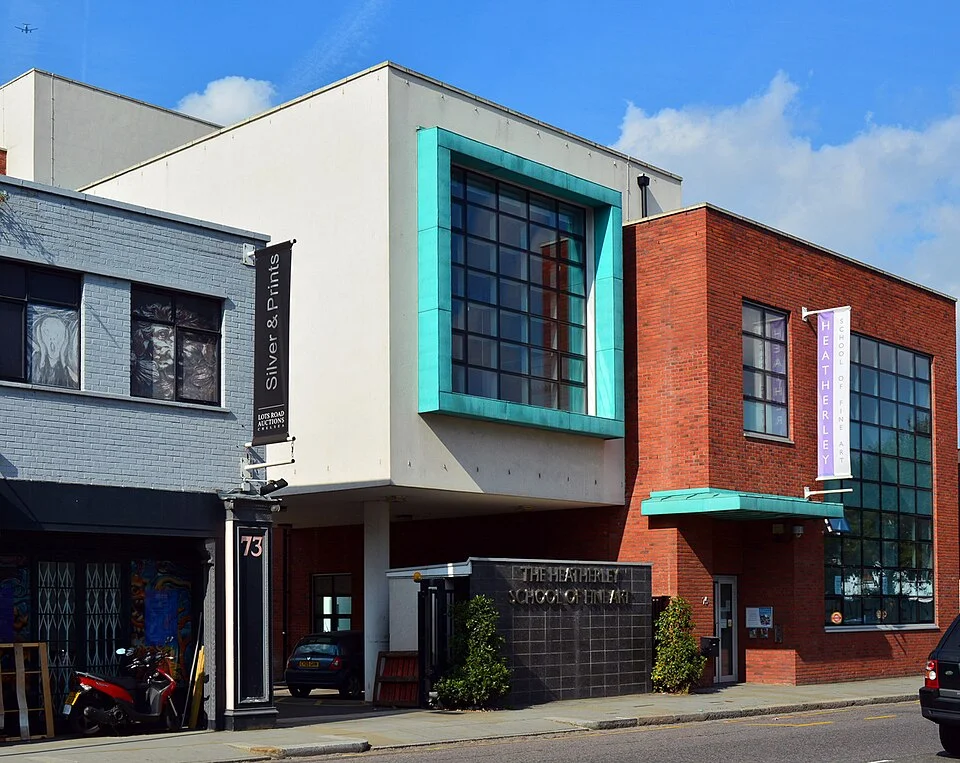
From figurative painting to a short, influential abstract career
- 1910 and the early years: Born in Wilkes-Barre, Pennsylvania, on 23 May 1910, Kline spent part of his childhood at Girard College in Philadelphia after his father’s death. His family later lived in Lehighton. Smithsonian: biographical chronology
- 1930s: He studied art in Boston and at the Heatherley School of Fine Art in London. He married British ballet dancer Elizabeth V. Parsons and settled in New York towards the end of the decade. Published chronologies differ on the exact year of his move, so the broad sequence is more secure than a single arrival date. Smithsonian chronology Peggy Guggenheim Collection biography
- 1940s: Portraits, murals, landscapes and city scenes preceded his mature abstractions. He met Willem de Kooning and developed connections with the New York art world. Whitney: early figurative work Peggy Guggenheim Collection
- 1950 to 1954: A solo exhibition at the Charles Egan Gallery in 1950 established his abstract reputation. He helped organise the Ninth Street Show in 1951 and taught at Black Mountain College and Pratt during the early 1950s. Smithsonian chronology
- 1950s to 1962: His work circulated internationally through biennials and MoMA’s travelling exhibition The New American Painting. Colour became increasingly prominent again. Kline died in New York on 13 May 1962, aged fifty-one. Peggy Guggenheim Collection Gagosian biography
The figurative work is more than an embarrassing prelude to a supposedly inevitable breakthrough. The Whitney connects it with Social Realist interests and urban experience. Our proposed comparison is to look for changing ways of organising a surface, while resisting the assumption that every early railway or building already contains the mature abstract style in miniature. Whitney Museum
The ideas: painted space, scale, preparation and colour
White is an action, too
Kline’s most recognisable paintings rely on black and white, but the white has its own weight and direction. Smithsonian collection commentary describes the active exchange between them, including grey mixtures in a late work. This changes the viewing question: instead of identifying a black symbol, examine how adjacent painted areas establish pressure, balance and movement. Smithsonian collection commentary
Our practical test is to trace a white contour on paper without drawing the black shape beside it. If the traced white has a particular character, you have evidence that it does more than fill leftover space. Then compare two junctions. Do they produce the same tension? A restricted palette can intensify small differences that a quick glance mistakes for a repeated formula.
The enlargement is a change of experience
The Whitney describes Kline enlarging a small ink study for Mahoning with a Bell-Opticon projector introduced by de Kooning. Gagosian likewise places projection among his experiments in translating intimate drawings into monumental structures. The projector was a tool within the development, not proof that every painting followed an identical mechanical recipe. Whitney: projection and Mahoning Gagosian: process
Our interpretation is that enlargement changes the relationship between a mark and your body. A short movement across a page can become a span you have to scan. Compare the whole arrangement before deciding whether the large version is merely a bigger copy. The useful issue is what survives the change of scale and what must be reworked to make the new object convincing.
Action painting can include sustained preparation
The familiar category of action painting places Kline among artists whose visible marks emphasise making. His drawings complicate any equation between that category and unplanned execution. The Whitney’s paired study and painting make preparation visible; MoMA’s collection also includes drawings and studies alongside the finished canvases. Whitney: study and painting MoMA: works and studies
Our reading separates three things: the speed a mark appears to possess, the action that originally produced it, and the sequence of decisions that fixed the finished composition. Those can overlap without being identical. A brushstroke that seems effortless can be the outcome of repeated trials. Evidence of planning does not automatically remove the force of the final image.
Colour never disappears from the whole career
The Smithsonian explicitly corrects the idea that Kline worked only in black and white. Colour was present across his career and reasserted itself around the middle of the 1950s. Its discussion of Blueberry Eyes and a late work on paper identifies a further direction interrupted by his early death. Smithsonian: colour works
Our suggestion is to compare what colour changes rather than treating it as decoration added to a finished black-and-white language. Does it suggest depth, atmosphere or a different relation between neighbouring masses? The question prevents a famous signature from becoming a rule that excludes the evidence. It also makes the unfinished possibilities of the late career easier to see.
What people say: America, Europe and Japan
Museums: dynamism with an underlying structure
The Whitney foregrounds the relationship between spontaneous-looking gesture and a carefully translated study. The Smithsonian presents both a biographical sequence and the formal significance of black, white and colour. Their accounts complement one another: one supplies a particularly clear making history, while the other prevents a monochrome identity from standing in for the whole career. Whitney Museum Smithsonian American Art Museum
Japan: exchange cannot be reduced to resemblance
In Tate’s research publication, Eugenia Bogdanova-Kummer documents Kline’s correspondence with Morita Shiryū, circulation of the journal Bokubi and mutual interest between American abstraction and Japanese avant-garde calligraphy. She reads later denials of influence in the context of artistic nationalism. That documented relationship complicates both the claim that Kline simply copied calligraphy and the claim that no meaningful exchange occurred. Bogdanova-Kummer, Tate research, 2017
Kline’s stated distinction, reproduced by Tate, was “calligraphy is writing and I am not writing”. The researcher tests that distinction against experimental Japanese work that also moved beyond legible characters. Our inference is that visual comparison and historical influence require separate questions. Similar-looking marks alone cannot establish a direction of borrowing, while surviving letters are evidence that an exchange took place. Tate: correspondence and contested comparisons
International galleries and European exhibitions
Gagosian stresses tonal contrast, scale, material differences and the bodily act of painting. Its account lists solo exhibitions in Barcelona and Turin as well as the United States, and the European itinerary of The New American Painting. The dealer’s framing favours the direct visual force of the work. Tate’s archive-based account adds the historical complications that this concise commercial biography leaves out. Gagosian: Franz Kline
The Peggy Guggenheim Collection in Venice situates Kline among the artists whose work crossed national exhibition circuits during his lifetime, including Venice and São Paulo. That international recognition preceded the retrospective and auction histories discussed today. It is useful evidence against imagining the work as confined to a closed New York conversation. Peggy Guggenheim Collection
Auction evidence: US$40,402,500 in 2012
Christie’s reported US$40,402,500 for an Untitled painting of 1957 in New York on 14 November 2012, describing it as a new world auction record for Kline. This is the published realised figure, including the auction house’s sale charges, rather than the hammer amount alone. Christie’s: November 2012 results
Our reading of that result is deliberately narrow. A record documents an exceptional transaction, not the standard cost of every drawing, collage or early figurative work. Before comparing prices, compare the category of object and the evidence attached to it. A spectacular result cannot establish condition, authenticity or relevance for another work offered under the same artist’s name.
Seven works and studies to compare
The following sequence uses museum records and the research links, with our own looking questions clearly identified. Follow the links to view the works: the image on this page shows a place associated with Kline’s education, rather than reproducing a copyrighted painting.
1. Palmerton, Pa., 1941
The Smithsonian describes an early Pennsylvania townscape with a soot-toned palette, clustered buildings and a train. It warns against too readily claiming to see the mature abstraction already present. Smithsonian: Palmerton Our exercise compares surface and subject. How much attention goes to a depicted town, and how much to the arrangement of its shapes? Let the early painting remain an independent achievement rather than a coded prediction of later fame.
2. Chief, 1950
MoMA’s collection lists Chief among the early mature abstractions. MoMA: Chief Our proposed reading begins with the entire balance before examining a single stroke. Ask which area seems most stable and which threatens to move. Compare that answer with the distribution of light and dark. A title is useful identifying information; it need not turn an abstract arrangement into a rebus with one correct depicted object.
3. Untitled II, circa 1952
Tate reproduces this MoMA work and identifies ink and oil on cut and pasted telephone-book pages, mounted on paper on board. Tate: Untitled II and printed supports Our looking question concerns the printed matter. Does the regularity of the type alter the apparent scale of the painted marks? Compare a stroke’s path with the tiny repeated units beneath it. Small works can pose spatial problems as specific as a monumental canvas.
4. Painting Number 2, 1954
MoMA holds this painting and a related drawing dated to the same year. MoMA: Painting Number 2 and related drawing Our suggested comparison keeps the two objects visible together. Trace a major direction through each, then compare the spaces around it. Avoid assuming that resemblance proves identical execution. The useful question is how a relationship first examined on paper becomes an encounter at a different scale and in a different material.
5. Mahoning, 1956
The Whitney’s account connects this large painting to a much smaller ink study made on a telephone-book page and explains the use of projection in translating it. Whitney: Mahoning Our reading starts with the apparent momentum, then asks where it is arrested. Examine the white passages with the same attention as the dark ones. Holding the small study and the large result together makes the difference between a rapid impression and a developed composition unusually concrete.
6. Blueberry Eyes, 1959 to 1960
The Smithsonian identifies this colour work as a counterexample to Kline’s purely monochrome reputation. Its description foregrounds saturated blue and a sense of spatial or atmospheric depth. Smithsonian: Blueberry Eyes Our exercise compares it with one black-and-white work. Decide whether colour changes the depth you perceive, the direction of movement or the emotional association. Keep those responses distinct: seeing a blue area is an observation; naming its mood is an interpretation.
7. Meryon, 1960 to 1961
Tate’s focused research takes this painting as the starting point for examining Kline’s relationship with Japanese calligraphy and its later interpretation. Tate: Meryon research context Our looking question is how an arrangement can invite a cultural comparison without settling its historical explanation. First describe the marks and intervals. Then read the correspondence and criticism. This order lets visual attention and archival evidence challenge each other instead of allowing either one to stand in for both.
What does Kline’s legacy let us investigate?
Hauser & Wirth Institute produced the freely accessible Franz Kline Paintings, 1950 to 1962 catalogue raisonné in cooperation with the estate. It also supported the cataloguing and digitisation of Elisabeth Zogbaum’s papers at the Archives of American Art. The Institute explicitly says it does not provide authentication or valuations. Research access and a commercial guarantee are different services. Hauser & Wirth Institute: catalogue and archive
Our contemporary lesson concerns editing. Try making three small arrangements with only dark and light, then enlarge one and ask what stops working. Preserve the small original so you can compare decisions. This is our exercise, not a reconstruction of every step in Kline’s studio. It tests the difference between repeating a recognisable style and solving a particular relationship of size, weight and interval.
There is also a reading lesson. Put the gallery biography beside the Tate essay and ask what kinds of evidence each prioritises. One gives an accessible formal overview; the other examines letters, published arguments and international cultural politics. The strongest account of an artist can hold both the immediate encounter and the difficult historical questions in view.
Questions people ask about Franz Kline
What is Franz Kline famous for?
Franz Kline is famous for large Abstract Expressionist paintings built from forceful black and white forms. He also made figurative paintings, drawings, collages and colour works. The monochrome signature should not be mistaken for his complete career. Smithsonian biography
Why did Franz Kline use black and white?
His mature paintings use black and white as interacting painted forms. The white is active, shaping and interrupting the black, rather than serving only as a blank background. This is a relationship to examine in each painting, not a universal symbolic code. Smithsonian commentary
Were Kline’s paintings spontaneous?
They often look spontaneous, but some developed from small studies and careful translation into larger compositions. The Whitney documents that process for Mahoning. Apparent speed and actual preparation are different questions. Whitney Museum
Was Franz Kline influenced by Japanese calligraphy?
There was a documented exchange with Japanese avant-garde calligraphers, including correspondence and shared publications. Kline later denied that his paintings were calligraphy. Tate’s research treats the relationship as historically contested rather than a simple story of copying or complete separation. Tate research
Did Franz Kline ever paint in colour?
Yes. Colour appeared throughout his career and became more prominent again around the mid-1950s. The Smithsonian discusses Blueberry Eyes, dated 1959 to 1960, among the late works that complicate his monochrome reputation. Smithsonian colour paintings
What is Kline’s documented auction record?
Christie’s reported US$40,402,500 for Untitled, 1957, in New York on 14 November 2012 as a new world auction record. This is a dated realised sale result, not an estimate or a standard valuation for other works. Christie’s results
How can a collector research a Franz Kline painting?
The free Franz Kline Paintings, 1950 to 1962 catalogue raisonné and the associated archival resources are useful starting points. The Institute does not authenticate works or provide valuations. Our suggested next checks concern the specific object’s provenance, condition, medium and matching catalogue information. Hauser & Wirth Institute
Where are Franz Kline’s paintings held?
Collections discussed here include MoMA, the Whitney, the Smithsonian American Art Museum, Tate and the Peggy Guggenheim Collection in Venice. Ownership is not a guarantee of current display. Check the institution and the exact work before planning a visit. MoMA Peggy Guggenheim Collection Tate
Sources and image credits
Sources opened on 26 October 2026. Biography, museum interpretation, commercial presentation and our looking notes are distinguished throughout. Collection ownership does not guarantee current display.
- Smithsonian American Art Museum
- Whitney Museum biography
- Wikimedia Commons file
- Peggy Guggenheim Collection
- Gagosian: Franz Kline
- MoMA
- Tate
- Christie’s results
- Hauser & Wirth Institute

Photograph rights and conversion are stated in the caption. No reproductions of this artist’s paintings are hosted here.